Neet 2026 Paper Review 9958461445
A Scientific and Technical Review of NEET 2026 Physics
Why This Paper Was a Masterpiece of Conceptual Filtering
NEET 2026 Physics was not merely a paper of formulas and numericals. It was a carefully engineered conceptual filter designed to test scientific maturity, mathematical stability, emotional control, and conceptual depth.
Externally, the paper looked simple. Internally, it behaved like a precision-based elimination system.
Weak students feared the paper immediately.
Average students became overconfident.
Only conceptually trained students maintained accuracy from Question 1 to Question 45.
That was the hidden architecture of NEET 2026 Physics.
The paper was not difficult in the traditional IIT-JEE sense. There were no monstrous derivations or extremely lengthy calculations. Instead, the paper focused on:
-
Precision under pressure
-
Conceptual sequencing
-
Graph interpretation
-
Unit discipline
-
Physical visualization
-
Emotional stability
This paper rewarded students who understood the language of Physics instead of merely memorizing formulas.
Question-wise Scientific and Mathematical Review
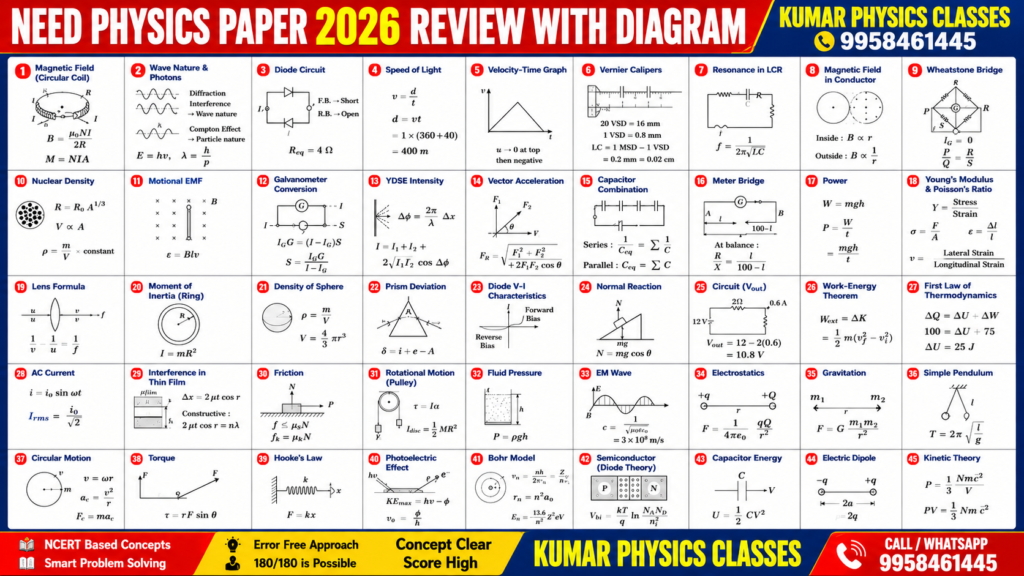
Question 1 — Magnetic Field of Circular Coil
Difficulty Level: Moderate Conceptual + Formula Application
This question tested whether students could connect multiple physical ideas sequentially.
Main concepts used:
B = (mu0 × N × I) / (2r)
Magnetic Moment:
M = NIA
The mathematics itself was not difficult. The real challenge was scientific sequencing.
A weak student directly starts manipulating equations randomly.
A conceptually trained student understands the logical chain:
Magnetic Field → Current → Magnetic Moment
That is how scientific thinking works.
Question 2 — Wave Nature and Photon Concepts
Difficulty Level: Easy but Concept Sensitive
This question checked conceptual categorization.
Students had to identify:
-
Diffraction → Wave Nature
-
Interference → Wave Nature
-
Compton Effect → Particle Nature
-
E = hν → Energy of Photon
The challenge was not memory.
The challenge was conceptual organization.
Students with deep understanding solved instantly.
Students dependent only on rote learning became confused.
Question 3 — Diode Network Circuit
Difficulty Level: Moderate and Dangerous
This question looked easy mathematically but was psychologically dangerous.
Before solving resistance combinations, students first had to identify:
-
Forward biased diode
-
Reverse biased diode
Most students immediately started calculations without understanding which branch was actually conducting.
That is a scientific mistake.
A trained Physics mind first analyzes physical behavior and only then performs mathematics.
That single habit saves marks.
Question 4 — Speed of Light and Units
Difficulty Level: Very Easy but Highly Risky
This was a unit-based trap question.
Core relation:
Velocity = Distance / Time
Distance = Velocity × Time
The question itself was easy.
But easy questions are dangerous because students stop respecting them.
Many rank losses happen not in difficult questions but in “too easy” questions.
Scientific discipline means respecting every numerical equally.
Question 5 — Velocity-Time Graph
Difficulty Level: Conceptual Graph Interpretation
This question tested physical visualization.
For upward motion:
-
Velocity decreases linearly
-
Velocity becomes zero at highest point
-
Velocity becomes negative during downward motion
Students who truly understood motion solved instantly.
Students dependent only on formulas struggled in graph interpretation.
This is exactly where conceptual teaching becomes powerful.
Question 6 — Vernier Calipers
Difficulty Level: NCERT Precision Question
Core concept:
Least Count = 1 MSD – 1 VSD
Students had to perform correct unit conversion carefully.
The question was not mathematically difficult.
It was scientifically disciplined.
Question 7 — Resonance Frequency in LCR Circuit
Difficulty Level: Formula Based but Numerically Sensitive
Main formula:
f = 1 / (2π√LC)
The real challenge was powers of ten and unit handling.
Good students remained calm during numerical simplification.
Weak students panicked unnecessarily.
Question 8 — Magnetic Field Variation in Conductor
Difficulty Level: Advanced Conceptual NCERT
Inside conductor:
B proportional to r
Outside conductor:
B proportional to 1/r
This question required field visualization.
Students with deep understanding recognized the graph immediately.
Students dependent on memorization became confused.
Question 9 — Wheatstone Bridge Style Circuit
Difficulty Level: Moderate Circuit Analysis
This question tested symmetry recognition.
A scientifically trained student simplifies the circuit mentally before solving.
An average student performs unnecessary calculations.
That difference separates rankers from ordinary students.
Question 10 — Nuclear Density
Difficulty Level: Scientific Scaling Question
Core relation:
R = R0 × A^(1/3)
Volume proportional to A
This question tested physical scaling understanding.
Students who understood nuclear structure solved rapidly.
Others became trapped in algebra.
Questions 11–20: Precision and Scientific Stability Zone
This section included:
-
Electromagnetic induction
-
Galvanometer conversion
-
YDSE
-
Vector resolution
-
Capacitor combinations
-
Meter bridge
-
Power
-
Elasticity
-
Optics
-
Moment of inertia
None of these questions were impossible.
The challenge was continuous accuracy.
That is what made the paper dangerous.
Question 13 — YDSE Intensity
Difficulty Level: Moderate Wave Mathematics
This question tested phase understanding.
Students had to interpret wave superposition physically.
This was not merely a formula problem.
This was a wave behavior problem.
Question 14 — Vector Acceleration
Difficulty Level: Simple but Visualization Based
Resultant force relation:
F = √(F1² + F2²)
The mathematics was easy.
But rushed students marked wrong directions.
Physics punishes impatience silently.
Question 15 — Capacitor Combination
Difficulty Level: High NEET Standard
This question separated:
-
Students who understood electrostatics
from -
Students who memorized patterns
Conceptually strong students redraw circuits mentally.
Weak students search memory for similar questions.
That difference decides ranks.
Questions 21–30: Emotional Stability and Numerical Discipline
This section tested:
-
Density calculations
-
Prism deviation
-
Diode graphs
-
SHM energy
-
Terminal voltage
-
Gravitation
-
Thermodynamics
-
Reaction time
-
Capacitor energy
-
Pendulum concepts
The mathematics remained manageable.
But emotional fatigue started increasing.
That is why many hardworking students still lost marks.
Questions 31–45: Final Scientific Filtering
The last section involved:
-
AC current
-
Interference
-
Friction
-
Rotational motion
-
Fluid pressure
-
Electromagnetic waves
-
Electrostatics
-
Photoelectric effect
-
Bohr model
-
Semiconductor theory
-
Kinetic theory
At this stage, the paper became a mental endurance test.
Students who practiced only hard questions started collapsing emotionally.
Students with conceptual training remained stable.
That was the difference.
Why NEET 2026 Physics Was Scientifically Brilliant
This paper was not testing memory.
It was testing:
-
Scientific thinking
-
Numerical calmness
-
Emotional control
-
Physical visualization
-
Graph interpretation
-
Unit discipline
-
Conceptual flexibility
The paper controlled student emotions beautifully.
That is why even hardworking students lost marks.
How Mr. Kumar Could Make Students Better
Most coaching systems train students to solve questions.
Mr. Kumar trains students to understand Physics scientifically.
That difference is enormous.
His teaching develops:
-
Deep conceptual clarity
-
Graph interpretation ability
-
Numerical stability
-
Error reduction habits
-
Visual understanding of Physics
-
Emotional confidence during exams
Students stop memorizing blindly.
They begin thinking like physicists.
Why Kumar Sir’s Students Perform Better
Students trained under Mr. Kumar become scientifically stable.
They do not panic in unfamiliar questions.
They do not rush in easy questions.
They respect units.
They analyze graphs calmly.
They understand concepts deeply.
Most importantly:
They maintain emotional control during examination pressure.
That is the real secret behind high NEET Physics scores.
Message for NEET 2027 Aspirants
If you are preparing for NEET 2027, remember one permanent truth:
Physics is not about memorizing formulas.
Physics is about understanding nature mathematically.
You must develop:
-
Conceptual depth
-
Numerical discipline
-
Scientific visualization
-
Emotional stability
-
Error control habits
-
Calmness under pressure
Only then can 180/180 become realistic.
Final Scientific Observation
NEET 2026 Physics proved one permanent law of competitive examinations:
The future belongs not to students who study the most.
The future belongs to students who understand the deepest.
And that depth comes only from scientific teaching, conceptual discipline, and emotionally stable preparation.
Kumar Physics Classes
Mr. Kumar — NEET Physics Specialist
WhatsApp / Call: +91-9958461445
Website: https://www.kumarphysicsclasses.com
One-to-One Zoom Classes
Complete Conceptual NEET Physics Training
For students targeting 180/180 in Physics with scientific clarity, mathematical precision, and emotional confidence, Kumar Physics Classes provides one of the most concept-driven preparation systems for NEET 2027.NEET 2026 Physics Paper Solution PDF