
Physics Tutor in Viman Nagar Pune – Torque, Potential Energy, Electric Dipole and Rotational Motion Explained by Kumar
+91-9958461445
Physics becomes beautiful when students understand the logic behind formulas instead of blindly memorizing equations. One of the most important concepts in Electrostatics and Rotational Mechanics is Torque and Potential Energy of Electric Dipole in Electric Field. Many students preparing for NEET Physics, IIT-JEE Physics, AP Physics, IB Physics, A Level Physics, IGCSE Physics, CBSE Physics, and ICSE Physics become confused because they directly memorize formulas like:
U = -PE cos(theta)
without understanding where the formula actually comes from.
At Kumar Physics Classes Viman Nagar Pune, students are taught complete derivations step-by-step so that they can understand the physical meaning behind every formula. This develops strong conceptual clarity and helps students solve advanced numerical questions confidently.
What is Torque?
Torque is the turning effect of force.
Just like force produces linear motion, torque produces rotational motion.
The formula of torque is:
tau = rF sin(theta)
Where:
tau = torque
r = perpendicular distance
F = force
theta = angle between r and F
This formula is extremely important in rotational mechanics.
Relation Between Work and Force
In translational motion, small work done is:
dW = F · dx
Where:
F = force
dx = small displacement
This is the basic formula of work done.
Now students should understand one very important thing.
In rotational motion:
Force is replaced by torque
Linear displacement is replaced by angular displacement
Therefore:
dW = tau d(theta)
This is one of the most important concepts in rotational mechanics.
Torque on Electric Dipole
Suppose an electric dipole is placed in uniform electric field.
Then torque acting on dipole becomes:
tau = PE sin(theta)
Where:
P = dipole moment
E = electric field
theta = angle between dipole moment and electric field
This torque tries to rotate dipole toward stable equilibrium position.
Derivation of Potential Energy of Dipole
This is one of the most important derivations in Electrostatics.
We know:
dW = tau d(theta)
Substitute torque:
dW = PE sin(theta) d(theta)
Now integrate.
Suppose dipole rotates from angle theta1 to theta2.
Then:
W = integration of PE sin(theta) d(theta)
Since PE is constant:
W = PE integration of sin(theta) d(theta)
Integration of sin(theta) is:
-cos(theta)
Therefore:
W = PE[-cos(theta)] from theta1 to theta2
After applying limits:
W = -PE cos(theta2) + PE cos(theta1)
This is the general expression.
Potential Energy Formula
Suppose reference angle is 90 degrees.
Then:
theta1 = 90 degrees
We know:
cos(90 degrees) = 0
Therefore potential energy becomes:
U = -PE cos(theta)
This is the standard formula.
Students generally memorize this formula directly, but understanding derivation is extremely important.
Stable and Unstable Equilibrium
This concept is very important for NEET and JEE.
Stable Equilibrium
When:
theta = 0 degrees
Then:
U = -PE
Potential energy is minimum.
This is stable equilibrium.
Dipole naturally tries to come to this position.
Unstable Equilibrium
When:
theta = 180 degrees
Then:
U = +PE
Potential energy becomes maximum.
This is unstable equilibrium.
Even small disturbance rotates dipole away from this position.
Understanding Cos(180 Degrees)
Students must carefully remember:
cos(180 degrees) = -1
Therefore:
U = -PE(-1)
Hence:
U = +PE
This gives maximum potential energy.
Physical Meaning of Potential Energy
Potential energy tells us how stable or unstable the system is.
Lower energy means:
more stable configuration
Higher energy means:
less stable configuration
Nature always tries to move toward minimum energy state.
This is one of the deepest ideas in Physics.
Why Students Fear Electrostatics
Many students fear Electrostatics because:
vector quantities
torque
trigonometry
integration
rotational motion concepts
But actually the chapter becomes easy if concepts are understood physically.
At Kumar Physics Classes Viman Nagar Pune, every derivation is explained step-by-step with logic.
Difference Between Linear and Rotational Motion
Students must compare both carefully.
Translational Motion
Force causes displacement.
Work done:
dW = F dx
Rotational Motion
Torque causes angular displacement.
Work done:
dW = tau d(theta)
This comparison helps students remember formulas easily.
Why Integration is Used
Torque changes with angle because:
tau = PE sin(theta)
Since torque is not constant, normal multiplication cannot be used.
Therefore integration becomes necessary.
This is an extremely important mathematical understanding.
Importance of Trigonometry in Physics
Physics and Mathematics are deeply connected.
Students preparing for IIT-JEE and NEET should become comfortable with:
sine functions
cosine functions
differentiation
integration
vector concepts
Strong Mathematics makes Physics easy.
Most Important Concepts from Electric Dipole
Students must remember:
Torque = PE sin(theta)
Potential energy = -PE cos(theta)
Stable equilibrium at 0 degrees
Unstable equilibrium at 180 degrees
Potential energy minimum at stable equilibrium
Potential energy maximum at unstable equilibrium
These concepts are asked frequently in competitive exams.
Real Life Importance of Dipole Physics
Electric dipole concepts are used in:
molecular physics
chemistry bonding
capacitors
dielectric materials
electric polarization
antennas
microwave physics
communication systems
That is why conceptual understanding is extremely important.
Why Conceptual Teaching is Important
Most students memorize formulas temporarily.
But conceptual understanding creates long-term retention.
At Kumar Physics Classes:
every derivation is explained logically
formulas are derived step-by-step
real-life interpretation is given
advanced conceptual questions are practiced
This helps students become strong problem solvers.
Best Books Used at Kumar Physics Classes
Students preparing for NEET and IIT-JEE are guided using top-quality books such as:
H.C. Verma
Resnick Halliday
I.E. Irodov
DC Pandey
NCERT Physics
Previous Year Questions
These books build strong conceptual foundation.
Why H.C. Verma is Important
H.C. Verma teaches students:
conceptual thinking
analytical ability
physical interpretation
problem-solving approach
This book is one of the best books for developing Physics intuition.
Why Irodov is Important
Irodov develops:
advanced problem-solving
deep conceptual clarity
mathematical strength
logical thinking
Students preparing for Olympiads and advanced JEE benefit greatly.
Physics Tutor in Viman Nagar Pune – Areas Covered
Physics Tutor in Viman Nagar Pune, Physics Tutor in Kalyani Nagar Pune, Physics Tutor in Wadgaon Sheri Pune, Physics Tutor in Koregaon Park Pune, Physics Tutor in Kharadi Pune, Physics Tutor in Magarpatta Pune, Physics Tutor in Yerawada Pune, Physics Tutor in Lohegaon Pune, Physics Tutor in Vishrantwadi Pune, Physics Tutor in Camp Pune, Physics Tutor in Hadapsar Pune, Physics Tutor in Pune Station Area
Physics Tutor Near Top Schools in Pune
Physics Tutor in Symbiosis International School Pune, Physics Tutor in Lexicon International School Pune, Physics Tutor in Bishop’s School Pune, Physics Tutor in Vibgyor High School Pune, Physics Tutor in EuroSchool Pune, Physics Tutor in Orchid School Pune, Physics Tutor in Army Public School Pune, Physics Tutor in Delhi Public School Pune
Physics Tutor Near Colleges and Universities
Physics Tutor in Savitribai Phule Pune University, Physics Tutor in COEP Pune, Physics Tutor in MIT World Peace University Pune, Physics Tutor in Symbiosis Pune, Physics Tutor in Fergusson College Pune, Physics Tutor in Modern College Pune
Physics Tutor for Different Curriculums
Physics Tutor in NEET Physics Pune, Physics Tutor in IIT-JEE Physics Pune, Physics Tutor in AP Physics Pune, Physics Tutor in IB Physics Pune, Physics Tutor in A Level Physics Pune, Physics Tutor in IGCSE Physics Pune, Physics Tutor in British Curriculum Physics Pune, Physics Tutor in CBSE Physics Pune, Physics Tutor in ICSE Physics Pune
Why Students Choose Kumar Physics Classes
Students choose Kumar Physics Classes because:
Concepts are taught deeply
Theory is explained step-by-step
Numerical methods are simplified
Real-life Physics interpretation is given
Strong focus on conceptual clarity
Advanced books are covered
NEET and JEE oriented teaching is provided
Doubt solving is personalized
Many students from top schools and coaching institutes take guidance from Kumar Sir for advanced conceptual Physics.
Conclusion
Torque, rotational work, electric dipole, and potential energy are among the most important topics in Electrostatics and Rotational Mechanics.
Students who understand:
torque
rotational work
integration of torque
stable equilibrium
unstable equilibrium
dipole potential energy
trigonometric relations
develop a very strong Physics foundation.
At Kumar Physics Classes Viman Nagar Pune, every concept is taught logically, visually, mathematically, and conceptually so that students can confidently solve NEET Physics, IIT-JEE Physics, AP Physics, IB Physics, A Level Physics, and Olympiad-level questions.
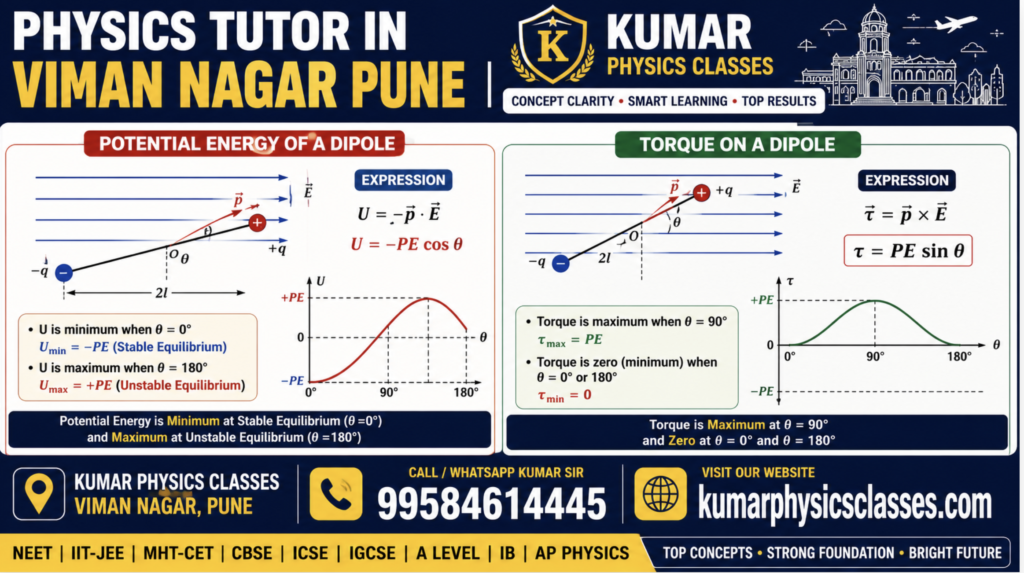
Electric dipole is formed when two equal and opposite charges, +q and −q, are separated by a small distance. The product of charge and separation is called dipole moment and is represented by:
P = q × 2l
When an electric dipole is placed inside a uniform electric field, a torque acts on it. This torque tries to rotate the dipole in the direction of the electric field. The torque acting on the dipole is given by:
Tau = PE sin(theta)
where theta is the angle between dipole moment and electric field.
Torque becomes maximum when:
theta = 90 degrees
because sin(90 degrees) = 1.
Therefore:
Tau(max) = PE
Torque becomes minimum when:
theta = 0 degrees or 180 degrees
because sin(0) = 0 and sin(180) = 0.
Hence torque becomes zero at these positions.
The potential energy of electric dipole is given by:
U = −PE cos(theta)
Potential energy becomes minimum when:
theta = 0 degrees
because cos(0) = 1.
Therefore:
U(min) = −PE
This position is called stable equilibrium because if the dipole is slightly disturbed, torque again brings it back to the original position.
Potential energy becomes maximum when:
theta = 180 degrees
because cos(180 degrees) = −1.
Therefore:
U(max) = +PE
This position is called unstable equilibrium because even a small disturbance rotates the dipole away from that position.
Thus:
Stable equilibrium occurs at theta = 0 degrees
Unstable equilibrium occurs at theta = 180 degrees
Torque maximum at theta = 90 degrees
Torque minimum at theta = 0 degrees and 180 degrees
Potential energy minimum at stable equilibrium
Potential energy maximum at unstable equilibrium
These concepts are extremely important for NEET Physics, IIT-JEE Physics, AP Physics, IB Physics, and A Level Physics.