
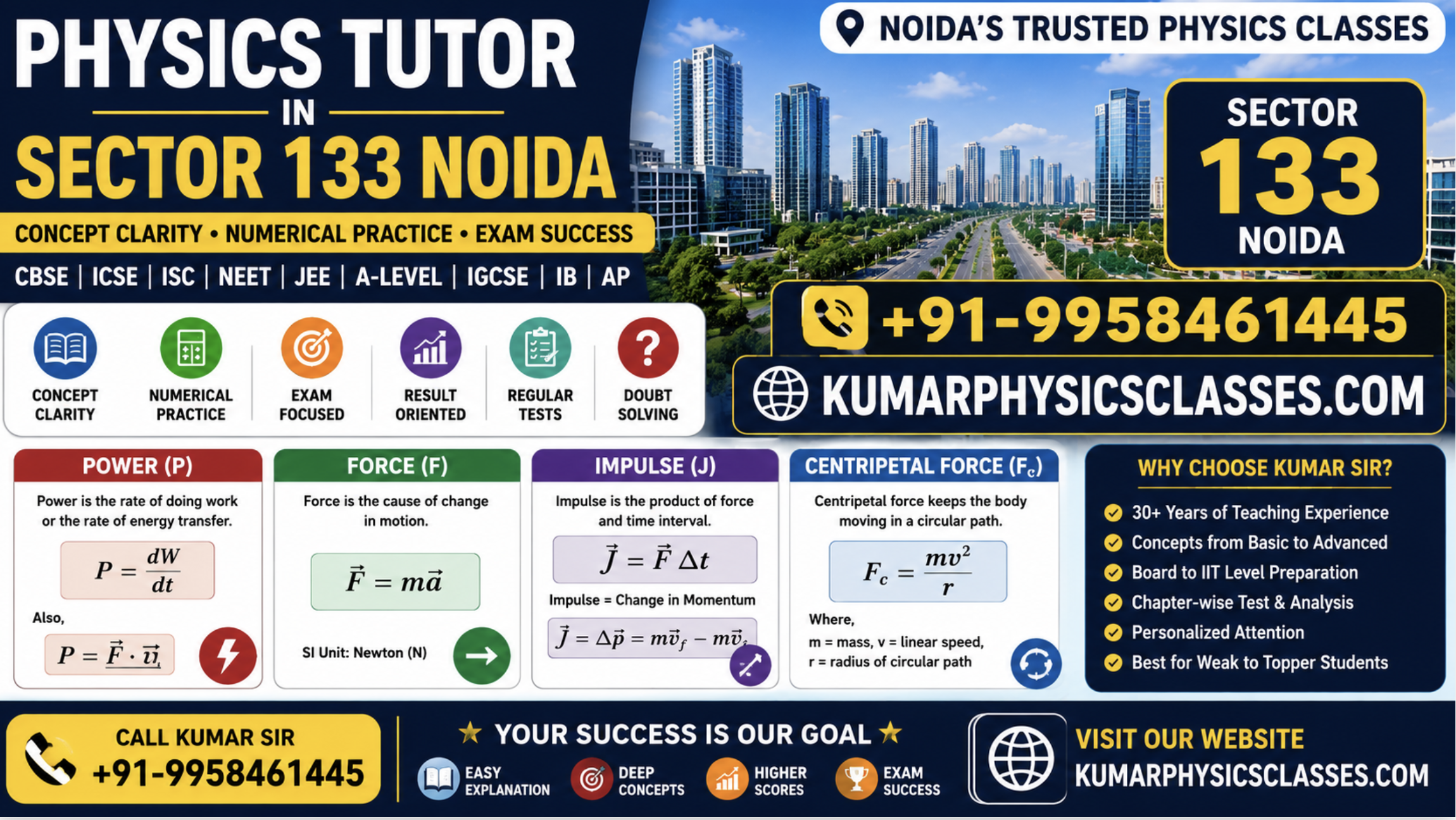
Physics Tutor in Sector 133 Noida – Kumar Physics Classes
+91-9958461445
If you live in Sector 133 Noida and Physics is becoming difficult for your child, then the problem is not always the child’s intelligence. Many students from good families, good schools and good coaching centres still struggle in Physics because their concepts are not clear. They attend school, term tests, mid-term tests, coaching classes, online lectures and YouTube videos, but still marks do not improve.
Physics is not a subject of only memorising formulas. Physics needs concept clarity, derivation, numerical practice and proper guidance. If the basic idea is weak, then even a simple question becomes difficult. This is why many students feel that Physics is tough, but actually Physics becomes tough only when it is taught without logic.
At Kumar Physics Classes, Kumar Sir teaches Physics with proper explanation, step-by-step derivation and exam-oriented numerical practice. With more than 30 years of teaching experience, Kumar Sir focuses on CBSE Physics, ICSE Physics, ISC Physics, NEET Physics, JEE Physics, AP Physics, IB Physics, IGCSE Physics, A-Level Physics and British Curriculum Physics.
Website: Kumar Physics Classes
Contact: +91-9958461445
Email: kumarsirphysics@gmail.com
Why Students in Sector 133 Noida Need a Proper Physics Tutor
Sector 133 Noida is a well-developed and civilized residential area. Many students here study in reputed schools and coaching institutes. Still, many students face the same problem: Physics marks are not coming.
The reason is simple. Physics cannot be improved by random shortcuts. A student may go to school, coaching, Allen, Vidyamandir or online platforms, but if the teacher does not build the concept from the base, the student remains confused.
A good Physics tutor must explain:
Why the formula is used
How the formula is derived
Where the formula is applicable
How to identify the correct concept in a numerical
How to write answers in exams
How to solve NEET and JEE level questions
This is exactly the method followed at Kumar Physics Classes.
Concept: Power When Force is Given as a Function of Time
Suppose a force is given as a function of time and a block moves under that force. If we have to find power, then we should not directly jump to the answer.
The basic formula of power is:
Power = Force × Velocity
In vector form:
P = F · v
So, to calculate power, we need force and velocity at that instant.
If force is given as a function of time, first we use Newton’s second law:
F = ma
So,
a = F/m
Now acceleration is:
a = dv/dt
So we write:
dv/dt = F(t)/m
Then integrate with respect to time to find velocity:
v = ∫ F(t)/m dt
After finding velocity, we use:
P = F · v
This is the proper method. First find acceleration, then velocity, then power. This is how Kumar Sir explains Physics: not by shortcut, but by logic.
Example Explanation
If a force acts on a block and changes with time, then acceleration also changes with time. Since acceleration is the rate of change of velocity, we cannot find power unless we know velocity.
So the sequence is:
Force is given
Use F = ma
Find acceleration
Use a = dv/dt
Find velocity
Use P = Fv
This is the correct conceptual approach.
Physics Tutor in Noida Sectors
Physics Tutor in Sector 1 Noida, Physics Tutor in Sector 2 Noida, Physics Tutor in Sector 3 Noida, Physics Tutor in Sector 11 Noida, Physics Tutor in Sector 12 Noida, Physics Tutor in Sector 15 Noida, Physics Tutor in Sector 18 Noida, Physics Tutor in Sector 22 Noida, Physics Tutor in Sector 25 Noida, Physics Tutor in Sector 27 Noida, Physics Tutor in Sector 30 Noida, Physics Tutor in Sector 34 Noida, Physics Tutor in Sector 37 Noida, Physics Tutor in Sector 44 Noida, Physics Tutor in Sector 45 Noida, Physics Tutor in Sector 50 Noida, Physics Tutor in Sector 51 Noida, Physics Tutor in Sector 52 Noida, Physics Tutor in Sector 55 Noida, Physics Tutor in Sector 56 Noida, Physics Tutor in Sector 61 Noida, Physics Tutor in Sector 62 Noida, Physics Tutor in Sector 71 Noida, Physics Tutor in Sector 72 Noida, Physics Tutor in Sector 75 Noida, Physics Tutor in Sector 76 Noida, Physics Tutor in Sector 77 Noida, Physics Tutor in Sector 78 Noida, Physics Tutor in Sector 79 Noida, Physics Tutor in Sector 93 Noida, Physics Tutor in Sector 100 Noida, Physics Tutor in Sector 104 Noida, Physics Tutor in Sector 105 Noida, Physics Tutor in Sector 107 Noida, Physics Tutor in Sector 108 Noida, Physics Tutor in Sector 110 Noida, Physics Tutor in Sector 117 Noida, Physics Tutor in Sector 119 Noida, Physics Tutor in Sector 120 Noida, Physics Tutor in Sector 121 Noida, Physics Tutor in Sector 122 Noida, Physics Tutor in Sector 128 Noida, Physics Tutor in Sector 129 Noida, Physics Tutor in Sector 131 Noida, Physics Tutor in Sector 132 Noida, Physics Tutor in Sector 133 Noida, Physics Tutor in Sector 134 Noida, Physics Tutor in Sector 135 Noida, Physics Tutor in Sector 137 Noida, Physics Tutor in Sector 143 Noida, Physics Tutor in Sector 150 Noida, Physics Tutor in Sector 151 Noida, Physics Tutor in Sector 168 Noida
Physics Tutor Near Noida Schools
Physics Tutor in Delhi Public School Noida, Physics Tutor in Amity International School Noida, Physics Tutor in Lotus Valley International School Noida, Physics Tutor in Shiv Nadar School Noida, Physics Tutor in Step by Step School Noida, Physics Tutor in Pathways School Noida, Physics Tutor in Genesis Global School Noida, Physics Tutor in The Shriram Millennium School Noida, Physics Tutor in Apeejay School Noida, Physics Tutor in Cambridge School Noida, Physics Tutor in Somerville School Noida, Physics Tutor in Ryan International School Noida, Physics Tutor in Khaitan School Noida, Physics Tutor in Kothari International School Noida, Physics Tutor in Billabong High International School Noida, Physics Tutor in Global Indian International School Noida, Physics Tutor in JBM Global School Noida, Physics Tutor in Mayoor School Noida, Physics Tutor in Sapphire International School Noida, Physics Tutor in Manav Rachna International School Noida
Physics Courses in Noida
CBSE Physics Tutor in Noida
ICSE Physics Tutor in Noida
ISC Physics Tutor in Noida
NEET Physics Tutor in Noida
JEE Physics Tutor in Noida
IIT Physics Tutor in Noida
JEE Advanced Physics Tutor in Noida
AP Physics Tutor in Noida
IB Physics Tutor in Noida
IGCSE Physics Tutor in Noida
A-Level Physics Tutor in Noida
British Curriculum Physics Tutor in Noida
Why Kumar Sir for Physics?
Kumar Sir does not teach Physics like a random formula subject. He explains every topic from the basic level. Students are trained to understand the concept, derive the formula, solve numerical questions and apply the concept in exams.
For students of Sector 133 Noida, this approach is very useful because many students already have exposure to good schools and coaching, but they need personal concept correction. Once the concept becomes clear, numerical confidence automatically improves.
Final Words
If you live in Sector 133 Noida and your child is struggling in Physics, do not wait until the final exam. Physics needs regular practice and proper guidance. Whether the student is preparing for CBSE, ICSE, ISC, NEET, JEE, AP, IB, IGCSE, A-Level or British Curriculum Physics, Kumar Physics Classes can help with systematic and exam-focused preparation.
Contact Kumar Physics Classes today.
Website: Kumar Physics Classes
Contact: +91-9958461445
Email: kumarsirphysics@gmail.com
50 Conceptual Questions with Answers
Power, Linear Acceleration and Impulse
What is power in mechanics?
Answer: Power is the rate of doing work or the rate of energy transfer.Write the basic formula of power.
Answer: (P = \frac{dW}{dt})How is instantaneous power related to force and velocity?
Answer: Instantaneous power is (P = \vec F \cdot \vec v).When is power maximum for a given force and speed?
Answer: Power is maximum when force and velocity are in the same direction.When is power zero even if force is acting?
Answer: Power is zero when force is perpendicular to velocity.Can power be negative?
Answer: Yes. Power is negative when force has a component opposite to velocity, such as friction or braking force.What is the SI unit of power?
Answer: Watt.Why does a car engine require more power at high speed?
Answer: At high speed, resistive forces increase, so more power is needed to maintain or increase speed.If velocity is zero, what is instantaneous power?
Answer: Instantaneous power is zero because (P = \vec F \cdot \vec v).Does a large force always mean large power?
Answer: No. Power also depends on velocity and the angle between force and velocity.If a force acts on a block but displacement is zero, is work done?
Answer: No, work done is zero if displacement is zero.If work is done slowly, what happens to power?
Answer: Power decreases because power depends on time taken.What is average power?
Answer: Average power is total work done divided by total time taken.What is linear acceleration?
Answer: Linear acceleration is the rate of change of linear velocity with time.Write the formula of linear acceleration.
Answer: (a = \frac{dv}{dt})What is the SI unit of acceleration?
Answer: (m/s^2)Can acceleration exist when speed is constant?
Answer: Yes, if direction changes, as in circular motion.Can acceleration be negative?
Answer: Yes. Negative acceleration means acceleration is opposite to the chosen positive direction.What does zero acceleration mean?
Answer: Zero acceleration means velocity is constant.If net force is zero, what is acceleration?
Answer: Acceleration is zero according to Newton’s second law.How is acceleration related to net force?
Answer: (a = \frac{F_{net}}{m})If mass increases for the same force, what happens to acceleration?
Answer: Acceleration decreases.Can a body have velocity and no acceleration?
Answer: Yes, when it moves with constant velocity.Can a body have acceleration and zero velocity at an instant?
Answer: Yes, for example at the highest point of vertical motion.Why is acceleration a vector quantity?
Answer: Because it has both magnitude and direction.What is impulse?
Answer: Impulse is the product of force and time for which the force acts.Write the formula of impulse.
Answer: (J = F \Delta t)What is impulse in terms of momentum?
Answer: Impulse equals change in momentum: (J = \Delta p)What is the SI unit of impulse?
Answer: Newton-second or (kg,m/s).Why are impulse and momentum dimensionally same?
Answer: Because impulse equals change in momentum.Why does a cricketer move hands backward while catching a ball?
Answer: It increases the time of impact, reducing the force on hands.Why are airbags used in cars?
Answer: Airbags increase collision time, reducing impact force.Why does a boxer move backward when punched?
Answer: Moving backward increases impact time and reduces force.Why does a glass break when it falls on a hard floor?
Answer: Collision time is very small, so impact force becomes very large.Why does the same glass not break easily on a soft carpet?
Answer: Carpet increases stopping time, reducing impact force.Can impulse be zero if force acts?
Answer: Yes, if net change in momentum is zero over the interval.What does area under force-time graph represent?
Answer: It represents impulse.If force is variable, how is impulse calculated?
Answer: (J = \int F,dt)Why is impulse important in collisions?
Answer: Because collision forces act for a very short time and cause large momentum changes.What is the relation between impulse and average force?
Answer: (J = F_{avg}\Delta t)A constant force acts on a body initially at rest. How does power vary with time?
Answer: Since velocity increases linearly with time, power also increases linearly with time.If force is constant, how does velocity change?
Answer: Velocity changes linearly with time because acceleration is constant.If acceleration is constant, what type of motion occurs?
Answer: Uniformly accelerated motion occurs.If power is constant and force is constant, how does velocity behave?
Answer: Since (P = Fv), velocity remains constant if both power and force are constant.If power is constant and velocity increases, what happens to force?
Answer: Force decreases because (F = P/v).Why is power not simply force multiplied by displacement?
Answer: Force multiplied by displacement gives work, not power.What happens to impulse if collision time is doubled for the same momentum change?
Answer: Impulse remains the same, but average force becomes half.Why does a bullet cause more damage than a slowly moving object of same mass?
Answer: The bullet has much larger momentum and kinetic energy due to high velocity.Can a body have high momentum but low kinetic energy?
Answer: Yes, a very massive body moving slowly can have high momentum but relatively low kinetic energy.What is the key difference between force and impulse?
Answer: Force is an interaction at an instant, while impulse measures the total effect of force over time.