
Physics Tutor in Rolla Sharjah
+91-9958461445
If you live in Rolla Sharjah or nearby areas and Physics is becoming difficult for you, then you are not alone. Many students attend school regularly, complete homework, and still feel confused when numerical questions come from electrostatics, capacitors, current electricity, magnetism, ray optics or wave optics.
In many schools, the syllabus is completed very fast. Sometimes teachers are under pressure to finish the course on time, so they move quickly from one chapter to another. But Physics is not a subject that can be understood by only reading theory. Physics needs concept clarity, diagram understanding, formula derivation, sign convention, vector direction and numerical practice.
This is where Kumar Physics Classes can help.
At Kumar Physics Classes, Kumar Sir teaches Physics from basic level to advanced level. He explains every concept step by step so that students preparing for CBSE, ICSE, IGCSE, IB, A-Level, AP Physics, NEET and IIT JEE can understand Physics properly.
Contact Kumar Sir: +91-9958461445
Website: kumarphysicsclasses.com
Email: kumarsirphysics@gmail.com
Why Students in Rolla Sharjah Need a Good Physics Tutor
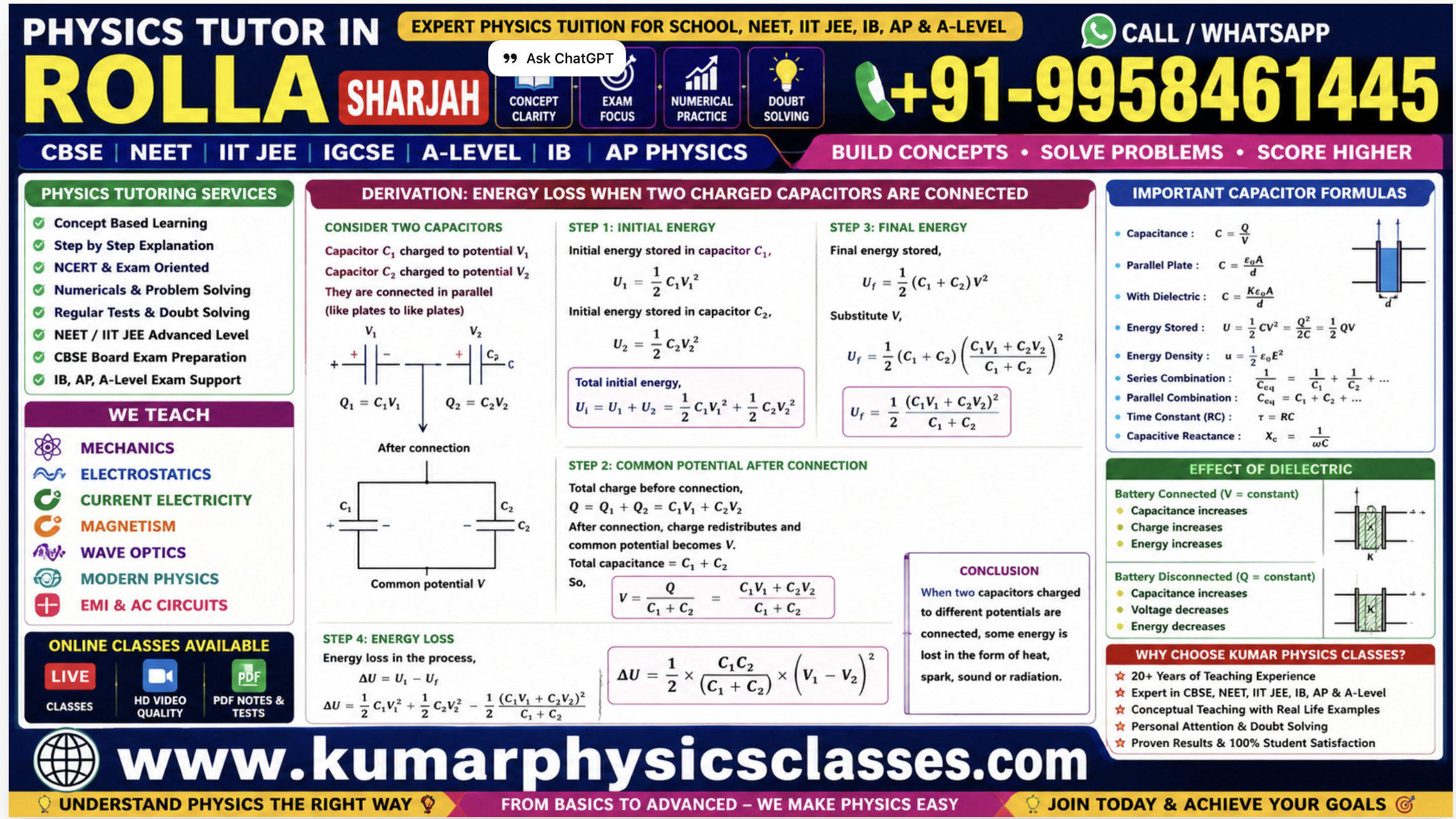
Physics becomes difficult when students memorize formulas without understanding the logic behind them. For example, in capacitors, many students know the formula:
Energy stored in capacitor = 1/2 CV²
But when two capacitors are connected, disconnected, charged at different potentials and then joined together, students get confused.
Kumar Sir explains that such questions can be solved in two ways:
Find initial energy and final energy, then subtract.
Use direct formula for energy loss when two capacitors share charge.
This method helps students understand the concept instead of just remembering the formula.
Capacitor Energy Concept Explained
When a capacitor is charged to potential V, energy stored is:
U = 1/2 CV²
If two capacitors are connected together after being charged to different potentials, charge redistributes. Final common potential is calculated by charge conservation.
Final potential:
V = (C₁V₁ + C₂V₂) / (C₁ + C₂)
Initial energy:
Uᵢ = 1/2 C₁V₁² + 1/2 C₂V₂²
Final energy:
U_f = 1/2 (C₁ + C₂)V²
Energy lost:
Energy loss = Uᵢ − U_f
Direct formula:
Energy loss = 1/2 × C₁C₂/(C₁ + C₂) × (V₁ − V₂)²
This is the kind of conceptual clarity Kumar Sir gives in every topic.
Physics Tutor Links for Rolla and Nearby Schools / Areas
Physics Tutor in Rolla, Physics Tutor in Al Ghuwair, Physics Tutor in Al Shuwaiheen, Physics Tutor in Al Musalla, Physics Tutor in Al Nabba, Physics Tutor in Al Qasimia, Physics Tutor in Al Majaz, Physics Tutor in Al Taawun, Physics Tutor in Muwaileh, Physics Tutor in Al Nahda Sharjah, Physics Tutor in Sharjah, NEET Physics Tutor in Sharjah, IIT Physics Tutor in Sharjah, JEE Physics Tutor in Sharjah, IB Physics Tutor in Sharjah, AP Physics Tutor in Sharjah, IGCSE Physics Tutor in Sharjah, A-Level Physics Tutor in Sharjah, CBSE Physics Tutor in Sharjah
Why Kumar Sir Is Different
Kumar Sir does not teach Physics like a normal formula-based subject. He teaches Physics with logic, diagrams, derivations and real exam approach. If a student is weak, Kumar Sir starts from zero level. If a student is preparing for NEET or IIT JEE, he takes the same concept to advanced level.
His teaching style focuses on:
Concept clarity
Numerical practice
Derivation understanding
Diagram-based explanation
Vector direction and sign convention
NEET and IIT JEE level problem solving
CBSE board exam writing style
AP, IB, IGCSE and A-Level Physics preparation
If you are living in Rolla Sharjah and Physics is creating stress, low marks, fear or confusion, then the right step is to take proper guidance before the problem becomes bigger.
Contact Kumar Physics Classes and start learning Physics in a simple, logical and powerful way.
Phone: +91-9958461445
Website: kumarphysicsclasses.com
Email: kumarsirphysics@gmail.com
50 CBSE Conceptual Questions on Capacitors with Answers
1. What is a capacitor?
A capacitor is a device used to store electric charge and electrical energy.
2. What is capacitance?
Capacitance is the ability of a conductor to store charge.
C = Q/V
3. What is the SI unit of capacitance?
The SI unit of capacitance is farad (F).
4. Why is capacitance independent of charge?
Because capacitance depends only on the size, shape, separation and medium between conductors, not on charge or potential.
5. What happens to capacitance if plate area increases?
Capacitance increases because
C ∝ A
6. What happens to capacitance if distance between plates increases?
Capacitance decreases because
C ∝ 1/d
7. Why is a capacitor used in circuits?
A capacitor is used to store charge, store energy, filter signals and control current flow.
8. What is the capacitance of a parallel plate capacitor?
C = ε₀A/d
9. What happens when dielectric is inserted between capacitor plates?
Capacitance increases by factor K.
10. Why does dielectric increase capacitance?
Dielectric reduces the effective electric field and potential difference, so capacitance increases.
11. If battery remains connected and dielectric is inserted, what happens to charge?
Charge increases because voltage remains constant and capacitance increases.
12. If battery is disconnected and dielectric is inserted, what happens to charge?
Charge remains constant.
13. If battery is disconnected and dielectric is inserted, what happens to potential difference?
Potential difference decreases.
14. If battery is disconnected and dielectric is inserted, what happens to energy?
Energy decreases.
15. If battery remains connected and dielectric is inserted, what happens to energy?
Energy increases because voltage remains constant and capacitance increases.
16. What is dielectric constant?
Dielectric constant is the ratio of capacitance with dielectric to capacitance without dielectric.
K = C/C₀
17. Can capacitance be negative?
No, capacitance is always positive.
18. Can a capacitor store charge without potential difference?
No, charge storage needs potential difference.
19. What is energy stored in a capacitor?
U = 1/2 CV² = Q²/2C = 1/2 QV
20. Where is energy stored in a capacitor?
Energy is stored in the electric field between the plates.
21. What is energy density in electric field?
u = 1/2 ε₀E²
22. Why is there no electric field outside an ideal parallel plate capacitor?
Because fields due to both plates cancel outside.
23. Why is electric field uniform inside a parallel plate capacitor?
Because plates are large and separation is small compared to plate size.
24. What happens if a charged capacitor is connected to an uncharged capacitor?
Charge redistributes until both capacitors reach common potential.
25. Is charge conserved when two capacitors are connected?
Yes, total charge is conserved.
26. Is energy conserved when two capacitors are connected?
No, some energy is lost as heat, spark or radiation.
27. Why is energy lost when charged capacitors are connected?
Because charge flows suddenly due to potential difference.
28. What is common potential after connecting two capacitors?
V = (C₁V₁ + C₂V₂)/(C₁ + C₂)
29. What is energy loss when two capacitors are connected?
Energy loss = 1/2 × C₁C₂/(C₁ + C₂) × (V₁ − V₂)²
30. What happens to equivalent capacitance in parallel combination?
Equivalent capacitance increases.
Ceq = C₁ + C₂ + C₃
31. Why does capacitance increase in parallel?
Because effective plate area increases.
32. What happens to equivalent capacitance in series combination?
Equivalent capacitance decreases.
1/Ceq = 1/C₁ + 1/C₂ + 1/C₃
33. Why does capacitance decrease in series?
Because effective separation increases.
34. In series combination, what remains same?
Charge remains same on each capacitor.
35. In parallel combination, what remains same?
Potential difference remains same across each capacitor.
36. Which capacitor gets more voltage in series?
The capacitor with smaller capacitance gets more voltage.
37. Which capacitor gets more charge in parallel?
The capacitor with larger capacitance gets more charge.
38. Why should capacitors not be connected directly across high voltage?
Because breakdown of dielectric may occur.
39. What is dielectric breakdown?
When dielectric starts conducting due to very high electric field, it is called dielectric breakdown.
40. What is breakdown voltage?
The maximum voltage a capacitor can withstand safely.
41. Why is air capacitor less efficient than dielectric capacitor?
Because air has lower dielectric constant.
42. What happens if a conducting slab is inserted between capacitor plates?
Effective separation decreases, so capacitance increases.
43. Capacitance with conducting slab of thickness t is?
C = ε₀A/(d − t)
44. What happens if dielectric slab of thickness t is inserted partially?
Effective separation becomes
d − t + t/K
45. Capacitance with dielectric slab of thickness t is?
C = ε₀A / (d − t + t/K)
46. Why does a charged capacitor attract dielectric slab?
Because insertion of dielectric lowers energy of the system.
47. Does capacitor allow DC current?
After full charging, capacitor blocks DC current.
48. Does capacitor allow AC current?
Yes, capacitor allows AC due to continuous charging and discharging.
49. What happens to capacitance of isolated spherical conductor?
Capacitance is
C = 4πε₀R
50. Does capacitance of spherical conductor depend on charge?
No, it depends only on radius and surrounding medium.