
Physics Tutor in NIBM Road Pune – Pseudo Force and Friction Explained by Kumar Sir
+91-9958461445
If you are searching for a Physics Tutor in NIBM Road Pune for IIT JEE, NEET, AP Physics, ICSE Physics, CBSE Physics, A Level Physics, or advanced mechanics, then understanding concepts like pseudo force, friction, and non-inertial frames becomes extremely important.
According to Kumar Sir, most students try to memorize formulas without understanding actual Physics. But mechanics becomes easy when students visualize forces physically.
One of the most important chapters in mechanics is:
Friction
Pseudo force
Non-inertial frames
Relative motion
Newton’s laws
These topics are extremely important for:
IIT JEE Main
IIT JEE Advanced
NEET Physics
AP Physics
CBSE Class 11 Physics
A Level Mechanics
The Question Discussed by Kumar Sir
Question:
A block of mass 12 kg is placed on a long trolley.
The coefficient of static friction between block and trolley is:
mu = 0.2
The trolley accelerates from rest with:
a = 0.2 m/s^2
Find the net force on the block.
Step 1 – Understanding the Physical Situation
According to Kumar Sir, before solving any mechanics question, students should first identify all forces physically.
Suppose a block is placed on a trolley.
Initially:
Weight acts downward
Normal reaction acts upward
Therefore:
N = Mg
Now trolley starts accelerating toward positive X direction.
Students usually become confused here.
They think friction always acts backward.
But friction opposes relative motion, not actual motion.
This is one of the most important concepts.
Step 2 – Understanding Pseudo Force
If we observe motion from the trolley frame, then trolley becomes a non-inertial frame.
Therefore pseudo force appears.
Pseudo force always acts opposite to acceleration of frame.
So if trolley accelerates in +X direction:
Pseudo force acts in -X direction.
Formula:
F(pseudo) = Ma
Therefore:
F(pseudo) = 12 × 0.2
F(pseudo) = 2.4 N
Direction:
Backward.
Step 3 – Role of Friction
Now what happens physically?
Pseudo force tends to move the block backward relative to trolley.
To oppose this relative motion, friction acts forward.
This is extremely important.
So friction acts in +X direction.
Step 4 – Static Friction Concept
Students often make a major mistake.
They directly use:
f = muN
But this is maximum static friction.
Actual static friction depends on requirement.
According to Kumar Sir:
“Static friction adjusts itself according to need.”
This is one of the most important mechanics concepts.
Maximum static friction:
f(max) = muN
Since:
N = Mg
Therefore:
f(max) = 0.2 × 12 × 10
f(max) = 24 N
Now required force to move block with trolley is only:
F = Ma = 2.4 N
Since:
2.4 N < 24 N
Static friction can easily provide this force.
Therefore block does not slip.
Final Net Force on Block
Since block moves together with trolley:
Net force on block:
F = Ma
Therefore:
F = 12 × 0.2
F = 2.4 N
Direction:
Forward.
Final Answer
Net force on block = 2.4 N
towards positive X direction.
The Most Important Concept by Kumar Sir
According to Kumar Sir:
Students should never think:
f = muN always
Actually:
Static friction <= muN
Only at limiting condition:
f = muN
Otherwise friction takes whatever value is needed to prevent slipping.
This is one of the most misunderstood topics in Physics.
Why Students Fear Friction
Students fear friction because they memorize formulas mechanically.
But friction becomes easy when students understand:
Relative motion
Tendency of motion
Frame of reference
Pseudo force
Newton’s laws
According to Kumar Sir:
“Always ask: which body tends to move relative to which body?”
That single question solves most friction problems.
IIT JEE Physics Preparation by Kumar Sir
In IIT JEE, mechanics questions are highly conceptual.
Students must understand:
Non-inertial frames
Relative motion
Constraint motion
Friction analysis
Advanced free body diagrams
Kumar Sir trains students on:
HC Verma
Advanced modules
JEE Advanced PYQs
Assertion reasoning
Graphical mechanics
Multi-concept problems
Students learn actual Physics thinking instead of rote memorization.
NEET Physics Preparation
In NEET Physics, friction and Newton’s laws are scoring topics.
Students are trained to solve:
Direct numericals
Assertion reasoning
Conceptual MCQs
Motion analysis
Force balance questions
Kumar Sir focuses on:
Fast solving methods
Concept clarity
Error reduction
Smart approaches
Many students scoring above 99 percentile in Physics build strong mechanics fundamentals through proper visualization.
AP Physics and A Level Physics
Students preparing for:
must deeply understand:
Newtonian mechanics
Free body diagrams
Pseudo force
Inertial frames
Relative motion
Kumar Sir explains derivations step-by-step from basic principles.
ICSE and CBSE Physics
Students preparing for boards often struggle with mechanics numericals.
Kumar Sir teaches:
Diagram-based learning
Concept visualization
Step-by-step solving
Formula derivation
Logic-based mechanics
This improves confidence tremendously.
Why Students Prefer Kumar Physics Classes
Students prefer Kumar Physics Classes because:
Concepts are taught deeply
Doubts are solved logically
Numerical solving becomes easier
Classes are highly interactive
Physics becomes enjoyable
Topics covered include:
Mechanics
Friction
Circular motion
Ray optics
Electrodynamics
Modern Physics
Waves
Thermodynamics
HC Verma solutions
Physics Tutor in Nearby Areas
Physics Tutor in NIBM Road Pune
Physics Tutor in Kondhwa Pune
Physics Tutor in Wanowrie Pune
Physics Tutor in Undri Pune
Physics Tutor in Camp Pune
Physics Tutor in Salisbury Park Pune
Physics Tutor in Fatima Nagar Pune
Physics Tutor in Hadapsar Pune
Physics Tutor in Bibwewadi Pune
Physics Tutor in Nearby Schools and Colleges
Physics Tutor in Delhi Public School Pune
Physics Tutor in Vibgyor High School Pune
Physics Tutor in Bishop’s School Pune
Physics Tutor in Sinhgad College Pune
Physics Tutor in MIT Pune
Physics Tutor in JSPM Pune
Physics Tutor in Symbiosis College Pune
Physics Tutor in Pune University
Specialized Coaching Keywords
IIT JEE Physics Tutor in NIBM Road Pune
NEET Physics Tutor in NIBM Road Pune
CBSE Physics Tutor in NIBM Road Pune
ICSE Physics Tutor in NIBM Road Pune
AP Physics Tutor in NIBM Road Pune
A Level Physics Tutor in NIBM Road Pune
Mechanics Physics Tutor in NIBM Road Pune
Friction Physics Tutor in NIBM Road Pune
Newton Laws Physics Tutor in NIBM Road Pune
HC Verma Physics Tutor in NIBM Road Pune
Final Conclusion
Mechanics becomes extremely easy when students stop memorizing formulas and start understanding force interaction physically.
According to Kumar Sir:
Friction opposes relative motion
Static friction adjusts automatically
Pseudo force appears in non-inertial frame
Newton’s laws explain everything beautifully
Once students understand these ideas visually, even advanced IIT JEE and NEET mechanics questions become easy and scoring.
Friction in Physics – Static Friction, Limiting Friction and Dynamic Friction Explained by Kumar Sir
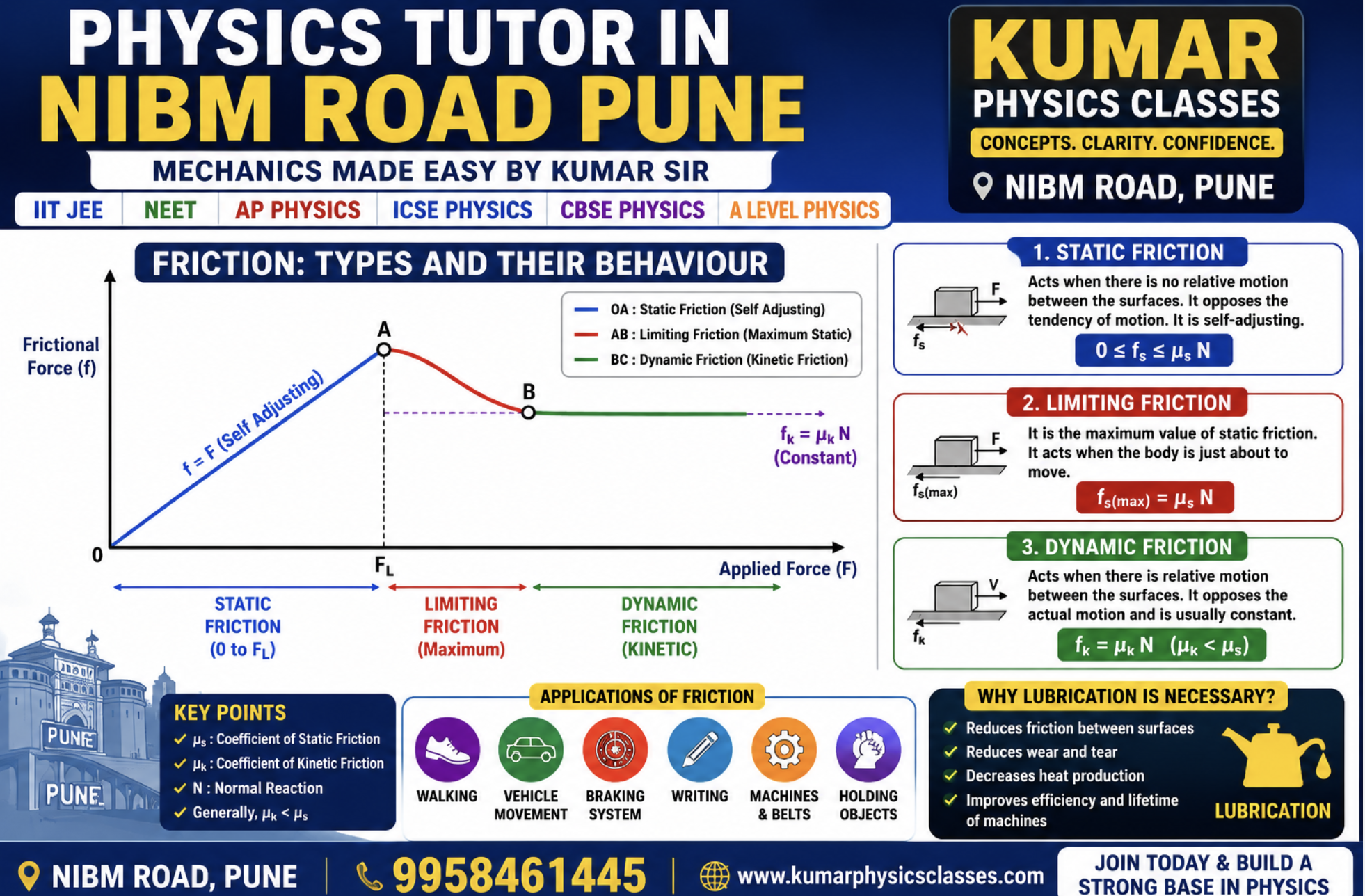
Friction is one of the most important concepts in mechanics. According to Kumar Sir, students often think friction is a force that only opposes motion, but actually friction is much deeper than that. Friction is the force which opposes relative motion or the tendency of relative motion between two surfaces in contact.
Without friction:
We cannot walk
Vehicles cannot move
Brakes cannot work
Objects cannot remain at rest properly
Friction is extremely important in IIT JEE, NEET, AP Physics, CBSE Physics, ICSE Physics, and A Level Physics.
1. Static Friction
Static friction acts when two surfaces are in contact but there is no relative motion between them.
Suppose a block is placed on a table and you apply a small force. The block does not move immediately because static friction balances the applied force.
Important Point:
Static friction is self-adjusting.
That means it changes according to requirement.
Formula:
f(static) <= mu(s)N
Where:
mu(s) = coefficient of static friction
N = normal reaction
According to Kumar Sir:
“Static friction takes only as much force as needed to prevent slipping.”
2. Limiting Friction
Limiting friction is the maximum value of static friction just before motion starts.
At this stage, the body is about to move.
Formula:
f(limiting) = mu(s)N
This is the maximum possible static friction.
If applied force exceeds limiting friction, the body starts moving.
Important Concept:
Limiting friction acts at the verge of motion.
3. Dynamic Friction (Kinetic Friction)
Dynamic friction acts when one surface actually slides over another.
Once motion begins, friction becomes kinetic or dynamic friction.
Formula:
f(dynamic) = mu(k)N
Where:
mu(k) = coefficient of kinetic friction
Important Point:
Dynamic friction is generally smaller than limiting friction.
That is why it is easier to move an already moving object compared to starting its motion.
Difference Between Static, Limiting and Dynamic Friction
Static Friction
Acts before motion starts
Prevents relative motion
Self-adjusting
Value changes continuously
Limiting Friction
Maximum static friction
Acts just before motion begins
Body is at verge of motion
Dynamic Friction
Acts after motion starts
Opposes actual sliding motion
Usually constant
Relation Between Them
Generally:
Static Friction < Limiting Friction
and
Dynamic Friction < Limiting Friction
This is one of the most important concepts in mechanics.
Applications of Friction
Friction has many practical applications.
Walking
We walk because friction exists between foot and ground.
Vehicle Motion
Cars and bikes move because tires get friction from road.
Braking System
Brakes work due to friction.
Writing
Pen and pencil work because of friction with paper.
Belt Drives
Machines use friction for power transmission.
Clutch Plates
Vehicles use friction in clutch systems.
Holding Objects
Without friction we cannot grip objects properly.
Disadvantages of Friction
Although friction is useful, excessive friction creates problems.
Heat production
Energy loss
Wear and tear
Reduced efficiency
Noise generation
Machines may get damaged due to excessive friction.
Why Lubrication is Necessary
Lubrication reduces friction between moving surfaces.
Lubricants like oil or grease form a thin layer between surfaces.
This reduces direct contact.
Advantages of lubrication:
Reduces wear and tear
Increases machine life
Reduces heating
Improves efficiency
Reduces energy loss
Makes motion smoother
Examples:
Engine oil
Grease
Machine lubricants
According to Kumar Sir:
“Lubrication converts harmful friction into controlled friction.”
Important Concept by Kumar Sir
Students should always remember:
Static friction prevents motion
Limiting friction is maximum static friction
Dynamic friction acts during motion
Understanding these three properly makes mechanics much easier for:
IIT JEE
NEET
AP Physics
CBSE Physics
ICSE Physics
A Level Physics
Friction becomes simple when students visualize actual surface interaction instead of memorizing formulas only.