
Physics Tutor in Magarpatta Pune – RLC Circuit, Resonance, Inductive Reactance and Capacitive Reactance Explained by Kumar
+91-9958461445
Alternating Current (AC) Physics is one of the most important and concept-based chapters in Physics. Students preparing for NEET Physics, IIT-JEE Physics, AP Physics, IB Physics, A Level Physics, IGCSE Physics, CBSE Physics, ICSE Physics, and engineering entrance examinations often feel confused in topics such as RLC circuits, resonance, impedance, phase difference, inductive reactance, and capacitive reactance.
At Kumar Physics Classes Magarpatta Pune, students are taught these concepts visually, logically, and mathematically so that they can understand the physical meaning behind every formula instead of simply memorizing equations.
If you are living in Magarpatta Pune and searching for a Physics Tutor for NEET Physics, IIT-JEE Physics, AP Physics, IB Physics, A Level Physics, IGCSE Physics, CBSE Physics, ICSE Physics, or college-level Physics, then Kumar Sir can help you build strong conceptual understanding and advanced problem-solving ability.
What is an RLC Circuit?
An RLC circuit contains:
Resistance (R)
Inductor (L)
Capacitor (C)
connected together in alternating current supply.
This chapter is extremely important because it combines:
resistance
inductance
capacitance
phase difference
resonance
power factor
impedance
Students who understand RLC circuits deeply become very strong in AC Physics.
Inductive Reactance and Capacitive Reactance
In AC circuits:
Inductor opposes change in current
Capacitor opposes change in voltage
The opposition produced by inductor is called:
Inductive Reactance
Represented by:
XL
The opposition produced by capacitor is called:
Capacitive Reactance
Represented by:
XC
These quantities play the most important role in RLC circuits.
Three Important Conditions in RLC Circuit
Students must clearly understand these three conditions.
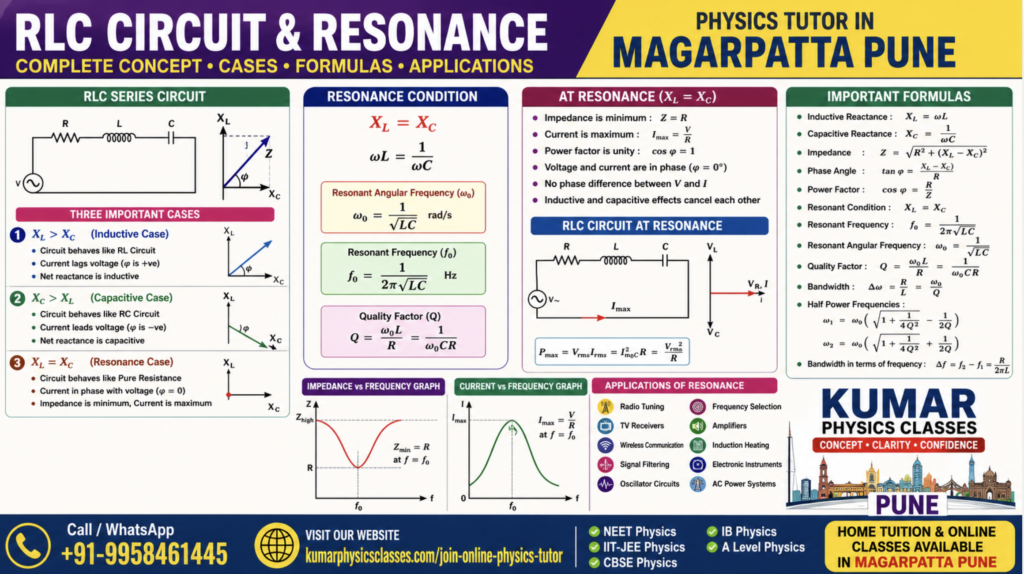
Condition 1 – XL Greater Than XC
When:
XL > XC
the inductive effect dominates.
In this condition:
circuit behaves like RL circuit
current lags voltage
phase angle becomes lagging
inductive nature becomes stronger
This means inductor controls the behavior of the circuit.
Why Current Lags in RL-Type Circuit
Inductor opposes sudden change in current due to self-induced emf.
According to Lenz’s Law:
induced emf opposes the cause producing it.
Therefore current becomes delayed compared to voltage.
This creates lagging phase difference.
Students preparing for NEET and IIT-JEE must remember:
In inductive circuits:
Current lags voltage.
Condition 2 – XC Greater Than XL
When:
XC > XL
capacitive effect dominates.
In this condition:
circuit behaves like RC circuit
current leads voltage
phase angle becomes leading
capacitive nature becomes stronger
This means capacitor controls the behavior of the circuit.
Why Current Leads in RC-Type Circuit
Capacitor allows rapid charge accumulation.
Because of this:
current changes faster than voltage.
Therefore current becomes ahead of voltage.
Students must remember:
In capacitive circuits:
Current leads voltage.
Condition 3 – XL Equal to XC
This is the most important condition.
When:
XL = XC
the circuit enters resonance condition.
This condition is called:
Electrical Resonance
What Happens During Resonance?
At resonance:
inductive reactance cancels capacitive reactance
net reactance becomes zero
impedance becomes minimum
current becomes maximum
phase difference becomes zero
power factor becomes maximum
This is one of the most beautiful concepts in Physics.
Why Resonance is Important
At resonance:
Voltage and current become in same phase.
Therefore:
Power Factor = 1
This means maximum power transfer occurs.
This condition is extremely important in:
radio tuning
communication systems
electronics
wireless transmission
filters
resonance circuits
Impedance in RLC Circuit
In AC circuits, total opposition to current flow is called impedance.
Represented by:
Z
Impedance depends upon:
resistance
inductive reactance
capacitive reactance
At resonance:
Impedance becomes minimum.
Therefore current becomes maximum.
Power Factor in RLC Circuit
Power factor tells us how efficiently electrical energy is being used.
Formula:
Power Factor = cos(phi)
Where phi is phase angle between voltage and current.
Different Power Factor Conditions
RL-Type Circuit
current lags
lagging power factor
RC-Type Circuit
current leads
leading power factor
Resonance Circuit
phase difference zero
power factor maximum
Students must compare these carefully.
Why Students Fear AC Physics
Students often fear AC chapter because of:
trigonometry
vectors
phasor diagrams
reactance
impedance
phase angle
But when concepts are taught physically and visually, the chapter becomes extremely easy.
At Kumar Physics Classes Magarpatta Pune, every concept is explained step-by-step using:
diagrams
graphs
conceptual visualization
real-life examples
advanced numericals
Why Conceptual Physics is Important
Most students memorize formulas temporarily.
But conceptual learning develops:
analytical thinking
long-term retention
confidence
problem-solving ability
This is why Kumar Sir focuses heavily on conceptual Physics.
Books Followed by Kumar Sir
Kumar Sir mainly follows top conceptual Physics books such as:
H.C. Verma
Resnick Halliday
I.E. Irodov
DC Pandey
NCERT Physics
These books help students develop strong foundations for:
NEET
IIT-JEE
Olympiads
AP Physics
IB Physics
A Level Physics
Why H.C. Verma is Important
H.C. Verma develops:
conceptual clarity
visualization
logical understanding
numerical solving ability
Students preparing for competitive exams greatly benefit from this approach.
Why Irodov is Important
Irodov develops advanced analytical thinking.
Students learn:
deep Physics concepts
advanced mathematical interpretation
high-level problem-solving
This is especially useful for IIT-JEE Advanced and Olympiads.
Real-Life Applications of RLC Circuits
RLC circuits are used in:
radio systems
communication devices
mobile phones
television systems
tuning circuits
transmitters
receivers
filters
signal processing
This is why resonance is extremely important in modern electronics.
Common Mistakes Students Make
Mistake 1 – Confusing XL and XC
Students often confuse inductive and capacitive behavior.
Remember:
XL > XC → RL behavior
XC > XL → RC behavior
XL = XC → resonance
Mistake 2 – Forgetting Phase Difference
Students forget whether current leads or lags.
Remember:
inductive → current lags
capacitive → current leads
Mistake 3 – Memorizing Without Understanding
Physics must always be understood physically.
Why Students Choose Kumar Physics Classes
Students prefer Kumar Physics Classes because:
concepts are simplified
difficult numericals become easy
theory is explained deeply
NEET and IIT-JEE oriented teaching is provided
international curriculum support is available
personalized doubt solving is done
Students from top schools and coaching institutes take conceptual guidance from Kumar Sir.
Physics Tutor in Magarpatta Pune – Areas Covered
Physics Tutor in Magarpatta Pune, Physics Tutor in Hadapsar Pune, Physics Tutor in Kharadi Pune, Physics Tutor in Viman Nagar Pune, Physics Tutor in Koregaon Park Pune, Physics Tutor in Kalyani Nagar Pune, Physics Tutor in Camp Pune, Physics Tutor in Wadgaon Sheri Pune, Physics Tutor in Lohegaon Pune, Physics Tutor in Yerawada Pune
Physics Tutor Near Schools and Universities
Physics Tutor in Vibgyor High School Pune, Physics Tutor in Delhi Public School Pune, Physics Tutor in Symbiosis International School Pune, Physics Tutor in Bishop’s School Pune, Physics Tutor in Lexicon International School Pune, Physics Tutor in MIT World Peace University Pune, Physics Tutor in COEP Pune, Physics Tutor in Symbiosis Pune
Physics Tutor for Different Curriculums
Physics Tutor in NEET Physics Pune, Physics Tutor in IIT-JEE Physics Pune, Physics Tutor in AP Physics Pune, Physics Tutor in IB Physics Pune, Physics Tutor in A Level Physics Pune, Physics Tutor in IGCSE Physics Pune, Physics Tutor in British Curriculum Physics Pune, Physics Tutor in CBSE Physics Pune, Physics Tutor in ICSE Physics Pune
Contact Kumar Physics Classes
Website: kumarphysicsclasses.com
Contact Number: +91-9958461445
Email: KUMARSIRPHYSICS@GMAIL.COM
Coaching Available For:
NEET Physics
IIT-JEE Physics
AP Physics
IB Physics
A Level Physics
IGCSE Physics
CBSE Physics
ICSE Physics
College Physics
Conclusion
RLC circuits and resonance are among the most important topics in Alternating Current Physics.
Students who understand:
inductive reactance
capacitive reactance
impedance
resonance
phase difference
power factor
leading and lagging current
develop a very strong Physics foundation.
At Kumar Physics Classes Magarpatta Pune, AC Physics is taught conceptually, visually, logically, and mathematically so that students can confidently solve NEET Physics, IIT-JEE Physics, AP Physics, IB Physics, A Level Physics, IGCSE Physics, and engineering-level Physics questions.
RLC circuit resonance has many important applications in Physics, Electronics, Communication Systems, and Electrical Engineering. Resonance occurs when inductive reactance becomes equal to capacitive reactance. At this condition, impedance becomes minimum and current becomes maximum. Because of this special property, resonance circuits are widely used in modern technology.
One of the most common applications of resonance is in radio tuning. When we select a particular radio station, the RLC tuning circuit adjusts itself to resonate at the frequency of that station. At resonance, the circuit responds strongly only to the desired frequency and rejects other unwanted frequencies. This allows clear reception of signals.
Another important application is in television and communication systems. Mobile phones, transmitters, receivers, and wireless communication devices use resonance circuits to select desired frequencies and improve signal quality. Without resonance, modern communication systems would not work efficiently.
RLC resonance is also used in filters. Electronic filters are designed using resistors, inductors, and capacitors to allow certain frequencies and block others. These filters are used in audio systems, amplifiers, and signal processing circuits.
In induction heating systems, resonance helps transfer energy efficiently. Industries use resonant circuits in induction furnaces for heating metals without direct contact.
Resonance is also used in oscillators. Electronic oscillators generate stable alternating signals required in clocks, computers, radio transmitters, and digital circuits.
Power systems also use resonance concepts in tuning and improving efficiency of electrical networks.
Important applications of RLC resonance include:
Radio tuning
Television circuits
Mobile communication
Frequency selection
Signal filtering
Oscillator circuits
Induction heating
Wireless transmission
Audio amplifiers
Electronic instruments
Thus, resonance in RLC circuits plays a very important role in modern electronics and communication technology.