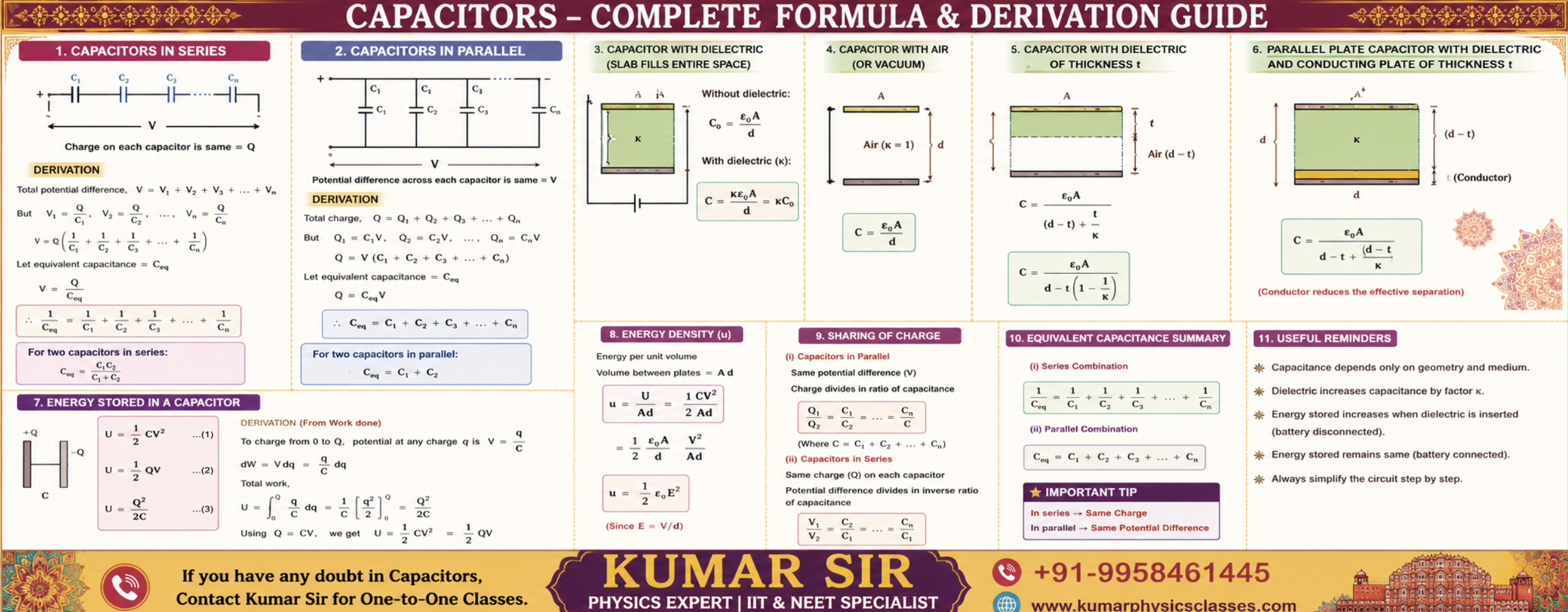
Capacitors Combinations help students understand how capacitors are connected in series, parallel, bridge circuits, multi-plate arrangements and advanced capacitor networks. This topic is important for CBSE, NEET, JEE Main and JEE Advanced Physics.
10 Diagram Based Capacitor Plate Arrangement Questions
Capacitor Plate Arrangement Questions
10 diagram-based questions for Class 12, NEET, JEE Main and JEE Advanced. Focus: connected plates, common potential, parallel grouping, and equivalent capacitance.
CBSENEETJEE MainJEE Advanced
Key idea: In multi-plate capacitor systems, plates connected by a wire are at the same potential. Adjacent oppositely charged conducting plates form capacitors. Count effective gaps carefully.
1Basic Concept
Five identical plates are arranged as shown. Plates 1 and 4 are connected to terminal P, while plates 3 and 5 are connected to terminal Q. Find equivalent capacitance between P and Q if capacitance between two adjacent plates is C.
A. C
B. 2C
C. 3C
D. 4C
Answer: B. 2C Effective gaps are between plates 2-3 and 4-5 for opposite groups. The gaps 1-2 and 3-4 are not both across P-Q in this connection. Therefore two capacitors are in parallel. Ceq = C + C = 2C
2Plate Counting
Six identical parallel plates are connected alternately to P and Q. If capacitance between two adjacent plates is C, find equivalent capacitance.
A. 3C
B. 4C
C. 5C
D. 6C
Answer: C. 5C For n alternately connected plates, there are n − 1 active gaps. Here n = 6. Ceq = (6 − 1)C = 5C
3JEE Main
Four plates are arranged in air. Plates 1 and 3 are joined to P; plates 2 and 4 are joined to Q. If each adjacent pair has capacitance C, what is Ceq?
A. C
B. 2C
C. 3C
D. C/3
Answer: C. 3C The active adjacent gaps are 1-2, 2-3, and 3-4. All are between P and Q, so they act in parallel. Ceq = 3C
4NEET
Three identical plates are connected so that plates 1 and 3 are at P and plate 2 is at Q. If adjacent plate capacitance is C, equivalent capacitance is:
A. C/2
B. C
C. 2C
D. 3C
Answer: C. 2C Two active gaps exist: 1-2 and 2-3. Both are across P and Q, therefore parallel. Ceq = 2C
5Dielectric
In question 4, if the upper gap has dielectric constant K and lower gap is air, find equivalent capacitance. Air gap capacitance is C.
A. KC
B. (K + 1)C
C. KC/(K + 1)
D. 2KC
Answer: B. (K + 1)C Upper gap capacitance becomes KC. Lower gap remains C. These two are in parallel. Ceq = KC + C = (K + 1)C
6JEE Advanced
Five plates are connected alternately to P and Q. The middle gap is filled with dielectric K. Other gaps are air. Air gap capacitance is C. Find Ceq.
A. (K + 3)C
B. 4KC
C. (K + 1)C
D. (2K + 2)C
Answer: A. (K + 3)C There are four active gaps. Three air gaps contribute 3C. One dielectric gap contributes KC. Ceq = 3C + KC = (K + 3)C
7Conceptual
In a plate system, plates 1, 2 and 3 are connected together to P. Plates 4 and 5 are connected to Q. Adjacent capacitance is C. Find equivalent capacitance.
A. C
B. 2C
C. 3C
D. 4C
Answer: A. C Gaps 1-2 and 2-3 are between plates at the same potential, so no capacitor action. Gap 4-5 is also same potential. Only gap 3-4 is across P and Q. Ceq = C
8Numerical
Seven plates are connected alternately to P and Q. Area of each plate is A, separation is d, and medium is air. Find equivalent capacitance.
A. ε₀A/d
B. 3ε₀A/d
C. 6ε₀A/d
D. 7ε₀A/d
Answer: C. 6ε₀A/d Seven alternately connected plates create six active gaps. Each gap has capacitance ε₀A/d. Ceq = 6ε₀A/d
9Trap Question
Four plates are shown. Plate 2 is isolated and plates 1 and 4 are connected to P, while plate 3 is connected to Q. What should be remembered first?
A. Isolated plate always gives zero effect
B. Isolated plate may create series capacitors
C. All four gaps are parallel
D. Ceq is always 3C
Answer: B. Isolated plate may create series capacitors An isolated conducting plate can divide a region into two capacitors in series. Such questions need charge neutrality and potential conditions, not simple gap counting.
10Formula Based
For n identical plates connected alternately to two terminals, each adjacent gap having capacitance C, the equivalent capacitance is:
A. nC
B. (n − 1)C
C. C/(n − 1)
D. (n + 1)C
Answer: B. (n − 1)C There are n − 1 spaces between n plates. With alternate connection, each space is an active capacitor across the same two terminals. Ceq = (n − 1)C
Kumar Physics Classes
For Class 12, NEET and JEE Physics guidance, contact Kumar Sir.
If you have any doubt in Capacitor Combinations, equivalent capacitance, series-parallel circuits, bridge circuits or IIT Advanced level capacitor problems, contact Kumar Sir for one-to-one Physics guidance. Contact: +91-9958461445 | Website: https://kumarphysicsclasses.com
Complete premium Jaipur-style guide for CBSE, NEET, JEE Main, JEE Advanced, AP Physics, IB Physics, IGCSE, A-Level and Olympiad Physics.
CBSENEETJEE MainJEE AdvancedOlympiad
1. Introduction to Capacitor Combinations
Capacitor combinations help us replace a network of capacitors by a single equivalent capacitance between two terminals. This is essential in board exams, NEET, JEE Main and JEE Advanced circuit problems.
Equivalent capacitance means: Q = CeqV
2. Definition of Equivalent Capacitance
Equivalent capacitance is the capacitance of a single capacitor that stores the same charge for the same potential difference as the entire network.
Ceq = Qtotal/V
3. Capacitors in Series
In series, each capacitor gets the same charge Q, while potential differences are different.
V = V₁ + V₂ + V₃ + ...
V₁ = Q/C₁, V₂ = Q/C₂, V₃ = Q/C₃
Q/Ceq = Q/C₁ + Q/C₂ + Q/C₃ + ...
1/Ceq = 1/C₁ + 1/C₂ + 1/C₃ + ...
For two capacitors: Ceq = C₁C₂/(C₁ + C₂)
4. Capacitors in Parallel
In parallel, every capacitor has the same potential difference V, while charge divides.
Q = Q₁ + Q₂ + Q₃ + ...
Q₁ = C₁V, Q₂ = C₂V, Q₃ = C₃V
CeqV = C₁V + C₂V + C₃V + ...
Ceq = C₁ + C₂ + C₃ + ...
5. Difference Between Series and Parallel Capacitors
Parameter
Series
Parallel
Charge
Same on each capacitor
Divides among capacitors
Voltage
Divides
Same across each capacitor
Equivalent capacitance
Less than smallest capacitor
Greater than largest capacitor
Energy
Sum of individual energies
Sum of individual energies
Use
High voltage sharing
Increasing capacitance
6. Parallel Plate Capacitors Connected in Series and Parallel
Parallel plate capacitors in series effectively increase separation, reducing capacitance. In parallel, effective plate area increases, increasing capacitance.
Series meaning: effective d increases.
Parallel meaning: effective A increases.
7. Multi-Plate Capacitor Problems
Ceq = (n − 1)ε₀A/d
5 plates: C = 4ε₀A/d
10 plates: C = 9ε₀A/d
15 plates: C = 14ε₀A/d
8. Capacitor Networks
Simple series-parallel networks: reduce step by step.
Ladder networks: start from far end or use self-similarity.
Unbalanced bridge: use node potential or delta-star method.
9. Delta-Star Transformation for Capacitors
For capacitors, transformation formulas are reciprocal-like compared with resistor networks because series and parallel rules are interchanged.
For delta C₁₂, C₂₃, C₃₁
Star arm at node 1: C₁ = (C₁₂C₃₁ + C₁₂C₂₃ + C₂₃C₃₁)/C₂₃
Use transformation in IIT Advanced networks where no simple series-parallel reduction is visible.
10. Capacitor Bridge Circuits
A capacitor bridge is balanced when the potential difference across the middle capacitor is zero. Then the middle capacitor carries no charge and can be ignored.
Balanced condition: C₁/C₂ = C₃/C₄
11. Short Circuit and Same Potential Points
If two nodes are connected by an ideal wire, they are at the same potential. A capacitor connected between same-potential points has zero potential difference and stores no charge.
Equal potential nodes can be joined without changing the circuit.
Capacitors between equal potential nodes can be removed.
13. Equivalent Capacitance Between Two Points
Label all important nodes.
Identify direct series and parallel groups.
Use symmetry to find equal potential nodes.
Use bridge balance or delta-star if needed.
Apply Q = CeqV between required terminals.
14. Energy in Capacitor Combinations
dW = Vdq = (q/C)dq
U = ∫₀Q(q/C)dq = Q²/(2C)
U = ½CV² = ½QV = Q²/(2C)
Total energy of a network is the sum of energies stored in all capacitors.
15. Charge Distribution in Capacitor Networks
Series: same charge on each capacitor.
Parallel: same voltage across each capacitor.
Voltage divides inversely with capacitance in series.
Charge divides directly with capacitance in parallel.
16-20. Exam Practice Questions
21. Common Mistakes Students Make
22. Formula Master Sheet
C = Q/V
Series: 1/Ceq = Σ1/Cᵢ
Parallel: Ceq = ΣCᵢ
Two in series: C = C₁C₂/(C₁+C₂)
U = ½CV²
U = ½QV
U = Q²/(2C)
Multi-plate: C = (n−1)ε₀A/d
Balanced bridge: C₁/C₂ = C₃/C₄
Parallel plate: C = ε₀A/d
23. Revision Notes
CBSE: Master series and parallel derivations. NEET: Memorize charge and voltage rules. JEE Main: Practice mixed networks. JEE Advanced: Use symmetry, bridge balance, delta-star, node method and multi-plate logic.
24. FAQ Section
25. Final Guidance Banner
Still confused in Capacitor Combinations? Learn step-by-step with Kumar Sir through personal one-to-one Physics classes.
Clean derivation, energy loss concept, diagram, and calculator for Class 12, NEET and JEE Physics.
Class 12NEETJEE MainJEE Advanced
Concept
Consider two capacitors C₁ and C₂ initially charged separately. Capacitor C₁ has initial potential V₁ and capacitor C₂ has initial potential V₂.
When they are connected in parallel with the same polarity, charge redistributes between them. After some time, both capacitors reach a common final potential V.
Common Final Potential
Initial charges on the two capacitors are:
Q₁ = C₁V₁
Q₂ = C₂V₂
Since capacitors are connected with the same polarity, total charge is conserved:
Q = C₁V₁ + C₂V₂
After connection, the capacitors are in parallel, so total capacitance is:
Ceq = C₁ + C₂
Therefore, final common potential is:
V = (C₁V₁ + C₂V₂) / (C₁ + C₂)
Energy Loss Derivation
Initial energy stored in both capacitors:
Uᵢ = ½C₁V₁² + ½C₂V₂²
Final energy after charge sharing:
Uf = ½(C₁ + C₂)V²
Energy loss is:
Loss = Uᵢ − Uf
After simplification:
Loss = ½ × [C₁C₂ / (C₁ + C₂)] × (V₁ − V₂)²
Important: The lost energy does not disappear. It is converted mainly into heat energy in the connecting wires due to transient current. A small part may also be radiated as electromagnetic energy, but for basic Physics we write it as heat loss.
Charge Sharing Calculator
Enter capacitance values in the same unit, for example μF, and voltage in volts. Energy output will be in proportional capacitance-unit × V². If capacitance is in farads, energy is in joules.