
Physics Tutor in Al Taawun Sharjah
+91-9958461445
If you live in Al Taawun Sharjah or nearby areas and Physics is becoming difficult for you, then you are not alone. Many students preparing for CBSE Physics, NEET Physics, IIT JEE Physics, IGCSE Physics, A-Level Physics and AP Physics face the same problem. They attend school, coaching and regular classes, but when numerical questions come, they feel confused.
At Kumar Physics Classes, Kumar Sir teaches Physics from Delhi through live online Zoom classes. He explains every concept from basic level to advanced level with proper diagram, formula, derivation and numerical approach.
If you need a good online Physics tutor, you can contact Kumar Sir.
Phone / WhatsApp: +91-9958461445
Website: https://kumarphysicsclasses.com
Physics Tutor Near Al Taawun Sharjah
Physics Tutor in Al Taawun, Physics Tutor in Al Nahda Sharjah, Physics Tutor in Al Majaz, Physics Tutor in Al Khan, Physics Tutor in Al Qasimia, Physics Tutor in Rolla Sharjah, Physics Tutor in Muwaileh Sharjah, Physics Tutor in Sharjah
Physics Tutor for Courses
NEET Physics Tutor, IIT Physics Tutor, JEE Physics Tutor, CBSE Physics Tutor, IGCSE Physics Tutor, A-Level Physics Tutor, AP Physics Tutor, IB Physics Tutor
Concept: Interference of Two Waves
Question:
Two waves have intensity ratio 1 : 9. They cross each other at a point. Calculate the ratio of resultant intensity at that point when:
Waves are incoherent
Waves are coherent and phase difference is 60°
Given
Intensity ratio:
I₁ : I₂ = 1 : 9
Let:
I₁ = I
I₂ = 9I
Case 1: Incoherent Waves
For incoherent waves, resultant intensity is simply added:
I = I₁ + I₂
So,
I = I + 9I = 10I
Therefore,
Resultant intensity for incoherent waves = 10I
Case 2: Coherent Waves with Phase Difference 60°
For coherent waves:
I = I₁ + I₂ + 2√(I₁I₂) cos φ
Here,
I₁ = I
I₂ = 9I
φ = 60°
cos 60° = 1/2
Now,
I = I + 9I + 2√(I × 9I) × 1/2
√(9I²) = 3I
So,
I = 10I + 2 × 3I × 1/2
I = 10I + 3I
I = 13I
Therefore,
Resultant intensity for coherent waves = 13I
Final Answer
Incoherent intensity : Coherent intensity
= 10I : 13I
= 10 : 13
Important Point for Students
Always remember:
For incoherent sources:
I = I₁ + I₂
For coherent sources:
I = I₁ + I₂ + 2√(I₁I₂) cos φ
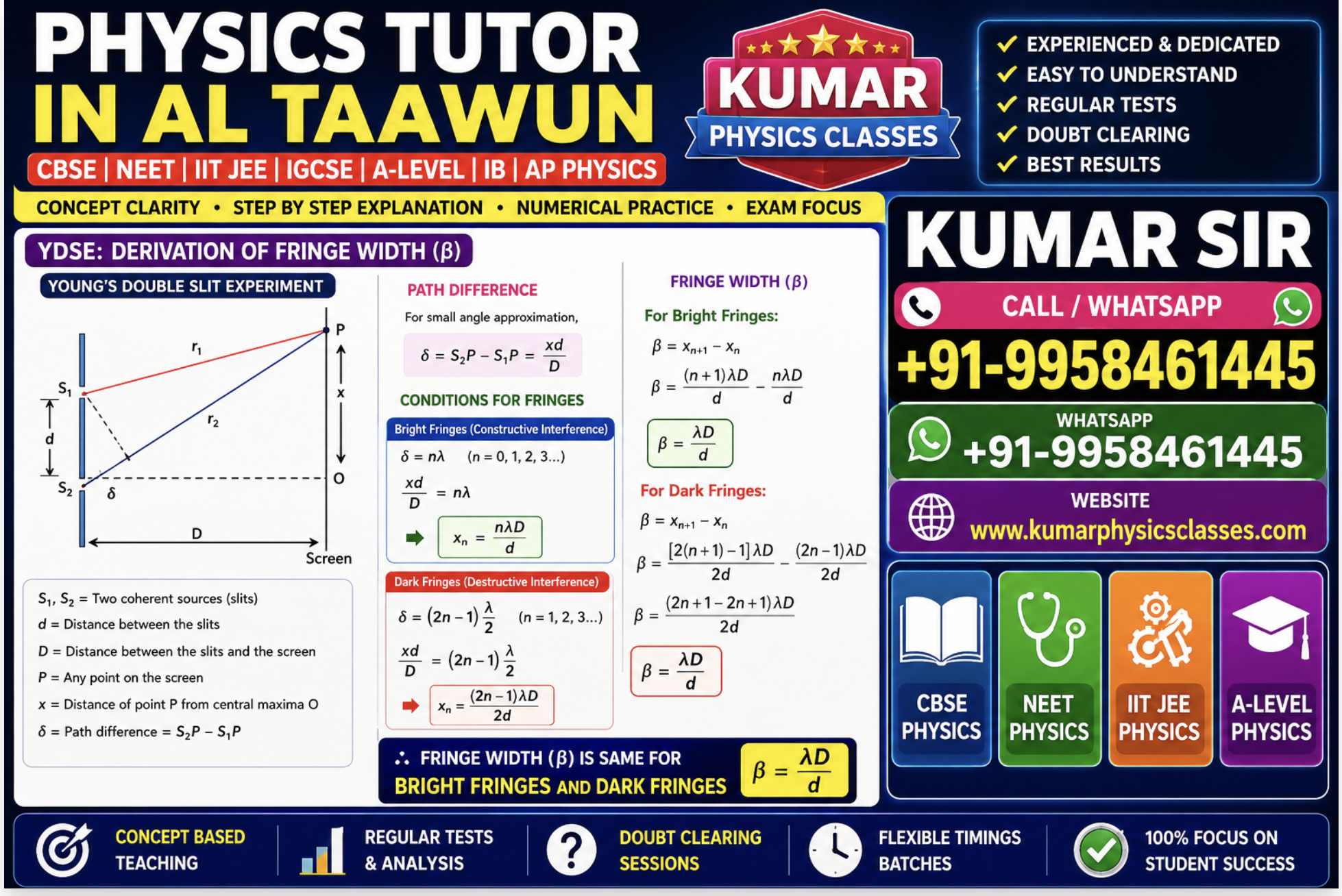
Young's Double Slit Experiment: Bright and Dark Fringes
In Young's Double Slit Experiment, the path difference between two waves reaching a point on the screen is:
Path difference = BP − AP
For small angle approximation:
BP − AP = xnd / D
Where:
- xn = distance of nth bright or dark fringe from central maximum
- d = distance between two slits
- D = distance between slits and screen
- λ = wavelength of light
Condition for Constructive Interference
For constructive interference, path difference is:
xnd / D = nλ
Therefore, position of nth bright fringe:
xn = nλD / d
Here, xn is the distance of nth bright fringe from the central maximum.
Fringe Width for Bright Fringes
The distance between two consecutive bright fringes gives fringe width.
β = xn − xn−1
Now,
xn = nλD / d
xn−1 = (n−1)λD / d
So,
β = nλD / d − (n−1)λD / d
β = λD / d
Condition for Destructive Interference
For destructive interference, path difference is:
xnd / D = (2n − 1)λ / 2
Therefore, position of nth dark fringe:
xn = (2n − 1)λD / 2d
Here, xn is the distance of nth dark fringe from the central maximum.
Fringe Width for Dark Fringes
The distance between two consecutive dark fringes gives fringe width.
β = xn − xn−1
For nth dark fringe:
xn = (2n − 1)λD / 2d
For (n−1)th dark fringe:
xn−1 = (2n − 3)λD / 2d
So,
β = (2n − 1)λD / 2d − (2n − 3)λD / 2d
β = [(2n − 1) − (2n − 3)]λD / 2d
β = 2λD / 2d
β = λD / d
Final Result
The fringe width for bright fringes and dark fringes is the same.
βbright = βdark = λD / d
Coherent Sources
Coherent sources are those sources of light which emit waves of the same frequency or same wavelength and maintain a constant phase difference with time.
In simple words, if two light waves always keep the same phase relationship, they are called coherent sources.
Example: In Young’s Double Slit Experiment, two slits behave as coherent sources because both receive light from the same original source.
Outcome of Young’s Double Slit Experiment
Young’s Double Slit Experiment proves the wave nature of light.
When light from two coherent sources overlaps on the screen, alternate bright and dark fringes are formed.
Bright fringes are formed due to constructive interference.
Dark fringes are formed due to destructive interference.
The fringe width is given by:
β = λD / d
Where:
β = fringe width
λ = wavelength of light
D = distance between slits and screen
d = distance between two slits
Why Two Physically Separate Sources Cannot Be Coherent
Two independent physical sources cannot be perfectly coherent because they emit light waves randomly.
The phase of light emitted by one source changes continuously and independently of the other source.
So, the phase difference between two independent sources does not remain constant.
That is why two separate bulbs, two separate lamps, or two separate candles cannot produce a stable interference pattern.
To obtain coherent sources, we generally derive two sources from the same original source, as done in Young’s Double Slit Experiment.
What Happens If White Light Is Used Instead of Monochromatic Light
If white light is used in Young’s Double Slit Experiment instead of monochromatic light, the central fringe is white.
This happens because at the central point, path difference is zero for all wavelengths, so all colours meet in phase and produce white light.
On both sides of the central white fringe, coloured fringes are observed.
The violet colour appears closer to the central fringe because violet has a smaller wavelength.
The red colour appears farther from the central fringe because red has a larger wavelength.
After a few fringes, the colours overlap and the pattern becomes less clear.
So, with white light, we observe:
Central white bright fringe
Coloured fringes on both sides
Violet nearer to the centre
Red farther from the centre
Fringes become blurred after some distance
Wave Optics: Coherent Sources and YDSE — Conceptual Questions with Answers
1. What are coherent sources?
Answer: Coherent sources are sources of light that have the same frequency and maintain a constant phase difference with time.
2. Why are coherent sources required for interference?
Answer: Coherent sources are required because a constant phase difference produces a stable interference pattern on the screen.
3. Can two independent bulbs act as coherent sources?
Answer: No. Two independent bulbs cannot act as coherent sources because their phase difference changes randomly with time.
4. Why are two slits in YDSE considered coherent sources?
Answer: In Young’s Double Slit Experiment, both slits receive light from the same source, so they behave as coherent sources.
5. What is the main outcome of Young’s Double Slit Experiment?
Answer: YDSE proves the wave nature of light by producing alternate bright and dark fringes due to interference.
6. What is constructive interference?
Answer: Constructive interference occurs when two waves meet in the same phase and the resultant intensity becomes maximum.
7. What is destructive interference?
Answer: Destructive interference occurs when two waves meet in opposite phase and the resultant intensity becomes minimum.
8. What is the condition for constructive interference?
Answer: The path difference should be an integral multiple of wavelength:
Path difference = nλ
9. What is the condition for destructive interference?
Answer: The path difference should be an odd multiple of half wavelength:
Path difference = (2n − 1)λ/2
10. What is fringe width?
Answer: Fringe width is the distance between two consecutive bright fringes or two consecutive dark fringes.
11. What is the formula of fringe width in YDSE?
Answer:
β = λD/d
where λ is wavelength, D is distance between slits and screen, and d is separation between slits.
12. Does fringe width depend on intensity?
Answer: No. Fringe width depends on wavelength, distance of screen, and slit separation, not on intensity.
13. What happens to fringe width if wavelength increases?
Answer: Fringe width increases because β is directly proportional to wavelength.
14. What happens to fringe width if slit separation increases?
Answer: Fringe width decreases because β is inversely proportional to slit separation.
15. What happens to fringe width if screen is moved farther away?
Answer: Fringe width increases because β is directly proportional to D.
16. What is the central fringe in YDSE?
Answer: The central fringe is the bright fringe formed at the point where path difference is zero.
17. Why is the central fringe bright?
Answer: The central fringe is bright because the path difference between waves reaching there is zero, so constructive interference occurs.
18. Are bright and dark fringes equally spaced in YDSE?
Answer: Yes. In YDSE, bright and dark fringes are equally spaced.
19. What happens if white light is used in YDSE?
Answer: A central white fringe is formed, and coloured fringes appear on both sides because different colours have different wavelengths.
20. Why do coloured fringes overlap when white light is used?
Answer: Coloured fringes overlap because each colour has a different wavelength and therefore a different fringe width.
21. Which colour has the maximum fringe width?
Answer: Red light has the maximum fringe width because it has the longest wavelength.
22. Which colour has the minimum fringe width?
Answer: Violet light has the minimum fringe width because it has the shortest wavelength.
23. What happens if one slit is closed in YDSE?
Answer: The interference pattern disappears because two coherent sources are no longer available.
24. What happens if the intensity of one slit is changed?
Answer: The contrast of fringes changes. Bright fringes become less bright and dark fringes may not be completely dark.
25. Why are dark fringes not perfectly dark when slit intensities are unequal?
Answer: Because complete cancellation occurs only when the amplitudes of the two waves are equal.
26. What is path difference?
Answer: Path difference is the difference between the distances travelled by two waves from the two slits to a point on the screen.
27. What is phase difference?
Answer: Phase difference tells how much one wave is ahead or behind another wave in phase.
28. What is the relation between path difference and phase difference?
Answer:
Phase difference = 2π/λ × path difference
29. What happens if the whole YDSE setup is placed in water?
Answer: The wavelength of light decreases in water, so fringe width decreases.
30. Why does wavelength decrease in water?
Answer: Because the speed of light decreases in water while frequency remains unchanged.
31. What happens to frequency when light enters water?
Answer: Frequency remains unchanged.
32. What happens to speed when light enters water?
Answer: Speed decreases because water is optically denser than air.
33. What happens to fringe width if a thin transparent sheet is placed in front of one slit?
Answer: The fringe pattern shifts because an extra optical path difference is introduced.
34. Does the fringe width change when a thin sheet is introduced?
Answer: No. The fringe width remains the same, but the entire fringe pattern shifts.
35. Why does the fringe pattern shift due to a thin sheet?
Answer: Because the sheet changes the optical path of light passing through that slit.
36. What is optical path?
Answer: Optical path is the product of refractive index and actual path travelled by light.
37. What is the condition for sustained interference?
Answer: The sources must be coherent, have the same frequency, and preferably have comparable intensities.
38. Why should the two sources have the same frequency?
Answer: If frequencies are different, the phase difference changes continuously and no stable interference pattern is formed.
39. What happens if the distance between slits is very large?
Answer: Fringe width becomes very small and fringes may become difficult to observe.
40. What happens if the distance between slits is very small?
Answer: Fringe width becomes large.
41. Why is YDSE important?
Answer: YDSE is important because it gives strong evidence that light behaves as a wave.
42. What is meant by intensity in interference?
Answer: Intensity represents the brightness of the fringe formed due to superposition of waves.
43. What is the intensity at constructive interference?
Answer: Intensity is maximum at constructive interference.
44. What is the intensity at destructive interference?
Answer: Intensity is minimum at destructive interference.
45. If two waves of equal intensity interfere constructively, what happens?
Answer: The resultant intensity becomes four times the intensity of one wave.
46. If two waves of equal intensity interfere destructively, what happens?
Answer: The resultant intensity becomes zero.
47. Why does interference not violate conservation of energy?
Answer: Energy is only redistributed. It is maximum at bright fringes and minimum at dark fringes.
48. What is the shape of fringes in YDSE?
Answer: The fringes are straight and parallel when the slit separation is small and the screen is far away.
49. What is the difference between interference and diffraction?
Answer: Interference occurs due to superposition of waves from two coherent sources, while diffraction occurs due to bending of waves around an obstacle or aperture.
50. What is the basic principle behind YDSE?
Answer: The basic principle is superposition of waves, where two coherent waves combine to form bright and dark fringes.