
Physics Tutor in Blue Ridge Hinjawadi Pune – Circular Motion and Friction Explained by Kumar Sir
+91-9958461445
If you are searching for a Physics Tutor in Blue Ridge Hinjawadi Pune for IIT JEE, NEET, IB Physics, AP Physics, A-Level Physics, Class 11, or Class 12 Physics, then understanding rotational motion and friction becomes extremely important. According to Kumar Sir, many students fear circular motion because they try to memorize formulas without understanding the actual force interaction happening in rotating systems.
But real Physics becomes easy when students understand:
-
Circular motion
-
Angular velocity
-
Centripetal force
-
Friction in rotational systems
-
Relative motion
-
Rotating frames
These topics are extremely important for:
-
IIT JEE Main
-
IIT JEE Advanced
-
NEET Physics
-
IB Physics
-
AP Physics
-
A-Level Physics
-
CBSE Physics
-
ICSE Physics
The Question Discussed by Kumar Sir
Question:
A disk revolves with speed:
5/3 revolution per second
Radius of disk:
10 cm
A coin is placed 9 cm away from the center of the disk.
The coin is just about to slip.
Find coefficient of friction mu.
Given:
g = 10 m/s^2
and
pi^2 = 9.8 approximately.
Step 1 – Understanding Revolution Per Second
According to Kumar Sir, students first need to convert revolution per second into angular velocity.
This is one of the most important concepts.
Formula:
omega = 2pi(n)
Where:
n = revolution per second.
Given:
n = 5/3
Therefore:
omega = 2pi × 5/3
omega = 10pi/3 rad/s
Step 2 – Understanding the Real Physics
Now the disk rotates.
Coin also tries to move in circular motion.
For circular motion, centripetal force is required.
Who provides this centripetal force?
Static friction.
This is the key concept.
According to Kumar Sir:
“Without friction the coin cannot rotate with the disk.”
Students often think friction only opposes motion.
But friction can also provide necessary centripetal force.
Step 3 – Centripetal Force Equation
Required centripetal force:
F = mR omega^2
Here:
R = 9 cm = 0.09 m
Therefore:
F = m(0.09)(10pi/3)^2
Now:
(10pi/3)^2 = 100pi^2/9
Given:
pi^2 = 9.8
Therefore:
omega^2 approximately equals:
100 × 9.8 / 9
approximately:
108.9
Now:
F = m × 0.09 × 108.9
approximately:
9.8m
Step 4 – Maximum Static Friction
Maximum static friction:
f(max) = mu(mg)
Since coin is just about to slip:
Required centripetal force = maximum friction.
Therefore:
mR omega^2 = mu(mg)
Mass cancels.
Thus:
mu = R omega^2 / g
Substituting values:
mu = (0.09 × 108.9)/10
mu approximately:
0.98
Final Answer
Coefficient of friction:
mu approximately = 0.98
Important Concept by Kumar Sir
According to Kumar Sir:
Students must understand the difference between:
-
Actual outward motion
-
Tendency to slip outward
-
Friction direction
In rotating systems:
-
Coin tends to move outward relative to disk
-
Friction acts inward
-
Friction provides centripetal force
This is one of the most important concepts in rotational mechanics.
Why Students Fear Circular Motion
Students fear circular motion because they memorize formulas mechanically.
But circular motion becomes easy when students understand:
-
Force direction
-
Rotating frames
-
Friction behavior
-
Angular velocity
-
Relative motion
According to Kumar Sir:
“Always identify which force provides centripetal motion.”
That single idea solves most circular motion questions.
IIT JEE Physics by Kumar Sir
Students preparing for IIT JEE must deeply understand:
-
Circular motion
-
Friction in rotating systems
-
Rotational dynamics
-
Relative motion
-
Constraint motion
Kumar Sir trains students on:
-
HC Verma
-
Advanced modules
-
JEE Advanced PYQs
-
Multi-concept mechanics
-
Assertion reasoning
NEET Physics Preparation
In NEET Physics, rotational motion and friction are very scoring topics.
Students are trained to solve:
-
Conceptual questions
-
Diagram-based questions
-
Circular motion numericals
-
Friction-based MCQs
Many students scoring above 99 percentile in Physics develop strong mechanics fundamentals through concept clarity.
IB Physics, AP Physics and A-Level Physics
Students preparing for:
study advanced topics like:
-
Rotational dynamics
-
Angular motion
-
Rotating reference frames
-
Frictional constraints
-
Circular acceleration
Kumar Sir explains every derivation step-by-step from basics.
Why Students Prefer Kumar Physics Classes
Students prefer Kumar Physics Classes because:
-
Concepts are taught deeply
-
Doubts are solved logically
-
Numerical solving becomes systematic
-
Physics becomes visual and interesting
Topics covered include:
-
Mechanics
-
Rotational motion
-
Friction
-
Circular motion
-
Ray optics
-
Electrodynamics
-
Modern Physics
-
Thermodynamics
Physics Tutor in Nearby Areas
Physics Tutor in Blue Ridge Hinjawadi Pune
Physics Tutor in Hinjawadi Phase 1 Pune
Physics Tutor in Hinjawadi Phase 2 Pune
Physics Tutor in Hinjawadi Phase 3 Pune
Physics Tutor in Wakad Pune
Physics Tutor in Baner Pune
Physics Tutor in Balewadi Pune
Physics Tutor in Marunji Pune
Physics Tutor in Tathawade Pune
Physics Tutor in Pimpri Pune
Physics Tutor in Nearby Schools, Colleges and Institutes
Physics Tutor in Blue Ridge Public School Pune
Physics Tutor in Mercedes Benz International School Pune
Physics Tutor in Symbiosis International University Pune
Physics Tutor in MIT Pune
Physics Tutor in JSPM Pune
Physics Tutor in Indira College Pune
Physics Tutor in DY Patil Pune
Physics Tutor in COEP Pune
Specialized Coaching Keywords
IIT JEE Physics Tutor in Blue Ridge Hinjawadi Pune
NEET Physics Tutor in Blue Ridge Hinjawadi Pune
IB Physics Tutor in Blue Ridge Hinjawadi Pune
AP Physics Tutor in Blue Ridge Hinjawadi Pune
A-Level Physics Tutor in Blue Ridge Hinjawadi Pune
CBSE Physics Tutor in Blue Ridge Hinjawadi Pune
ICSE Physics Tutor in Blue Ridge Hinjawadi Pune
Circular Motion Physics Tutor in Blue Ridge Hinjawadi Pune
Rotational Motion Physics Tutor in Blue Ridge Hinjawadi Pune
Friction Physics Tutor in Blue Ridge Hinjawadi Pune
HC Verma Physics Tutor in Blue Ridge Hinjawadi Pune
Contact Kumar Physics Classes
Kumar Physics Classes
Call / WhatsApp: +91-9958461445
Website: https://kumarphysicsclasses.com
Final Conclusion
According to Kumar Sir:
Rotational mechanics becomes easy when students stop memorizing formulas and start visualizing force interaction physically.
Students should always ask:
-
Which force provides centripetal motion?
-
Which direction is friction acting?
-
Why does slipping occur?
-
What happens in rotating frame?
Once these ideas become clear, even advanced IIT JEE and NEET rotational mechanics questions become easy and scoring.
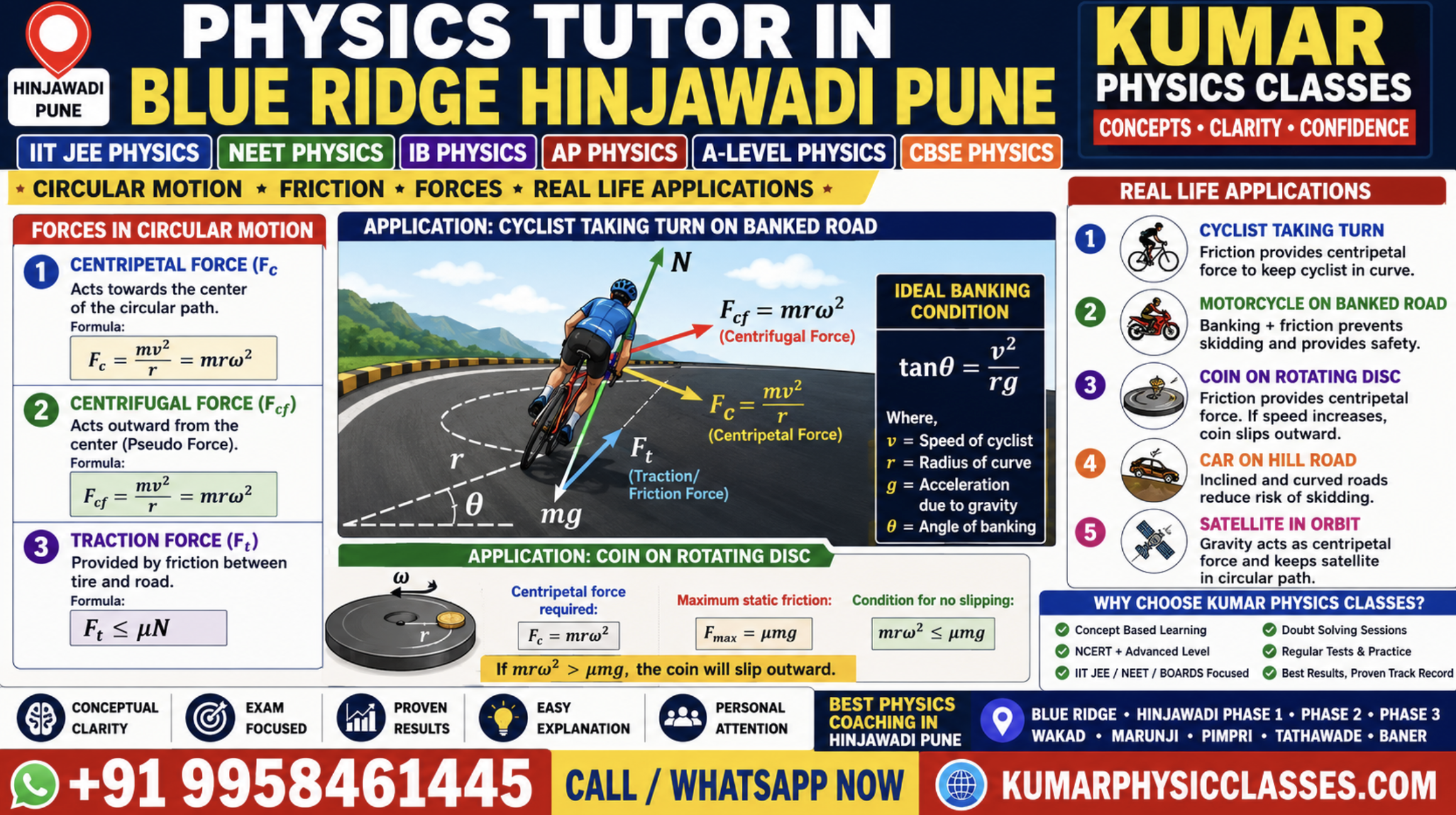
Banking of Roads, Cyclist Motion and Coin on Rotating Disc – Explained by Kumar Sir
Whenever a cyclist turns on a curved road, a motorcycle moves on a banking road, or a coin rotates on a rotating disc without slipping, the same Physics concept is involved:
-
Circular motion
-
Centripetal force
-
Friction
-
Inclination angle
According to Kumar Sir, students should first understand one golden rule:
“Every body moving in a circle requires centripetal force toward the center.”
Without centripetal force, the body cannot continue circular motion.
1. Cyclist Taking a Turn
Suppose a cyclist moves on a curved road.
While turning, the cyclist bends inward.
Why?
Because during turning, centripetal force is required toward the center of circular path.
This force is provided by friction between tire and road.
If cyclist does not bend inward, the body tends to topple outward due to rotational effect.
For safe turning:
tan(theta) = v^2/rg
Where:
theta = inclination angle
v = speed of cyclist
r = radius of curve
g = acceleration due to gravity
Important Concept:
Higher speed requires larger inclination angle.
That is why racers lean more while taking sharp turns.
2. Motorcycle on Banking Road
Now consider a motorcycle moving on a banked road.
Banking means road is tilted at an angle.
Why are roads banked?
Because banking helps provide centripetal force through normal reaction.
Without banking, friction alone must provide centripetal force.
At proper banking angle:
tan(theta) = v^2/rg
This allows safer turning even at high speed.
If speed increases too much, vehicle may skid outward.
If speed becomes very low, vehicle may slide inward.
According to Kumar Sir:
“Banking reduces dependence on friction.”
This is one of the most important applications of circular motion.
3. Coin on Rotating Disc
Suppose a coin is placed on a rotating disc.
The coin rotates with the disc.
Why does it not fly away?
Because static friction provides centripetal force.
Required centripetal force:
F = mR omega^2
Maximum static friction:
f(max) = mu(mg)
If:
mR omega^2 <= mu(mg)
then coin will not slip.
But if rotational speed becomes too high:
mR omega^2 > mu(mg)
then friction cannot provide required centripetal force.
The coin slips outward.
This is one of the most beautiful applications of friction in rotational motion.
4. Car Moving on Hill Road
Now consider hill roads.
Hill roads are generally inclined and curved.
Why?
Because inclined roads help vehicles climb gradually.
If slope becomes too steep:
-
Engine load increases
-
Vehicle may skid backward
-
Friction requirement becomes very high
Inclined roads reduce sudden height change.
During turning on hill roads:
-
Banking helps prevent skidding
-
Friction provides additional stability
-
Centripetal force keeps vehicle on curved path
According to Kumar Sir:
“Hill road design itself is an application of Physics.”
Real-Life Applications
1. Racing Tracks
Racing tracks are banked to help vehicles move safely at high speed.
2. Mountain Roads
Hill roads are inclined to reduce engine stress and improve stability.
3. Washing Machines
Clothes rotate in circular path because drum provides centripetal motion.
4. Satellites
Satellites move in circular orbit because gravity provides centripetal force.
5. Roller Coasters
Roller coaster loops use circular motion and centripetal force principles.
Important Concept by Kumar Sir
According to Kumar Sir:
Students should never memorize formulas only.
Always ask:
-
Which force provides centripetal motion?
-
Why does body incline inward?
-
Why does slipping occur?
-
What role does friction play?
Once students visualize force directions physically, circular motion becomes one of the easiest and most interesting chapters in Physics.
Newton’s First Law of Motion
Newton’s First Law states:
“A body continues to remain at rest or continue to move with uniform velocity in a straight line unless acted upon by an external unbalanced force.”
This law is also called:
Law of Inertia.
Meaning:
If net external force is zero, body will not change its state.
Rest remains rest.
Motion remains motion.
Examples:
Passenger falls backward when bus starts suddenly.
Passenger falls forward when bus stops suddenly.
Newton’s Second Law of Motion
Newton’s Second Law states:
“The rate of change of momentum is directly proportional to the applied external force and occurs in the direction of force.”
Formula:
F = dp/dt
For constant mass:
F = ma
Where:
F = force
m = mass
a = acceleration
Important Concept:
Greater force produces greater acceleration.
Newton’s Third Law of Motion
Newton’s Third Law states:
“For every action, there is an equal and opposite reaction.”
Meaning:
If body A applies force on body B,
then body B also applies equal and opposite force on body A.
Examples:
Gun recoil
Rocket propulsion
Walking
Swimming
Important Point:
Action and reaction always act on different bodies.
Pseudo Force
Pseudo force is a fictitious force observed in a non-inertial frame of reference.
It appears only because observer is inside an accelerating frame.
Formula:
F(pseudo) = -ma
Direction:
Opposite to acceleration of frame.
Example:
If bus accelerates forward,
passenger feels pushed backward.
Actually body tries to maintain its state due to inertia.
Centripetal Force
Centripetal force is the force acting towards the center of circular path which keeps a body moving in circular motion.
Formula:
F(c) = mv^2/r
or
F(c) = mrw^2
Direction:
Always towards the center.
Examples:
Tension in string
Friction in turning vehicle
Gravitational force in satellite motion
Important Concept:
Without centripetal force, circular motion is impossible.
Centrifugal Force
Centrifugal force is a pseudo force observed in rotating frame which appears to act away from the center.
Formula:
F(cf) = mv^2/r
Direction:
Away from center.
Important Point:
It is not a real force in inertial frame.
It appears only in rotating frame.
Examples:
Feeling pushed outward in turning car.
Mud flying from rotating tire.
Difference Between Centripetal and Centrifugal Force
Centripetal Force:
Real force
Acts towards center
Necessary for circular motion
Centrifugal Force:
Pseudo force
Acts away from center
Observed in rotating frame
Important Concept by Kumar Sir
According to Kumar Sir:
Always identify:
Which frame is inertial?
Which force is real?
Which direction is center?
Which force provides circular motion?
Once students understand force direction physically, mechanics becomes very easy for:
IIT JEE
NEET
AP Physics
A-Level Physics
CBSE Physics
ICSE Physics