
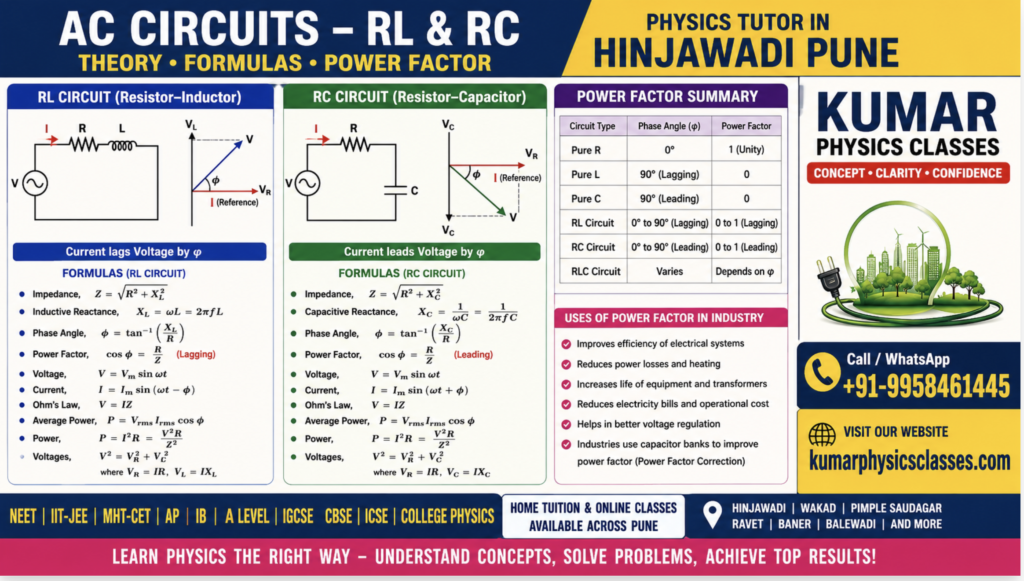
Physics Tutor in Hinjawadi Pune – RL Circuit, RC Circuit, Power Factor and AC Physics Explained by Kumar
+91-9958461445
Alternating Current (AC) Physics is one of the most important chapters for students preparing for NEET Physics, IIT-JEE Physics, AP Physics, IB Physics, A Level Physics, IGCSE Physics, CBSE Physics, ICSE Physics, and college-level engineering Physics. Many students feel confused when they study RL circuits, RC circuits, impedance, phase difference, and power factor because these concepts combine Mathematics, Trigonometry, and Physical interpretation together.
At Kumar Physics Classes Hinjawadi Pune, students are taught AC Physics conceptually and visually so that even difficult concepts become simple and easy to understand. Kumar Sir mainly follows conceptual books such as H.C. Verma, Resnick Halliday, and I.E. Irodov to develop strong Physics fundamentals and advanced problem-solving ability.
If you are living in Hinjawadi Pune or nearby areas and looking for a Physics Tutor for NEET, IIT-JEE, AP Physics, IB Physics, A Level Physics, British Curriculum Physics, CBSE Physics, ICSE Physics, IGCSE Physics, or college Physics, then Kumar Physics Classes can help you build strong conceptual clarity.
What is Alternating Current?
Alternating current is the electric current whose magnitude and direction change continuously with time.
The general equation of AC current is:
I = I0 sin(omega t)
Similarly voltage can be represented as:
V = V0 sin(omega t)
Because voltage and current continuously change with time, phase difference appears in AC circuits.
This phase difference is one of the most important concepts in AC Physics.
What is an RL Circuit?
An RL circuit contains:
Resistance (R)
Inductor (L)
connected together in alternating current.
In RL circuit, current lags behind voltage because the inductor opposes sudden change in current.
Students must remember:
In RL circuit:
Current lags voltage.
This lagging nature creates phase difference.
Why Current Lags in Inductor
Inductor produces self-induced emf whenever current changes.
According to Lenz’s Law, induced emf opposes the cause producing it.
Therefore current cannot change instantly.
Because of this opposition:
Current becomes delayed compared to voltage.
This creates lagging phase angle.
Equation of Voltage and Current in RL Circuit
Suppose current is:
I = I0 sin(omega t − phi)
Then voltage leads current by angle phi.
This phase angle depends upon:
resistance
inductive reactance
Average power consumed in RL circuit is:
Pavg = Vrms Irms cos(phi)
This formula is extremely important.
Power Factor in RL Circuit
Power factor is:
cos(phi)
In RL circuit:
power factor becomes lagging
current lags voltage
Some energy is consumed in resistance and some energy is temporarily stored in magnetic field of inductor.
What is an RC Circuit?
An RC circuit contains:
Resistance (R)
Capacitor (C)
connected together in AC supply.
In RC circuit:
Current leads voltage.
This is opposite to RL circuit.
Why Current Leads in Capacitor
Capacitor allows charge accumulation quickly.
Because of this:
Current responds earlier than voltage.
Therefore current becomes ahead of voltage.
This produces leading phase angle.
Voltage and Current Equation in RC Circuit
Suppose current is:
I = I0 sin(omega t + phi)
Then current leads voltage by phase angle phi.
Average power again becomes:
Pavg = Vrms Irms cos(phi)
But here power factor becomes leading.
Power Factor in RC Circuit
In RC circuit:
current leads voltage
power factor is leading
This is one of the most important conceptual differences between RL and RC circuits.
Difference Between RL and RC Circuit
RL Circuit
Current lags voltage
Inductor dominates
Magnetic energy storage
Lagging power factor
RC Circuit
Current leads voltage
Capacitor dominates
Electric energy storage
Leading power factor
Students preparing for NEET and IIT-JEE must clearly understand this comparison.
What is Impedance?
In AC circuits, opposition to current flow is called impedance.
Represented by:
Z
Impedance is the AC equivalent of resistance.
It depends upon:
resistance
inductive reactance
capacitive reactance
Why AC Physics is Important
AC concepts are used in:
transformers
generators
electrical appliances
communication systems
industries
power transmission
electronic circuits
engineering systems
That is why this chapter has huge importance in competitive exams and engineering studies.
Why Students Fear AC Chapter
Students generally fear AC because of:
phase diagrams
trigonometric functions
vectors
reactance
impedance
power factor
But when concepts are taught visually, AC becomes very easy.
At Kumar Physics Classes Hinjawadi Pune, concepts are explained using:
graphical visualization
phasor diagrams
conceptual teaching
real-life examples
advanced numerical practice
Role of H.C. Verma and Irodov
Kumar Sir mainly follows:
H.C. Verma
Resnick Halliday
I.E. Irodov
because these books develop:
conceptual clarity
logical thinking
advanced problem-solving
Physics intuition
Students preparing for IIT-JEE and Olympiads especially benefit from these books.
Why Conceptual Physics Matters
Most students memorize formulas temporarily.
But conceptual understanding creates:
long-term retention
confidence
analytical thinking
numerical solving ability
That is why conceptual teaching is extremely important.
Real Life Applications of RL and RC Circuits
RL and RC circuits are used in:
mobile chargers
filters
communication devices
audio systems
television circuits
signal processing
industrial electronics
timing circuits
Physics becomes interesting when students connect theory with practical applications.
Common Mistakes Students Make
Mistake 1 – Confusing Lead and Lag
Students confuse RL and RC circuits.
Remember:
RL → Current lags
RC → Current leads
Mistake 2 – Ignoring Phase Angle
Phase angle is extremely important in AC Physics.
Mistake 3 – Memorizing Without Understanding
Students who understand physically perform much better.
Why Students Choose Kumar Physics Classes
Students choose Kumar Physics Classes because:
difficult concepts are simplified
theory is explained deeply
advanced numericals are practiced
NEET and IIT-JEE preparation is provided
international curriculum support is available
one-to-one doubt solving is done
Many students from top schools and coaching institutes take conceptual guidance from Kumar Sir.
Physics Tutor in Hinjawadi Pune – Areas Covered
Physics Tutor in Hinjawadi Pune, Physics Tutor in Wakad Pune, Physics Tutor in Baner Pune, Physics Tutor in Balewadi Pune, Physics Tutor in Aundh Pune, Physics Tutor in Bavdhan Pune, Physics Tutor in Pashan Pune, Physics Tutor in Kothrud Pune, Physics Tutor in Sus Pune, Physics Tutor in Shivajinagar Pune, Physics Tutor in Pimpri Pune
Physics Tutor Near Schools and Universities
Physics Tutor in Symbiosis International University Pune, Physics Tutor in MIT World Peace University Pune, Physics Tutor in COEP Pune, Physics Tutor in Vibgyor High School Pune, Physics Tutor in Orchid School Pune, Physics Tutor in Akshara International School Pune, Physics Tutor in Delhi Public School Pune, Physics Tutor in Ryan International School Pune
Physics Tutor for Different Curriculums
Physics Tutor in NEET Physics Pune, Physics Tutor in IIT-JEE Physics Pune, Physics Tutor in AP Physics Pune, Physics Tutor in IB Physics Pune, Physics Tutor in A Level Physics Pune, Physics Tutor in IGCSE Physics Pune, Physics Tutor in British Curriculum Physics Pune, Physics Tutor in CBSE Physics Pune, Physics Tutor in ICSE Physics Pune
Contact Kumar Physics Classes
Website: kumarphysicsclasses.com
Physics Coaching Available For:
NEET Physics
IIT-JEE Physics
AP Physics
IB Physics
IGCSE Physics
A Level Physics
CBSE Physics
ICSE Physics
College Physics
Conclusion
RL and RC circuits are among the most important topics in Alternating Current Physics.
Students who understand:
phase difference
impedance
lagging current
leading current
power factor
average power
voltage-current relation
develop a very strong foundation in AC Physics.
At Kumar Physics Classes Hinjawadi Pune, AC circuits are taught logically, visually, and conceptually so that students can confidently solve NEET Physics, IIT-JEE Physics, AP Physics, IB Physics, A Level Physics, IGCSE Physics, and engineering-level Physics questions.
Power factor is one of the most important concepts in Alternating Current (AC) circuits. It tells us how efficiently electrical power is being used in a circuit. Mathematically, power factor is equal to cos(phi), where phi is the phase difference between voltage and current.
In a pure resistive circuit, voltage and current remain in the same phase. Therefore phase angle phi is zero and:
Power Factor = cos(0) = 1
This means all supplied electrical energy is consumed usefully in the resistance as heat, light, or work. Heaters and electric irons are examples of resistive devices.
In a pure inductive circuit, current lags behind voltage by 90 degrees. Therefore:
Power Factor = cos(90°) = 0
In this case, no average power is consumed because the inductor stores energy temporarily in its magnetic field and returns it back to the source.
In a pure capacitive circuit, current leads voltage by 90 degrees. Again:
Power Factor = 0
Capacitor stores energy in electric field and returns it back, so no net energy is consumed.
In an RL circuit, current lags voltage by an angle less than 90 degrees. Therefore power factor becomes lagging. Some energy is consumed in resistance while some is stored in the inductor.
In an RC circuit, current leads voltage, so power factor becomes leading.
In an RLC circuit, resistance, inductance, and capacitance are all present together. The phase angle depends upon the values of inductive reactance and capacitive reactance. At resonance, inductive reactance becomes equal to capacitive reactance, phase angle becomes zero, and power factor becomes maximum.
Power factor is extremely important in industries because low power factor increases energy loss, heating, and electricity cost. Industries use capacitor banks to improve power factor and increase efficiency of electrical systems.