
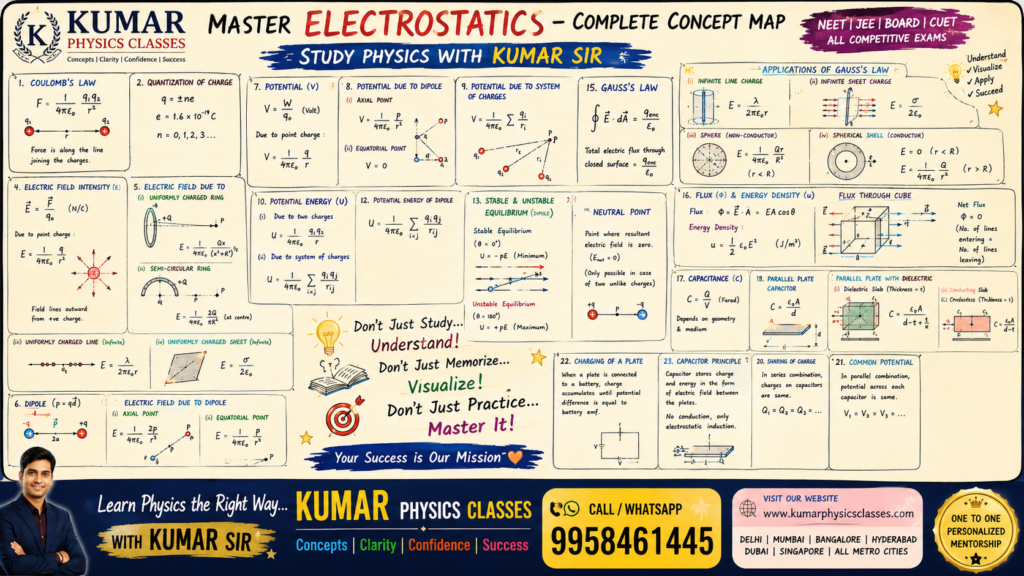
How NEET Aspirants Should Study Electrostatics – Complete Strategy by Mr. Kumar | Best Physics Tutor for NEET Physics-9958461445
NEET Electrostatics Strategy
is one of the most important chapters in NEET Physics. Every year, multiple questions are directly or indirectly asked from Electrostatics, Capacitance, Electric Field, Dipole, Potential, and Gauss Law. Yet many students struggle in this chapter because they study formulas without understanding concepts.
According to Mr. Kumar, one of the most trusted Physics mentors for NEET aspirants, Electrostatics should never be studied randomly. It must be studied in a proper sequence where every concept builds naturally on the previous one.
That is why students searching for the best Physics Tutor for NEET Physics often choose:How NEET Aspirants Should Study Electrostatics – Complete Strategy by Mr. Kumar | Best Physics Tutor for NEET Physics
NEET Electrostatics Strategy
Kumar Physics Classes
🌐 https://kumarphysicsclasses.com
Mr. Kumar teaches Electrostatics through visualization, concept clarity, numerical logic, and exam-oriented strategies so that students do not just memorize formulas — they actually understand Physics.
Why Electrostatics is Difficult for Many NEET Students
Most students make three major mistakes:How NEET Aspirants Should Study Electrostatics – Complete Strategy by Mr. Kumar | Best Physics Tutor for NEET Physics
-
They memorize formulas without understanding physical meaning
-
They jump directly to difficult numericals
-
They do not understand field visualization
As a result:
-
Electric field becomes confusing
-
Potential and work concepts mix up
-
Capacitors become difficult
-
Gauss Law feels impossible
Mr. Kumar explains that Electrostatics is like building a house. If your basics are weak, the higher concepts collapse automatically.
That is why the chapter must be studied in a carefully structured order.
Step 1 – Start with Coulomb’s Law Properly
Every NEET aspirant should begin Electrostatics with Coulomb’s Law.
F=\frac{1}{4\pi\varepsilon_0}\frac{q_1q_2}{r^2}
But according to Mr. Kumar, students should not only memorize this formula.
They must deeply understand:
-
Why force is inversely proportional to distance squared
-
Difference between attraction and repulsion
-
Direction of force
-
Vector nature of electric force
-
Medium dependence
-
Relative permittivity concepts
Students should solve:
-
Two-charge force questions
-
Net force problems
-
Collinear charge systems
-
Equilateral triangle charge systems
-
Square and polygon-based problems
Mr. Kumar teaches students how to draw force directions quickly because NEET often tests visualization.
Step 2 – Quantization and Conservation of Charge
Many students ignore this part because it appears theoretical.
But NEET frequently asks conceptual questions here.
Students must understand:
q=ne
Mr. Kumar explains:
-
Why charge is quantized
-
Why electrons transfer but protons generally do not
-
Conservation of charge in systems
-
Basic charging methods
This creates conceptual confidence.
Step 3 – Charge Density Concepts
This is where many students begin making mistakes.
Students must clearly differentiate:
-
Linear charge density
-
Surface charge density
-
Volume charge density
\lambda=\frac{q}{L}
\sigma=\frac{q}{A}
\rho=\frac{q}{V}
Mr. Kumar teaches students how to identify which density is being used from the geometry itself.
This becomes extremely important in Gauss Law later.
Step 4 – Electric Field Intensity
This is the backbone of Electrostatics.
Students must understand:
E=\frac{F}{q}
Mr. Kumar focuses heavily on visualization:
-
Direction of electric field
-
Field due to positive charge
-
Field due to negative charge
-
Superposition principle
-
Vector addition of fields
Students must practice:
-
Electric field at midpoint
-
Electric field cancellation
-
Ring and semicircle concepts
-
Field line interpretation
According to Mr. Kumar, if Electric Field is clear, half of Electrostatics becomes easy.
Step 5 – Electric Dipole
Most NEET aspirants fear Dipole because they memorize formulas without understanding geometry.
Students must first understand:
-
What a dipole physically represents
-
Dipole moment direction
-
Why dipoles rotate in electric fields
p=qd
Then students should study:
-
Axial point electric field
-
Equatorial point electric field
-
Torque on dipole
-
Potential energy of dipole
Mr. Kumar explains dipoles using real-life analogies and vector visualization.
This makes difficult questions feel simple.
Step 6 – Torque Due to Dipole
Students must derive and understand:
\tau=pE\sin\theta
Many NEET questions are directly based on orientation.
Students must understand:
-
Stable equilibrium
-
Unstable equilibrium
-
Minimum potential energy
-
Maximum potential energy
This chapter becomes easy when students visualize rotation.
Step 7 – Electric Potential
Students often confuse Electric Field and Potential.
Mr. Kumar teaches them separately and conceptually.
Students must understand:
-
Scalar nature of potential
-
Work-energy relation
-
Potential due to point charge
-
Potential due to system of charges
V=\frac{1}{4\pi\varepsilon_0}\frac{q}{r}
Students must solve:
-
Potential at center problems
-
Potential due to multiple charges
-
Equipotential surface questions
Step 8 – Potential Energy of System of Charges
This topic is extremely important for NEET conceptual questions.
Students should learn:
U=\frac{1}{4\pi\varepsilon_0}\frac{q_1q_2}{r}
Then extend it to:
-
Three-charge systems
-
Four-charge systems
-
Work done in assembling charges
-
Potential energy conservation
Mr. Kumar trains students to break complicated systems into simple pairs.
Step 9 – Gauss Law (Most Important Concept)
Many students fear Gauss Law because they do not understand symmetry.
Mr. Kumar says:
“Gauss Law is not difficult. Visualization is missing.”
Students must first understand:
\Phi=\oint \vec{E}\cdot d\vec{A}=\frac{q_{enc}}{\varepsilon_0}
Then they must practice:
-
Infinite wire
-
Infinite sheet
-
Spherical shell
-
Conducting sphere
Students should understand:
-
Flux
-
Enclosed charge
-
Symmetry arguments
-
Gaussian surfaces
This is one of the highest-scoring sections in Electrostatics.
Step 10 – Capacitance (Very Important for NEET)
This is where many students struggle badly.
Students should first understand:
“What is capacitance physically?”
C=\frac{Q}{V}
Mr. Kumar teaches:
-
Meaning of charge storage
-
Why capacitance increases
-
Effect of area and separation
-
Energy stored in capacitor
Step 11 – Parallel Plate Capacitor
Students must deeply understand:
C=\frac{\varepsilon_0A}{d}
Then move to:
-
Dielectric slab
-
Conducting slab
-
Partial dielectric filling
-
Thickness problems
Most coaching institutes rush this topic.
But Mr. Kumar explains:
-
Effective distance concept
-
Equivalent separation
-
Potential distribution
This removes confusion permanently.
Step 12 – Equivalent Capacitor and Charge Sharing
This is one of the most scoring sections in NEET.
Students must master:
-
Series capacitors
-
Parallel capacitors
-
Mixed combinations
-
Common potential
-
Charge conservation
Students often calculate equivalent capacitance correctly but fail in charge sharing.
Mr. Kumar specially trains students for:
-
Common potential problems
-
Energy loss questions
-
Earth connection problems
-
Capacitor switching circuits
Step 13 – Energy Density and Capacitor Energy
Students must understand:
U=\frac{1}{2}CV^2
and
u=\frac{1}{2}\varepsilon_0E^2
Mr. Kumar explains:
-
Why energy exists in electric field
-
Energy density meaning
-
Work done in charging capacitor
This creates conceptual maturity.
How Mr. Kumar Teaches Electrostatics Differently
Students from Delhi, Mumbai, Bangalore, Hyderabad, Dubai, Singapore, and other metropolitan cities learn from Kumar Physics Classes because of the teaching methodology.
Mr. Kumar focuses on:
✔ Concept clarity
✔ Diagram visualization
✔ Step-by-step problem solving
✔ Common NEET mistakes
✔ Smart shortcuts
✔ Deep understanding
✔ Numerical confidence
Instead of simply teaching formulas, he teaches students how to think like Physics learners.
Common Mistakes NEET Students Make in Electrostatics
According to Mr. Kumar, students lose marks because:
-
Wrong direction of electric field
-
Incorrect sign conventions
-
Confusing potential and field
-
Weak visualization
-
Memorized learning
-
Poor capacitor concepts
That is why regular revision and conceptual practice are extremely important.
Best Strategy to Revise Electrostatics for NEET
Mr. Kumar recommends:
Daily Practice:
-
25 MCQs daily
-
5 conceptual questions
-
2 assertion-reason questions
Weekly Revision:
-
Formula revision
-
Mistake notebook
-
Previous year NEET questions
Important Focus Areas:
-
Dipole
-
Gauss Law
-
Capacitors
-
Charge sharing
-
Common potential
-
Electric field graphs
Why Students Choose Kumar Physics Classes
🌐 https://kumarphysicsclasses.com
Students searching for:
-
Best Physics Tutor for NEET
-
Electrostatics Coaching
-
Physics Tutor in Delhi
-
Online NEET Physics Classes
choose Kumar Physics Classes because of:
✔ One-to-one mentoring
✔ Personalized guidance
✔ Deep conceptual teaching
✔ Exam-oriented preparation
✔ Complete doubt solving
Final Advice for NEET Aspirants
Electrostatics is not difficult.
It only becomes difficult when students memorize formulas without understanding concepts.
If you study Electrostatics step-by-step:
-
Coulomb Law
-
Electric Field
-
Dipole
-
Potential
-
Gauss Law
-
Capacitance
then the entire chapter becomes logical and interconnected.
According to Mr. Kumar:
“Physics is not about memorizing formulas. Physics is about understanding nature logically.”
That is why proper guidance, conceptual clarity, and structured learning are the keys to scoring high in NEET Physics.
Kumar Physics Classes
🌐 https://kumarphysicsclasses.com
📞 +91-9958461445
Courses:
-
NEET Physics
-
IIT-JEE Physics
-
CBSE Physics
-
ICSE Physics
-
IB Physics
-
AP Physics
✔ One-to-One Classes
✔ Complete Doubt Solving
✔ Online Interactive Sessions
✔ Concept-Based Learning
✔ NEET Physics Mastery
Ask. Learn. Understand. Succeed.