
Physics Tutor in Kharadi Pune – AC Circuits, Resistance, Inductor, Capacitor and Power Factor Explained by Kumar
+91-9958461445
Alternating Current (AC) is one of the most important and beautiful topics in Physics. Many students preparing for NEET Physics, IIT-JEE Physics, AP Physics, IB Physics, A Level Physics, IGCSE Physics, CBSE Physics, ICSE Physics, and British Curriculum Physics feel confused because AC circuits contain phase difference, inductors, capacitors, power factor, and phasor diagrams. But when these concepts are understood physically, the entire chapter becomes easy.
At Kumar Physics Classes Kharadi Pune, students are taught AC circuits conceptually and visually so that they can understand the actual meaning of voltage, current, phase difference, impedance, resonance, and power consumption instead of blindly memorizing formulas.
What is Alternating Current?
Alternating Current is the current which continuously changes magnitude and direction with time.
The most common AC current follows sinusoidal form:
I = I0 sin(omega t)
Similarly alternating voltage is written as:
V = V0 sin(omega t)
Because of sinusoidal variation, AC circuits become different from DC circuits.
In DC circuits:
current remains constant
voltage remains constant
But in AC circuits:
current continuously changes
voltage continuously changes
phase difference appears
This phase difference is one of the most important concepts in AC Physics.
Pure Resistive Circuit
Suppose we connect only resistance in AC circuit.
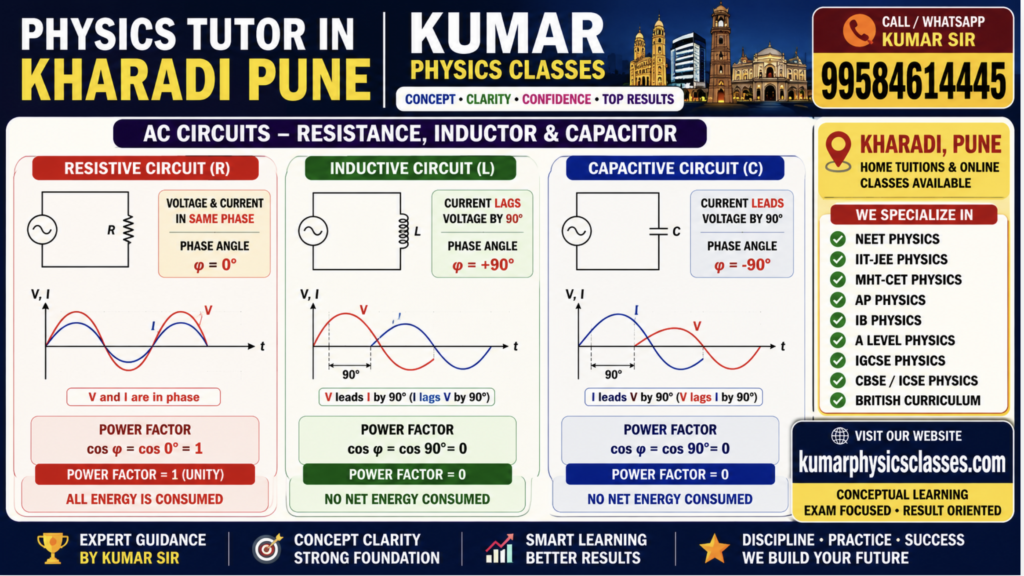
Then voltage and current remain in the same phase.
This means:
when voltage is maximum, current is also maximum
when voltage becomes zero, current also becomes zero
Therefore phase difference becomes:
phi = 0
This is the simplest AC circuit.
Why Voltage and Current are in Same Phase in Resistance
Resistance opposes current directly.
It does not store energy.
Therefore no delay is produced between voltage and current.
That is why:
Voltage and current remain in same phase in pure resistive circuit.
This concept is extremely important for NEET and JEE.
Power Factor in Resistive Circuit
Power factor is defined as:
cos(phi)
In resistive circuit:
phi = 0
Therefore:
cos(0) = 1
Hence power factor becomes 1.
This means all supplied electrical energy is consumed by resistance.
Energy converts into:
heat
light
useful work
Examples:
heater
bulb
electric iron
toaster
These are mainly resistive devices.
Pure Inductive Circuit
Now suppose we connect pure inductor in AC circuit.
Then current lags behind voltage by 90 degrees.
This is extremely important.
Students must remember:
In pure inductive circuit:
Current lags voltage by 90 degrees.
Why Current Lags in Inductor
Inductor opposes change in current.
Whenever current changes, self-induced emf is produced.
This induced emf opposes the applied voltage according to Lenz’s Law.
Therefore current cannot increase immediately.
Hence current becomes delayed.
That delay produces phase difference.
Phase Difference in Inductive Circuit
In pure inductive circuit:
phi = 90 degrees
Voltage leads current by 90 degrees.
Students generally remember using shortcut:
ELI
In inductor:
E leads I
This is a very famous mnemonic.
Power Factor in Inductive Circuit
Power factor:
cos(phi)
In inductor:
phi = 90 degrees
Therefore:
cos(90 degrees) = 0
Hence power factor becomes zero.
This means average power consumed becomes zero.
Why Inductor Consumes No Power
This is one of the most important conceptual questions.
Inductor stores energy temporarily in magnetic field and returns it back to source.
Therefore energy is not permanently consumed.
Energy continuously oscillates between:
source
magnetic field
That is why average power consumption becomes zero.
Pure Capacitive Circuit
Now consider pure capacitor in AC circuit.
In capacitive circuit:
Current leads voltage by 90 degrees.
This is opposite to inductive circuit.
Students must remember:
In capacitor:
Current leads voltage by 90 degrees.
Shortcut:
ICE
In capacitor:
I leads E
This is extremely important.
Why Current Leads in Capacitor
Capacitor allows charge accumulation quickly.
Current changes first before voltage fully develops.
Hence current becomes ahead of voltage.
This creates phase lead.
Phase Difference in Capacitor
For pure capacitor:
phi = 90 degrees
Current leads voltage by 90 degrees.
Power Factor in Capacitor
Again:
cos(90 degrees) = 0
Therefore power factor becomes zero.
Hence average power consumed is zero.
Why Capacitor Does Not Consume Energy
Capacitor stores energy temporarily in electric field and returns it back to source.
Therefore net energy consumption becomes zero.
Energy continuously oscillates between:
source
electric field
This is one of the deepest concepts in AC circuits.
Comparison Between R, L and C Circuits
Resistive Circuit
Voltage and current in same phase
Phase angle zero
Power factor one
Energy consumed completely
Inductive Circuit
Current lags voltage
Phase difference 90 degrees
Power factor zero
No net energy consumption
Capacitive Circuit
Current leads voltage
Phase difference 90 degrees
Power factor zero
No net energy consumption
Students should compare all three carefully.
What is Power Factor?
Power factor tells how efficiently electrical power is used.
Formula:
Power Factor = cos(phi)
Where phi is phase difference between voltage and current.
Higher power factor means:
better efficiency
lower energy loss
Industries try to improve power factor.
Real Power in AC Circuit
Average power consumed:
P = VI cos(phi)
Where:
V = rms voltage
I = rms current
cos(phi) = power factor
This formula is one of the most important formulas in AC Physics.
Meaning of Power Factor
If cos(phi) = 1
All energy consumed.
Pure resistive circuit.
If cos(phi) = 0
No net energy consumed.
Pure inductor or capacitor.
If 0 < cos(phi) < 1
Partial energy consumed.
Practical circuits.
Practical Importance of AC Circuits
AC concepts are used everywhere:
power transmission
transformers
generators
motors
mobile chargers
electrical appliances
industries
communication systems
That is why AC chapter is extremely important.
Resonance in LCR Circuit
When inductive reactance equals capacitive reactance:
XL = XC
Then resonance occurs.
At resonance:
impedance minimum
current maximum
phase difference zero
power factor one
This is one of the most important concepts in AC Physics.
Why Students Fear AC Chapter
Students fear AC because of:
phase diagrams
trigonometry
vectors
reactance
impedance
power factor
But when concepts are taught visually, the chapter becomes very easy.
At Kumar Physics Classes Kharadi Pune, students learn AC through:
conceptual explanation
graphs
phasor diagrams
real-life applications
numerical problem solving
Common Mistakes Students Make
Mistake 1 – Forgetting Lead and Lag
Students confuse:
capacitor
inductor
Remember:
ICE → current leads in capacitor
ELI → voltage leads in inductor
Mistake 2 – Confusing Power Consumption
Inductor and capacitor do not consume average power.
Resistance consumes power.
Mistake 3 – Memorizing Without Understanding
Conceptual understanding is extremely important.
Why Conceptual Physics Matters
Students who understand Physics conceptually perform much better in:
NEET
IIT-JEE
AP Physics
IB Physics
Olympiads
School examinations
Conceptual clarity develops long-term confidence.
Books Used at Kumar Physics Classes
Students are guided through top books such as:
H.C. Verma
Resnick Halliday
I.E. Irodov
DC Pandey
NCERT
Previous Year Questions
These books build strong fundamentals.
Why Students Choose Kumar Physics Classes
Students prefer Kumar Physics Classes because:
concepts are explained deeply
theory becomes easy
difficult numericals are simplified
personalized doubt solving is provided
NEET and JEE oriented teaching is done
international curriculum support is available
Many students from top schools and coaching institutes take guidance from Kumar Sir for conceptual Physics.
Physics Tutor in Kharadi Pune – Areas Covered
Physics Tutor in Kharadi Pune, Physics Tutor in Viman Nagar Pune, Physics Tutor in Kalyani Nagar Pune, Physics Tutor in Wadgaon Sheri Pune, Physics Tutor in Magarpatta Pune, Physics Tutor in Hadapsar Pune, Physics Tutor in Koregaon Park Pune, Physics Tutor in Yerawada Pune, Physics Tutor in Lohegaon Pune, Physics Tutor in Vishrantwadi Pune
Physics Tutor Near Schools and Colleges
Physics Tutor in Symbiosis International School Pune, Physics Tutor in Lexicon International School Pune, Physics Tutor in Vibgyor High School Pune, Physics Tutor in Delhi Public School Pune, Physics Tutor in Bishop’s School Pune, Physics Tutor in EuroSchool Pune, Physics Tutor in MIT World Peace University Pune, Physics Tutor in COEP Pune, Physics Tutor in Symbiosis Pune
Physics Tutor for Different Curriculums
Physics Tutor in NEET Physics Pune, Physics Tutor in IIT-JEE Physics Pune, Physics Tutor in AP Physics Pune, Physics Tutor in IB Physics Pune, Physics Tutor in A Level Physics Pune, Physics Tutor in IGCSE Physics Pune, Physics Tutor in British Curriculum Physics Pune, Physics Tutor in CBSE Physics Pune, Physics Tutor in ICSE Physics Pune
Conclusion
AC circuits become easy when students understand phase difference physically.
Students must clearly remember:
Resistance → voltage and current same phase
Inductor → current lags voltage
Capacitor → current leads voltage
Resistance consumes power
Inductor and capacitor store and return energy
Power factor determines efficiency
At Kumar Physics Classes Kharadi Pune, AC Physics is taught logically, visually, and conceptually so that students can confidently solve NEET Physics, IIT-JEE Physics, AP Physics, IB Physics, A Level Physics, IGCSE Physics, and Olympiad-level questions.
Faraday’s Law of Electromagnetic Induction is one of the most important laws in Physics. It explains how electricity can be produced using magnetism. This principle is used in generators, transformers, motors, and many electrical devices used in daily life.
Michael Faraday discovered that whenever the magnetic flux linked with a conductor changes, an induced emf (electromotive force) is produced in the conductor. If the circuit is closed, induced current also flows through it. This phenomenon is called electromagnetic induction.
Magnetic flux depends upon:
strength of magnetic field
area of coil
orientation of coil
If any of these quantities change, magnetic flux changes and emf is induced.
Faraday’s law states that the induced emf in a circuit is directly proportional to the rate of change of magnetic flux linked with the circuit.
The negative sign in Faraday’s law comes from Lenz’s Law. It shows that the induced current always opposes the cause producing it. Nature always resists sudden changes.
For example:
moving a magnet toward a coil
moving a coil inside magnetic field
rotating a coil in magnetic field
all produce induced current.
This principle is used in AC generators.
AC Generator
An AC generator is a device that converts mechanical energy into electrical energy using electromagnetic induction.
The main parts of an AC generator are:
rectangular coil
strong magnetic field
slip rings
carbon brushes
axle for rotation
In an AC generator, the rectangular coil rotates continuously inside a magnetic field. As the coil rotates, the magnetic flux linked with the coil continuously changes. Due to Faraday’s law, induced emf is produced.
During one half rotation, current flows in one direction. During the next half rotation, direction of current reverses. Therefore the generator produces alternating current (AC).
The output current continuously changes direction and magnitude with time. The graph of AC output is sinusoidal in nature.
The frequency of generated AC depends upon the speed of rotation of the coil.
AC generators are used in:
power stations
hydroelectric plants
thermal plants
wind turbines
bicycle dynamos
Large power plants use huge turbines to rotate coils inside magnetic fields and generate electricity for homes and industries.
The working of an AC generator is one of the best practical applications of Faraday’s law of electromagnetic induction.