
Physics Tutor in Senapati Bapat Road Pune – Vertical Circular Motion Explained by Kumar Sir
+91-9958461445
If you are searching for a Physics Tutor in Senapati Bapat Road Pune for IIT JEE, NEET, AP Physics, A Level Physics, Class 11, or Class 12 Physics, then understanding mechanics deeply is extremely important. One of the most conceptually difficult chapters for students is Vertical Circular Motion.
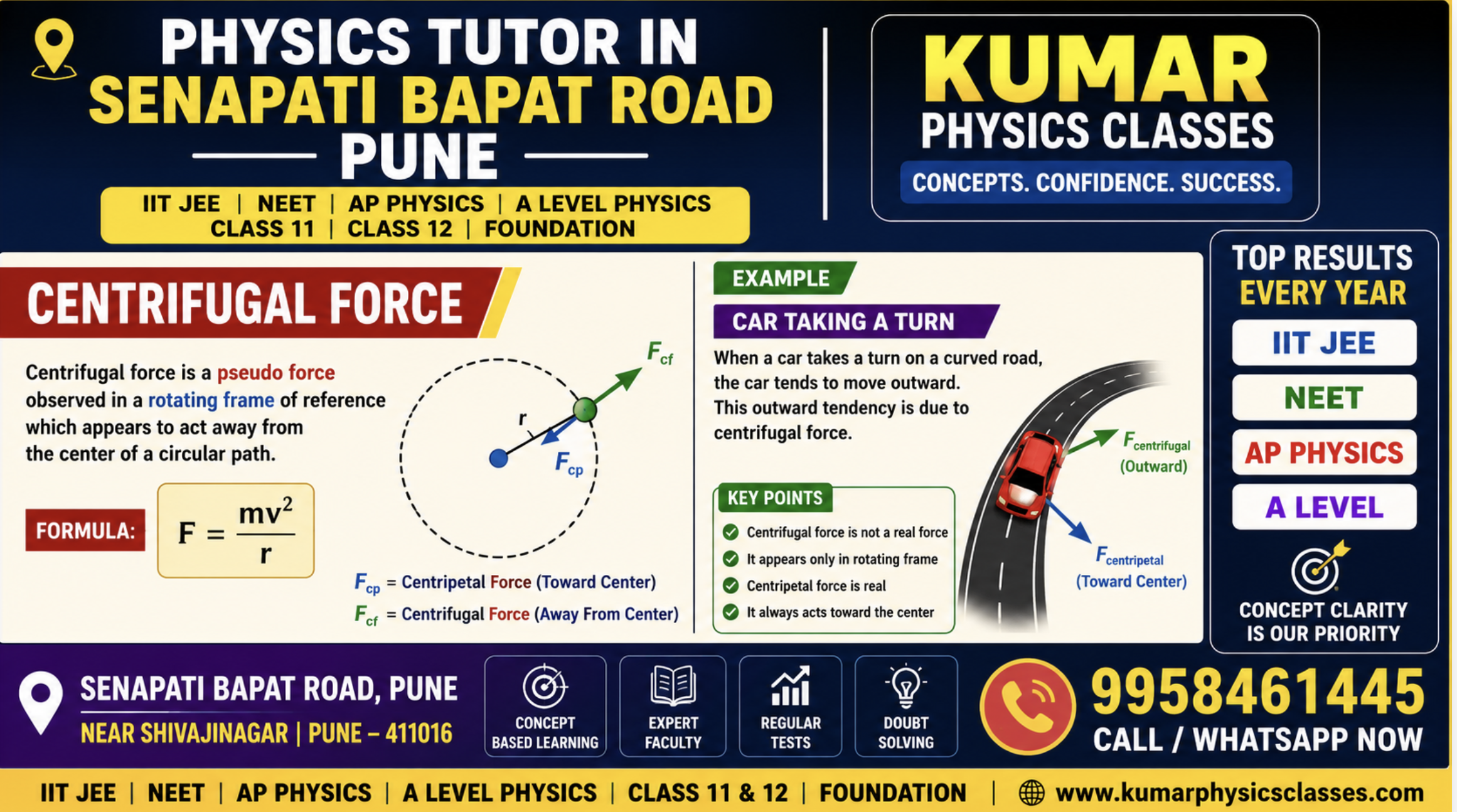
Centripetal Force
Centripetal force is the force acting towards the center of a circular path which keeps a particle moving in circular motion.
Formula:
F = mv^2/r
Where:
F = centripetal force
m = mass of particle
v = speed of particle
r = radius of circular path
Direction:
Towards the center of the circle.
Examples:
Tension force in circular motion
Gravitational force in planetary motion
Friction force in turning vehicles
Centrifugal Force
Centrifugal force is a pseudo force observed in a rotating frame which appears to act away from the center of the circular path.
Formula:
F = mv^2/r
Direction:
Away from the center of the circle.
Important Points:
Centrifugal force is not a real force in inertial frame.
It appears only in rotating frame.
Centripetal Acceleration
Centripetal acceleration is the acceleration directed towards the center of the circular path responsible for changing the direction of velocity.
Formula:
a = v^2/r
Direction:
Towards the center.
Concave Curve Equation (Valley Type Curve)
If a vehicle or particle moves on a concave curve, then centripetal acceleration acts upward towards the center.
At lowest point:
N – Mg = mv^2/r
Therefore:
N = Mg + mv^2/r
Where:
N = normal reaction
Mg = weight
mv^2/r = centripetal force requirement
Important Concept:
Apparent weight increases at lowest point.
Convex Curve Equation (Hill Type Curve)
If a vehicle moves on a convex curve, then center lies downward.
At topmost point:
Mg – N = mv^2/r
Therefore:
N = Mg – mv^2/r
Important Concept:
Apparent weight decreases at topmost point.
Key Difference
Concave Curve:
N > Mg
Convex Curve:
N < Mg
Golden Rule by Kumar Sir
Always look towards the center first.
Then apply:
Net force towards center = mv^2/r
Never memorize signs directly.
Identify force directions physically first.
What is Vertical Circular Motion?
Vertical circular motion occurs when a particle moves in a circular path in a vertical plane.
Examples include:
Stone tied to a string rotating vertically
Roller coaster motion
Pendulum-like circular systems
Loop-the-loop problems
In these questions students usually become confused about:
Direction of tension
Direction of centripetal force
Why equations change at top and bottom
Difference between centripetal and centrifugal ideas
Kumar Sir explains these concepts visually and logically.
The Biggest Confusion in Circular Motion
Students often think:
“Centripetal force acts separately.”
But actually centripetal force is not an extra force.
It is simply the net force toward the center.
This is the most important concept.
According to Kumar Sir:
“Centripetal force is a result, not a separate force.”
Lowest Point of Vertical Circular Motion
Suppose a particle attached to a string is moving in a vertical circle.
At the lowest point:
Tension acts upward toward the center
Weight (Mg) acts downward
Now many students incorrectly write:
[
Mg – T = \frac{mv^2}{r}
]
This is wrong.
Why?
Because centripetal acceleration is always toward the center.
At the lowest point, center lies upward.
Therefore net force toward center must be upward.
Since tension is upward and weight is downward:
[
T – Mg = \frac{mv^2}{r}
]
This is the correct equation.
According to Kumar Sir, students should never memorize this equation directly.
Instead ask:
“Which side is the center?”
The net force toward center becomes:
[
\text{Force toward center} = \frac{mv^2}{r}
]
Physical Interpretation
At the bottom point, tension must do two jobs:
Balance the weight
Provide centripetal force
Therefore:
[
T = Mg + \frac{mv^2}{r}
]
This is why tension becomes maximum at the lowest point.
This is one of the most important IIT JEE and NEET concepts.
Topmost Point of Vertical Circle
Now consider the topmost point.
At the top:
Tension acts downward
Weight also acts downward
And center also lies downward.
Therefore both forces help provide centripetal force.
So equation becomes:
[
T + Mg = \frac{mv^2}{r}
]
Students usually become confused here because they think:
“Why did sign change?”
The answer is simple.
At the top:
Both forces act toward center
At the bottom:
One force acts toward center
One force acts away from center
That is why equations differ.
The Golden Rule by Kumar Sir
According to Kumar Sir:
“Never memorize formulas in circular motion. Just identify the center.”
This single rule solves almost every vertical circular motion problem.
Students should always follow these steps:
Locate the center
Identify force directions
Take forces toward center positive
Apply Newton’s second law
Centrifugal Force Misconception
Another major confusion occurs because of centrifugal force.
Students think centrifugal force acts toward center.
But actually:
Centripetal force acts toward center
Centrifugal pseudo force appears away from center in rotating frame
According to Kumar Sir, in inertial frame we generally solve problems using centripetal acceleration only.
Why Speed Changes in Vertical Circular Motion
Students also ask:
“Why does speed become different at top and bottom?”
Because gravity changes kinetic energy.
At bottom:
Speed becomes maximum
At top:
Speed becomes minimum
This is explained using conservation of energy.
Minimum Speed at Top
For successful circular motion:
[
T \ge 0
]
At limiting condition:
[
T = 0
]
Therefore:
[
Mg = \frac{mv^2}{r}
]
So minimum speed at top becomes:
v=\sqrt{gr}
This is one of the most important formulas in vertical circular motion.
Why Students Fear Circular Motion
Students fear circular motion because they try to remember too many equations.
But Kumar Sir teaches circular motion using:
Visualization
Force analysis
Center identification
Energy conservation
Real-life imagination
This makes the chapter extremely easy.
IIT JEE Physics by Kumar Sir
For IIT JEE, students must solve:
Multi-concept problems
Advanced mechanics
Constraint motion
Relative motion
Rotational dynamics
Circular motion
Kumar Sir trains students on:
HC Verma
Advanced modules
JEE Advanced PYQs
Assertion reasoning
Graph-based mechanics
Students develop actual Physics thinking instead of rote learning.
NEET Physics Preparation
In NEET Physics, vertical circular motion questions are often conceptual.
Students must understand:
Force direction
Energy concepts
Circular acceleration
String tension
Kumar Sir teaches:
Shortcut methods
Fast solving
Diagram visualization
Error reduction techniques
Many students scoring above 99 percentile in Physics have developed strong conceptual clarity through structured teaching.
AP Physics and A Level Physics
Students preparing for:
AP Physics
A Level Physics
International curriculum
also study:
Circular dynamics
Centripetal acceleration
Rotational motion
Energy methods
Kumar Sir explains every derivation from basic principles.
Why Students Prefer Kumar Physics Classes
Students prefer Kumar Physics Classes because:
Concepts are taught deeply
Numerical solving is systematic
Doubts are solved logically
Classes are interactive
Physics becomes interesting
Topics covered include:
Mechanics
Circular motion
Ray optics
Electrodynamics
Modern Physics
Waves
HC Verma solutions
Advanced numericals
Physics Tutor in Nearby Areas
Physics Tutor in Senapati Bapat Road Pune
Physics Tutor in Shivajinagar Pune
Physics Tutor in Model Colony Pune
Physics Tutor in Deccan Pune
Physics Tutor in Aundh Pune
Physics Tutor in Baner Pune
Physics Tutor in Kothrud Pune
Physics Tutor in Pashan Pune
Physics Tutor in FC Road Pune
Physics Tutor in Bhosale Nagar Pune
Physics Tutor in Nearby Colleges and Universities
Physics Tutor in Fergusson College Pune
Physics Tutor in BMCC Pune
Physics Tutor in Symbiosis College Pune
Physics Tutor in Savitribai Phule Pune University
Physics Tutor in Modern College Pune
Physics Tutor in COEP Pune
Physics Tutor in MIT Pune
Physics Tutor in JSPM Pune
Specialized Coaching Keywords
IIT JEE Physics Tutor in Senapati Bapat Road Pune
NEET Physics Tutor in Senapati Bapat Road Pune
AP Physics Tutor in Senapati Bapat Road Pune
A Level Physics Tutor in Senapati Bapat Road Pune
Class 11 Physics Tutor in Senapati Bapat Road Pune
Class 12 Physics Tutor in Senapati Bapat Road Pune
Vertical Circular Motion Tutor in Pune
HC Verma Physics Tutor in Pune
Mechanics Physics Tutor in Pune
Rotational Motion Physics Tutor in Pune
Final Conclusion
Vertical circular motion becomes very easy when students stop memorizing formulas and start understanding force directions physically.
According to Kumar Sir, students should always ask:
Where is the center?
Which force acts toward center?
Which force acts away from center?
Once these ideas become clear, circular motion problems from:
IIT JEE
NEET
AP Physics
A Level Physics
become extremely easy and scoring.
Centripetal Force
Centripetal force is the net force acting towards the center of a circular path which keeps a particle moving in circular motion.
Formula:
F = mv²/r
Where:
F = centripetal force
m = mass of particle
v = speed of particle
r = radius of circular path
Direction:
Always towards the center of the circle.
Examples:
Tension force in circular motion
Gravitational force in planetary motion
Friction force in turning vehicles
Centrifugal Force
Centrifugal force is a pseudo force observed in a rotating frame of reference which appears to act away from the center of the circular path.
Formula:
F = mv²/r
Direction:
Away from the center of the circle.
Important Point:
Centrifugal force is not a real force in inertial frame.
It appears only in rotating or non-inertial frames.
Centripetal Acceleration
Centripetal acceleration is the acceleration directed towards the center of the circular path responsible for changing the direction of velocity.
Formula:
a = v²/r
Direction:
Towards the center.
Concave Curve Equation (Valley Type Curve)
If a vehicle or particle moves on a concave curve (dip or valley shape), then centripetal acceleration acts upward towards the center.
At lowest point:
N – Mg = mv²/r
Therefore:
N = Mg + mv²/r
Where:
N = normal reaction
Mg = weight
mv²/r = centripetal force requirement
Important Concept:
Apparent weight increases at lowest point.
Convex Curve Equation (Hill Type Curve)
If a vehicle moves on a convex curve (hill shape), then center lies downward.
At topmost point:
Mg – N = mv²/r
Therefore:
N = Mg – mv²/r
Important Concept:
Apparent weight decreases at topmost point.
Key Difference
Concave Curve:
N > Mg
Convex Curve:
N < Mg
Golden Rule by Kumar Sir
Always look towards the center first.
Then apply:
Net force towards center = mv²/r
Never memorize signs directly.
Identify force directions physically first.