
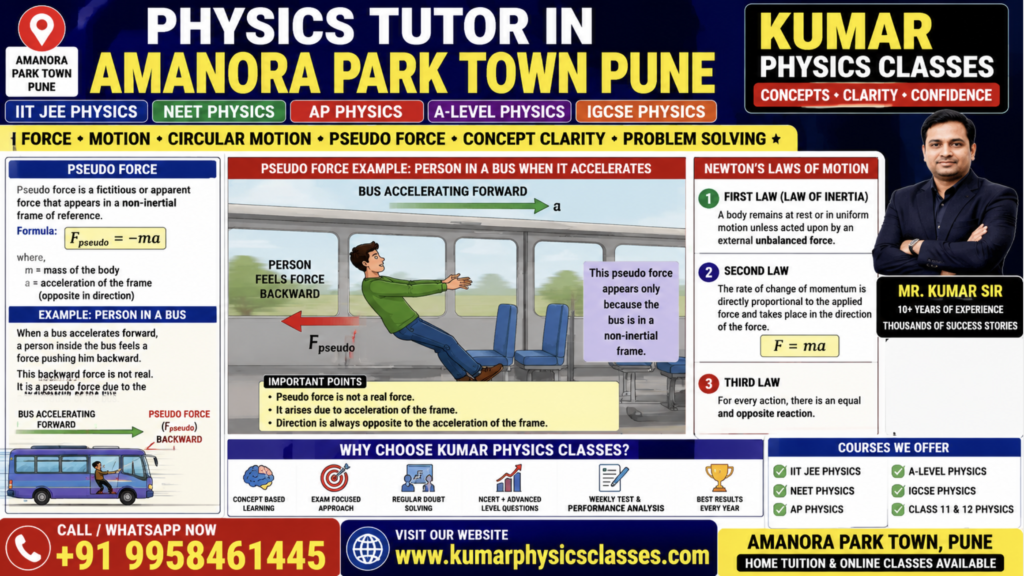
Physics Tutor in Amanora Park Town Pune – Centripetal Force and Contact Force Explained by Kumar Sir
+91-9958461445
If you are searching for a Physics Tutor in Amanora Park Town Pune for IIT JEE, NEET, AP Physics, A-Level Physics, IGCSE Physics, Class 11, or Class 12 Physics, then understanding centripetal force and contact force becomes extremely important. According to Kumar Sir, students often get confused in circular motion because they try to memorize formulas directly without understanding which force is actually providing the circular motion.
But real Physics becomes easy when students understand:
Force direction
Circular motion
Friction force
Contact force
Limiting friction
Reaction force
Centripetal acceleration
These concepts are extremely important for:
IIT JEE Main
IIT JEE Advanced
NEET Physics
AP Physics
IGCSE Physics
A-Level Physics
CBSE Physics
ICSE Physics
The Question Discussed by Kumar Sir
Question:
A car of mass m is moving on a horizontal circular track.
If coefficient of static friction between road and tire is:
mu = 0.75
Then find maximum contact force acting by the road on the car.
Why This Question Is Beautiful
According to Kumar Sir:
“This question tries to confuse students between normal reaction and actual contact force.”
Most students immediately think:
Contact force = Normal reaction.
But that is wrong.
Why?
Because road exerts two forces on car:
Normal reaction upward
Friction force horizontally inward
Both together form actual contact force.
This is the real concept.
Step 1 – Understanding the Forces
Suppose car moves on horizontal circular track.
Then forces acting on car are:
Weight Mg downward
Normal reaction N upward
Friction force inward toward center
Now since road is horizontal:
N = Mg
because there is no vertical acceleration.
Step 2 – Centripetal Force
For circular motion, inward centripetal force is required.
Who provides this force?
Static friction.
This is the most important concept.
Maximum static friction:
f(max) = muN
Since:
N = Mg
Therefore:
f(max) = muMg
Given:
mu = 0.75
Thus:
f(max) = 0.75Mg
Step 3 – Actual Contact Force
Now comes the real trick.
Road applies two perpendicular forces:
Normal reaction upward
Friction horizontally inward
Therefore resultant contact force becomes:
F(contact) = sqrt(N^2 + f^2)
Substituting values:
F(contact) = sqrt[(Mg)^2 + (0.75Mg)^2]
Taking Mg common:
F(contact) = Mg sqrt(1 + 0.75^2)
Now:
0.75^2 = 0.5625
Therefore:
F(contact) = Mg sqrt(1.5625)
F(contact) = 1.25Mg
Final Answer
Maximum contact force:
F(contact) = 1.25Mg
Important Concept by Kumar Sir
According to Kumar Sir:
Students must understand difference between:
Individual forces
Resultant force
Contact force
Centripetal force
The road never gives only normal reaction.
It can simultaneously provide:
Friction
Normal reaction
Their vector combination becomes actual contact force.
This is one of the most important IIT JEE concepts.
Why Students Fear Circular Motion
Students fear circular motion because they memorize formulas mechanically.
But circular motion becomes easy when students ask:
Which force acts inward?
Which force provides centripetal motion?
Which forces combine vectorially?
Is friction static or kinetic?
According to Kumar Sir:
“Always identify force direction first.”
That single idea solves most mechanics questions.
IIT JEE Physics by Kumar Sir
Students preparing for IIT JEE study:
Circular motion
Friction
Contact force
Banking of roads
Rotational motion
Relative motion
Kumar Sir trains students using:
HC Verma
Advanced modules
PYQs
Multi-concept numericals
Assertion reasoning
NEET Physics Preparation
For NEET Physics, students are trained to solve:
Circular motion MCQs
Friction problems
Force analysis questions
Diagram-based numericals
Many students scoring above 99 percentile in Physics build strong mechanics fundamentals through concept clarity.
AP Physics, IGCSE Physics and A-Level Physics
Students preparing for:
study advanced topics like:
Circular dynamics
Contact force
Static friction
Rotational frames
Banking motion
Kumar Sir explains every derivation from basics.
Why Students Prefer Kumar Physics Classes
Students prefer Kumar Physics Classes because:
Concepts are taught deeply
Doubts are solved logically
Numerical solving becomes easier
Physics becomes visual and interesting
Topics covered include:
Mechanics
Friction
Circular motion
Electrodynamics
Optics
Modern Physics
Waves
Thermodynamics
Physics Tutor in Nearby Areas
Physics Tutor in Amanora Park Town Pune
Physics Tutor in Hadapsar Pune
Physics Tutor in Magarpatta Pune
Physics Tutor in Kharadi Pune
Physics Tutor in Viman Nagar Pune
Physics Tutor in Wagholi Pune
Physics Tutor in Mundhwa Pune
Physics Tutor in Fatima Nagar Pune
Physics Tutor in NIBM Road Pune
Physics Tutor in Camp Pune
Physics Tutor in Nearby Schools, Colleges and Institutes
Physics Tutor in Delhi Public School Pune
Physics Tutor in Vibgyor High School Pune
Physics Tutor in Bishop’s School Pune
Physics Tutor in Symbiosis College Pune
Physics Tutor in MIT Pune
Physics Tutor in JSPM Pune
Physics Tutor in DY Patil Pune
Physics Tutor in COEP Pune
Physics Tutor in Pune University
Specialized Coaching Keywords
IIT JEE Physics Tutor in Amanora Park Town Pune
NEET Physics Tutor in Amanora Park Town Pune
AP Physics Tutor in Amanora Park Town Pune
A-Level Physics Tutor in Amanora Park Town Pune
IGCSE Physics Tutor in Amanora Park Town Pune
Friction Physics Tutor in Amanora Park Town Pune
Circular Motion Physics Tutor in Amanora Park Town Pune
Contact Force Physics Tutor in Amanora Park Town Pune
HC Verma Physics Tutor in Amanora Park Town Pune
Contact Kumar Physics Classes
Kumar Physics Classes
Call / WhatsApp: +91-9958461445
Website: https://kumarphysicsclasses.com
Final Conclusion
According to Kumar Sir:
Mechanics becomes easy when students stop memorizing formulas and start visualizing forces physically.
Students should always ask:
Which force acts inward?
Which force provides centripetal motion?
Which forces combine together?
Is friction helping or opposing motion?
Once these ideas become clear, even advanced IIT JEE and NEET mechanics questions become easy and scoring.
Contact Force
Contact force is the force which acts only when two bodies are physically touching each other.
If there is no physical contact, contact force cannot act.
Examples of contact forces:
Friction force
Normal reaction force
Tension force
Spring force
Muscular force
Suppose a book is placed on a table.
The table pushes the book upward.
This upward force is a contact force because both surfaces are touching.
According to Kumar Sir:
“Whenever two bodies touch physically, some interaction force may appear between them.”
Reaction Force
Reaction force comes from Newton’s Third Law.
Whenever one body applies force on another body, the second body also applies equal and opposite force.
This opposite force is called reaction force.
Examples:
Walking
Rocket propulsion
Gun recoil
Swimming
Suppose you push a wall.
You apply force on wall.
Wall also pushes you backward.
That backward force is reaction force.
Important Point:
Action and reaction always act on different bodies.
Lubrication
Lubrication is the process of reducing friction between moving surfaces using lubricants like oil or grease.
Why lubrication is needed:
Reduces wear and tear
Reduces heating
Increases machine life
Reduces energy loss
Improves efficiency
Lubricants form a thin layer between surfaces.
This reduces direct surface contact.
Examples:
Engine oil
Grease in machines
Lubricants in bearings
According to Kumar Sir:
“Lubrication converts harmful friction into controlled friction.”
Rolling Motion
Rolling motion occurs when a body rotates as well as translates simultaneously.
Examples:
Rolling wheel
Moving ball
Bicycle tire
In rolling motion:
Center of mass moves forward
Body also rotates about its center
Velocity relation:
v = rw
Where:
v = linear velocity
r = radius
w = angular velocity
Rolling motion is very important in rotational mechanics.
Rolling Without Slipping
Rolling without slipping means point of contact of rolling body remains momentarily at rest relative to ground.
Condition:
v = rw
Important Concept:
In pure rolling:
No relative motion exists at contact point
Static friction acts
Energy loss becomes very small
Examples:
Bicycle wheel moving properly
Car tire rolling normally
According to Kumar Sir:
“Pure rolling is combination of translation and rotation without sliding.”
Sliding Motion
Sliding occurs when one surface actually moves over another surface.
In sliding motion:
Relative motion exists between surfaces
Kinetic friction acts
Energy loss occurs due to friction
Examples:
Sliding box on floor
Skidding tire
Sliding book on table
Important Difference:
Rolling is more efficient than sliding because frictional loss is much smaller.
Difference Between Rolling and Sliding
Rolling:
Rotation + translation
Static friction usually acts
Less energy loss
More efficient
Sliding:
Only surface slipping
Kinetic friction acts
More energy loss
Less efficient
Real-Life Applications
Vehicle Tires
Car tires are designed for rolling without slipping.
Ball Bearings
Bearings reduce sliding friction using rolling motion.
Conveyor Systems
Rolling reduces energy consumption.
Sports
Football and cricket balls show rolling motion.
Machines
Lubrication and rolling improve machine efficiency.
Important Concept by Kumar Sir
According to Kumar Sir:
Students should always understand physically:
Which surfaces are touching?
Is body rolling or sliding?
Which friction is acting?
Is there relative motion at contact point?
Once students visualize motion properly, mechanics becomes much easier for:
IIT JEE
NEET
AP Physics
A-Level Physics
CBSE Physics
ICSE Physics