Physics Tutor For NEET, IIT JEE, CBSE, AP Physics, A-Level Physics & British Curriculum
Physics Tutor in UAE
+91-9958461445
If you live in the UAE and study in a CBSE school, IB school, British curriculum school, A-Level program, IGCSE program, or any international curriculum, and you are searching for a reliable Physics Tutor in UAE, then you have reached the right place.
Physics is a beautiful subject, but many students feel it is difficult because they do not get proper concept clarity. In Physics, only memorising formulas is not enough. A student must understand definitions, derivations, diagrams, graphs, vectors, scalars, numerical methods, and the logic behind every formula.
Many students in Dubai, Abu Dhabi, Sharjah, Ajman, Ras Al Khaimah, Fujairah and other parts of UAE face the same problem. They study in good schools, but when Physics becomes conceptual and numerical-based, they start feeling pressure. They may understand the theory in class, but when they sit with numerical questions, derivations, or application-based problems, they get confused.
This is where Kumar Physics Classes can help.
Kumar Sir is an experienced Physics teacher from India with more than 30 years of teaching experience. He teaches students for CBSE Physics, IB Physics, IGCSE Physics, A-Level Physics, AP Physics, NEET Physics, IIT JEE Physics and other competitive exams. His teaching style is simple, friendly, concept-based and result-oriented.
For online Physics classes, contact:
Kumar Physics Classes
Website: kumarphysicsclasses.com
Phone: +91-9958461445
Email: kumarsirphysics@gmail.com
Why Students in UAE Need a Good Physics Tutor
In UAE, many students study in top international schools. These schools follow CBSE, IB, British, American, IGCSE, A-Level and other global curriculums. The syllabus is strong, and the questions are often application-based.
Students usually face problems in topics like:
Vectors and scalars
Laws of motion
Work, energy and power
Rotational motion
Centre of mass
Gravitation
Electrostatics
Current electricity
Magnetism
Ray optics
Wave optics
Modern physics
Semiconductor physics
Numerical problem solving
Derivations
Graph-based questions
A good Physics tutor does not only solve questions. A good tutor builds the thinking process of the student. Kumar Sir explains every topic from the basic level and then slowly takes the student to advanced numerical questions.
Physics Tutor in UAE for CBSE, IB, A-Level, IGCSE and AP Physics
At Kumar Physics Classes, students can learn Physics for different boards and exams:
CBSE Class 11 Physics
CBSE Class 12 Physics
IB Physics SL and HL
IGCSE Physics
A-Level Physics
AP Physics 1
AP Physics 2
AP Physics C Mechanics
AP Physics C Electricity and Magnetism
NEET Physics
IIT JEE Main Physics
IIT JEE Advanced Physics
The classes are online, so students living anywhere in UAE can join from home.
Physics Tutor in UAE – Important Location Links
Physics Tutor in UAE, Physics Tutor in Dubai, Physics Tutor in Abu Dhabi, Physics Tutor in Sharjah, Physics Tutor in Ajman, Physics Tutor in Ras Al Khaimah, Physics Tutor in Fujairah, Physics Tutor in Umm Al Quwain, Physics Tutor in Dubai Marina, Physics Tutor in Downtown Dubai, Physics Tutor in Jumeirah Dubai, Physics Tutor in Business Bay, Physics Tutor in Palm Jumeirah, Physics Tutor in Arabian Ranches, Physics Tutor in Emirates Hills, Physics Tutor in Jumeirah Village Circle, Physics Tutor in Jumeirah Lake Towers, Physics Tutor in Al Barsha, Physics Tutor in Mirdif, Physics Tutor in Deira, Physics Tutor in Bur Dubai, Physics Tutor in Al Nahda Dubai, Physics Tutor in Al Qusais, Physics Tutor in Abu Dhabi City, Physics Tutor in Khalifa City, Physics Tutor in Al Reem Island, Physics Tutor in Saadiyat Island, Physics Tutor in Yas Island, Physics Tutor in Al Raha Beach, Physics Tutor in Mohammed Bin Zayed City, Physics Tutor in Mussafah, Physics Tutor in Al Ain, Physics Tutor in Sharjah City, Physics Tutor in Al Majaz, Physics Tutor in Al Nahda Sharjah, Physics Tutor in Muwaileh, Physics Tutor in University City Sharjah
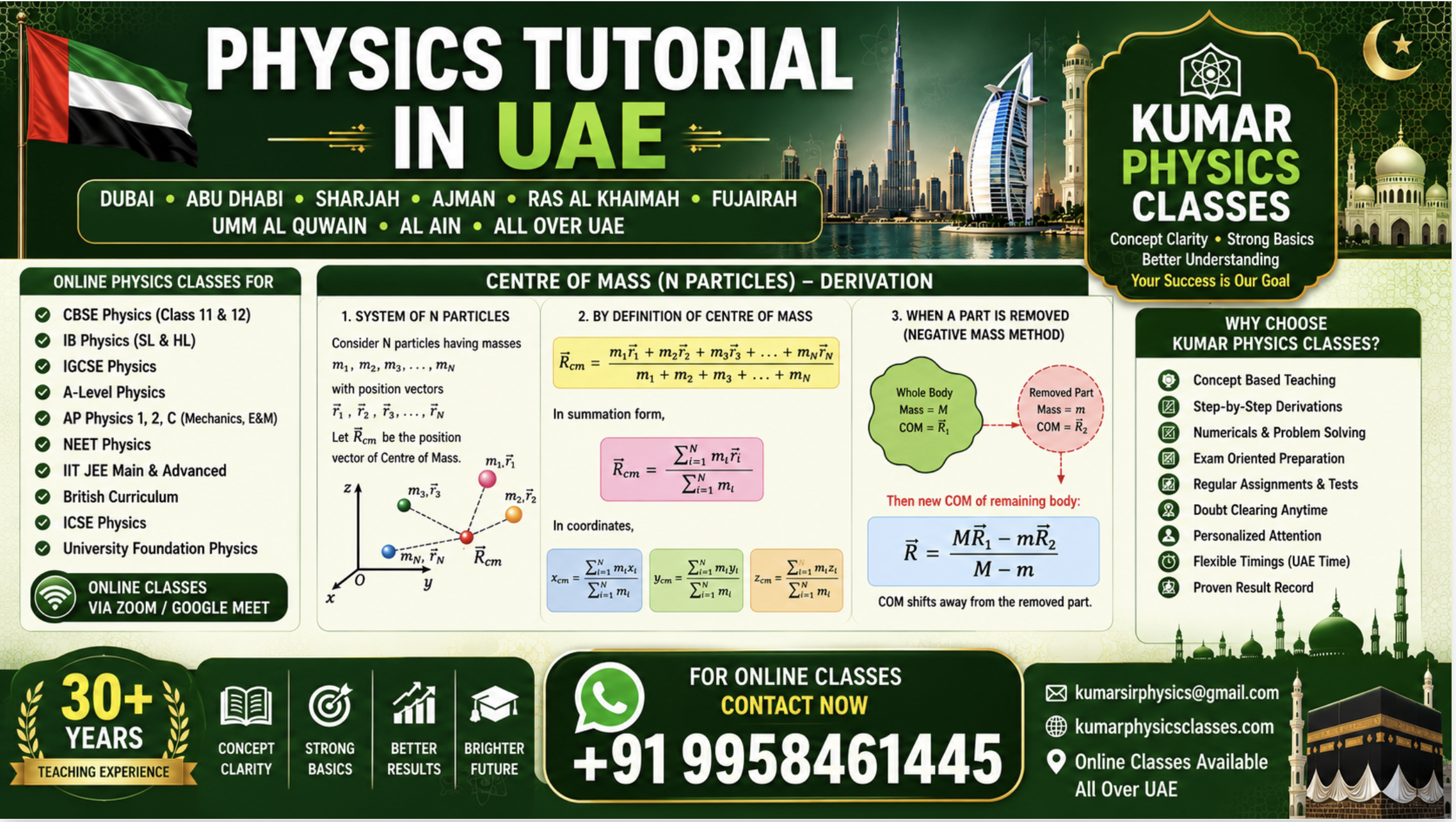
Centre of Mass Derivation for N Charged Particles
Centre of mass is an important topic in Mechanics. It is also useful in Electrostatics when we deal with many charged particles having mass.
Suppose there are N charged particles. Their masses are:
m₁, m₂, m₃, …, mₙ
Their position vectors are:
r₁, r₂, r₃, …, rₙ
Then the position vector of centre of mass is:
[
\vec{R}_{cm}=\frac{m_1\vec{r}_1+m_2\vec{r}_2+m_3\vec{r}_3+…+m_n\vec{r}_n}{m_1+m_2+m_3+…+m_n}
]
In compact form:
[
\vec{R}{cm}=\frac{\sum{i=1}^{n}m_i\vec{r}i}{\sum{i=1}^{n}m_i}
]
Here, charge does not directly decide the centre of mass. Centre of mass depends on mass and position. If charged particles are also moving under electric forces, then their motion may change, but at any instant, centre of mass is calculated using mass and position.
Simple Diagram for Centre of Mass
You can use this diagram on your website:
          m1,q1
           ●
          / \
         /   \
        /     \
m2,q2  ●-------●  m3,q3

          ● Rcm
     Centre of Mass
For N particles:
● m1,q1        ● m2,q2

       ● Rcm

● m3,q3        ● m4,q4        ● mn,qn
The centre of mass is the weighted average position of all particles.
Centre of Mass in X, Y and Z Coordinates
If the particles have coordinates:
(x₁, y₁, z₁), (x₂, y₂, z₂), …, (xₙ, yₙ, zₙ)
Then:
[
x_{cm}=\frac{m_1x_1+m_2x_2+…+m_nx_n}{m_1+m_2+…+m_n}
]
[
y_{cm}=\frac{m_1y_1+m_2y_2+…+m_ny_n}{m_1+m_2+…+m_n}
]
[
z_{cm}=\frac{m_1z_1+m_2z_2+…+m_nz_n}{m_1+m_2+…+m_n}
]
This method is very useful in numerical problems.
Centre of Mass When a Part is Removed
Many students get confused when a portion is cut or removed from a body. The best method is the negative mass method.
Suppose we have a complete body. Its mass is M and centre of mass is at R₁.
Now a small part is removed. Let the removed part have mass m and centre of mass at R₂.
Then the remaining body has mass:
[
M-m
]
The centre of mass of the remaining body will be:
[
\vec{R}=\frac{M\vec{R}_1-m\vec{R}_2}{M-m}
]
This is called the negative mass method because the removed part is treated as negative mass.
Example: Circular Disc With a Hole
Suppose a uniform circular disc has a small circular hole removed from it.
Step 1: Take the full disc as positive mass.
Step 2: Take the removed hole as negative mass.
Step 3: Apply centre of mass formula.
Full Disc Centre: O
Removed Hole Centre: A
New Centre of Mass: shifts away from hole

        _________
     .-'         '-.
   .'      O        '.
  /                 \
 |        ○ A        |
  \                 /
   '.             .'
     '-._______.-'

New COM shifts opposite to removed part.
Formula:
[
\vec{R}{new}=\frac{M\vec{R}{disc}-m\vec{R}_{hole}}{M-m}
]
This method is very powerful for solving questions from JEE, NEET, CBSE, IB and A-Level Physics.
Why Kumar Sir’s Physics Classes Are Useful
Kumar Sir focuses on:
Concept clarity
Step-by-step derivations
Numerical practice
Board exam preparation
Competitive exam preparation
Doubt solving
Regular assignments
Online personal attention
Strong fundamentals
Friendly explanation
Many students are afraid of Physics because they think it is only formula-based. But Physics becomes easy when concepts are explained in a simple way.
Kumar Sir explains every topic in easy English and Hindi, depending on the student’s comfort.
Final Words
If you are living in UAE and searching for a good online Physics tutor, Kumar Physics Classes can be a strong option for you. Whether you are preparing for CBSE, IB, IGCSE, A-Level, AP Physics, NEET or IIT JEE, you can learn Physics with proper concept clarity.
For classes, contact:
Kumar Physics Classes
Website: kumarphysicsclasses.com
Phone: +91-9958461445
Email: kumarsirphysics@gmail.com
NEET Physics Tutor, IIT Physics Tutor, JEE Physics Tutor, CBSE Physics Tutor, ICSE Physics Tutor, IB Physics Tutor, A-Level Physics Tutor, British Curriculum Physics Tutor
Here are 25 conceptual questions on Centre of Mass in simple Kumar Sir style English.
25 Conceptual Questions on Centre of Mass with Answers
1. What is centre of mass?
Answer:
Centre of mass is that point where we can assume the whole mass of the system to be concentrated for translational motion.
2. Does centre of mass always lie inside the body?
Answer:
No. Centre of mass may lie inside or outside the body. For example, in a ring, the centre of mass lies at the centre, where there is no material.
3. On what factors does centre of mass depend?
Answer:
It depends on the mass distribution and position of different parts of the body.
4. Does centre of mass depend on charge?
Answer:
No. Centre of mass depends on mass, not charge. Charge may affect motion due to electric force, but COM calculation uses mass.
5. If two equal masses are placed at two points, where is the COM?
Answer:
For two equal masses, COM lies exactly at the midpoint of the line joining them.
6. If two unequal masses are placed on a line, where is the COM?
Answer:
COM lies closer to the heavier mass. More mass pulls the COM towards itself.
7. Can centre of mass move even if no particle is present there?
Answer:
Yes. COM is a mathematical point. It can move even if no actual particle exists at that point.
8. What happens to COM if a body is cut into two equal parts?
Answer:
If the body is uniform and cut symmetrically, COM of the whole body remains at the original geometrical centre.
9. What happens to COM if a part is removed from a body?
Answer:
COM shifts away from the removed part. We can solve this using the negative mass method.
10. What is negative mass method?
Answer:
When a portion is removed, we treat that removed part as negative mass and apply the normal COM formula.
11. If a hole is made in a uniform disc, where does COM shift?
Answer:
COM shifts opposite to the hole because mass has been removed from that side.
12. Is centre of mass same as centre of gravity?
Answer:
In a uniform gravitational field, centre of mass and centre of gravity are practically the same.
13. Can centre of mass of a system accelerate?
Answer:
Yes, but only due to external force. Internal forces cannot accelerate the COM of the system.
14. Why internal forces cannot change motion of COM?
Answer:
Because internal forces occur in action-reaction pairs. They cancel each other for the whole system.
15. If a bomb explodes in air, what happens to its COM?
Answer:
The pieces fly in different directions, but the COM continues along the same path as the bomb would have followed.
16. If a man walks on a boat, what happens to the system COM?
Answer:
If there is no external horizontal force, the COM of man + boat remains fixed in horizontal direction.
17. Why does a boat move backward when a person walks forward on it?
Answer:
Because the system tries to keep its COM at the same position. So when man moves forward, boat moves backward.
18. If two particles move towards each other, what happens to COM?
Answer:
If no external force acts, COM continues its original motion. It may remain at rest or move with constant velocity.
19. Can COM be at rest while particles are moving?
Answer:
Yes. For example, two equal masses moving with equal speed in opposite directions have COM at rest.
20. Can particles be at rest but COM move?
Answer:
No. If all particles are at rest, COM is also at rest.
21. What is the COM of a uniform rod?
Answer:
For a uniform rod, COM lies at its middle point.
22. What is the COM of a uniform circular ring?
Answer:
For a uniform ring, COM lies at its centre.
23. What is the COM of a uniform triangular lamina?
Answer:
It lies at the centroid, where the medians of the triangle meet.
24. Why do high jumpers bend their body while jumping?
Answer:
They bend their body so that their COM can pass below the bar while the body crosses above the bar. This makes jumping easier.
25. Why is COM important in Physics?
Answer:
Because complex motion of many particles can be simplified by studying the motion of one point: the centre of mass.