
Physics Tutor in Hiranandani Estate Thane Mumbai – Learn Projectile Motion with Kumar Sir
+91-9958461445
If you live in Hiranandani Estate Thane Mumbai and Physics is not becoming clear, then the real issue is usually not intelligence. The real issue is weak concept clarity. Many students attend school, coaching and online lectures, but when numerical questions come in NEET Physics, IIT JEE Physics, CBSE Physics, ICSE Physics, IB Physics, IGCSE Physics, A-Level Physics or AP Physics, they get stuck.
This is where Kumar Physics Classes helps students. Kumar Sir teaches Physics from the basic level to the advanced level. He does not only explain formulas; he explains the logic behind every formula, the diagram behind every concept and the application behind every numerical.
Projectile Motion Concept – Kumar Sir Style
In projectile motion, one very important point must be clear:
Horizontal velocity remains constant.
Horizontal acceleration is zero.
Vertical acceleration is g downward.
Why?
Because in ideal projectile motion, we ignore air resistance. After projection, the only force acting on the body is gravity. Gravity acts vertically downward. There is no force in the horizontal direction, so horizontal acceleration becomes zero.
That is why:
ax = 0
So horizontal velocity does not change:
vx = constant
But in the vertical direction, gravity acts continuously downward. Therefore vertical acceleration is:
ay = g downward
This means the horizontal motion is uniform motion, while the vertical motion is uniformly accelerated motion. Kumar Sir explains projectile motion by separating the motion into two independent parts: horizontal and vertical. Once a student understands this separation, projectile motion becomes very easy.
Why Students in Hiranandani Estate Need Concept-Based Physics
Students living in Hiranandani Estate, Thane West, Ghodbunder Road, Manpada, Patlipada, Brahmand, Kolshet Road and nearby areas often study in good schools and coaching institutes. But Physics becomes difficult when concepts are not visualised properly.
A student may remember the formula of range, time of flight and maximum height, but if the student does not understand why horizontal velocity is constant and why vertical acceleration is g, then projectile motion numericals become confusing.
Kumar Sir focuses on:
Concept clarity
Diagram-based explanation
Step-by-step numerical solving
NEET and IIT JEE level application
Board exam writing style
Doubt clearing according to student level
Kumar Physics Classes Details
Kumar Physics Classes
Phone: +91-9958461445
Email: kumarsirphysics@gmail.com
Website: https://kumarphysicsclasses.com
Linked Locality Keywords
Physics Tutor in Hiranandani Estate Thane, Physics Tutor in Thane West, Physics Tutor in Ghodbunder Road Thane, Physics Tutor in Manpada Thane, Physics Tutor in Patlipada Thane, Physics Tutor in Brahmand Thane, Physics Tutor in Kolshet Road Thane, Physics Tutor in Majiwada Thane, Physics Tutor in Vasant Vihar Thane, Physics Tutor in Panch Pakhadi Thane, Physics Tutor in Naupada Thane, Physics Tutor in Wagle Estate Thane, Physics Tutor in Kasarvadavali Thane, Physics Tutor in Dhokali Thane, Physics Tutor in Balkum Thane, Physics Tutor in Kalwa Thane, Physics Tutor in Mumbra Thane, Physics Tutor in Diva Thane.
Projectile Motion – 50 Questions With Answers
Kumar Physics Classes | +91-9958461445 | www.kumarphysicsclasses.com
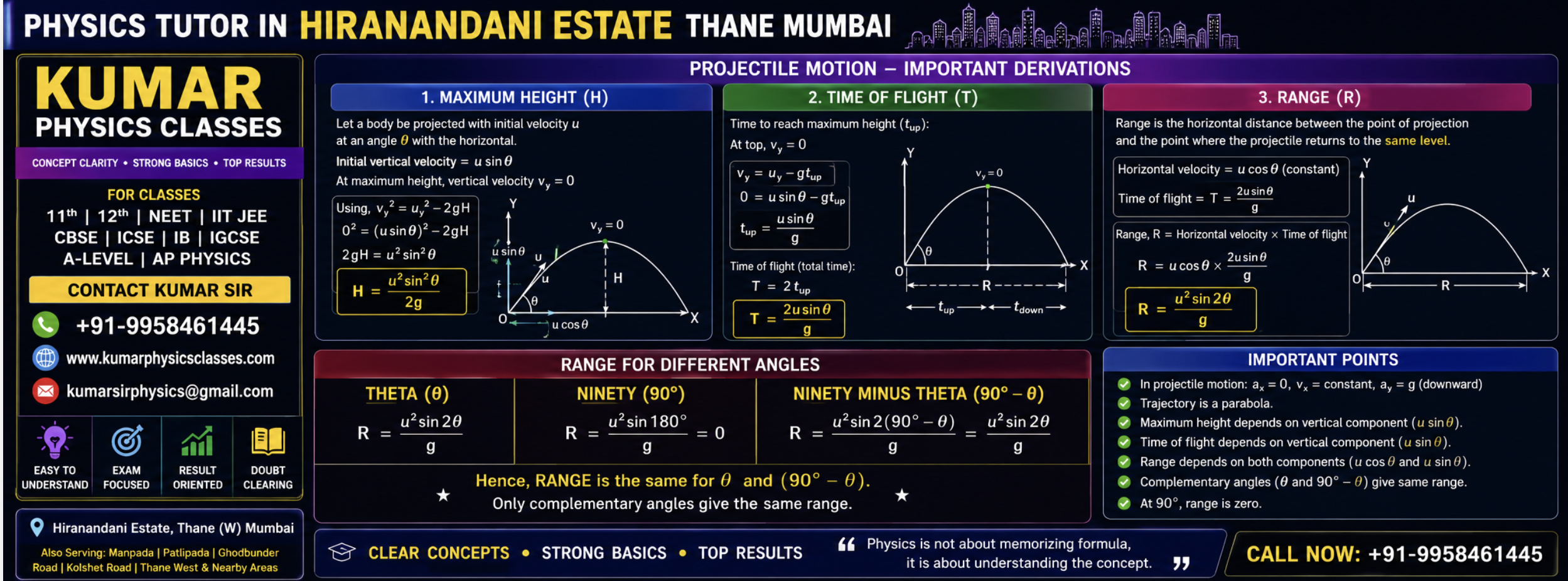
Important Concept: In projectile motion, horizontal velocity remains constant, horizontal acceleration is zero, and vertical acceleration is g downward.
ax = 0, vx = constant, ay = g downward
- Question: In projectile motion, why does horizontal velocity remain constant?
Answer: Because no horizontal force acts on the projectile, so horizontal acceleration is zero. - Question: What is horizontal acceleration in ideal projectile motion?
Answer: Zero. - Question: What is vertical acceleration in projectile motion?
Answer: g downward. - Question: Which force acts on a projectile after projection?
Answer: Only gravitational force, if air resistance is neglected. - Question: Is projectile motion two-dimensional motion?
Answer: Yes, it has horizontal and vertical components. - Question: If a projectile is thrown horizontally, what is its initial vertical velocity?
Answer: Zero. - Question: If a projectile is thrown with speed u at angle θ, what is horizontal component?
Answer: u cos θ. - Question: What is vertical component of initial velocity?
Answer: u sin θ. - Question: What is time of flight on level ground?
Answer: T = 2u sin θ / g. - Question: What is maximum height?
Answer: H = u² sin²θ / 2g. - Question: What is horizontal range on level ground?
Answer: R = u² sin 2θ / g. - Question: At maximum height, what is vertical velocity?
Answer: Zero. - Question: At maximum height, what is horizontal velocity?
Answer: u cos θ. - Question: At maximum height, what is acceleration?
Answer: g downward. - Question: For maximum range, angle of projection should be?
Answer: 45°. - Question: Which two angles give same range?
Answer: Complementary angles, θ and 90° − θ. - Question: If angle is 30°, which other angle gives same range?
Answer: 60°. - Question: If projectile is thrown at 45°, range is?
Answer: Maximum. - Question: Does mass affect range in ideal projectile motion?
Answer: No, if air resistance is neglected. - Question: Does mass affect time of flight?
Answer: No, in ideal projectile motion. - Question: What is trajectory of projectile?
Answer: Parabolic path. - Question: Why is trajectory parabolic?
Answer: Because horizontal motion is uniform and vertical motion is uniformly accelerated. - Question: Is speed constant during projectile motion?
Answer: No, speed changes because vertical velocity changes. - Question: Is horizontal component of velocity constant?
Answer: Yes. - Question: Is vertical component of velocity constant?
Answer: No, it changes due to gravity. - Question: At same height during upward and downward motion, speed is?
Answer: Same in magnitude. - Question: At same height, vertical velocity during upward and downward motion is?
Answer: Equal in magnitude but opposite in direction. - Question: At same height, horizontal velocity is?
Answer: Same. - Question: If u = 20 m/s and θ = 30°, find horizontal velocity.
Answer: u cos30° = 20 × √3/2 = 10√3 m/s. - Question: If u = 20 m/s and θ = 30°, find vertical velocity.
Answer: u sin30° = 20 × 1/2 = 10 m/s. - Question: If vertical component is 20 m/s, time to reach maximum height is?
Answer: t = uy/g = 20/g. - Question: If uy = 20 m/s and g = 10 m/s², time to top is?
Answer: 2 s. - Question: If time to top is 2 s, total time of flight is?
Answer: 4 s. - Question: If horizontal velocity is 15 m/s and time is 4 s, range is?
Answer: R = vx × T = 15 × 4 = 60 m. - Question: A body is projected horizontally from height. What decides time of fall?
Answer: Height and vertical acceleration g. - Question: In horizontal projection, horizontal distance depends on?
Answer: Horizontal velocity and time of fall. - Question: If horizontal velocity doubles, horizontal range becomes?
Answer: Double, for same height. - Question: If height increases, time of fall becomes?
Answer: Increases. - Question: For horizontal projection, vertical displacement is given by?
Answer: y = 1/2 gt². - Question: For horizontal projection, horizontal displacement is?
Answer: x = ut. - Question: In projectile motion, acceleration is always directed?
Answer: Vertically downward. - Question: Can acceleration become zero at highest point?
Answer: No, acceleration remains g downward. - Question: At highest point, is projectile momentarily at rest?
Answer: No, horizontal velocity is still present. - Question: What is the angle between velocity and acceleration at highest point?
Answer: 90°. - Question: What is the angle between velocity and acceleration during upward motion?
Answer: More than 90°. - Question: What is the angle between velocity and acceleration during downward motion?
Answer: Less than 90°. - Question: Why should projectile motion be resolved into components?
Answer: Because horizontal and vertical motions are independent. - Question: What is the biggest mistake students make in projectile motion?
Answer: They think velocity is zero at highest point, but only vertical velocity is zero. - Question: Why is projectile motion important for NEET and IIT JEE?
Answer: It builds understanding of vectors, kinematics, gravity and two-dimensional motion. - Question: Final concept: what is projectile motion in one line?
Answer: Projectile motion is two-dimensional motion under gravity where horizontal velocity remains constant and vertical velocity changes uniformly.
Kumar Physics Classes
Phone: +91-9958461445
Email: kumarsirphysics@gmail.com
Website: www.kumarphysicsclasses.com
NEET Physics | IIT JEE Physics | CBSE | ICSE | IB | IGCSE | A-Level | AP Physics