
Physics Tutor in Sector 120 Noida | Kumar Physics Classes
+91-9958461445
If you live in Sector 120 Noida and Physics is becoming difficult for you, then the problem is not only the subject. The real problem is usually the way Physics is being taught. Many students attend school regularly, take notes, watch videos, and still they are unable to understand basic concepts like viscosity, friction, viscous force, terminal velocity, Poiseuille’s formula, pressure difference and rate of flow.
Physics cannot be mastered by memorising formulas only. A student must understand the meaning of every formula, the physical logic behind every concept, and the correct method of applying it in numerical problems.
At Kumar Physics Classes, Kumar Sir teaches Physics with proper concept clarity, textbook-based explanation, derivation, numerical practice and exam-oriented preparation. Students from Class 11, Class 12, NEET, JEE, AP Physics, IB Physics, IGCSE, A-Level and British Curriculum Physics can learn Physics in a systematic way.
Website: Kumar Physics Classes
Contact: +91-9958461445
Email: kumarsirphysics@gmail.com
Why Students in Sector 120 Noida Need a Good Physics Tutor
Many students feel that Physics is difficult because they do not understand the basic language of Physics. For example, when a teacher says that viscosity is similar to friction, many students simply memorise the line. But a good teacher explains what it really means.
Viscosity is internal friction in fluids. It comes into play when different layers of a liquid move with different velocities. Just like solid friction opposes relative motion between two solid surfaces, viscosity opposes relative motion between two layers of a fluid.
If a student does not understand this basic comparison, then topics like fluid mechanics, terminal velocity, Poiseuille’s equation and Stokes’ law become very difficult.
Kumar Sir explains these ideas step by step so that the student can understand the subject properly.
Viscosity and Solid Friction
Viscosity is similar to solid friction in some ways, but it is also different in many important ways.
Similarities Between Viscosity and Solid Friction
Both come into play when there is relative motion.
Both oppose relative motion.
Both are due to molecular forces.
Both convert mechanical energy into heat.
Both resist smooth motion.
Difference Between Viscosity and Solid Friction
Viscous force between two liquid layers depends on:
Area of the liquid layer
Relative velocity between the two layers
Distance between the two layers
Nature of the liquid
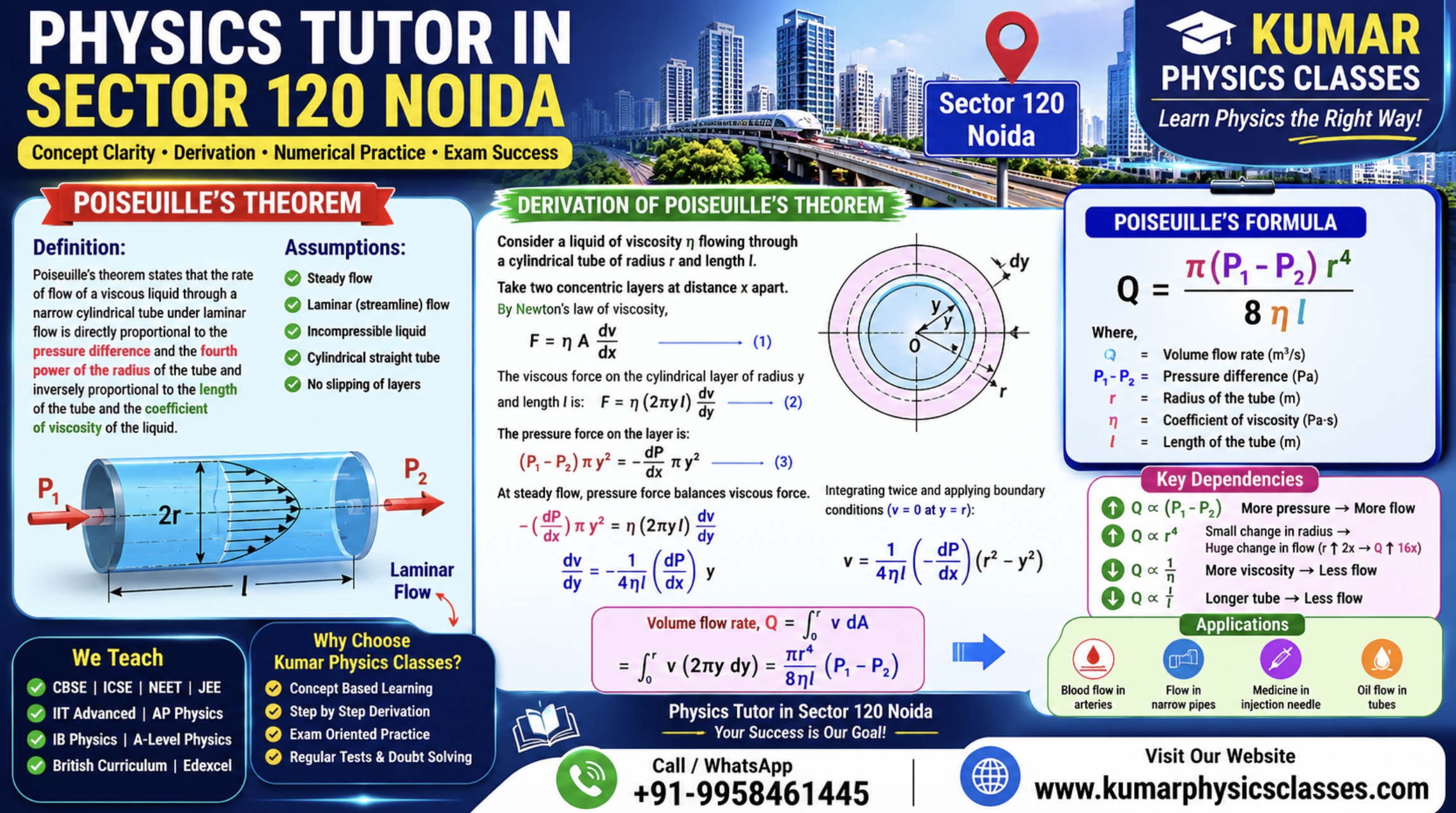
The formula for viscous force is:
F = eta A dv/dx
Where:
F = viscous force
eta = coefficient of viscosity
A = area of liquid layer
dv/dx = velocity gradient
This formula shows that viscous force increases when area increases and when velocity gradient increases.
But solid friction is different. Friction between two solid surfaces is generally independent of the apparent area of contact and relative velocity.
So, viscosity and solid friction are similar in concept, but different in mathematical behaviour.
Newton’s Law of Viscosity
According to Newton’s law of viscosity, the viscous force between two layers of a liquid is directly proportional to the area of contact and the velocity gradient.
Formula:
F = eta A dv/dx
This means:
If area A increases, viscous force increases.
If velocity gradient dv/dx increases, viscous force increases.
If coefficient of viscosity eta increases, viscous force increases.
Meaning of Coefficient of Viscosity
The coefficient of viscosity tells us how much internal resistance a liquid offers to flow.
If eta is large, the liquid is highly viscous.
Example:
Honey has high viscosity.
Water has low viscosity.
Air has very low viscosity.
Poiseuille’s Formula
Poiseuille’s formula gives the rate of flow of a liquid through a narrow tube.
Copy-paste friendly formula:
V = pi P r^4 / 8 eta l
Where:
V = volume of liquid flowing per second
P = pressure difference between two ends of the tube
r = radius of the tube
eta = coefficient of viscosity
l = length of the tube
Sometimes V is also written as Q.
So:
Q = pi P r^4 / 8 eta l
Important Points from Poiseuille’s Formula
Rate of flow is directly proportional to pressure difference.
Q proportional to P
Rate of flow is directly proportional to fourth power of radius.
Q proportional to r^4
Rate of flow is inversely proportional to coefficient of viscosity.
Q proportional to 1/eta
Rate of flow is inversely proportional to length of tube.
Q proportional to 1/l
The most important point is radius. If radius is doubled, rate of flow becomes 16 times.
Because:
2^4 = 16
This is why small change in radius creates a very large change in liquid flow.
Why Poiseuille’s Formula Is Important
Poiseuille’s formula is very important in Physics, Biology and Medical Science. It explains how liquids flow through narrow tubes.
Applications:
Blood flow in arteries and capillaries
Flow of water through narrow pipes
Flow of medicine through injection needles
Flow of oil through tubes
Understanding resistance in fluid flow
Physics Courses Available at Kumar Physics Classes
Students can contact Kumar Physics Classes for:
Physics Tutor in Noida, IIT Physics Tutor in Noida, JEE Physics Tutor in Noida, JEE Advanced Physics Tutor in Noida, NEET Physics Tutor in Noida, AP Physics Tutor in Noida, IB Physics Tutor in Noida, CBSE Physics Tutor in Noida, ICSE Physics Tutor in Noida, ISC Physics Tutor in Noida, A-Level Physics Tutor in Noida, British Curriculum Physics Tutor in Noida, IGCSE Physics Tutor in Noida, Edexcel Physics Tutor in Noida
Noida Sector Wise Physics Tutor Links
Physics Tutor in Sector 1 Noida, Physics Tutor in Sector 2 Noida, Physics Tutor in Sector 3 Noida, Physics Tutor in Sector 11 Noida, Physics Tutor in Sector 12 Noida, Physics Tutor in Sector 15 Noida, Physics Tutor in Sector 18 Noida, Physics Tutor in Sector 19 Noida, Physics Tutor in Sector 20 Noida, Physics Tutor in Sector 21 Noida, Physics Tutor in Sector 22 Noida, Physics Tutor in Sector 25 Noida, Physics Tutor in Sector 26 Noida, Physics Tutor in Sector 27 Noida, Physics Tutor in Sector 30 Noida, Physics Tutor in Sector 37 Noida, Physics Tutor in Sector 50 Noida, Physics Tutor in Sector 62 Noida, Physics Tutor in Sector 71 Noida, Physics Tutor in Sector 72 Noida, Physics Tutor in Sector 75 Noida, Physics Tutor in Sector 76 Noida, Physics Tutor in Sector 77 Noida, Physics Tutor in Sector 78 Noida, Physics Tutor in Sector 79 Noida, Physics Tutor in Sector 100 Noida, Physics Tutor in Sector 104 Noida, Physics Tutor in Sector 108 Noida, Physics Tutor in Sector 110 Noida, Physics Tutor in Sector 117 Noida, Physics Tutor in Sector 119 Noida, Physics Tutor in Sector 120 Noida, Physics Tutor in Sector 121 Noida, Physics Tutor in Sector 122 Noida, Physics Tutor in Sector 128 Noida, Physics Tutor in Sector 132 Noida, Physics Tutor in Sector 137 Noida, Physics Tutor in Sector 150 Noida
School Wise Physics Tutor Links in Noida
Physics Tutor in DPS Noida, Physics Tutor in Amity International School Noida, Physics Tutor in Mayoor School Noida, Physics Tutor in Somerville School Noida, Physics Tutor in Apeejay School Noida, Physics Tutor in Cambridge School Noida, Physics Tutor in Lotus Valley International School Noida, Physics Tutor in Bal Bharati Public School Noida, Physics Tutor in Ryan International School Noida, Physics Tutor in The Khaitan School Noida, Physics Tutor in Shiv Nadar School Noida, Physics Tutor in Step by Step School Noida, Physics Tutor in Genesis Global School Noida, Physics Tutor in Kothari International School Noida, Physics Tutor in Ramagya School Noida, Physics Tutor in Sapphire International School Noida, Physics Tutor in Jaypee Public School Noida, Physics Tutor in Father Agnel School Noida, Physics Tutor in Shriram Millennium School Noida, Physics Tutor in GD Goenka Global School Noida, Physics Tutor in Global Indian International School Noida
Final Note
If you are searching for Physics Tutor in Sector 120 Noida, Kumar Physics Classes can help you understand Physics from the root level. Topics like viscosity, friction, Poiseuille’s formula, fluid flow and pressure difference become easy when they are explained with proper logic.
Physics is not difficult when the teacher explains it properly.
Website: Kumar Physics Classes
Contact: +91-9958461445
Email: kumarsirphysics@gmail.com
40 Conceptual Questions with Answers on Poiseuille’s Theorem, Terminal Velocity and Thermal Resistance
Part A: Poiseuille’s Theorem
1. What does Poiseuille’s theorem explain?
Answer:
Poiseuille’s theorem explains the rate of flow of a viscous liquid through a narrow tube.
2. What is the formula of Poiseuille’s theorem?
Answer:
Q = pi P r^4 / 8 eta l
Where Q is volume flow rate, P is pressure difference, r is radius of tube, eta is coefficient of viscosity, and l is length of tube.
3. Why is Poiseuille’s theorem important?
Answer:
It is important because it explains how liquids flow through narrow tubes such as capillaries, pipes and blood vessels.
4. What type of flow is required for Poiseuille’s theorem?
Answer:
Poiseuille’s theorem is valid for steady, streamline and laminar flow.
5. How does flow rate depend on radius?
Answer:
Flow rate is directly proportional to the fourth power of radius.
Q proportional to r^4
So, a small increase in radius produces a very large increase in flow rate.
6. What happens to flow rate if radius is doubled?
Answer:
If radius is doubled, flow rate becomes 16 times because:
2^4 = 16
7. How does flow rate depend on viscosity?
Answer:
Flow rate is inversely proportional to viscosity.
If viscosity increases, flow rate decreases.
8. How does flow rate depend on length of tube?
Answer:
Flow rate is inversely proportional to the length of the tube.
Longer tube gives smaller flow rate.
9. How does flow rate depend on pressure difference?
Answer:
Flow rate is directly proportional to pressure difference.
Greater pressure difference gives greater flow rate.
10. Why does honey flow slower than water?
Answer:
Honey has greater viscosity than water, so its flow rate is smaller.
11. Why is radius the most sensitive factor in Poiseuille’s theorem?
Answer:
Because flow rate depends on r^4. Even a small change in radius causes a large change in flow rate.
12. Why is Poiseuille’s theorem useful in blood circulation?
Answer:
It explains how blood flow depends strongly on the radius of blood vessels.
13. What happens if the radius of a blood vessel decreases?
Answer:
Blood flow decreases sharply because flow rate depends on the fourth power of radius.
Part B: Terminal Velocity
14. What is terminal velocity?
Answer:
Terminal velocity is the constant maximum velocity acquired by a body falling through a viscous medium.
15. Why does a falling body attain terminal velocity?
Answer:
A falling body attains terminal velocity when its weight is balanced by buoyant force and viscous force.
16. What is the net force at terminal velocity?
Answer:
At terminal velocity, net force is zero.
17. Is acceleration zero at terminal velocity?
Answer:
Yes, acceleration becomes zero at terminal velocity.
18. Does velocity become zero at terminal velocity?
Answer:
No, velocity does not become zero. It becomes constant.
19. What forces act on a sphere falling in a viscous liquid?
Answer:
Three forces act:
Weight downward
Buoyant force upward
Viscous drag upward
20. What is the formula for terminal velocity of a small sphere?
Answer:
v = 2 r^2 g (rho – sigma) / 9 eta
Where r is radius of sphere, rho is density of sphere, sigma is density of liquid, eta is viscosity, and g is acceleration due to gravity.
21. How does terminal velocity depend on radius?
Answer:
Terminal velocity is directly proportional to the square of radius.
v proportional to r^2
22. What happens to terminal velocity if radius is doubled?
Answer:
If radius is doubled, terminal velocity becomes four times.
23. How does terminal velocity depend on viscosity?
Answer:
Terminal velocity is inversely proportional to viscosity.
If viscosity increases, terminal velocity decreases.
24. Why does a small raindrop fall slowly?
Answer:
A small raindrop has small radius, so its terminal velocity is small.
25. Why does a large raindrop fall faster than a small raindrop?
Answer:
A large raindrop has greater radius, so its terminal velocity is greater.
26. What happens if density of body equals density of liquid?
Answer:
If density of body equals density of liquid, terminal velocity becomes zero.
27. Why does a steel ball fall faster in water than in glycerine?
Answer:
Glycerine has higher viscosity than water, so terminal velocity in glycerine is smaller.
Part C: Thermal Resistance
28. What is thermal resistance?
Answer:
Thermal resistance is the opposition offered by a material to the flow of heat.
29. What is the formula of thermal resistance?
Answer:
R = L / kA
Where R is thermal resistance, L is thickness, k is thermal conductivity, and A is area.
30. What is the SI unit of thermal resistance?
Answer:
The SI unit of thermal resistance is kelvin per watt.
31. How does thermal resistance depend on thickness?
Answer:
Thermal resistance is directly proportional to thickness.
Greater thickness means greater thermal resistance.
32. How does thermal resistance depend on area?
Answer:
Thermal resistance is inversely proportional to area.
Greater area means smaller thermal resistance.
33. How does thermal resistance depend on thermal conductivity?
Answer:
Thermal resistance is inversely proportional to thermal conductivity.
Higher conductivity means lower thermal resistance.
34. Why is wood a good insulator?
Answer:
Wood has low thermal conductivity, so its thermal resistance is high.
35. Why is metal a good conductor of heat?
Answer:
Metal has high thermal conductivity, so its thermal resistance is low.
36. What is the heat current formula using thermal resistance?
Answer:
H = Delta T / R
Where H is heat current and Delta T is temperature difference.
37. What happens to heat flow if thermal resistance increases?
Answer:
Heat flow decreases when thermal resistance increases.
38. What is equivalent thermal resistance in series?
Answer:
In series:
R = R1 + R2 + R3
Thermal resistances add directly.
39. What is equivalent thermal resistance in parallel?
Answer:
In parallel:
1/R = 1/R1 + 1/R2 + 1/R3
40. Why are thick blankets warm?
Answer:
Thick blankets trap air and increase thermal resistance, so heat loss from the body becomes slow.