
Physics Tutor in Yas Island +91-9958461445
If you live in Yas Island, Abu Dhabi, and Physics is becoming difficult for you, then you are on the right page. Many students study in good schools, but still they face problems in Physics because concepts are not clear.
At Kumar Physics Classes, Kumar Sir teaches Physics for CBSE, ICSE, IGCSE, IB, AP Physics, A-Level Physics, NEET and IIT JEE with proper concept clarity, derivations, diagrams and numerical practice.
Kumar Physics Classes
Phone: +91-9958461445
Website: https://kumarphysicsclasses.com
Email: kumarsirphysics@gmail.com
Gauss Theorem Statement
Gauss theorem states that the total electric flux through any closed surface is equal to the total charge enclosed by that surface divided by epsilon zero.
Electric Flux
Electric flux is the total number of electric field lines passing normally through a given surface.
Here, θ is the angle between electric field vector and area vector.
Area Vector
Area vector is always perpendicular to the surface. For a closed surface, area vector is taken outward.
Derivation of Gauss Theorem for Point Charge
Suppose a point charge Q is placed at the centre of a spherical Gaussian surface of radius r.
Electric field due to point charge:
Vector form:
Small area vector:
Now,
Since,
Therefore,
Now integrate over the complete spherical surface:
Since Q, r and epsilon zero are constant on the spherical surface:
For a sphere:
So,
Finally,
Hence proved.
Why Students Find Gauss Theorem Difficult
- They do not understand electric flux.
- They get confused between electric field vector and area vector.
- They do not understand why dot product is used.
- They forget why spherical surface area becomes 4πr2.
- They do not know how to apply symmetry.
Physics Tutor in Yas Island for Different Courses
Physics Tutor in Yas Island, NEET Physics Tutor, IIT JEE Physics Tutor, CBSE Physics Tutor, ICSE Physics Tutor, IGCSE Physics Tutor, IB Physics Tutor, AP Physics Tutor, A-Level Physics Tutor
Nearby Areas
Physics Tutor in Yas Island, Physics Tutor in Saadiyat Island, Physics Tutor in Al Reem Island, Physics Tutor in Khalifa City, Physics Tutor in Mohammed Bin Zayed City, Physics Tutor in Mussafah, Physics Tutor in Abu Dhabi City, Physics Tutor in Al Raha Beach
25 Conceptual Questions on Electric Flux with Answers
Electric flux is the measure of electric field lines passing through a given surface.
ΦE = E · A = EA cosθ
Theta is the angle between electric field vector and area vector.
Electric flux is maximum when θ = 0°, because electric field is parallel to area vector.
Electric flux is zero when θ = 90°, because electric field is perpendicular to area vector.
Area vector is a vector perpendicular to the surface.
For a closed surface, area vector is always outward normal.
Electric flux is a scalar quantity because it is obtained by dot product.
The SI unit of electric flux is N m2/C.
Yes, electric flux is negative when electric field lines enter a closed surface.
Flux is positive when electric field lines come out of the closed surface.
Net electric flux is zero.
No, for a closed surface flux depends only on enclosed charge.
Net electric flux through a closed surface is equal to charge enclosed divided by ε0.
∮ E · dS = Q / ε0
Net flux due to outside charge is zero because field lines entering and leaving are equal.
Yes, electric field can be non-zero even if net flux is zero.
Because only the component of electric field perpendicular to the surface contributes to flux.
Flux is zero.
Flux becomes double, if electric field and angle remain same.
Flux becomes double, if area and angle remain same.
ΦE = Q / ε0
ΦE = Q / ε0
Flux through one face = Q / 6ε0
Electric flux helps us apply Gauss theorem and calculate electric field easily in symmetric charge distributions.
Applications of Gauss Theorem
Gauss Theorem is one of the most powerful tools in Electrostatics. It is used to find electric field due to symmetric charge distributions like line charge, conducting sheet, conducting sphere and non-conducting sphere.
1. Electric Field Due to Infinite Line Charge
Consider an infinitely long straight line charge having uniform linear charge density λ. To find electric field at distance r, we choose a cylindrical Gaussian surface of radius r and length L.
Derivation
Charge enclosed by Gaussian cylinder:
By Gauss theorem:
Electric field is radial and constant on curved surface. Flux through end caps is zero.
Result
Electric field due to infinite line charge is inversely proportional to distance r.
2. Electric Field Due to Infinite Conducting Plane Sheet
Consider an infinite conducting plane sheet having surface charge density σ. We choose a pillbox Gaussian surface crossing the sheet.
Derivation
Charge enclosed:
Total flux passes through two flat faces of pillbox:
By Gauss theorem:
Important Point
Electric field due to infinite plane sheet is independent of distance.
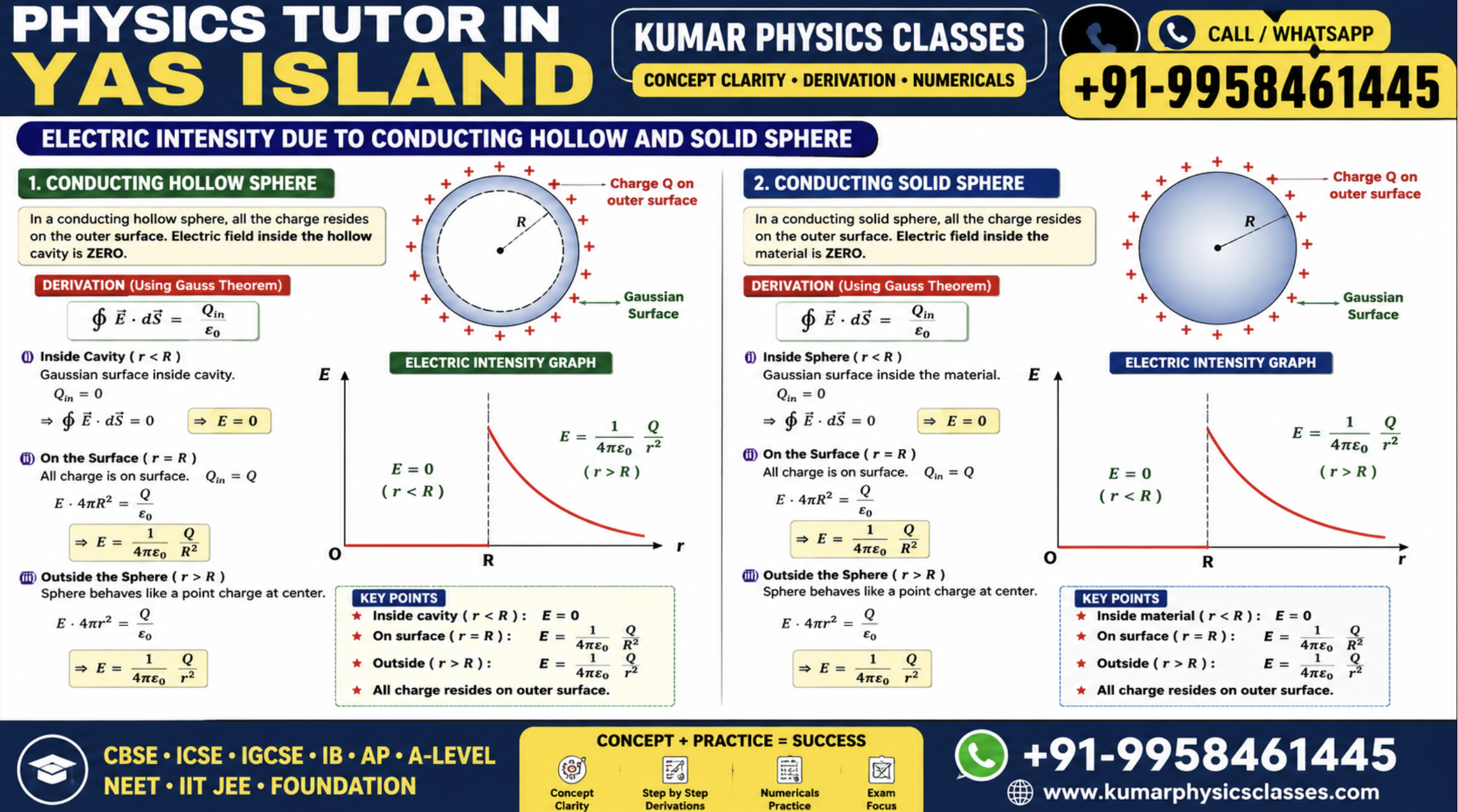
3. Electric Field Due to Conducting Sphere
In a conducting sphere, all charge resides on the outer surface. Electric field inside the conductor is zero.
Case 1: Inside Conducting Sphere
For r < R, charge enclosed is zero.
Case 2: On Surface
For r = R:
Case 3: Outside Conducting Sphere
For r > R, sphere behaves like a point charge placed at centre.
Graph
4. Electric Field Due to Hollow Conducting Sphere
For a hollow conducting sphere, charge always resides on the outer surface. Electric field inside the hollow cavity is zero if no charge is placed inside.
Inside Hollow Sphere
On Surface
Outside Hollow Sphere
5. Electric Field Due to Uniformly Charged Non-Conducting Sphere
In a non-conducting solid sphere, charge is uniformly distributed throughout the volume. Let total charge be Q and radius be R.
Volume Charge Density
Case 1: Inside Non-Conducting Sphere
For r < R, charge enclosed inside Gaussian sphere of radius r:
Substitute value of ρ:
By Gauss theorem:
Case 2: On Surface
Case 3: Outside Non-Conducting Sphere
Electric Intensity Graph
Inside the sphere, electric field increases linearly with r. Outside the sphere, electric field decreases as 1/r².
Quick Summary Table
| Charge Distribution | Electric Field |
|---|---|
| Infinite Line Charge | E = λ / 2π ε0 r |
| Infinite Plane Sheet | E = σ / 2ε0 |
| Inside Conducting Sphere | E = 0 |
| Outside Conducting Sphere | E = 1 / 4π ε0 × Q / r2 |
| Inside Non-Conducting Sphere | E = 1 / 4π ε0 × Qr / R3 |
| Outside Non-Conducting Sphere | E = 1 / 4π ε0 × Q / r2 |