
Physics Tutor in Saadiyat Island
+91-9958461445
If you live in Saadiyat Island, Abu Dhabi, and Physics is becoming difficult for you, then you are not alone. Many students study in good schools, attend regular classes, complete notebooks, and still feel that Physics is not clear. The teacher may finish the chapter on the board, the syllabus may move ahead, but when numerical questions come, students feel confused.
This is where Kumar Physics Classes can help you. Kumar Sir teaches Physics from the basic level to advanced level with proper concept clarity, derivation, formula application, numerical practice and exam-oriented preparation.
Whether you are preparing for CBSE Physics, ICSE Physics, IGCSE Physics, IB Physics, A-Level Physics, AP Physics, NEET Physics or IIT JEE Physics, you can learn online from Kumar Sir through Zoom classes.
Contact Kumar Physics Classes
Kumar Physics Classes
Phone / WhatsApp: +91-9958461445
Email: kumarsirphysics@gmail.com
Website: https://kumarphysicsclasses.com
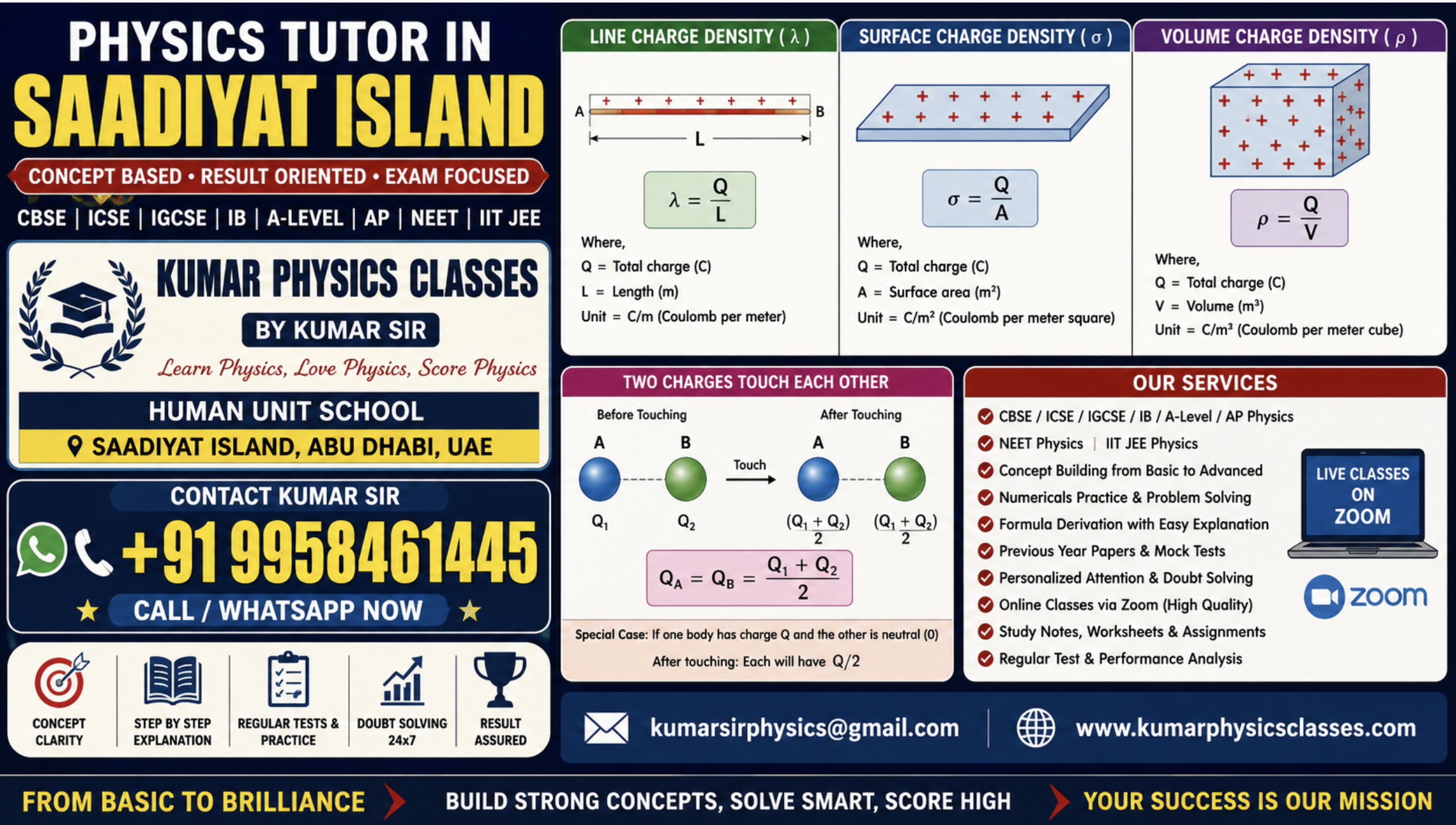
Important Electrostatics Concept: Sharing of Charge by Touching
Suppose we have two identical conducting bodies, A and B.
Body A has charge:
Q1
Body B has charge:
Q2
Now both bodies are touched together and then separated.
Since the bodies are identical, the total charge is equally shared.
Total charge:
Qtotal = Q1 + Q2
Charge on A after touching:
QA = (Q1 + Q2) / 2
Charge on B after touching:
QB = (Q1 + Q2) / 2
So, after contact and separation:
QA = QB = (Q1 + Q2) / 2
Special Case
If one body has charge Q and the other body is neutral, then:
Q1 = Q
Q2 = 0
After touching:
QA = (Q + 0) / 2 = Q / 2
QB = (Q + 0) / 2 = Q / 2
So both bodies will have:
Q / 2
This concept is very important in CBSE, NEET and JEE Physics because many questions are based on charge sharing.
Quantization of Charge
Charge is always an integral multiple of electronic charge.
Q = ± ne
where:
n = 1, 2, 3, 4, ...
e = 1.6 × 10^-19 C
This means charge cannot have any random value. It must be a multiple of e.
Examples:
Allowed charges:
+e
-e
+2e
-3e
+5e
Not allowed in normal electrostatics:
0.5e
1.7e
2.3e
Types of Charge Density
There are three important types of charge density in Electrostatics.
1. Linear Charge Density
When charge is distributed along a line or wire, we use linear charge density.
λ = Q / L
Unit:
C/m
where:
λ = linear charge density
Q = total charge
L = length
2. Surface Charge Density
When charge is distributed over a surface, we use surface charge density.
sigma = Q / A
Unit:
C/m²
where:
sigma = surface charge density
Q = total charge
A = area
3. Volume Charge Density
When charge is distributed throughout a volume, we use volume charge density.
rho = Q / V
Unit:
C/m³
where:
rho = volume charge density
Q = total charge
V = volume
Physics Tutor in Nearby Saadiyat Island Areas
Physics Tutor in Saadiyat Beach, Physics Tutor in Cultural District, Physics Tutor in Mamsha Al Saadiyat, Physics Tutor in Hidd Al Saadiyat, Physics Tutor in Louvre Abu Dhabi Area, Physics Tutor in Jubail Island, Physics Tutor in Al Reem Island, Physics Tutor in Abu Dhabi City, Physics Tutor in Al Maryah Island
Physics Tutor for Schools Near Saadiyat Island
Physics Tutor in Cranleigh Abu Dhabi, Physics Tutor in Redwood Montessori Nursery Saadiyat, Physics Tutor in NYU Abu Dhabi, Physics Tutor in Repton Abu Dhabi, Physics Tutor in GEMS World Academy Abu Dhabi, Physics Tutor in British International School Abu Dhabi
Physics Courses Offered
CBSE Physics Tutor
ICSE Physics Tutor
IGCSE Physics Tutor
IB Physics Tutor
A-Level Physics Tutor
AP Physics Tutor
NEET Physics Tutor
IIT JEE Physics Tutor
Why Choose Kumar Physics Classes?
Kumar Sir explains Physics in a simple, practical and exam-oriented way. He does not only write formulas on the board. He explains where the formula comes from, how to apply it, how to avoid mistakes and how to solve numerical questions step by step.
Students in Saadiyat Island can attend online Physics classes from home. You only need a laptop, tablet or mobile phone and a proper internet connection. Classes are interactive, doubts are discussed properly, and students get personal attention.
If Physics is not clear, do not wait until exams come near. Start learning from the basics and build strong concepts with Kumar Sir.
Final Call
If you are searching for the best Physics Tutor in Saadiyat Island, then contact Kumar Physics Classes today.
Phone / WhatsApp: +91-9958461445
Email: kumarsirphysics@gmail.com
Website: https://kumarphysicsclasses.com
20 Conceptual Questions on Charge Density with Answers
What is charge density?
Charge density means charge per unit length, area or volume.Why do we need charge density?
Because charge may be distributed on a wire, surface or inside a body.What is linear charge density?
Charge per unit length is called linear charge density.Formula of linear charge density?
λ = Q / LSI unit of linear charge density?
C/mWhere is linear charge density used?
It is used for charged wires, rods or rings.What is surface charge density?
Charge per unit area is called surface charge density.Formula of surface charge density?
σ = Q / ASI unit of surface charge density?
C/m²Where is surface charge density used?
It is used for charged plates, sheets and conductor surfaces.What is volume charge density?
Charge per unit volume is called volume charge density.Formula of volume charge density?
ρ = Q / VSI unit of volume charge density?
C/m³Where is volume charge density used?
It is used when charge is distributed inside a solid body.Can charge density be negative?
Yes, if the distributed charge is negative.What does positive charge density mean?
It means positive charge is distributed on length, area or volume.What does negative charge density mean?
It means negative charge is distributed on length, area or volume.If same charge is spread over smaller area, what happens?
Surface charge density increases.Which charge density is used for a charged sphere surface?
Surface charge density is used.Why is charge density important in Gauss law?
It helps calculate electric field for continuous charge distributions.