Kumar Physics Classes

Physics Tutor in Hawally

One-to-one online Physics mentoring by Kumar Sir for students in Hawally, Kuwait preparing for NEET, IIT-JEE, CBSE, ICSE, IB, IGCSE, A-Level and AP Physics.

  • NEET Physics
  • IIT-JEE Physics
  • CBSE
  • IB
  • IGCSE
  • A-Level
  • AP Physics

Personal Physics mentoring in Kuwait

Why Students in Hawally Need Strong Physics Guidance

Many Indian and international students living in Hawally, Kuwait study in CBSE, British curriculum, IB, IGCSE, A-Level or American curriculum schools. They may have good books, online videos, school notes and question banks, but Physics becomes difficult when concepts are not clear. Physics is not only formula memorisation. It is about understanding force, motion, energy, fields, circuits, diagrams and the logic behind every step of a solution.

A student may understand the teacher during class but get stuck while solving numericals alone. This usually happens because Physics needs slow, step-by-step explanation, accurate free body diagrams, correct formula selection and regular practice. A small mistake in sign convention, units, direction of acceleration or diagram reading can change the answer completely. With proper mentoring, even a weak or average student can build confidence and learn to approach questions in a more disciplined way.

Kumar Sir teaches one-to-one online Physics classes for students in Hawally and across Kuwait. The focus is on strong fundamentals, concept clarity, doubt solving, numerical practice, derivations and exam-focused preparation. Students can study from home through live online classes, ask questions freely, revise difficult school chapters and prepare for competitive exams without wasting travel time.

For NEET and IIT-JEE aspirants, Kumar Sir gives special attention to problem-solving approach, formula connection, multi-concept questions and time management. For CBSE, ICSE, IB, IGCSE, A-Level and AP Physics students, the classes are aligned with school requirements, board-style answers, diagrams, definitions and application-based numericals. The aim is not to promise unrealistic results; the aim is to help each student develop personal attention, disciplined practice and genuine confidence in Physics.

Featured Physics concept

Newton’s Laws of Motion and Pulley Systems

Newton’s First Law

Newton’s First Law says that a body remains at rest or continues uniform motion in a straight line unless an external unbalanced force acts on it. This law explains inertia. In pulley problems, inertia reminds students that a body changes its state of motion only when net force is present.

Newton’s Second Law

Newton’s Second Law connects force, mass and acceleration.

F = ma

Net force produces acceleration. In pulley problems, we apply this law separately to each block, then combine the equations using the relation between their accelerations.

Newton’s Third Law

For every action, there is an equal and opposite reaction. In pulley and string systems, students must understand tension, normal reaction and contact forces carefully. Action-reaction pairs act on different bodies, so they should not be cancelled inside the same free body diagram.

Free Body Diagram

A free body diagram is the most important step in pulley questions. Each block must be drawn separately with all forces:

  • weight mg downward
  • tension T along string
  • normal reaction if surface is present
  • friction if surface is rough
  • acceleration direction
m1 m2 weight tension

Pulley Concept

In an ideal string and ideal pulley, tension remains same throughout the string. If the string is light and inextensible, connected bodies have related acceleration. For NEET and JEE, pulley questions mainly test Newton’s Second Law and constraint relation.

a = (m₂ - m₁)g / (m₁ + m₂)
T = 2m₁m₂g / (m₁ + m₂)

This formula works only for a simple Atwood machine with ideal string and pulley.

Pulley practice

Pulley Practice Questions With Answers

Question 1

Two masses 3 kg and 5 kg are connected by a light string over a smooth pulley. Find acceleration and tension.

Answer: a = (5 - 3)g / (5 + 3) = g/4.

If g = 10 m/s², a = 2.5 m/s². T = 2m₁m₂g/(m₁+m₂) = 2×3×5×10/8 = 37.5 N.

Question 2

A 4 kg block on a smooth table is connected to a hanging 2 kg block by a light string over a pulley. Find acceleration.

Answer: Net driving force = 2g. Total mass = 4 + 2 = 6 kg.

a = 2g/6 = g/3. If g = 10 m/s², a = 3.33 m/s².

Question 3

Two equal masses are connected over a smooth pulley. What is acceleration?

Answer: Since masses are equal, net driving force is zero.

a = 0 and T = mg. The system remains balanced if no extra force is applied.

Question 4

A 6 kg mass and 2 kg mass are connected over a pulley. Which side moves down and why?

Answer: The 6 kg side moves down because its weight is greater.

Acceleration: a = (6 - 2)g/(6 + 2) = g/2.

Question 5

Why should students draw separate free body diagrams in pulley problems?

Answer: Because each body has different forces.

Without separate FBDs, students often mix tension, weight and acceleration direction, which creates wrong equations.

Exam Tip for NEET and IIT-JEE

Never start pulley questions directly with formula. First draw FBD, choose direction of acceleration, write F = ma for each block, then solve. This method reduces mistakes and helps students handle new pulley variations with confidence.

Courses covered

Online Physics Support for School and Entrance Exams

NEET Physics

Medical entrance

IIT-JEE Physics

Engineering entrance

CBSE Class 11 Physics

School foundation

CBSE Class 12 Physics

Board preparation

ICSE Physics

Concept support

IB Physics

International curriculum

IGCSE Physics

Cambridge support

A-Level Physics

Advanced topics

AP Physics

American curriculum

SAT Physics Support

Practice and revision

Book Online Physics Classes From Hawally

Connect with Kumar Sir for personal Physics guidance, chapter-wise doubt solving, numerical practice and exam-focused mentoring for students in Hawally, Kuwait.

Physics Tutor in Hawally for CBSE, NEET, IIT-JEE, IB, IGCSE, AP and A Level Physics by Kumar Sir

Physics Tutor in Hawally 

+91-9958461445

If you live in Hawally, Kuwait, and your child is facing difficulty in Physics, then this article is for you. Hawally is one of the important areas of Kuwait and is known as a busy residential and commercial hub. Many Indian, Pakistani, Arab and international families live here, and many students study in CBSE, Edexcel, Cambridge, IB, IGCSE, American Curriculum and British Curriculum schools. Hawally is also known for computer-related markets and a strong expat population. (Wikipedia)

But one problem is very common: students attend school, coaching and online videos, still they do not get the real “feel” of Physics.

They may understand theory in class, but when NEET questions come, they get stuck. When IIT-JEE numericals come, they lose confidence. When IB or Edexcel questions ask reasoning, graphs and explanation, students feel confused. Physics is not only formula learning. Physics needs concept, logic, diagram, mathematical thinking and regular doubt clearing.

That is why a strong Physics Tutor in Hawally is very important.

Why Students in Hawally Need a Good Physics Tutor

Many students in Hawally study hard, but Physics still remains weak because:

  • School classes move fast

  • Coaching batches are large

  • Doubts are not solved personally

  • Numericals are not practised step by step

  • Students memorise formulas but do not understand application

  • International curriculum questions need written explanation and graph skills

  • NEET and IIT-JEE need speed, accuracy and deep concept clarity

Kumar Sir from Delhi teaches Physics in a different way. He first checks the student’s level, then starts teaching according to the child’s need. He teaches CBSE Physics, NEET Physics, IIT-JEE Physics, AP Physics, IB Physics, IGCSE Physics, Edexcel Physics, A Level Physics and British Curriculum Physics.

Physics Tutor in Hawally Schools

Students from many schools in and around Hawally can study online from Kumar Sir:

Physics Tutor in Universal American School Hawally, Physics Tutor in Al-Bayan Bilingual School Hawally, Physics Tutor in Kuwait National English School Hawally, Physics Tutor in American School of Kuwait Hawally, Physics Tutor in The English Academy Hawally, Physics Tutor in Cambridge English School Hawally, Physics Tutor in American Creativity Academy Hawally, Physics Tutor in Kuwait International English School Hawally, Physics Tutor in Pakistan National English School Hawally, Physics Tutor in Hawally Pakistan English School.

Physics Tutor in Hawally Universities

Students preparing for higher studies, foundation Physics or entrance exams can also take guidance:

Physics Tutor in Kuwait University, Physics Tutor in Gulf University for Science and Technology, Physics Tutor in American University of Kuwait, Physics Tutor in Australian University Kuwait, Physics Tutor in American International University Kuwait, Physics Tutor in College of Technological Studies Kuwait.

Physics Tutor in Hawally Localities and Nearby Areas

If you live in or near Hawally, online classes are easy because the student can study from home:

Physics Tutor in Salmiya, Physics Tutor in Jabriya, Physics Tutor in Bayan, Physics Tutor in Mishref, Physics Tutor in Rumaithiya, Physics Tutor in Salwa, Physics Tutor in Shaab, Physics Tutor in Kuwait City, Physics Tutor in Farwaniya, Physics Tutor in Fahaheel, Physics Tutor in Ahmadi.

Physics Tutor in Boards and Curriculums

Kumar Sir teaches students from different boards:

Physics Tutor in CBSE Physics Hawally, Physics Tutor in Edexcel Physics Hawally, Physics Tutor in Cambridge Physics Hawally, Physics Tutor in IB Physics Hawally, Physics Tutor in IGCSE Physics Hawally, Physics Tutor in AP Physics Hawally, Physics Tutor in A Level Physics Hawally, Physics Tutor in British Curriculum Physics Hawally, Physics Tutor in American Curriculum Physics Hawally.

Why Kumar Sir Is Different

Kumar Sir does not teach Physics like simple formula memorisation. He teaches the reason behind every concept. For example, in mechanics, he explains force, acceleration, energy and momentum with diagrams. In electricity, he explains current, potential difference, resistance and circuits logically. In modern Physics and semiconductors, he connects theory with real electronic devices.

His teaching includes:

  • First interaction with student

  • Basic level checking

  • Concept building

  • Numerical solving

  • Doubt clearing

  • NEET MCQ practice

  • IIT-JEE problem solving

  • Board answer writing

  • IB, AP, Edexcel and Cambridge explanation style

  • Regular revision

Logic Gates in Semiconductor Physics

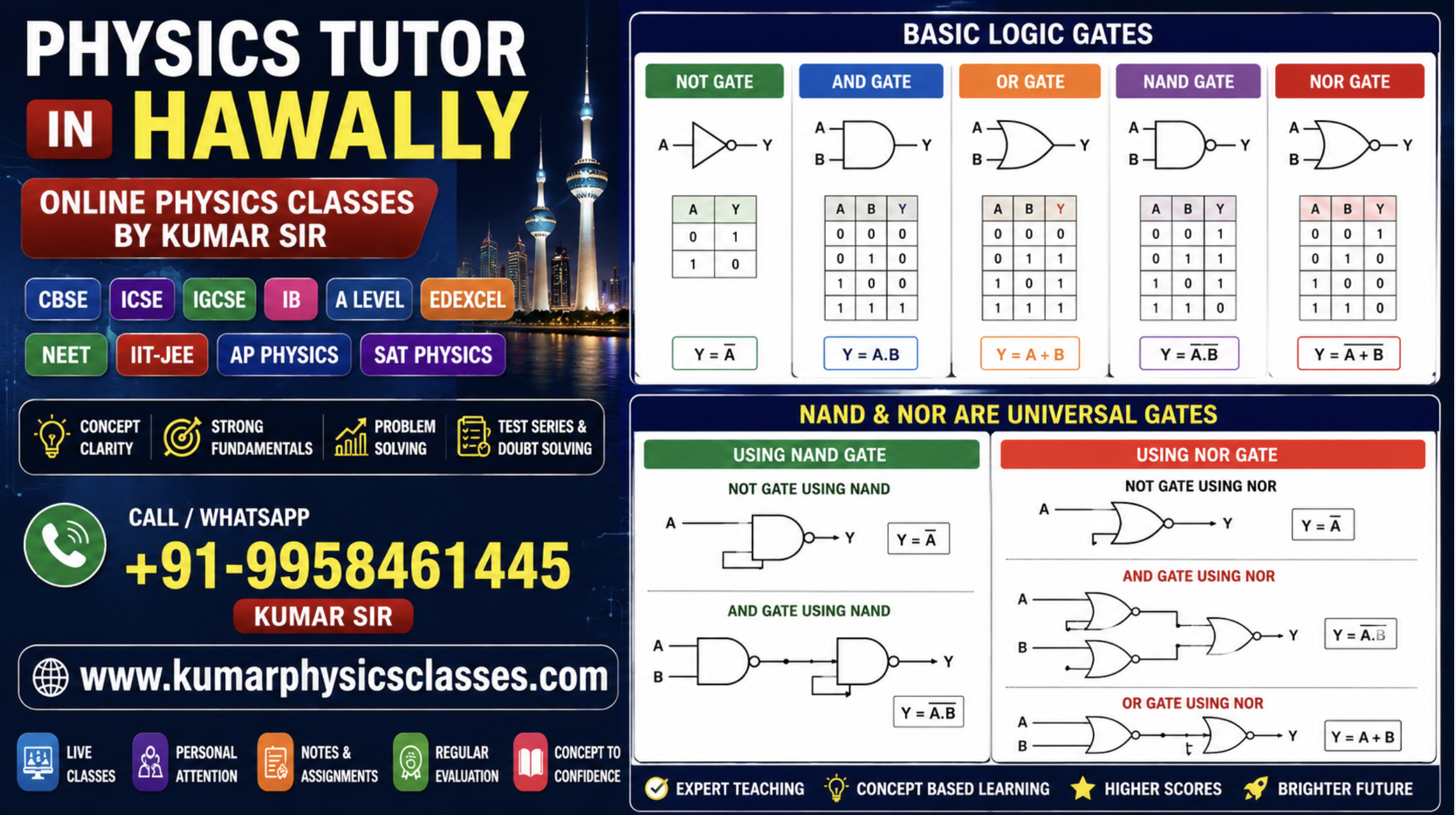
Logic gates are an important part of semiconductor electronics. They work on two values: 0 and 1.

Here:

  • 0 means LOW signal or OFF state

  • 1 means HIGH signal or ON state

Logic gates are the basic building blocks of digital electronics, computers, calculators, mobile phones and microprocessors.

Main Logic Gates

1. AND Gate
Output is 1 only when all inputs are 1.
Example:
A = 1, B = 1, Output = 1
Otherwise output is 0.

2. OR Gate
Output is 1 when at least one input is 1.
Example:
A = 1, B = 0, Output = 1

3. NOT Gate
It reverses the input.
If input is 1, output is 0.
If input is 0, output is 1.

4. NAND Gate
It is the opposite of AND gate.
Output is 0 only when all inputs are 1.
Otherwise output is 1.

5. NOR Gate
It is the opposite of OR gate.
Output is 1 only when all inputs are 0.

6. XOR Gate
Output is 1 when inputs are different.
Example:
A = 1, B = 0, Output = 1

7. XNOR Gate
Output is 1 when inputs are same.
Example:
A = 1, B = 1, Output = 1

These gates are taught in semiconductor Physics because they explain how electronic circuits make decisions using binary numbers.

Final Message for Parents in Hawally

If your child lives in Hawally and is struggling in Physics, do not wait. Whether the problem is CBSE, NEET, IIT-JEE, Edexcel, IB, IGCSE, AP Physics or A Level Physics, Kumar Sir can help online from Delhi.

A good Physics teacher can change the student’s confidence completely.

Contact Kumar Physics Classes
Phone: +91-9958461445
Website: www.kumarphysicsclasses.com
Email: kumarsirphysics@gmail.com

50 Conceptual Questions on Logic Gates with Answers

  1. What is a logic gate?
    Answer: A logic gate is an electronic circuit that gives output according to input logic levels 0 and 1.

  2. What does logic 0 mean?
    Answer: Logic 0 means LOW voltage or OFF state.

  3. What does logic 1 mean?
    Answer: Logic 1 means HIGH voltage or ON state.

  4. Which gate gives output 1 only when all inputs are 1?
    Answer: AND gate.

  5. Which gate gives output 1 when at least one input is 1?
    Answer: OR gate.

  6. Which gate reverses the input?
    Answer: NOT gate.

  7. What is the output of NOT gate when input is 1?
    Answer: 0.

  8. What is the output of NOT gate when input is 0?
    Answer: 1.

  9. What is NAND gate?
    Answer: NAND gate is the combination of AND gate followed by NOT gate.

  10. What is NOR gate?
    Answer: NOR gate is the combination of OR gate followed by NOT gate.

  11. Why is NAND called a universal gate?
    Answer: Because all basic gates can be made using only NAND gates.

  12. Why is NOR called a universal gate?
    Answer: Because all basic gates can be made using only NOR gates.

  13. What is XOR gate?
    Answer: XOR gate gives output 1 when inputs are different.

  14. What is XNOR gate?
    Answer: XNOR gate gives output 1 when inputs are same.

  15. What is the output of AND gate for inputs 1 and 1?
    Answer: 1.

  16. What is the output of AND gate for inputs 1 and 0?
    Answer: 0.

  17. What is the output of OR gate for inputs 0 and 0?
    Answer: 0.

  18. What is the output of OR gate for inputs 1 and 0?
    Answer: 1.

  19. What is the output of NAND gate for inputs 1 and 1?
    Answer: 0.

  20. What is the output of NAND gate for inputs 0 and 1?
    Answer: 1.

  21. What is the output of NOR gate for inputs 0 and 0?
    Answer: 1.

  22. What is the output of NOR gate for inputs 1 and 0?
    Answer: 0.

  23. What is the output of XOR gate for inputs 0 and 0?
    Answer: 0.

  24. What is the output of XOR gate for inputs 1 and 0?
    Answer: 1.

  25. What is the output of XNOR gate for inputs 1 and 1?
    Answer: 1.

  26. What is the output of XNOR gate for inputs 1 and 0?
    Answer: 0.

  27. Which gate is also called inverter?
    Answer: NOT gate.

  28. Which gates are called basic gates?
    Answer: AND, OR and NOT gates.

  29. Which gates are called derived gates?
    Answer: NAND, NOR, XOR and XNOR gates.

  30. Why are logic gates important?
    Answer: They are the building blocks of digital circuits, computers and calculators.

  31. Where are logic gates used?
    Answer: In computers, mobiles, calculators, microprocessors and digital electronics.

  32. What is a truth table?
    Answer: A truth table shows all possible inputs and corresponding outputs of a logic gate.

  33. How many input combinations are possible for 2 inputs?
    Answer: 4 combinations.

  34. How many input combinations are possible for 3 inputs?
    Answer: 8 combinations.

  35. Formula for number of combinations for n inputs?
    Answer: 2^n.

  36. Can AND gate have more than two inputs?
    Answer: Yes, AND gate can have two or more inputs.

  37. Can OR gate have more than two inputs?
    Answer: Yes, OR gate can have two or more inputs.

  38. Can NOT gate have two inputs?
    Answer: No, NOT gate has only one input.

  39. Which gate gives output 0 only when all inputs are 1?
    Answer: NAND gate.

  40. Which gate gives output 1 only when all inputs are 0?
    Answer: NOR gate.

  41. Which gate is used for comparison of two inputs?
    Answer: XOR or XNOR gate.

  42. Which gate gives output 1 for odd number of 1s?
    Answer: XOR gate.

  43. Which gate gives output 1 for even number of 1s?
    Answer: XNOR gate.

  44. What is Boolean algebra?
    Answer: Boolean algebra is the mathematics of logic using 0 and 1.

  45. Boolean expression for AND gate?
    Answer: Y = A.B.

  46. Boolean expression for OR gate?
    Answer: Y = A + B.

  47. Boolean expression for NOT gate?
    Answer: Y = A’.

  48. Boolean expression for NAND gate?
    Answer: Y = (A.B)’.

  49. Boolean expression for NOR gate?
    Answer: Y = (A + B)’.

  50. Why do students study logic gates in semiconductor Physics?
    Answer: Because logic gates are made using semiconductor devices like diodes and transistors, and they form the base of digital electronics.

Scroll to Top