Physics Tutor in Dumas Road Surat
+91-9958461445
Dumas Road Surat is known for lifestyle, business families, good schools, coaching culture and ambitious students. But one truth is very clear: a good location alone cannot create a doctor, engineer or IITian. Success comes when the student understands Physics deeply, practises regularly and gets the right guidance at the right time.
My name is Kumar Sir, and today I want to share an inspiring story. In 2023, one student named Rekha worked hard, stayed consistent and achieved success with 636 marks. Her journey proves one thing clearly: if one student can rise with discipline, concept clarity and proper Physics guidance, then other students of Dumas Road Surat can also do it.
If you live near Dumas Road Surat and Physics is not clear, do not wait until the exam pressure becomes too high. If numericals are not solving, if NCERT feels easy but NEET questions feel difficult, if capacitor, electrostatics, current electricity, mechanics or modern physics is creating confusion, then you should contact Kumar Sir at Kumar Physics Classes.
Why Students on Dumas Road Need Strong Physics Guidance
Many students attend school, coaching and online classes, but still they feel stuck in Physics. They read the theory but cannot apply formulas. They remember definitions but cannot solve conceptual questions. They watch videos but forget the method during tests. This happens because Physics is not a subject of memorisation only. Physics needs imagination, diagram understanding, mathematical confidence and step-by-step reasoning.
For NEET students, Physics often decides the final rank. Biology may be strong, Chemistry may be manageable, but if Physics is weak, the total score suffers. For JEE students, Physics is even more important because every question checks concept depth. For CBSE and Gujarat Board students, derivations, definitions, diagrams and numericals must be prepared properly.
That is why a personal and concept-based Physics tutor becomes very important.
Energy Stored in a Capacitor
A capacitor stores electrostatic energy in the electric field between its plates. The energy stored in a capacitor is written in three important forms:
U = 1/2 CV²
U = 1/2 Q²/C
U = 1/2 QV
Here,
C = capacitance,
V = potential difference,
Q = charge stored,
U = electrostatic energy.
These three formulas are the same energy written in different forms. If voltage and capacitance are known, use 1/2 CV². If charge and capacitance are known, use 1/2 Q²/C. If charge and voltage are known, use 1/2 QV.
The important concept is that energy is stored in the electric field of the capacitor, not inside the metal plates like water in a tank. When a capacitor is charged, opposite charges appear on the two plates and an electric field is created between them. This electric field contains energy.
When we short the two plates of a charged capacitor, the stored energy suddenly comes out. This may appear as a spark, heat, sound or light. That spark is not magic. It is the electrostatic energy of the capacitor being released quickly through a conducting path.
This is why capacitor questions are very important in NEET, JEE, CBSE and Gujarat Board Physics. Students must understand charge, potential difference, capacitance, electric field and energy together.
Why Kumar Sir for Physics in Dumas Road Surat?
Kumar Sir teaches Physics from the basic level to advanced level. The aim is not only to finish the chapter but to make the student understand the soul of the concept. If the student is weak, Kumar Sir starts from fundamentals. If the student is preparing for NEET or JEE, Kumar Sir moves towards conceptual and numerical depth.
Students are taught how to read a question, how to draw diagrams, how to identify formulas, how to avoid silly mistakes and how to revise regularly. Whether the topic is capacitor, current electricity, mechanics, ray optics, modern physics or thermodynamics, the method remains simple: concept first, formula second, application third.
If Rekha could score 636 in 2023 with hard work and proper guidance, then students living near Dumas Road Surat can also improve. The first step is to accept the problem. The second step is to take action.
Physics Tutor Keywords for Dumas Road Surat
Physics Tutor in Dumas Road Surat, Physics Tutor in Dumas Beach Surat, Physics Tutor in Magdalla Surat, Physics Tutor in Piplod Surat, Physics Tutor in Vesu Surat, Physics Tutor in City Light Surat, Physics Tutor in New City Light Surat, Physics Tutor in VIP Road Surat, Physics Tutor in Athwa Surat, Physics Tutor in Adajan Surat, Physics Tutor in Pal Surat, Physics Tutor in Pal Gam Surat, Physics Tutor in Ghod Dod Road Surat, Physics Tutor in Bhatar Surat, Physics Tutor in Althan Surat, Physics Tutor in SVNIT Surat, Physics Tutor in Ryan International School Surat, Physics Tutor in DPS Surat, Physics Tutor in GD Goenka International School Surat, Physics Tutor in Fountainhead School Surat, Physics Tutor in Lancers Army School Surat, Physics Tutor in Tapti Valley International School Surat, Physics Tutor in Lourdes Convent School Surat, Physics Tutor in Essar International School Surat, Physics Tutor in Allen Surat, Physics Tutor in Aakash Institute Surat, Physics Tutor in Resonance Surat, Physics Tutor in Motion Surat, Physics Tutor in Dumas Road Apartments Surat, Physics Tutor in Weekend Address Surat, Physics Tutor in Avadh Utopia Surat
Final Message for Students
If you are living in Dumas Road Surat and Physics is becoming a burden, do not ignore it. A small weakness in Class 11 becomes a big problem in Class 12. A small doubt in electrostatics becomes a big problem in capacitors. A small confusion in current electricity becomes a big problem in circuits.
Physics can become your scoring subject if you study it correctly. You need concept clarity, regular practice, test analysis and proper doubt solving.
For NEET, JEE, CBSE, Gujarat Board, IB, IGCSE, AP Physics and A-Level Physics, students can contact Kumar Physics Classes.
Kumar Physics Classes
Call / WhatsApp: +91-9958461445
Website: https://kumarphysicsclasses.com
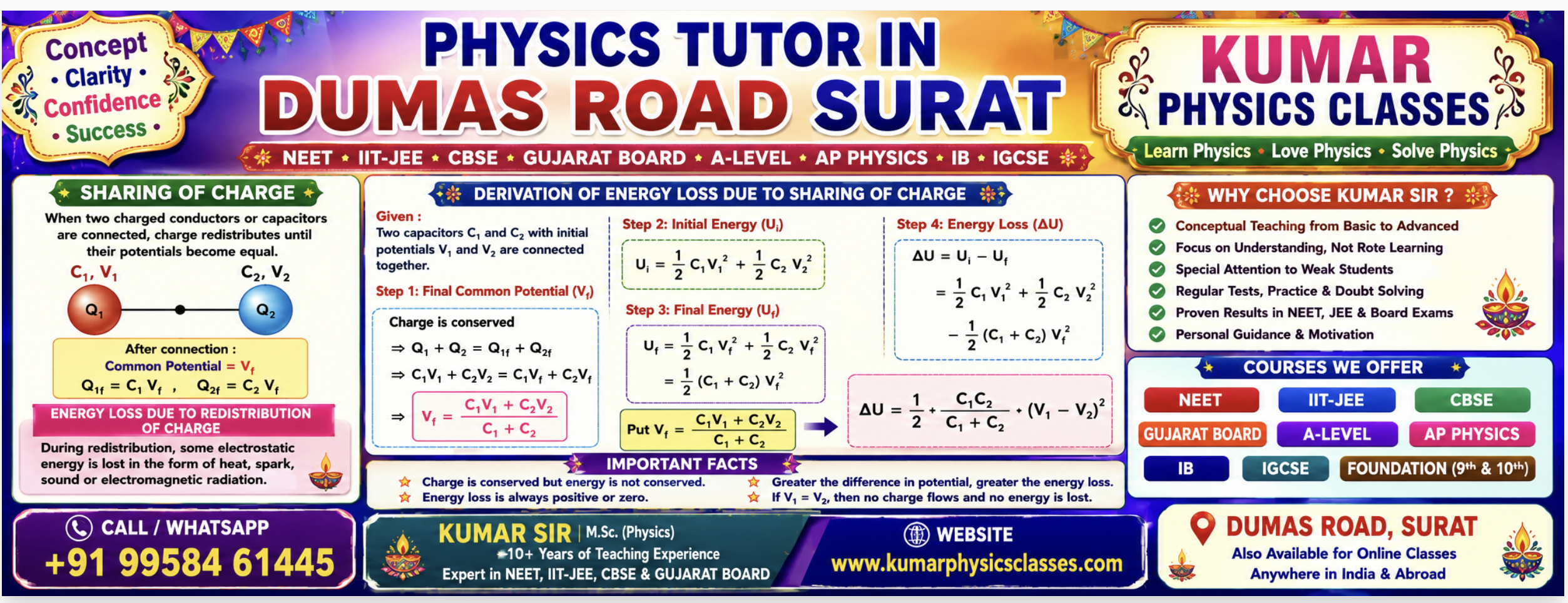
Sharing of Charge & Energy Loss
40 Conceptual Questions with Answers
Definition: Sharing of Charge
Sharing of charge is the process in which charge redistributes between two or more conductors or capacitors when they are connected together. Charge flows until all connected conductors reach the same final potential.
Definition: Energy Loss due to Redistribution of Charge
When charged conductors or capacitors are connected, charge redistributes to make their potentials equal. During this process, some electrostatic energy is lost in the form of heat, spark, sound or electromagnetic radiation.
Final Potential: V = (C₁V₁ + C₂V₂) / (C₁ + C₂)
Initial Energy: Uᵢ = ½C₁V₁² + ½C₂V₂²
Final Energy: U𝒇 = ½(C₁ + C₂)V²
Energy Loss: ΔU = Uᵢ − U𝒇
Ans: It is redistribution of charge between connected conductors or capacitors.
Ans: Because the two bodies have different potentials.
Ans: When both connected bodies reach the same potential.
Ans: Total charge remains conserved.
Ans: No, some energy is lost during redistribution.
Ans: It appears as heat, spark, sound or electromagnetic radiation.
Ans: V = (C₁V₁ + C₂V₂)/(C₁ + C₂).
Ans: Because connected conductors form an equipotential system.
Ans: Charge becomes equally shared if they are connected with same polarity.
Ans: Charge redistributes and final voltage decreases.
Ans: No, total charge remains constant.
Ans: Because energy depends on voltage squared, not only charge.
Ans: U = ½CV² = ½QV = Q²/2C.
Ans: Stored energy generally decreases.
Ans: Practically yes, energy may radiate as electromagnetic waves or spark.
Ans: Because sudden charge flow ionizes air and releases energy.
Ans: Both bodies must already be at the same potential.
Ans: Charge flows to or from earth until conductor potential becomes zero.
Ans: Because earth is a very large conductor with huge charge capacity.
Ans: Rearrangement of charge to make potential uniform.
Ans: Larger capacitance stores more charge at the same potential.
Ans: Q = CV, so larger C means larger Q.
Ans: Because final voltage is common and Q = CV.
Ans: Sum of energies stored in individual capacitors.
Ans: Energy stored in the equivalent capacitance at common final voltage.
Ans: No, energy loss is always zero or positive.
Ans: When initial potentials are equal.
Ans: It tests conservation of charge and energy loss concepts together.
Ans: They assume energy is conserved, but only charge is conserved.
Ans: Total charge of the system.
Ans: Electrostatic energy is not conserved.
Ans: Because potential difference quickly becomes zero.
Ans: No, because potential difference becomes zero.
Ans: Charges partially cancel and final potential may reduce greatly.
Ans: Yes, if net charge of the connected system becomes zero.
Ans: Because it carries more charge for the same voltage.
Ans: It provides a path for charge redistribution.
Ans: Ideally no, all points of a perfect wire are at same potential.
Ans: First conserve charge, then calculate final energy and energy loss.
Ans: Charge is conserved, potential becomes common, and some energy is lost.
Call / WhatsApp: +91-9958461445
Website: www.kumarphysicsclasses.com