Introduction to Waves
Waves transfer energy and information from one point to another without permanent transport of matter.
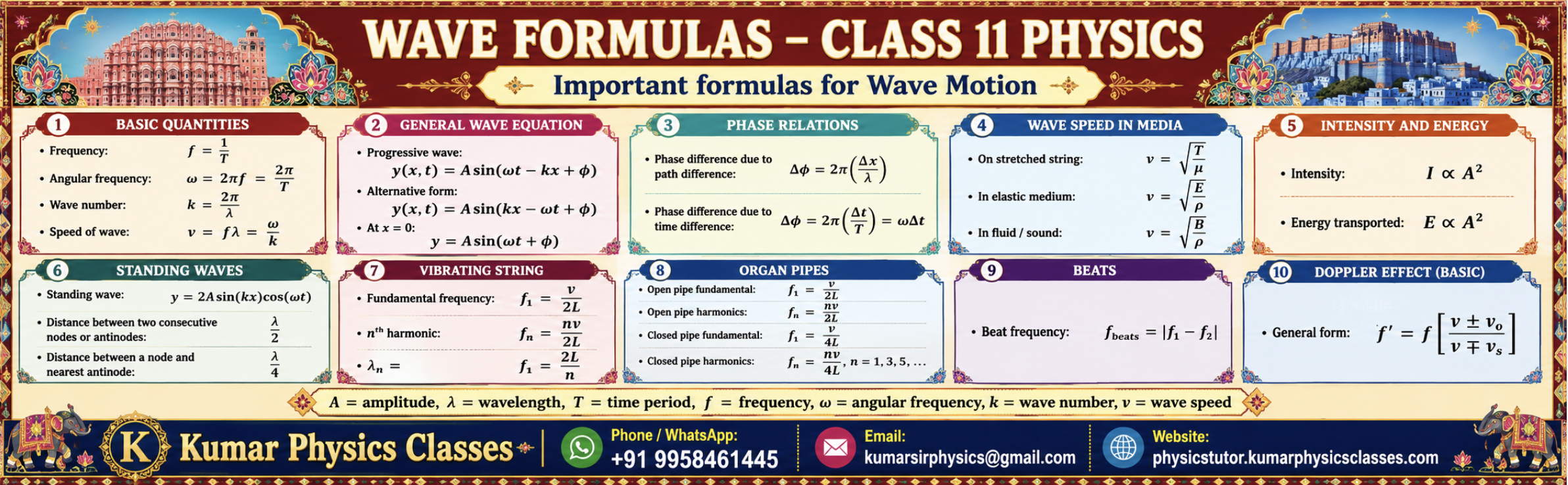
Study wave motion, sound waves, superposition and standing waves.
Waves transfer energy and information from one point to another without permanent transport of matter.
Mechanical, electromagnetic, transverse, longitudinal and progressive waves are classified by medium and particle motion.
Amplitude, wavelength, frequency, time period, phase and wave number describe the shape and motion of a wave.
The wave equation connects displacement with position and time, making phase and velocity easy to study.
Sound waves are longitudinal pressure waves whose speed depends on the medium and physical conditions.
Standing waves form through superposition of opposite travelling waves and produce nodes and antinodes.
The Doppler Effect explains apparent frequency change when source, observer or medium has relative motion.
Use the roadmap below to revise theory, formulas, numericals, PYQs and exam-focused applications.
Move step by step through wave motion, sound waves, standing waves, Doppler Effect, formulas and exam questions.
Learn wave motion and classification of waves.
Master wavelength, frequency, phase and wave equation.
Study wave speed and principle of superposition.
Understand sound waves and their characteristics.
Learn standing waves, harmonics and organ pipes.
Study beats and Doppler effect in detail.
Complete revision package with formulas and exam questions.
Waves form the foundation of Sound, Wave Optics, Electromagnetic Waves and Modern Physics. Concepts such as wave motion, superposition, standing waves, organ pipes and Doppler Effect are frequently asked in CBSE, NEET, JEE Main, JEE Advanced and international curricula.
If Wave Motion, Sound Waves, Standing Waves, Organ Pipes or Doppler Effect are not clear, contact Kumar Sir for one-to-one online Physics classes.