
Physics Tutor in Vasna Bhayli Road Vadodara – Why Current Electricity Becomes Easy When Concepts Become Clear
+91-9958461445
If you are living in Vasna Bhayli Road, Bhayli, Sevasi, Atladara, Akota, Old Padra Road, Gotri, Subhanpura, Alkapuri or any nearby area of Vadodara and Physics is creating stress in your life, then you are not alone.
Every year thousands of students prepare for NEET, IIT-JEE, JEE Advanced, CBSE, ICSE, IB, IGCSE, AP Physics and A-Level Physics. Most students are hardworking. They attend school regularly. They complete assignments. They buy expensive books. Yet when they sit in front of a Physics question, especially from Current Electricity, they become confused.
The reason is simple.
Physics is not a subject of memorization. Physics is a subject of understanding.
A student may remember twenty formulas, but if the concept is not clear, even a basic question can look impossible.
That is where Kumar Sir’s teaching method becomes different.
For more than 30 years, Kumar Sir has been helping students understand Physics from first principles. Instead of memorizing formulas, students learn how formulas are derived, why they work and when they should be used.
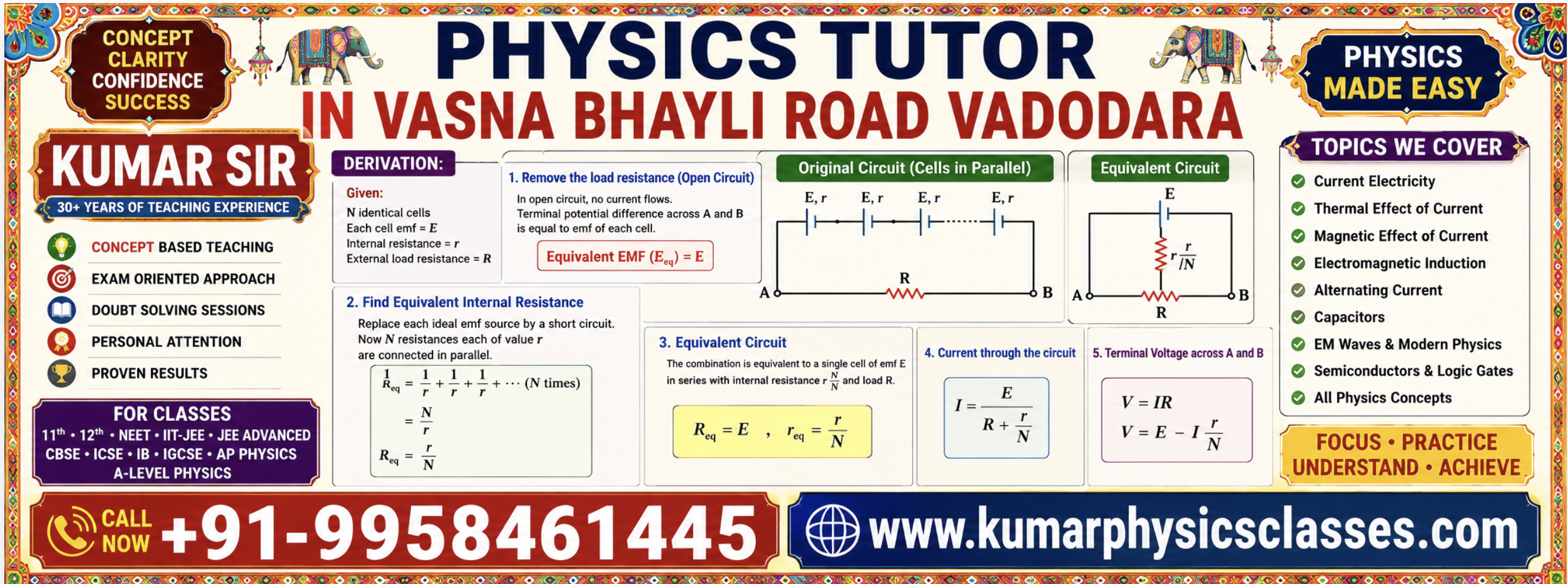
Understanding Cells Connected in Parallel – Kumar Sir’s Concept-Based Method
One of the most important concepts in Current Electricity is the equivalent emf and equivalent internal resistance of cells connected in parallel.
Many students simply memorize:
Equivalent EMF = E
Equivalent Internal Resistance = r/n
and move on.
But Kumar Sir teaches students to understand where these results come from.
Step 1: Remove the Load Resistance
Whenever you want to find the equivalent source of a circuit, first remove the external load.
Suppose we have:
n identical cells
Each cell has emf E
Internal resistance r
connected in parallel.
Since the circuit is open, no current flows.
Therefore the potential difference across the terminals A and B is simply:
V = E
Hence,
Equivalent EMF = E
Students who understand this never forget it.
Step 2: Find Equivalent Internal Resistance
Now remove all emf sources.
Replacing an ideal emf source means short-circuiting it with a zero-resistance wire.
After shorting all emf sources, the internal resistances remain.
Now n resistances each equal to r are connected in parallel.
Therefore,
1/r(eq) = 1/r + 1/r + 1/r + … n times
Therefore,
1/r(eq) = n/r
Hence,
r(eq) = r/n
This is the famous result used in NEET and IIT-JEE.
Step 3: Draw Equivalent Circuit
The entire combination can now be replaced by:
One equivalent emf E
One internal resistance r/n
connected in series.
When external resistance R is connected:
Current becomes
[
I=\frac{E}{R+\frac{r}{n}}
]
Terminal voltage becomes
[
V=IR
]
or
[
V=E-I\frac{r}{n}
]
Once students understand this derivation, hundreds of Current Electricity questions become easy.
Why Students Struggle in Current Electricity
Many students try to solve numerical problems immediately.
They see Kirchhoff’s Law.
They see Wheatstone Bridge.
They see Potentiometer.
They see Cell Combination.
They see Meter Bridge.
Then they become scared.
The problem is not the chapter.
The problem is the foundation.
If the concept of potential difference is weak, Kirchhoff’s Law will look difficult.
If the concept of resistance is weak, Meter Bridge will look difficult.
If the concept of emf is weak, Cell Combination will look difficult.
That is why Kumar Sir spends time building concepts.
Physics is Like Learning to Drive
Imagine somebody gives you the steering wheel of a car.
You memorize:
Clutch
Brake
Accelerator
Will you become a good driver?
No.
You need practice.
Physics is exactly the same.
Students often memorize:
Ohm’s Law
Kirchhoff’s Law
Joule’s Law
Wheatstone Bridge Formula
But they never learn how to apply them.
Then examination questions become difficult.
Kumar Sir trains students through concept-building and problem-solving.
Thermal Effect of Current
Many students think this chapter is easy because formulas look simple.
But examination questions can become tricky.
Students must understand:
Joule Heating
Electrical Power
Efficiency
Heating Appliances
Combination of Resistors
Once concepts become clear, even difficult questions become manageable.
Magnetic Effect of Current
This chapter forms the foundation of:
Moving Coil Galvanometer
Ammeter
Voltmeter
Electric Motor
Electromagnetic Induction
Alternating Current
If the Magnetic Effect of Current is weak, later chapters become difficult.
Kumar Sir teaches every concept through diagrams and logical reasoning.
Why Students in Vadodara Prefer Concept-Based Learning
Students today face tremendous competition.
NEET candidates compete with lakhs of students.
JEE Main candidates compete nationally.
JEE Advanced requires deep conceptual understanding.
IB, IGCSE and A-Level students face analytical questions.
Simple memorization no longer works.
Concepts win examinations.
A Story From Vasna Bhayli Road
Imagine a student living in Vasna Bhayli Road.
He studies every day.
He watches YouTube videos.
He reads books.
He solves assignments.
Yet Physics marks remain low.
One day he realizes that he has been collecting formulas but not understanding concepts.
He starts learning Physics systematically.
He learns:
Why current flows
Why emf exists
Why resistance occurs
Why magnetic fields are produced
Suddenly Physics starts making sense.
The same student who once feared Physics begins solving questions confidently.
This transformation happens when concepts become stronger than memorization.
That is exactly what Kumar Sir focuses on.
Students Preparing For Different Boards
Kumar Sir teaches:
Physics Tutor for NEET
Physics Tutor for IIT-JEE
Physics Tutor for JEE Advanced
Physics Tutor for CBSE Physics
Physics Tutor for ICSE Physics
Physics Tutor for IB Physics
Physics Tutor for IGCSE Physics
Physics Tutor for AP Physics
Physics Tutor for A-Level Physics
Physics Tutor for British Curriculum Physics
Nearby Areas Served
Physics Tutor in Vasna Bhayli Road Vadodara, Physics Tutor in Bhayli Vadodara, Physics Tutor in Sevasi Vadodara, Physics Tutor in Akota Vadodara, Physics Tutor in Old Padra Road Vadodara, Physics Tutor in Atladara Vadodara, Physics Tutor in Alkapuri Vadodara, Physics Tutor in Gotri Vadodara, Physics Tutor in Subhanpura Vadodara, Physics Tutor in Nizampura Vadodara, Physics Tutor in Fatehgunj Vadodara, Physics Tutor in Sayajigunj Vadodara, Physics Tutor in Karelibaug Vadodara, Physics Tutor in Harni Vadodara, Physics Tutor in Sama Vadodara, Physics Tutor in Manjalpur Vadodara, Physics Tutor in Waghodia Road Vadodara, Physics Tutor in Gorwa Vadodara.
Schools and Universities
Physics Tutor in Vasna Bhayli Road Vadodara, Physics Tutor in Bhayli Vadodara, Physics Tutor in Sevasi Vadodara, Physics Tutor in Akota Vadodara, Physics Tutor in Old Padra Road Vadodara, Physics Tutor in Atladara Vadodara, Physics Tutor in Alkapuri Vadodara, Physics Tutor in Gotri Vadodara, Physics Tutor in Subhanpura Vadodara, Physics Tutor in Nizampura Vadodara, Physics Tutor in Fatehgunj Vadodara, Physics Tutor in Sayajigunj Vadodara, Physics Tutor in Karelibaug Vadodara, Physics Tutor in Harni Vadodara, Physics Tutor in Sama Vadodara, Physics Tutor in Manjalpur Vadodara, Physics Tutor in Waghodia Road Vadodara, Physics Tutor in Gorwa Vadodara, Physics Tutor in Navrachana School Vadodara, Physics Tutor in Delhi Public School Vadodara, Physics Tutor in Bright Day School Vadodara, Physics Tutor in Cygnus World School Vadodara, Physics Tutor in Podar International School Vadodara, Physics Tutor in Nalanda International School Vadodara, Physics Tutor in Billabong High International School Vadodara, Physics Tutor in Gujarat Public School Vadodara, Physics Tutor in Vibgyor High Vadodara, Physics Tutor in Ambe School Vadodara, Physics Tutor in Tree House High School Vadodara, Physics Tutor in Global Discovery School Vadodara, Physics Tutor in Maharaja Sayajirao University Vadodara, Physics Tutor in Navrachana University Vadodara, Physics Tutor in GSFC University Vadodara, Physics Tutor in ITM University Vadodara, Physics Tutor in Sigma University Vadodara, Physics Tutor in Parul University Vadodara.
Contact Kumar Sir
Kumar Physics Classes
+91-9958461445
kumarsirphysics@gmail.com
https://kumarphysicsclasses.com
30+ Years Teaching Experience
NEET • IIT-JEE • JEE Advanced • CBSE • ICSE • IB • IGCSE • AP Physics • A-Level Physics
If you want to understand Physics instead of memorizing Physics, contact Kumar Sir.
N IDENTICAL CELLS CONNECTED IN PARALLEL
Circuit Diagram
     E,r      E,r      E,r
     | |      | |      | |
-----| |------| |------| |-----
|                             |
|                             |
-------------- R -------------
|                             |
-------------------------------
Derivation of Equivalent EMF and Internal Resistance
Given:
- N identical cells
- Each cell emf = E
- Internal resistance = r
- External load resistance = R
Step 1: Remove the load resistance.
Since all cells are identical and connected in parallel, terminal voltage across A and B equals the emf of one cell.
Equivalent EMF = E
Step 2: Find equivalent internal resistance.
Replace every ideal emf source by a short circuit.
Now all internal resistances r are connected in parallel.
1/r(eq) = 1/r + 1/r + 1/r + ... N times
1/r(eq) = N/r
r(eq) = r/N
Equivalent Circuit:
       E
       |
      r/N
       |
       R
       |
      ---
Total Current:
I = E / (R + r/N)
Terminal Voltage:
V = IR
V = E - I(r/N)
40 Numerical & Conceptual Questions with Answers
-
Q. Four identical cells each of emf 2V and internal resistance 1Ω are connected in parallel. Find equivalent emf.
Answer: 2V -
Q. Four identical cells each of internal resistance 1Ω are connected in parallel. Find equivalent resistance.
Answer: 0.25Ω -
Q. Ten identical cells each having internal resistance 2Ω are connected in parallel.
Answer: 0.2Ω -
Q. Five identical cells of emf 1.5V are connected in parallel.
Answer: Equivalent emf = 1.5V -
Q. Why does emf not increase in parallel combination?
Answer: Terminal voltage remains same as one cell. -
Q. Why does internal resistance decrease in parallel?
Answer: Parallel resistance combination. -
Q. Which combination gives maximum current capacity?
Answer: Parallel combination. -
Q. Why are batteries in power banks connected in parallel?
Answer: To reduce internal resistance. -
Q. Three cells each 3V, r=3Ω connected in parallel. Find r(eq).
Answer: 1Ω -
Q. Eight cells each 0.5Ω internal resistance connected in parallel.
Answer: 0.0625Ω -
Q. If N increases, what happens to internal resistance?
Answer: Decreases. -
Q. If N doubles, r(eq)?
Answer: Becomes half. -
Q. Equivalent emf of identical cells in parallel?
Answer: E -
Q. Can different emf cells be connected in parallel?
Answer: Generally not preferred. -
Q. What is the unit of emf?
Answer: Volt. -
Q. What is the unit of internal resistance?
Answer: Ohm. -
Q. Why is parallel combination useful?
Answer: Large current output. -
Q. Six cells each 1Ω in parallel.
Answer: 1/6 Ω -
Q. Twelve cells each 3Ω in parallel.
Answer: 0.25Ω -
Q. Two cells each 4Ω in parallel.
Answer: 2Ω -
Q. What is terminal voltage?
Answer: Voltage across external terminals. -
Q. Difference between emf and terminal voltage?
Answer: emf is open-circuit voltage. -
Q. What happens if load is removed?
Answer: Terminal voltage = emf. -
Q. What law is used after equivalent circuit?
Answer: Kirchhoff’s Law. -
Q. Why do competitive exams ask cell-combination questions?
Answer: Tests circuit understanding. -
Q. Formula of equivalent internal resistance?
Answer: r/N -
Q. Formula of current?
Answer: E/(R+r/N) -
Q. Formula of terminal voltage?
Answer: IR -
Q. Three cells, r=6Ω.
Answer: r(eq)=2Ω -
Q. Nine cells, r=9Ω.
Answer: r(eq)=1Ω -
Q. Twenty cells, r=2Ω.
Answer: 0.1Ω -
Q. Why are identical cells assumed?
Answer: Simplifies analysis. -
Q. Which combination gives same emf?
Answer: Parallel. -
Q. Which combination increases emf?
Answer: Series. -
Q. What is battery efficiency?
Answer: Useful power/output power ratio. -
Q. If R>>r/N, current approximately?
Answer: E/R -
Q. What happens if N becomes very large?
Answer: Internal resistance approaches zero. -
Q. NEET favourite topic?
Answer: Cell combinations. -
Q. JEE favourite topic?
Answer: Mixed cell networks. -
Q. Most important final result?
Answer: Equivalent emf = E, Equivalent resistance = r/N.
KUMAR PHYSICS CLASSES
📞 +91-9958461445
📧 kumarsirphysics@gmail.com
🌐 kumarphysicsclasses.com
NEET • IIT-JEE • JEE Advanced • CBSE • ICSE • IB • IGCSE • AP Physics • A-Level Physics