
Physics Tutor in Vesu Surat
+91-9958461445
Vesu is one of the most premium and fast-growing areas of Surat. It is known for modern residential societies, educated families, business-class homes, diamond and textile families, schools, coaching centres and a strong academic environment. Parents living in Vesu want their children to become doctors, engineers, researchers, IITians and successful professionals.
But many students face one serious problem — Physics.
They attend school, join coaching, buy modules, watch online lectures and solve worksheets. Still, when NEET, IIT-JEE, CBSE or Gujarat Board Physics questions come, they feel confused. They know the formula, but they do not know where to apply it. They revise the chapter, but numericals do not improve. They attend coaching, but doubts remain.
This is where Kumar Physics Classes can help students of Vesu Surat.
Kumar Sir has more than 30 years of Physics teaching experience. He has taught at reputed institutes like FIITJEE and Aakash and has guided many students for NEET, IIT-JEE, JEE Advanced, CBSE, ICSE, IB, AP Physics, IGCSE and British Curriculum Physics.
Surat may be famous for diamonds, textiles and business, but for a student, education is the real diamond. If Physics is weak, NEET rank suffers. If Physics is weak, JEE percentile suffers. If Physics is strong, confidence increases.
Why Students in Vesu Surat Struggle in Physics
Many students in Vesu study in good schools and coaching institutes. But Physics needs personal attention. In large batches, every student cannot ask every doubt. Some students are weak in basic mathematics. Some are weak in vectors. Some do not understand graphs. Some cannot connect theory with numericals.
Physics is not a subject of memorisation. It is a subject of understanding.
A student may remember the formula of capacitance, but if the question changes slightly, the student becomes confused. This happens because the concept is not clear from the root.
Kumar Sir teaches Physics concept by concept. He explains the logic behind formulas, the meaning of each physical quantity and the correct method of solving numericals.
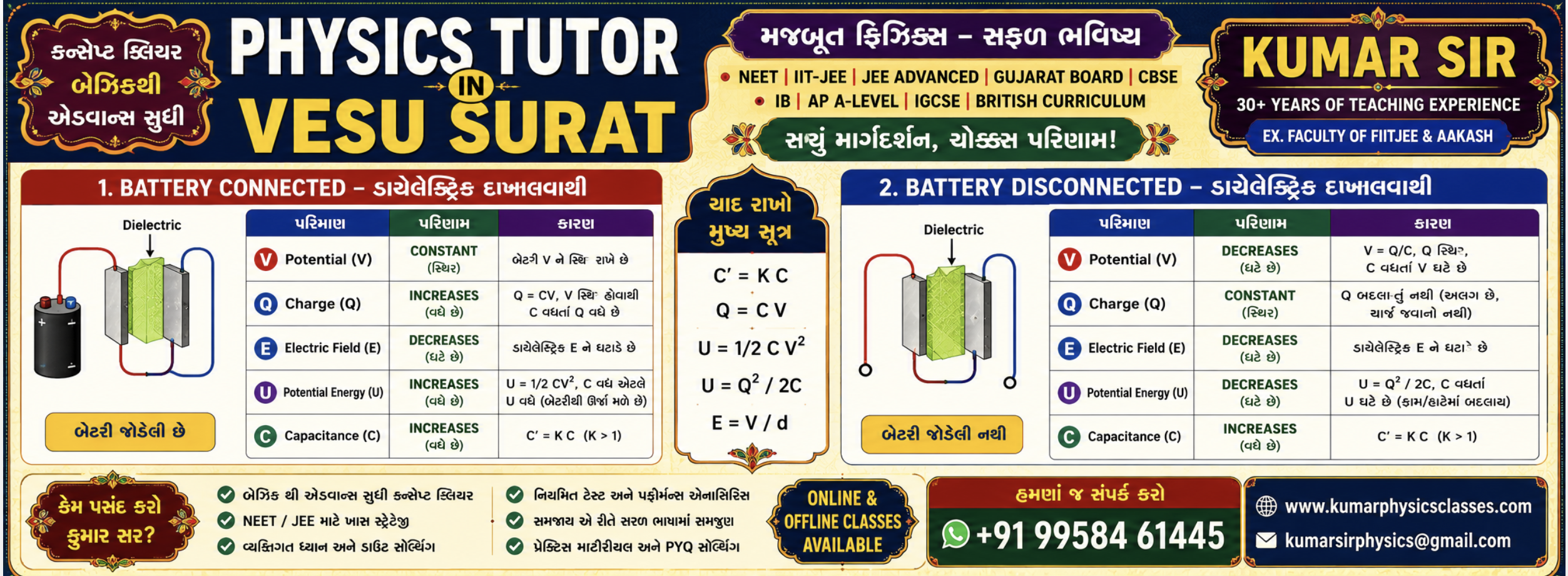
Capacitor Concept: Battery Connected vs Battery Disconnected
Capacitor questions are very important for NEET, IIT-JEE and board exams. Many students get confused when a dielectric slab is inserted between capacitor plates.
The result depends on one important condition:
Battery is connected
Battery is disconnected
Table: Effect of Dielectric in a Capacitor
| Quantity | Battery Connected | Battery Disconnected |
|---|---|---|
| Charge | Increases | Remains constant |
| Potential Difference | Remains constant | Decreases |
| Capacitance | Increases | Increases |
| Electric Field | Decreases inside dielectric | Decreases |
| Energy Stored | Increases | Decreases |
| Source of Extra Energy | Battery supplies energy | No battery supply |
| Polarisation | Increases | Increases |
| Main Reason | Voltage is fixed by battery | Charge is fixed because capacitor is isolated |
Case 1: When Battery is Connected
When a dielectric is inserted while the battery is connected, the potential difference remains constant because the battery maintains the same voltage.
Capacitance increases because dielectric reduces the effective electric field inside the capacitor.
Since capacitance increases and voltage remains constant, charge increases:
Q = CV
Here V is constant and C increases, so Q increases.
Energy stored also increases:
U = 1/2 CV²
Since V is constant and C increases, energy increases. This extra energy comes from the battery.
Case 2: When Battery is Disconnected
When the battery is disconnected, the capacitor is isolated. No extra charge can enter or leave the plates. Therefore charge remains constant.
When dielectric is inserted, capacitance increases. Since:
V = Q/C
Here Q is constant and C increases, so potential difference decreases.
Energy stored becomes:
U = Q²/2C
Since Q is constant and C increases, energy decreases. The lost energy may appear as mechanical work or heat during insertion of dielectric.
Simple Student-Friendly Explanation
If battery is connected, voltage is controlled by the battery. So voltage does not change. The capacitor takes more charge from the battery.
If battery is disconnected, charge is locked on the plates. So charge does not change. But capacitance increases, therefore voltage decreases.
This is the main funda.
Physics Tutor Keywords for Vesu Surat
Physics Tutor in Vesu Surat, NEET Physics Tutor in Vesu Surat, IIT-JEE Physics Tutor in Vesu Surat, CBSE Physics Tutor in Vesu Surat, Gujarat Board Physics Tutor in Vesu Surat, IB Physics Tutor in Vesu Surat, AP Physics Tutor in Vesu Surat, IGCSE Physics Tutor in Vesu Surat, A-Level Physics Tutor in Vesu Surat, British Curriculum Physics Tutor in Vesu Surat
Physics Tutor in Nearby Areas of Vesu Surat
Physics Tutor in VIP Road Surat, Physics Tutor in Piplod Surat, Physics Tutor in City Light Surat, Physics Tutor in Dumas Road Surat, Physics Tutor in Althan Surat, Physics Tutor in Bhimrad Surat, Physics Tutor in Pal Gam Surat, Physics Tutor in Canal Road Surat, Physics Tutor in Ghod Dod Road Surat
Physics Tutor in Schools Near Vesu Surat
Physics Tutor in Fountainhead School Surat, Physics Tutor in Delhi Public School Surat, Physics Tutor in G.D. Goenka International School Surat, Physics Tutor in Ryan International School Surat, Physics Tutor in Podar International School Surat, Physics Tutor in Tapti Valley International School Surat, Physics Tutor in T. M. Patel International School Surat, Physics Tutor in P. P. Savani School Surat
Physics Tutor in Colleges and Institutions Near Vesu Surat
Physics Tutor in SVNIT Surat, Physics Tutor in Veer Narmad South Gujarat University Surat, Physics Tutor in AURO University Surat, Physics Tutor in Bhagwan Mahavir University Surat, Physics Tutor in Sarvajanik College of Engineering and Technology Surat
Why Kumar Sir for Vesu Surat Students
Kumar Sir does not teach Physics as a collection of formulas. He teaches Physics as a thinking process. He explains every concept slowly, logically and clearly.
For NEET students, he focuses on speed, accuracy and MCQ practice.
For IIT-JEE students, he focuses on deep concepts and multi-step numericals.
For CBSE and Gujarat Board students, he focuses on derivations, diagrams and scoring answers.
For IB, AP, IGCSE and A-Level students, he focuses on explanation, graphs, reasoning and structured answers.
If a student in Vesu Surat is unable to solve capacitor questions, current electricity, mechanics, optics, modern physics or electrostatics, Kumar Sir can help from the root level.
Final Message for Vesu Surat Parents
Surat is a city of diamonds. But a child’s education is the biggest diamond of the family. Business, textile, diamond and stock market can come later, but Class 11 and Class 12 Physics must be handled at the right time.
If your child is struggling in Physics, do not wait until the exam comes near. Speak to Kumar Sir once.
Physics becomes easy when it is taught in the right way.
Contact Kumar Physics Classes
Call / WhatsApp: +91-9958461445
Email: kumarsirphysics@gmail.com
Website: https://kumarphysicsclasses.com
Capacitor & Dielectric: 50 NEET/JEE Conceptual Questions
Gujarati Colorful Style Physics Booster
Quick Funda
Battery Connected: Voltage remains constant, capacitance increases, charge increases, energy increases.
Battery Disconnected: Charge remains constant, capacitance increases, voltage decreases, energy decreases.
Capacitance increases because dielectric reduces effective electric field.
Potential difference remains constant.
Charge remains constant.
Charge increases because Q = CV and V is constant.
Charge remains unchanged because capacitor is isolated.
Voltage remains constant due to battery.
Voltage decreases because V = Q/C and C increases.
Energy increases because U = 1/2 CV² and C increases.
Energy decreases because U = Q²/2C and C increases.
Electric field decreases inside the dielectric.
It polarizes and reduces net electric field, so more charge can be stored.
It is the factor by which capacitance increases after inserting dielectric.
C' = KC.
Q' = KQ.
V' = V/K.
U' = KU.
U' = U/K.
Battery supplies extra charge and energy.
Part of energy is used as mechanical work or heat during dielectric insertion.
No, plate separation remains same unless physically changed.
No, plate area remains same.
C = ε₀A/d.
C = Kε₀A/d.
Because system energy decreases when capacitor is isolated.
The battery supplies extra charge.
No, because there is no conducting path for charge flow.
It decreases due to reduced electric field.
Separation of bound positive and negative charges inside dielectric.
No, it only polarizes; free charge flow does not occur.
Induced field inside dielectric opposes original field.
Charge becomes 4 times.
Voltage becomes one-fourth.
Energy becomes 4 times.
Energy becomes one-fourth.
Capacitance always increases.
Charge, voltage and energy depend on battery condition.
Macroscopic field remains E = V/d, but dielectric reduces effective internal field contribution.
Electric field decreases by factor K.
Battery fixes the potential difference across plates.
Plates are isolated, so charge cannot flow in or out.
First check whether battery is connected or disconnected.
Choose correct energy formula according to constant quantity.
U = 1/2 CV².
U = Q²/2C.
No, capacitance depends on geometry and medium.
No, for an ideal capacitor it does not depend on voltage.
Capacitance increases but calculation depends on geometry.
The system behaves like two capacitors in parallel.
The system behaves like two capacitors in series.
Battery connected means V constant. Battery disconnected means Q constant.