
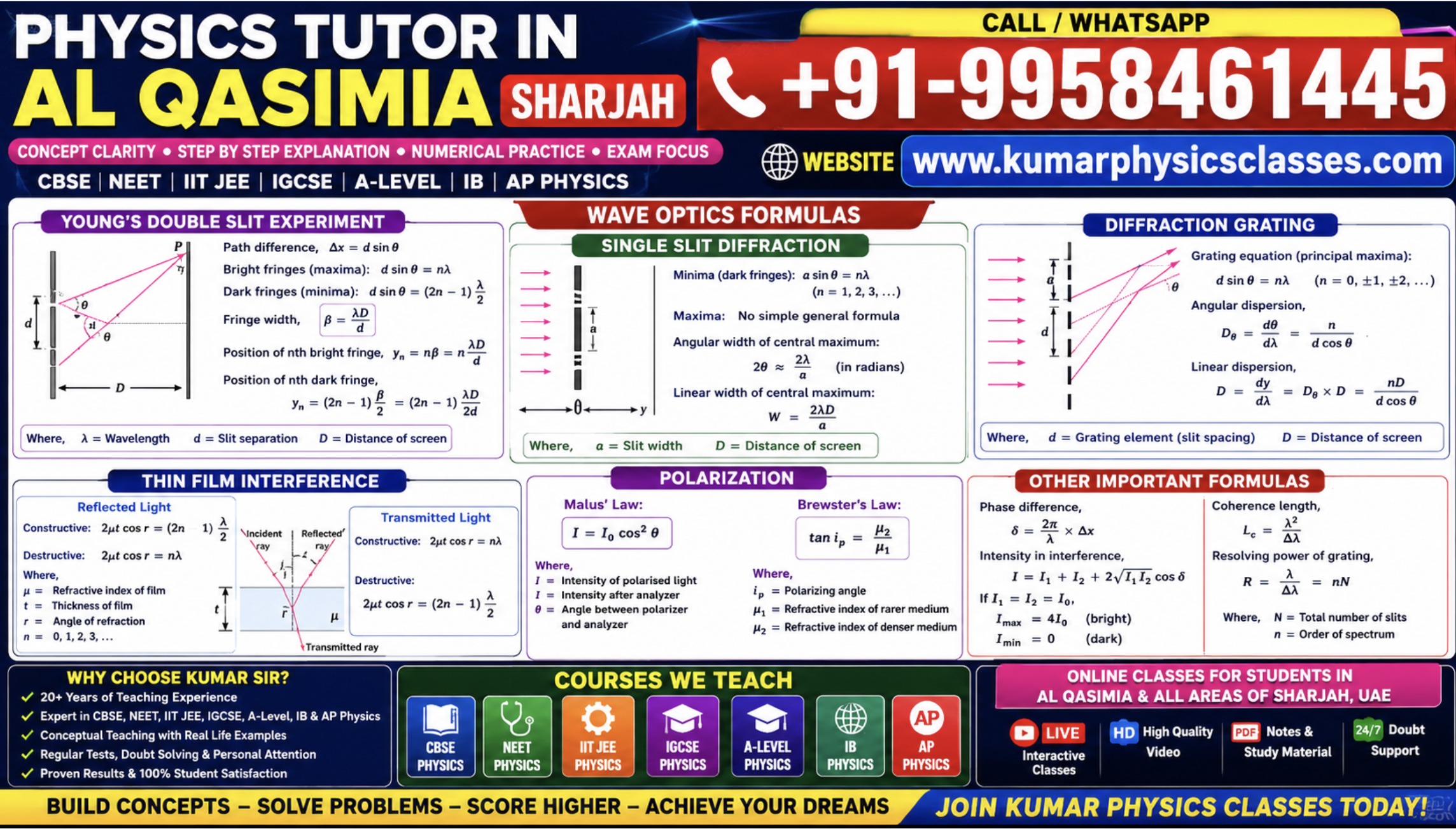
Physics Tutor in Al Qasimia
+91-9958461445
If you live in Al Qasimia, Sharjah, and Physics has started feeling like a bomb blast in your mind, then you are not alone. Many students attend school regularly, complete homework, sit in class, listen to the teacher, but when the exam paper comes, hands start shaking, legs start trembling, and the mind becomes completely blank.
This happens especially in Physics because Physics is not a subject of only reading theory. Physics needs concept clarity, formula understanding, diagram reading, mathematical confidence and regular numerical practice. If any one of these parts is weak, the student starts losing marks again and again.
At Kumar Physics Classes, Kumar Sir teaches Physics from the basic level to advanced level. He explains every formula, every derivation and every numerical step by step. Students preparing for CBSE, ICSE, IGCSE, IB, A-Level, AP Physics, NEET and IIT JEE can contact Kumar Sir for online Physics classes.
Contact Kumar Physics Classes
Phone: +91-9958461445
Email: kumarsirphysics@gmail.com
Website: https://kumarphysicsclasses.com
Why Students in Al Qasimia Need a Good Physics Tutor
Many students in Al Qasimia face one common problem: school teachers finish the syllabus quickly, but students do not get enough time to understand the chapter deeply. The teacher writes formulas on the board, completes the topic, gives homework and moves to the next chapter.
But the student is still confused:
Why is this formula used?
Where did this equation come from?
Which unit should be converted?
When should we use radians?
How to identify bright fringe and dark fringe?
How to solve NEET and JEE numerical questions quickly?
This is where Kumar Sir helps. He does not teach Physics like a boring subject. He teaches Physics like a logical story.
Young’s Double Slit Experiment Numerical Concept
Let us understand the question:
Question:
The fringe spacing for sodium light of wavelength 5890 Å in a double slit experiment has an angular width of 0.2°. For what wavelength will the angular width be 10% greater?
Concept
In Young’s Double Slit Experiment:
Angular fringe width is given by:
θ = β / D
But fringe width:
β = λD / d
So,
θ = λ / d
This means angular fringe width is directly proportional to wavelength, if slit separation remains the same.
So,
θ ∝ λ
If angular width becomes 10% greater, then:
θ₂ = 1.1 θ₁
Therefore,
λ₂ = 1.1 λ₁
Given:
λ₁ = 5890 Å
So,
λ₂ = 1.1 × 5890
λ₂ = 6479 Å
Final Answer
Required wavelength = 6479 Å
Important point: Since we are taking ratio, there is no need to convert 0.2° into radians. The angle cancels in ratio form. This is the smart way Kumar Sir teaches numerical Physics.
Why Students Make Mistakes in This Question
Students usually make mistakes because they try to convert every unit without thinking. In this question, angle is given as 0.2°, but actual value of angle is not required because only percentage change is asked.
If:
θ ∝ λ
Then 10% increase in angular width means 10% increase in wavelength.
This is why conceptual clarity is more important than blindly applying formulas.
Kumar Sir’s Teaching Style
Kumar Sir focuses on:
Basic concept building
Formula derivation
Diagram-based explanation
Numerical practice
NEET and IIT JEE shortcut methods
Board exam writing style
Doubt solving
Weak student improvement
Fear removal from Physics
Many students are scared of Physics because they never understood the foundation. Kumar Sir starts from zero level and slowly takes the student to advanced level.
Courses Taught by Kumar Physics Classes
Kumar Physics Classes provides online Physics tuition for:
NEET Physics Tutor
IIT JEE Physics Tutor
CBSE Physics Tutor
ICSE Physics Tutor
IGCSE Physics Tutor
IB Physics Tutor
A-Level Physics Tutor
AP Physics Tutor
Physics Tutor Near Al Qasimia Localities
Physics Tutor in Al Qasimia, Physics Tutor in Al Majaz, Physics Tutor in Al Nahda Sharjah, Physics Tutor in Al Taawun, Physics Tutor in Rolla, Physics Tutor in Abu Shagara, Physics Tutor in Al Khan, Physics Tutor in Muwaileh, Physics Tutor in Sharjah City Centre, Physics Tutor in Al Yarmook, Physics Tutor in Al Nud, Physics Tutor in Al Ghuwair, Physics Tutor in Al Soor, Physics Tutor in Al Mahatah, Physics Tutor in Al Manakh, Physics Tutor in Al Nabba, Physics Tutor in Al Mujarrah, Physics Tutor in Al Butina, Physics Tutor in Al Fayha, Physics Tutor in Al Ramla, Physics Tutor in Al Jazzat, Physics Tutor in Dasman, Physics Tutor in Al Gharb, Physics Tutor in Al Qulayaah, Physics Tutor in Al Layyeh, Physics Tutor in Al Mamzar Sharjah
Physics Tutor Near Schools in Sharjah
Physics Tutor in Delhi Private School Sharjah, Physics Tutor in Sharjah Indian School, Physics Tutor in Our Own English High School Sharjah, Physics Tutor in GEMS Millennium School Sharjah, Physics Tutor in International School of Choueifat Sharjah, Physics Tutor in Victoria English School Sharjah, Physics Tutor in Emirates National School Sharjah, Physics Tutor in Ryan International School Sharjah, Physics Tutor in ASPAM Indian International School Sharjah, Physics Tutor in Gulf Asian English School Sharjah, Physics Tutor in Scholars International Academy Sharjah, Physics Tutor in Brilliant International Private School Sharjah, Physics Tutor in The Westminster School Sharjah
Final Words
If you live in Al Qasimia and Physics is creating fear, pressure and confusion, then do not wait until marks become very low. Physics can be improved when the teacher explains concepts properly.
Kumar Sir teaches Physics with logic, derivation, diagrams and numerical practice. Whether you are preparing for school exams, NEET, IIT JEE, AP Physics, IB Physics, A-Level Physics or IGCSE Physics, Kumar Physics Classes can help you build confidence.
Call Kumar Physics Classes today: +91-9958461445
Website: https://kumarphysicsclasses.com
40 Conceptual Questions on Wave Optics: Interference and Diffraction
What is interference of light?
Answer: Interference is the redistribution of light intensity when two coherent light waves superpose.What is diffraction of light?
Answer: Diffraction is the bending and spreading of light around the edges of an obstacle or aperture.What is the main condition for sustained interference?
Answer: The two sources must be coherent, meaning they must have a constant phase difference.Why are two independent light sources not coherent?
Answer: Because they emit light with random phase changes, so the phase difference does not remain constant.What is a coherent source?
Answer: Sources having the same frequency and a constant phase difference are called coherent sources.Why is a single source used to produce two coherent sources in YDSE?
Answer: A single source ensures that the two secondary sources have a fixed phase relationship.What is constructive interference?
Answer: Constructive interference occurs when two waves meet in phase and produce maximum intensity.What is destructive interference?
Answer: Destructive interference occurs when two waves meet out of phase and produce minimum intensity.What is the path difference for constructive interference?
Answer: The path difference is an integral multiple of wavelength: Δx = nλ.What is the path difference for destructive interference?
Answer: The path difference is an odd multiple of half wavelength: Δx = (2n − 1)λ/2.What happens to fringe width if wavelength increases in YDSE?
Answer: Fringe width increases because β is directly proportional to wavelength.What happens to fringe width if slit separation increases?
Answer: Fringe width decreases because β is inversely proportional to slit separation.What happens to fringe width if screen distance increases?
Answer: Fringe width increases because β is directly proportional to screen distance.Why are bright fringes equally spaced in YDSE?
Answer: Because the path difference changes linearly with distance on the screen.Why are dark fringes equally spaced in YDSE?
Answer: Because the condition for darkness also changes linearly with position on the screen.What is fringe width?
Answer: Fringe width is the distance between two consecutive bright or two consecutive dark fringes.Is fringe width for bright and dark fringes the same in YDSE?
Answer: Yes, in YDSE the bright and dark fringe widths are equal.What happens if white light is used in YDSE?
Answer: The central fringe is white, and coloured fringes appear on both sides.Why is the central fringe white with white light?
Answer: At the centre, path difference is zero for all wavelengths, so all colours overlap.Which colour has maximum fringe width in YDSE?
Answer: Red has maximum fringe width because it has the longest wavelength.Which colour has minimum fringe width in YDSE?
Answer: Violet has minimum fringe width because it has the shortest wavelength.Why does diffraction become prominent when aperture size is small?
Answer: Diffraction becomes prominent when aperture size is comparable to the wavelength of light.What is single-slit diffraction?
Answer: It is the spreading of light after passing through a narrow single slit.Why is the central maximum in single-slit diffraction the brightest?
Answer: Most of the light energy is concentrated in the central maximum.Why is the central maximum in diffraction wider than secondary maxima?
Answer: The angular width of the central maximum is twice that of secondary maxima.What happens to diffraction pattern if slit width decreases?
Answer: The diffraction pattern spreads more.What happens to diffraction pattern if wavelength increases?
Answer: Diffraction increases and the pattern becomes wider.Why are secondary maxima weak in diffraction?
Answer: Intensity decreases because light from different parts of the slit partially cancels.What is the condition for minima in single-slit diffraction?
Answer: The condition is a sin θ = nλ, where n = 1, 2, 3, …What is the condition for maximum intensity in diffraction?
Answer: Maxima occur approximately between two consecutive minima.What is the main difference between interference and diffraction?
Answer: Interference is due to superposition of waves from two coherent sources, while diffraction is due to superposition of wavelets from different parts of the same wavefront.Why are interference fringes usually of equal intensity?
Answer: If the two coherent sources have equal intensity, bright fringes are nearly equally bright.Why are diffraction fringes not of equal intensity?
Answer: The intensity decreases as we move away from the central maximum.Can diffraction occur without interference?
Answer: No. Diffraction itself is a result of interference between secondary wavelets.Can interference occur without diffraction?
Answer: In practice, no. Light must pass through finite apertures, so diffraction is always present.Why does light not bend noticeably around large obstacles?
Answer: Because the size of the obstacle is much larger than the wavelength of light.Why is sound diffraction more common than light diffraction?
Answer: Sound has a much larger wavelength than light, so it bends more easily around obstacles.What happens if one slit is closed in YDSE?
Answer: The interference pattern disappears and a single-slit diffraction pattern may be observed.Why is interference evidence of wave nature of light?
Answer: Because only waves can superpose to produce alternate maxima and minima.Why is diffraction also evidence of wave nature of light?
Answer: Because bending and spreading around obstacles are characteristic properties of waves.