
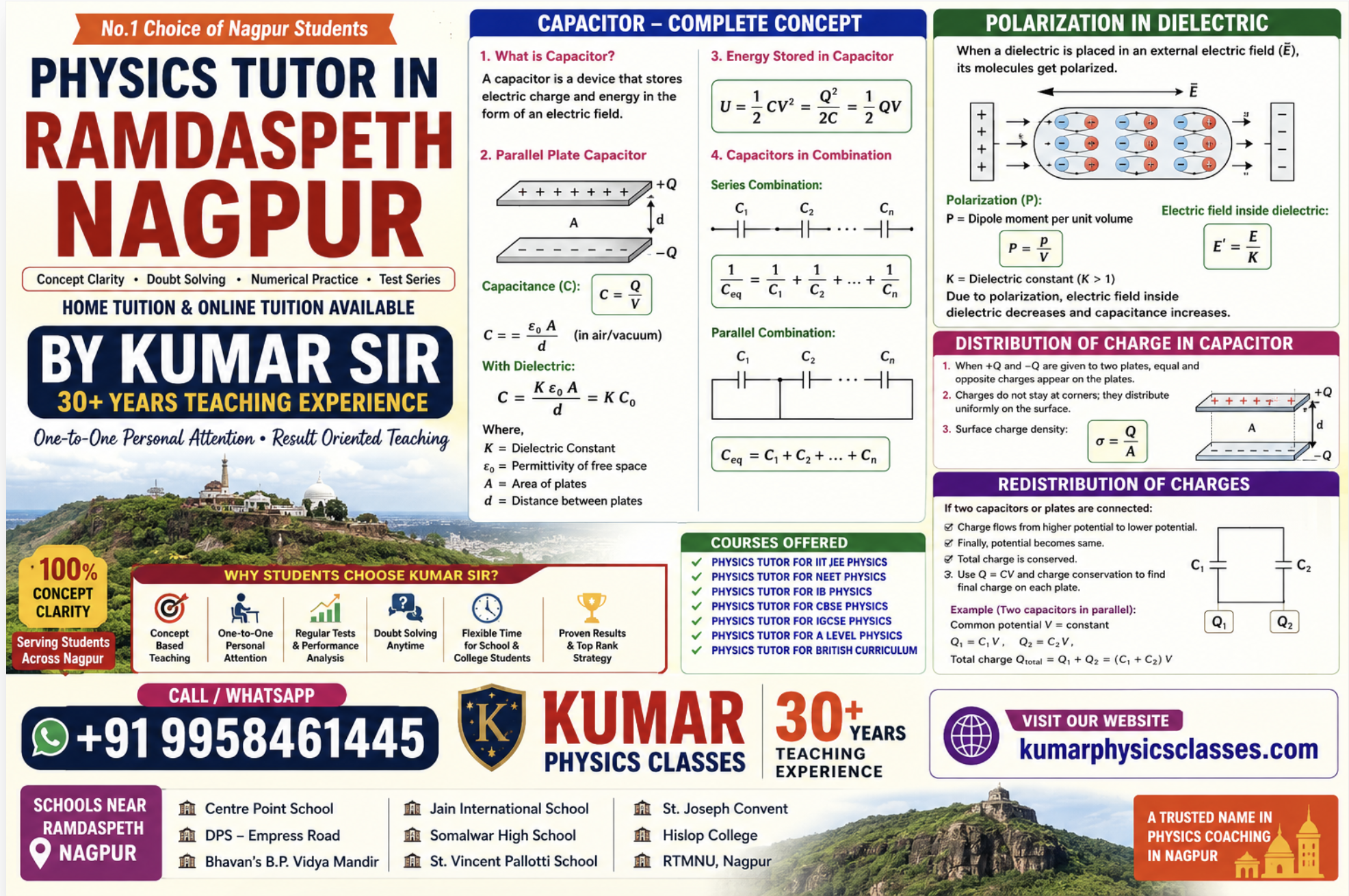
Physics Tutor in Ramdaspeth Nagpur – Capacitor Combination and Charge Redistribution
+91-9958461445
If you are searching for Physics Tutor in Ramdaspeth Nagpur, then Kumar Sir’s one-to-one Physics classes can help you understand difficult topics like capacitors, charge redistribution, equivalent capacitance and electrostatics in a very simple way.
Many students in Nagpur study formulas, but they do not understand how to think in capacitor questions. Kumar Sir teaches students how to identify points, how to find capacitance between two terminals, and how charge redistributes when two capacitor plates are connected.
Students from Physics Tutor in Civil Lines Nagpur, Physics Tutor in Dharampeth Nagpur, Physics Tutor in Sadar Nagpur, Physics Tutor in Seminary Hills Nagpur, Physics Tutor in Shivaji Nagar Nagpur, Physics Tutor in Laxmi Nagar Nagpur, Physics Tutor in Pratap Nagar Nagpur, Physics Tutor in Manish Nagar Nagpur, Physics Tutor in Wardha Road Nagpur and nearby areas can join Kumar Sir online.
How to Think in Capacitor Combination Questions
When a question asks for capacitance between two points, students should first identify the two terminals. For example, if the question asks for Cbd, it means capacitance between point B and point D. You should imagine a battery connected between B and D, then solve the circuit from that point of view.
Similarly:
Cbd = capacitance between B and D
Cad = capacitance between A and D
Cac = capacitance between A and C
This is the correct way to think. Whenever equivalent capacitance is asked between two points, connect an imaginary battery between those two points and then identify which capacitors are in series and which are in parallel.
Series and Parallel Capacitors
For capacitors in series:
1/Ceq = 1/C1 + 1/C2 + 1/C3 + … + 1/Cn
In series capacitors:
Charge remains same
For capacitors in parallel:
Ceq = C1 + C2 + C3 + … + Cn
In parallel capacitors:
Potential difference remains same
This is opposite to resistance. In resistance, series values add directly, but in capacitance, parallel values add directly.
Charge Redistribution in Parallel Plate Capacitor
In a parallel plate capacitor, if charge is given on two plates, say Q1 on one plate and Q2 on the other plate, then after connection, charge redistributes according to the condition of common potential.
The main idea is:
Total charge remains conserved
Final potential becomes common
If two conductors or plates are connected, charge flows until both connected parts reach the same potential. Kumar Sir explains this concept with diagrams so that students can understand why charge moves and where it finally settles.
In capacitor questions, students must remember:
Charge does not disappear
Charge redistributes
Potential becomes same after connection
Energy may change during redistribution
Equivalent capacitance depends on connection points
Why Kumar Sir for Capacitors and Electrostatics?
Capacitors are important for NEET, JEE, CBSE Class 12, IB Physics, IGCSE Physics and AP Physics. Many students make mistakes because they only memorize formulas. Kumar Sir focuses on concept building.
Students searching for Physics Tutor for IIT JEE Physics, Physics Tutor for NEET Physics, Physics Tutor for IB Physics, Physics Tutor for CBSE Physics, Physics Tutor for IGCSE Physics, Physics Tutor for A Level Physics, Physics Tutor for British Curriculum Physics can study directly from Kumar Sir.
Schools and Institutions Near Ramdaspeth Nagpur
Students from good schools and institutions can also join Kumar Physics Classes. If you are searching for Physics Tutor in Centre Point School Nagpur, Physics Tutor in Delhi Public School Nagpur, Physics Tutor in Bhavan’s Bhagwandas Purohit Vidya Mandir Nagpur, Physics Tutor in Jain International School Nagpur, Physics Tutor in Hislop College Nagpur, Physics Tutor in Rashtrasant Tukadoji Maharaj Nagpur University, Kumar Sir can guide you personally.
Final Words
If you live in Ramdaspeth Nagpur and Physics is difficult for you, especially capacitors, electrostatics, charge redistribution and equivalent capacitance, then you should learn from Kumar Sir.
Kumar Sir has 30 years teaching experience and teaches Physics with simple logic, proper diagrams, numerical practice and personal doubt solving.
Call / WhatsApp: +91-9958461445
Website: Kumar Physics Classes
Polarization Effect and Charge Redistribution in Capacitor
Polarization effect is produced when a dielectric material is placed in an external electric field. A dielectric is an insulating material, but its molecules contain positive and negative charge centres. When no electric field is applied, these charge centres are either randomly arranged or balanced. But when an electric field is applied, positive charge centres shift slightly in the direction of electric field and negative charge centres shift slightly opposite to the electric field. This small separation of charges inside the dielectric is called polarization.
In polar dielectric, molecules already have permanent dipole moment. External electric field only aligns these dipoles. In non-polar dielectric, molecules do not have permanent dipole moment, but electric field induces dipole moment in them.
Copy-paste friendly formulas:
Dipole moment = p = q × d
Polarization = P = dipole moment per unit volume
P = total dipole moment / volume
Electric field inside dielectric = E / K
Capacitance with dielectric = K C0
C = K ε0 A / d
Here:
K = dielectric constant
C0 = capacitance without dielectric
ε0 = permittivity of free space
A = area of plates
d = distance between plates
Due to polarization, an induced electric field is produced inside the dielectric in opposite direction of applied electric field. So the net electric field inside dielectric decreases. Because electric field decreases, potential difference decreases, and capacitance increases.
Charge Redistribution in Capacitor
In a capacitor, charge redistribution depends on connection and potential difference. Suppose one plate has positive charge and another plate has negative charge. When plates or conductors are connected, charge flows until connected parts reach the same potential.
Basic method:
First identify which plates are connected.
Total charge of connected conductor is conserved.
Final potential of connected parts becomes same.
Use formula Q = CV.
Distribute charge according to capacitance and common potential.
If two capacitors are connected in parallel, potential difference becomes same across both capacitors.
Formula:
V1 = V2 = common V
Q1 = C1 V
Q2 = C2 V
Total charge = Q1 + Q2
So larger capacitance stores more charge.
If capacitors are in series, charge remains same on each capacitor.
Formula:
Q1 = Q2 = Q
In simple words, charge redistribution happens because charges move from higher potential to lower potential until potential becomes equal.
Chemical Reaction in Capacitor
In normal capacitors like ceramic, mica, paper and plastic film capacitors, there is no chemical reaction during charging and discharging. They store energy only in electrostatic field.
But in electrolytic capacitors, electrolyte is used. A thin oxide layer works as dielectric. During manufacturing, chemical process forms this oxide layer. In supercapacitors, charge storage may happen by electrostatic double layer and sometimes by surface chemical reactions. These are called pseudo-capacitive effects.
Capacitor Breakdown
Capacitor breakdown happens when the electric field between the plates becomes greater than the dielectric strength of the insulating material. Every dielectric can tolerate only a limited electric field. If voltage becomes too high, the dielectric fails and starts conducting current.
In simple words, capacitor plates are separated by an insulator. Normally, current cannot pass directly through the dielectric. But if voltage is increased beyond the safe limit, the dielectric gets damaged and charge suddenly passes through it. This condition is called dielectric breakdown or capacitor breakdown.
Copy-paste friendly formula:
Electric field = E = V / d
Here:
V = potential difference between plates
d = distance between plates
If E becomes greater than dielectric strength, breakdown occurs.
Important point:
Breakdown condition: E > dielectric strength
During breakdown, the capacitor may heat up, spark, leak current, lose capacitance or get permanently damaged. In electrolytic capacitors, breakdown may also cause swelling or bursting.
To avoid capacitor breakdown, we should always use a capacitor with voltage rating higher than the applied voltage. For example, if circuit voltage is 12 V, we should not use a capacitor rated exactly 12 V. We should use a higher rated capacitor like 25 V or more for safety.
So, capacitor breakdown is the failure of dielectric due to excessive electric field.