
Physics Tutor in Farwaniya – Online Physics Classes for CBSE, NEET, IIT-JEE, IB, IGCSE, AP, A Level and Edexcel Students
+91-9958461445
If you live in Farwaniya, Kuwait, and your child is struggling in Physics, then this article is for you. Farwaniya is one of the important residential and commercial areas of Kuwait. Many Indian families, working professionals, business families and international school students live in and around Farwaniya. Parents work hard, children study in good schools, but one problem is very common: Physics does not become clear only by reading theory from books.
Physics needs concept, logic, diagrams, numerical practice and regular doubt solving. If a student is in CBSE, NEET, IIT-JEE, IB Physics, IGCSE Physics, AP Physics, A Level Physics or Edexcel Physics, then weak Physics can create serious problems later. A student may manage Chemistry or Biology by memorising, but Physics needs understanding. If force, current, voltage, resistance, waves, optics, modern physics and circuits are not clear, then marks will not come easily.
That is why students in Farwaniya can connect online with Kumar Sir from Delhi, an experienced Physics teacher with more than 30 years of teaching experience. Kumar Sir teaches Physics in a very clear, practical and exam-oriented way. Students can study from Kuwait through Zoom or online classes without leaving their home.
Why Students in Farwaniya Need a Good Physics Tutor
Many students in Kuwait study in Indian schools or international schools. They may be preparing for Indian entrance exams like NEET and IIT-JEE, or they may be studying for IB, IGCSE, A Level, AP or Edexcel Physics. The syllabus may be different, but the problem is almost the same: students understand the chapter in class, but when numerical questions come, they get stuck.
Physics is not a subject where only reading is enough. A good teacher must explain:
-
why the formula is used
-
where the formula comes from
-
how to draw the diagram
-
how to solve numericals step by step
-
how to write answers in board exams
-
how to attempt NEET and IIT-JEE questions quickly
-
how to handle IB, AP, A Level and IGCSE conceptual questions
Kumar Sir focuses on all these points. He first checks the level of the student, then starts teaching according to the child’s need.
Physics Tutor in Farwaniya for Different Curriculums
Students can contact Kumar Sir for:
-
CBSE Physics
-
NEET Physics
-
IIT-JEE Physics
-
IB Physics
-
IGCSE Physics
-
AP Physics
-
A Level Physics
-
Edexcel Physics
-
British Curriculum Physics
-
School Physics doubt solving
-
Numerical practice
-
Board exam preparation
-
Entrance exam preparation
If your child is weak in Physics, do not wait until the final exam. Physics becomes easy only when concepts are corrected early.
Important Schools and Areas Around Farwaniya
Students from different schools and areas around Farwaniya can join online Physics classes with Kumar Sir.
Physics Tutor in Indian Central School Kuwait, Physics Tutor in United Indian School Kuwait, Physics Tutor in Delhi Public School Kuwait, Physics Tutor in Indian Educational School Kuwait, Physics Tutor in Gulf Indian School Kuwait, Physics Tutor in Kuwait Indian School, Physics Tutor in Cambridge English School Kuwait, Physics Tutor in British School of Kuwait, Physics Tutor in American International School Kuwait
Students from nearby localities can also study online:
Physics Tutor in Farwaniya, Physics Tutor in Khaitan, Physics Tutor in Jleeb Al-Shuyoukh, Physics Tutor in Abbasiya, Physics Tutor in Hawally, Physics Tutor in Salmiya, Physics Tutor in Fahaheel, Physics Tutor in Kuwait City, Physics Tutor in Mangaf
For university-level foundation and entrance support:
Physics Tutor in Kuwait University, Physics Tutor in American University of Kuwait, Physics Tutor in Gulf University for Science and Technology, Physics Tutor in Australian University Kuwait
Why Kumar Sir for Physics in Farwaniya?
Kumar Sir teaches Physics with clarity. He does not simply write formulas and ask students to memorise them. He explains the idea behind the formula. For example, in electricity, he explains current, voltage, resistance and potential difference with real-life examples. In mechanics, he explains force and motion with diagrams. In optics, he explains ray diagrams step by step. In modern physics, he connects theory with numericals.
His teaching is useful for students who want:
-
better school marks
-
NEET selection
-
IIT-JEE preparation
-
strong board exam performance
-
IB and AP conceptual clarity
-
A Level and Edexcel numerical practice
-
confidence in Physics
Many students lose confidence because they think Physics is difficult. But Physics becomes difficult only when the basics are weak. Once the basics are strong, Physics becomes logical and interesting.
Wheatstone Bridge – Concept, Principle and Why Current Does Not Flow in the Middle Branch
Wheatstone Bridge is an important circuit in Physics. It is used to find an unknown resistance accurately. It is also very important for CBSE, NEET, IIT-JEE, AP Physics, IB Physics and A Level Physics.
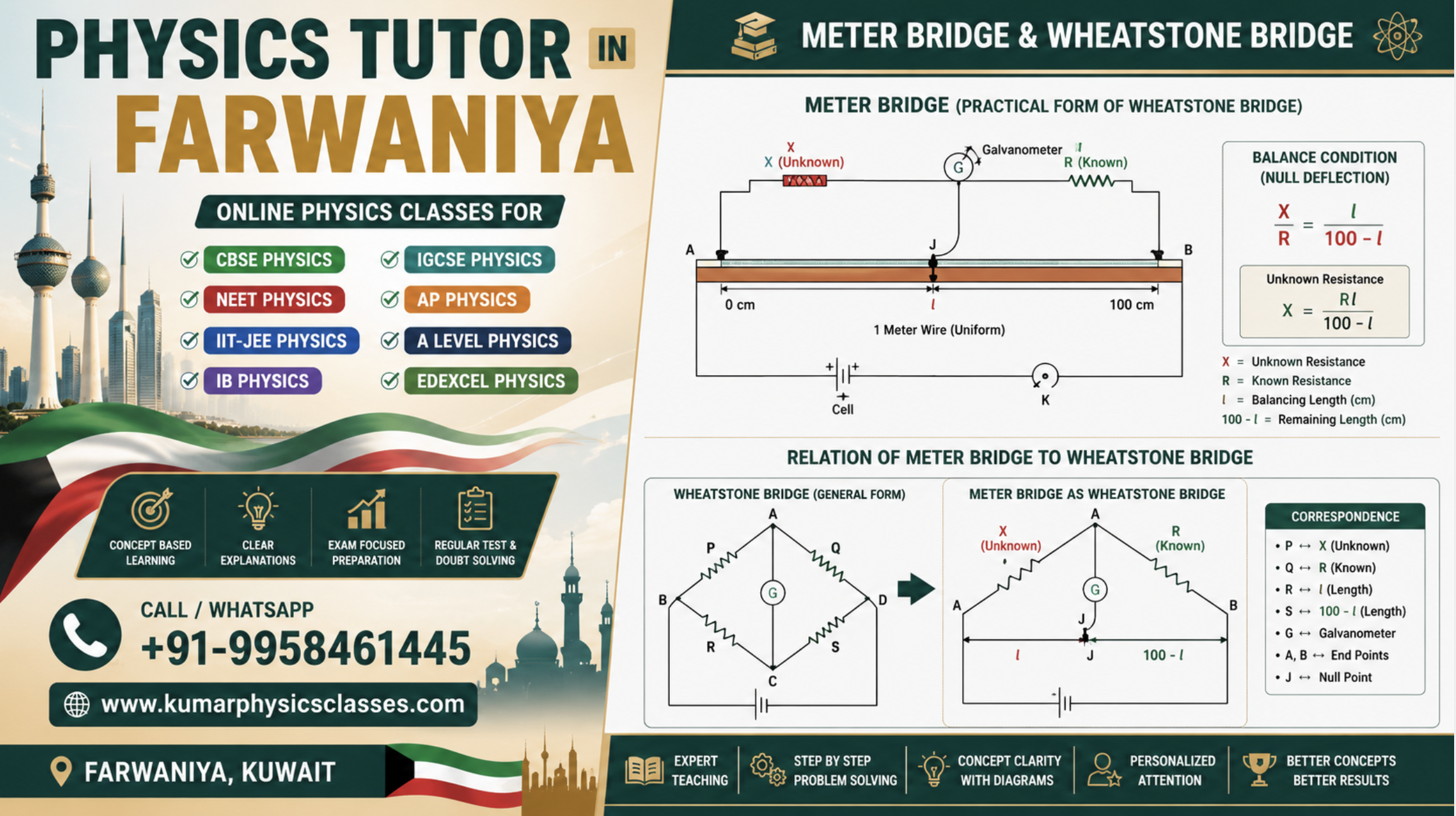
A Wheatstone Bridge has four resistances connected in the form of a bridge. A galvanometer is connected in the middle branch. The main idea is to compare two ratios of resistances.
Let the four resistances be P, Q, R and S.
The condition for balance is:
P / Q = R / S
When this condition is satisfied, the bridge is balanced.
Principle of Wheatstone Bridge
The principle of Wheatstone Bridge is based on the concept of equal potential. When the bridge is balanced, the two points connected by the galvanometer are at the same electric potential. Since potential difference between these two points is zero, no current flows through the galvanometer.
So, in balanced condition:
Potential difference across galvanometer = 0
Current through galvanometer = 0
This is why the middle branch does not carry current in a balanced Wheatstone Bridge.
Why Current Does Not Flow in the Middle Branch
Current flows only when there is a potential difference. In Wheatstone Bridge, when the ratio of resistances in one arm becomes equal to the ratio of resistances in the other arm, the two middle points reach the same potential.
So there is no potential difference between those points. Therefore, current through the galvanometer becomes zero.
In simple words:
If potential difference = 0, then current = 0.
Using Ohm’s law:
I = V / R
If V = 0, then:
I = 0 / R = 0
That is why no current flows in the middle branch.
Formula of Wheatstone Bridge
Balanced condition:
P / Q = R / S
If S is unknown, then:
S = (Q × R) / P
This formula is very useful in numerical problems.
Importance of Wheatstone Bridge in Exams
Wheatstone Bridge is asked in many forms:
-
finding unknown resistance
-
checking balanced condition
-
equivalent resistance problems
-
meter bridge questions
-
potentiometer comparison
-
conceptual questions on current in galvanometer
-
NEET and IIT-JEE numerical problems
A student must understand that the middle branch current becomes zero only in balanced condition, not always.
How Kumar Sir Teaches Wheatstone Bridge
Kumar Sir explains Wheatstone Bridge with circuit diagrams, potential concept and numerical practice. He first explains why current flows, then why current stops in the galvanometer branch during balance. After that, he teaches shortcut methods for NEET and IIT-JEE questions.
This helps students understand the topic deeply instead of memorising the formula.
Contact Kumar Physics Classes
For online Physics classes in Farwaniya, Kuwait, contact:
Kumar Physics Classes
Phone: +91-9958461445
Website: https://kumarphysicsclasses.com
Email: kumarsirphysics@gmail.com
50 Conceptual Questions with Answers on Wheatstone Bridge and Meter Bridge
-
What is a Wheatstone bridge?
Answer: A Wheatstone bridge is an electrical circuit used to find an unknown resistance accurately. -
What is the principle of Wheatstone bridge?
Answer: It works on the principle of null deflection, where no current flows through the galvanometer when the bridge is balanced. -
What is the balance condition of Wheatstone bridge?
Answer: P / Q = R / S. -
What happens in the galvanometer when Wheatstone bridge is balanced?
Answer: The galvanometer shows zero deflection. -
Why does no current flow through the galvanometer at balance point?
Answer: Because both ends of the galvanometer are at the same potential. -
What is meant by null point?
Answer: The point where galvanometer shows zero deflection is called null point. -
What is the use of Wheatstone bridge?
Answer: It is used to measure unknown resistance. -
Why is Wheatstone bridge more accurate than Ohm’s law method?
Answer: Because it uses null deflection, so the result does not depend much on galvanometer resistance. -
Which device is connected in the middle branch of Wheatstone bridge?
Answer: A galvanometer. -
Which device provides current in Wheatstone bridge?
Answer: A cell or battery. -
What are the four arms of Wheatstone bridge?
Answer: The four arms contain resistances P, Q, R and S. -
If P / Q = R / S, what is the bridge condition?
Answer: The bridge is balanced. -
If the bridge is not balanced, what happens?
Answer: Current flows through the galvanometer and it shows deflection. -
Can Wheatstone bridge measure very high resistance accurately?
Answer: No, it is not very suitable for very high resistance. -
Can Wheatstone bridge measure very low resistance accurately?
Answer: No, very low resistance measurement has errors due to contact resistance. -
What is a meter bridge?
Answer: A meter bridge is a practical form of Wheatstone bridge using a 1 meter long uniform wire. -
Why is it called meter bridge?
Answer: Because it uses a wire of length 1 meter. -
What is the principle of meter bridge?
Answer: It works on the principle of Wheatstone bridge. -
What is the balance condition in meter bridge?
Answer: R / X = l / (100 – l), where l is balancing length. -
What is balancing length?
Answer: The length of wire from one end to the null point is called balancing length. -
Why is the wire in meter bridge made uniform?
Answer: So that resistance is directly proportional to length. -
Which material is commonly used for meter bridge wire?
Answer: Manganin or constantan. -
Why manganin or constantan is used?
Answer: Because they have high resistivity and low temperature coefficient. -
Why should the jockey not be pressed hard on the wire?
Answer: Pressing hard changes the wire resistance and may damage the wire. -
What is the role of jockey in meter bridge?
Answer: It is used to find the null point on the wire. -
Why is galvanometer used in meter bridge?
Answer: To detect zero current at the balance point. -
What happens at the null point in meter bridge?
Answer: No current flows through the galvanometer. -
Why is meter bridge based on comparison of resistances?
Answer: Because unknown resistance is found by comparing it with a known resistance. -
Formula for unknown resistance X in meter bridge?
Answer: X = R(100 – l) / l, if R / X = l / (100 – l). -
What is end error in meter bridge?
Answer: Error due to resistance of copper strips and connections at the ends. -
How can end error be reduced?
Answer: By taking readings after interchanging known and unknown resistances. -
Why should balance point be near the middle of the wire?
Answer: To reduce percentage error and improve accuracy. -
Best balance point range in meter bridge?
Answer: Between 40 cm and 60 cm. -
Why is the meter bridge wire one meter long?
Answer: A longer wire gives better sensitivity and easier measurement. -
What is the relation between resistance and length in meter bridge wire?
Answer: Resistance is directly proportional to length. -
Why is the area of cross-section of wire uniform?
Answer: To keep resistance per unit length constant. -
What happens if wire is not uniform?
Answer: Resistance will not be proportional to length, causing error. -
Why is a plug key used in meter bridge?
Answer: To switch current on only during observation and avoid heating. -
Why should current not flow for a long time in meter bridge wire?
Answer: Heating changes resistance and causes error. -
What is the difference between Wheatstone bridge and meter bridge?
Answer: Wheatstone bridge is the general circuit, while meter bridge is its practical laboratory form. -
How is meter bridge related to Wheatstone bridge?
Answer: The two parts of the meter bridge wire act as two arms of Wheatstone bridge. -
Which two arms of Wheatstone bridge are replaced by wire lengths in meter bridge?
Answer: The ratio arms are replaced by lengths l and 100 – l. -
Why can length ratio replace resistance ratio in meter bridge?
Answer: Because for a uniform wire, resistance is proportional to length. -
What is the main advantage of null method?
Answer: It gives accurate results because no current flows through the detector at balance. -
Does galvanometer resistance affect balance condition?
Answer: No, at balance no current flows through it, so its resistance does not affect the result. -
What happens if the known resistance is too different from unknown resistance?
Answer: The balance point shifts near one end, increasing error. -
Why should known resistance be close to unknown resistance?
Answer: To get the balance point near the middle of the wire. -
Can meter bridge be used to compare two resistances?
Answer: Yes, it can compare two resistances using the balancing length. -
What is the main limitation of meter bridge?
Answer: It is affected by end error, contact resistance and non-uniform wire. -
Why is Wheatstone bridge important in Physics exams?
Answer: Because it tests concepts of resistance, potential difference, null method, circuits and measurement accuracy.