
Physics Tutor in Fujairah City
+91-9958461445
If you live in Fujairah City and Physics is becoming difficult for you, then you are not alone. Many students from Indian, British, American, CBSE, IB, IGCSE, A-Level, AP Physics, NEET and IIT JEE backgrounds face the same problem. They attend school, read NCERT, try H.C. Verma, attempt assignments, watch videos, but still feel confused when numerical questions come. The main reason is not lack of intelligence; the real reason is lack of concept clarity, step-by-step derivation practice and proper exam-oriented guidance.
At Kumar Physics Classes, Kumar Sir teaches Physics from the foundation level. He first clears the meaning of the concept, then explains the formula, then derives it, then solves numerical questions and finally trains the student for school exams, NEET, IIT JEE, AP Physics, A-Level Physics and IB Physics.
Students living in Fujairah City can connect with Kumar Sir for online Physics classes and get personal attention, doubt solving, numerical practice and proper exam strategy.
Contact: +91-9958461445
Website: https://kumarphysicsclasses.com
Important Fujairah City Area Links
Physics Tutor in Fujairah City, Physics Tutor in Al Faseel, Physics Tutor in Al Gurfa, Physics Tutor in Madhab, Physics Tutor in Sakamkam, Physics Tutor in Al Hayl, Physics Tutor in Merashid, Physics Tutor in Al Sharyah, Physics Tutor in Dibba Fujairah, Physics Tutor in Kalba
Physics Tutor in Fujairah City for NEET Physics, Physics Tutor in Fujairah City for IIT JEE Physics, Physics Tutor in Fujairah City for CBSE Physics, Physics Tutor in Fujairah City for AP Physics, Physics Tutor in Fujairah City for A-Level Physics, Physics Tutor in Fujairah City for IB Physics, Physics Tutor in Fujairah City for IGCSE Physics
Electromagnetic Induction: Complete Theory for Students
Electromagnetic Induction is one of the most beautiful chapters of Class 12 Physics. It connects electricity and magnetism. Before this chapter, students usually study electric current, magnetic field due to current, force on a current-carrying conductor and motion of charged particles in magnetic fields. But in Electromagnetic Induction, we learn the reverse idea: can magnetism produce electricity? The answer is yes.
Electromagnetic Induction means the production of induced emf or induced current in a circuit due to change in magnetic flux linked with the circuit.
Magnetic Flux
Magnetic flux is the total magnetic field passing through a given area. If a coil of area A is placed in a magnetic field B, and the angle between magnetic field and area vector is theta, then magnetic flux is:
Φ = B A cos θ
The SI unit of magnetic flux is weber.
Flux can change in three ways:
By changing magnetic field B
By changing area A
By changing angle θ between magnetic field and area vector
Whenever magnetic flux linked with a coil changes, emf is induced in the coil.
Faraday’s Law of Electromagnetic Induction
Faraday gave the basic law of electromagnetic induction. According to Faraday’s law:
Induced emf in a circuit is equal to the negative rate of change of magnetic flux linked with the circuit.
e = – dΦ/dt
For a coil having N turns:
e = – N dΦ/dt
Here, negative sign represents Lenz’s law.
This means if magnetic flux changes rapidly, induced emf will be large. If magnetic flux changes slowly, induced emf will be small. If magnetic flux is constant, no emf will be induced.
Lenz’s Law
Lenz’s law tells us the direction of induced current. According to Lenz’s law:
The direction of induced current is such that it opposes the cause which produces it.
This law is based on conservation of energy. If the induced current helped the change instead of opposing it, energy would be created from nothing, which is impossible.
Example: If the north pole of a magnet is moved towards a coil, the coil opposes the approach of the magnet. The face of the coil near the magnet behaves like a north pole. If the magnet is moved away, the coil opposes the separation and behaves like a south pole.
How EMF is Induced
EMF can be induced by relative motion between a magnet and a coil. Suppose a bar magnet is moved towards a coil connected to a galvanometer. The galvanometer shows deflection. This means current is produced. When the magnet stops moving, deflection becomes zero. When the magnet is moved away, deflection occurs in the opposite direction.
This proves that current is induced only when magnetic flux changes.
Motional EMF
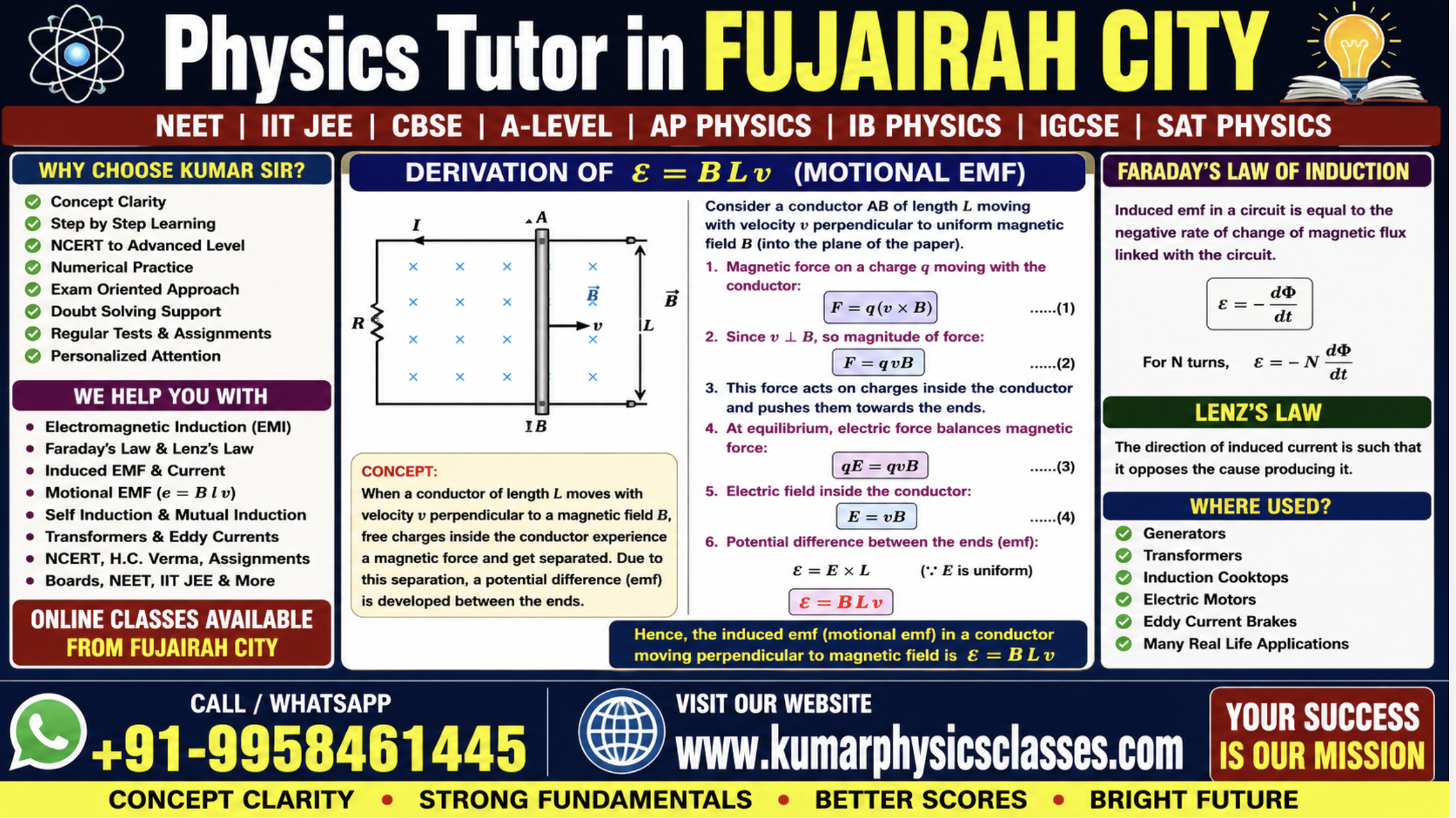
When a conducting rod moves in a magnetic field, free electrons inside the rod experience magnetic force. This force separates charges and creates potential difference across the ends of the rod. This potential difference is called motional emf.
If a rod of length l moves with velocity v perpendicular to magnetic field B, then:
e = B l v
This formula is very important for NEET, IIT JEE and board exams.
Self Induction
When current in a coil changes, magnetic flux linked with the same coil also changes. Due to this, emf is induced in the same coil. This phenomenon is called self induction.
The induced emf is:
e = – L dI/dt
Here L is self inductance.
Self inductance depends on number of turns, area of coil, length of coil and nature of core material.
Mutual Induction
When current changes in one coil, magnetic flux linked with nearby second coil changes. Due to this, emf is induced in the second coil. This is called mutual induction.
This principle is used in transformers.
Transformer
A transformer works on mutual induction. It changes AC voltage from one value to another. It has primary coil, secondary coil and soft iron core.
For an ideal transformer:
Vs / Vp = Ns / Np
If secondary turns are more than primary turns, it is a step-up transformer. If secondary turns are less than primary turns, it is a step-down transformer.
Transformer works only on AC because AC produces changing magnetic flux. It does not work on DC after steady state.
Eddy Currents
When a bulk conductor is placed in changing magnetic field, circular currents are induced inside the conductor. These currents are called eddy currents.
Uses of eddy currents:
Electromagnetic braking
Induction furnace
Speedometer
Energy meters
To reduce eddy currents, laminated cores are used in transformers.
Why Students Find EMI Difficult
Students often find Electromagnetic Induction difficult because it requires understanding of magnetic field, flux, calculus, sign convention, Lenz’s law and circuit concepts together. Many students memorize formulas but do not understand when to apply them.
Kumar Sir teaches EMI by first explaining magnetic flux physically, then Faraday’s law, then Lenz’s law, then motional emf, then self and mutual induction, and finally transformer and numerical problems. This step-by-step method helps students gain confidence.
Why Study EMI from Kumar Sir
Kumar Sir focuses on concept clarity, derivation, numerical application and exam pattern. Whether the student is preparing for NEET, IIT JEE, CBSE, AP Physics, A-Level Physics or IB Physics, the chapter is taught according to the required level.
For NEET, focus is on formula application and conceptual MCQs.
For IIT JEE, focus is on derivation, graphs, mixed circuits and advanced numerical problems.
For CBSE, focus is on theory, derivations and board-style questions.
For A-Level, AP and IB Physics, focus is on conceptual explanation, data-based questions and application-based reasoning.
If you are living in Fujairah City and Physics is troubling you, then proper guidance can change everything. Physics becomes easy when the teacher explains it in a logical, simple and numerical-based manner.
For online Physics classes, contact Kumar Physics Classes.
Phone: +91-9958461445
Website: https://kumarphysicsclasses.com
Faraday’s Laws of Electromagnetic Induction
Faraday’s laws explain how electricity can be produced from magnetism. Whenever the magnetic flux linked with a coil or circuit changes, an emf is induced in that circuit. If the circuit is closed, induced current also flows.
First Law
Whenever magnetic flux linked with a circuit changes, an induced emf is produced in the circuit.
Second Law
The magnitude of induced emf is directly proportional to the rate of change of magnetic flux linked with the circuit.
For one turn:
e = – dΦ/dt
For N turns:
e = – N dΦ/dt
Here:
e = induced emf
N = number of turns
Φ = magnetic flux
t = time
Negative sign shows Lenz’s law, meaning induced current always opposes the cause of change.
Procedure: How Induced EMF is Produced
Take a coil connected with a galvanometer.
Bring a bar magnet near the coil.
When the magnet moves towards the coil, galvanometer shows deflection.
When the magnet is stopped, deflection becomes zero.
When the magnet moves away, deflection occurs in opposite direction.
This proves that emf is induced only when magnetic flux changes.
Induced EMF Due to Motion
When a conductor of length l moves with velocity v in a magnetic field B, free electrons inside the conductor experience magnetic force.
Force on charge:
F = qvB
This force separates charges at the ends of the conductor. Due to charge separation, potential difference is produced. This potential difference is called motional emf.
If motion is perpendicular to magnetic field:
e = Blv
If angle between velocity and magnetic field is θ:
e = Blv sinθ
So, induced emf is produced when a conductor cuts magnetic field lines during motion.
50 Conceptual Questions with Answers on EMI
What is electromagnetic induction?
Electromagnetic induction is the production of induced emf due to change in magnetic flux.Who discovered electromagnetic induction?
Michael Faraday discovered electromagnetic induction.What is magnetic flux?
Magnetic flux is the total magnetic field passing through an area.Formula of magnetic flux?
Φ = BA cosθUnit of magnetic flux?
Weber.When is emf induced in a coil?
When magnetic flux linked with the coil changes.Faraday’s first law?
Change in magnetic flux produces induced emf.Faraday’s second law?
Induced emf is proportional to rate of change of magnetic flux.Formula of induced emf?
e = -dΦ/dtFormula for N turns coil?
e = -N dΦ/dtWhat does negative sign show?
It shows Lenz’s law.What is Lenz’s law?
Induced current opposes the cause producing it.Which conservation law supports Lenz’s law?
Conservation of energy.Can emf be induced without current?
Yes, if circuit is open, emf is induced but current does not flow.Can current be induced without closed circuit?
No, current needs a closed path.What is motional emf?
EMF produced due to motion of conductor in magnetic field.Formula of motional emf?
e = BlvWhen is e = Blv valid?
When conductor moves perpendicular to magnetic field.General formula of motional emf?
e = Blv sinθWhy charges separate in moving conductor?
Because magnetic force acts on free electrons.Magnetic force on charge?
F = qvB sinθWhat happens if conductor moves parallel to magnetic field?
No emf is induced.Why no emf for parallel motion?
Because conductor does not cut magnetic field lines.What is self induction?
Induction of emf in same coil due to change in its own current.Formula of self-induced emf?
e = -L dI/dtWhat is self inductance?
Property of coil to oppose change in current.Unit of inductance?
Henry.What is mutual induction?
Induction of emf in one coil due to changing current in another coil.Where is mutual induction used?
In transformers.Why transformer works only on AC?
Because AC produces changing magnetic flux.Does transformer work on DC?
No, after steady state DC does not change flux.What is eddy current?
Circular induced current produced in bulk conductor.One use of eddy current?
Electromagnetic braking.One disadvantage of eddy current?
It causes heating and energy loss.How are eddy currents reduced?
By using laminated core.What is flux linkage?
Total flux linked with all turns of coil, equal to NΦ.What increases induced emf?
More turns, stronger magnetic field, faster change in flux.If magnet is stationary near coil, is emf induced?
No, because flux is not changing.If magnet moves faster, what happens?
Induced emf increases.If coil area increases in magnetic field, what happens?
Flux changes, so emf is induced.If angle between B and area vector changes, what happens?
Flux changes, so emf is induced.Maximum flux condition?
When θ = 0°, Φ = BA.Zero flux condition?
When θ = 90°, Φ = 0.What is generator principle?
Generator works on electromagnetic induction.Energy conversion in generator?
Mechanical energy converts into electrical energy.What is back emf?
Opposing emf produced in motor due to rotation.Why EMI is important in Physics?
It explains generators, transformers, inductors and AC circuits.What is induced current direction when north pole approaches coil?
Coil opposes approach and behaves like north pole.What is induced current direction when magnet moves away?
Coil opposes separation and attracts the magnet.Main condition for EMI?
There must be change in magnetic flux linked with the circuit.