
Physics Tutor in RAK City – Capacitance, Farad, Microfarad and Why Capacitors Use Small Units
+91-9958461445
If you live in RAK City and Physics is becoming difficult for you, then you are not alone. Many students understand definitions in class, but when formulas, units and numerical comparisons come, they get confused. This is why Kumar Sir explains Physics from the most basic level, step by step, so that the student does not just remember the formula but understands the meaning behind it.
Students from Physics Tutor in RAK City, Physics Tutor in Al Hamra Village, Physics Tutor in Mina Al Arab, Physics Tutor in Al Nakheel RAK, Physics Tutor in Ras Al Khaimah, Physics Tutor in RAK Academy, Physics Tutor in Indian School Ras Al Khaimah, Physics Tutor in GEMS Westminster School RAK, NEET Physics Tutor, IIT JEE Physics Tutor, JEE Physics Tutor, IB Physics Tutor, A-Level Physics Tutor, AP Physics Tutor, and CBSE Physics Tutor can contact Kumar Physics Classes for online Physics tuition.
What is a Capacitor?
A capacitor is a device which stores electric charge and electrical energy. When potential difference is applied across a capacitor, charge starts accumulating on its plates. The important point is that the charge stored on a capacitor is directly proportional to the potential applied across it.
Copy-paste friendly formula:
Q proportional to V
So,
Q = kV
Here, k is the constant of proportionality. In capacitance, this constant is called C.
Therefore,
Q = CV
So,
C = Q / V
This means:
Capacitance = Charge / Potential Difference
Unit of capacitance:
Coulomb / Volt
This unit is called Farad.
So,
1 Farad = 1 Coulomb / 1 Volt
Why is Farad a Very Large Unit?
Farad is a very large unit because storing 1 coulomb of charge at only 1 volt potential difference requires a very large capacitance. In practical circuits, capacitors usually have very small capacitance values. That is why we commonly use microfarad, nanofarad and picofarad.
Important units:
1 microfarad = 10^-6 farad
1 nanofarad = 10^-9 farad
1 picofarad = 10^-12 farad
So, 1 microfarad is one millionth of a farad. This is why microfarad is much smaller and more practical than farad.
Capacitance of Earth as a Spherical Conductor
If we treat Earth as an isolated spherical conductor, its capacitance is given by:
C = 4 pi epsilon zero R
Where:
C = capacitance of Earth
epsilon zero = 8.85 × 10^-12 F/m
R = radius of Earth = 6.4 × 10^6 m
Now putting values:
C = 4 × 3.14 × 8.85 × 10^-12 × 6.4 × 10^6
C = 7.1 × 10^-4 F approximately
So,
Capacitance of Earth = 0.00071 F
In microfarad:
1 F = 10^6 microfarad
Therefore,
0.00071 F = 710 microfarad approximately
Important Comparison
The whole Earth, treated as a conductor, has capacitance of only about:
710 microfarad
This clearly shows how large 1 farad is. If the entire Earth has capacitance less than 1 farad, then in normal electronic circuits, using farad as a unit becomes impractical. That is why capacitors are usually measured in microfarad, nanofarad or picofarad.
Kumar Sir Style Explanation
Think simply. If a small capacitor is written as 1 microfarad, it means it is only:
1 / 1,000,000 farad
So, 1 microfarad is extremely small compared to 1 farad. But in real circuits, even this small value is useful. Fans, filters, mobile chargers, power supplies, amplifiers, motherboards and many electronic devices use capacitors of small values.
This is where students usually make mistakes. They remember Q = CV, but they do not understand the size of the unit. Kumar Sir explains these things with comparison. When a student understands that even Earth has capacitance around 710 microfarad, then the student immediately understands why farad is a very large unit.
Final Conclusion
Capacitance tells us how much charge a conductor can store for a given potential difference. The basic formula is:
C = Q / V
Its SI unit is farad, but farad is very large. That is why practical capacitors are measured in microfarad, nanofarad and picofarad. A 1 microfarad capacitor is much smaller than 1 farad because:
1 microfarad = 10^-6 farad
Even Earth has capacitance of only about 710 microfarad, so we can understand that 1 farad is a huge unit.
For Physics tuition in RAK City, NEET Physics, IIT JEE Physics, JEE Physics, IB Physics, A-Level Physics, AP Physics and CBSE Physics, students can contact Kumar Physics Classes.
Call / WhatsApp: +91-9958461445
Website: https://kumarphysicsclasses.com
40 Conceptual Questions with Answers on Capacitors
1. What is a capacitor?
A capacitor is a device used to store electric charge and electrical energy.
2. How is charge stored in a capacitor?
Charge is stored on the conducting plates of a capacitor. One plate gets positive charge and the other plate gets equal negative charge.
3. Does a capacitor store net charge?
No. The net charge of the capacitor is zero because both plates have equal and opposite charges.
4. What is capacitance?
Capacitance is the ability of a capacitor to store charge for a given potential difference.
5. What is the formula of capacitance?
C = Q / V
6. Does capacitance depend on charge?
No. Capacitance does not depend on charge. It depends on geometry and medium.
7. Does capacitance depend on potential?
No. Capacitance does not depend on potential difference.
8. If Q increases, what happens to V?
If capacitance is constant, then V increases because Q = CV.
9. What is the graph between capacitance and potential?
The C–V graph is a straight line parallel to the potential axis because capacitance remains constant.
10. What is the SI unit of capacitance?
The SI unit of capacitance is farad.
11. Why is farad a large unit?
Farad is large because even very big conductors have small capacitance in practical situations.
12. What is a normal parallel plate capacitor?
It is a capacitor made of two parallel conducting plates separated by a small distance.
13. Formula for parallel plate capacitor?
C = epsilon A / d
14. What happens if plate area increases?
Capacitance increases because C is directly proportional to area.
15. What happens if distance between plates increases?
Capacitance decreases because C is inversely proportional to distance.
16. Why is dielectric inserted between plates?
A dielectric increases capacitance by reducing effective electric field and potential difference.
17. What happens to capacitance when dielectric constant K is inserted?
Capacitance becomes K times.
18. What is a spherical capacitor?
A spherical capacitor consists of two concentric conducting spherical shells.
19. Formula for concentric spherical capacitor?
C = 4 pi epsilon ab / (b – a)
Here, a = radius of inner sphere and b = radius of outer sphere.
20. What happens if outer sphere is very far away?
If b tends to infinity, capacitance becomes:
C = 4 pi epsilon a
This is capacitance of an isolated spherical conductor.
21. What is capacitance of an isolated sphere?
C = 4 pi epsilon R
22. Does capacitance of isolated sphere depend on charge?
No. It depends only on radius and surrounding medium.
23. What happens if radius of spherical conductor increases?
Capacitance increases.
24. Why does a bigger sphere have more capacitance?
Because it can store more charge for the same potential.
25. What is a cylindrical capacitor?
A cylindrical capacitor consists of two coaxial conducting cylinders separated by an insulating medium.
26. Formula for cylindrical capacitor?
C = 2 pi epsilon L / ln(b/a)
Here, a = radius of inner cylinder, b = radius of outer cylinder, L = length.
27. What happens if length of cylindrical capacitor increases?
Capacitance increases.
28. What happens if distance between cylinders increases?
Capacitance decreases.
29. Why is cylindrical capacitor used in cables?
Because coaxial cables behave like cylindrical capacitors.
30. Where is electric field present in a capacitor?
Electric field is mainly present between the plates or between the conducting surfaces.
31. Is electric field inside conductor zero?
Yes. In electrostatic condition, electric field inside a conductor is zero.
32. Where does charge reside on a conductor?
Charge resides on the outer surface of a conductor.
33. In a capacitor, why do charges appear on facing surfaces?
Because opposite charges attract each other and electric field is formed between the plates.
34. What is energy stored in a capacitor?
Energy stored is:
U = 1/2 CV²
35. Other formulas for energy stored?
U = Q² / 2C
U = 1/2 QV
36. If potential is doubled, what happens to energy?
Energy becomes four times because U is proportional to V².
37. If charge is doubled, what happens to energy?
Energy becomes four times because U is proportional to Q².
38. What is the role of medium in capacitance?
Medium affects capacitance through permittivity.
39. Why does capacitance remain constant for a given capacitor?
Because for a given capacitor, geometry and medium remain fixed.
40. What is the most important concept of capacitor?
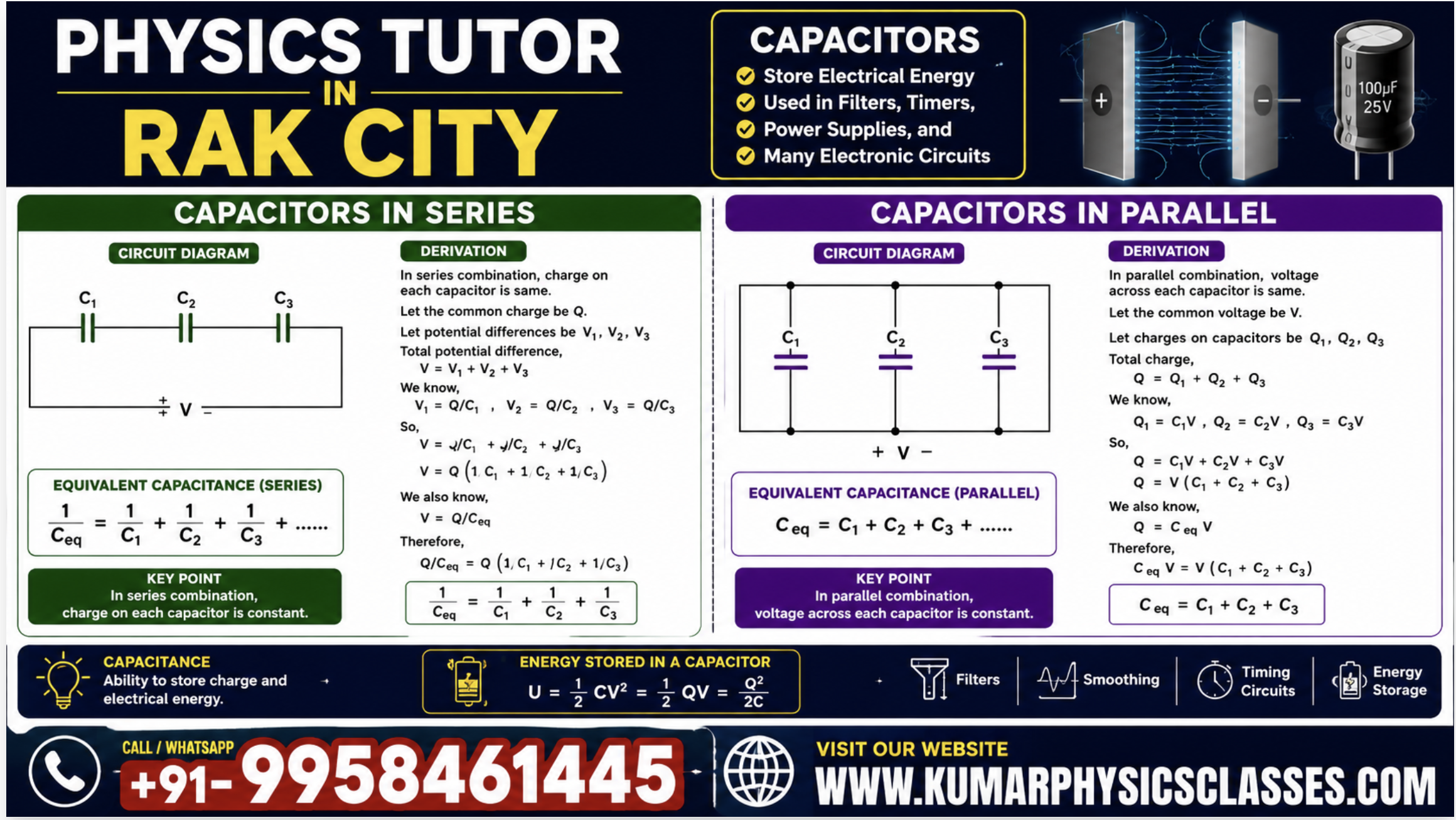
Capacitance is a property of the capacitor, not of charge or potential. Charge and potential change together, but their ratio Q/V remains constant. Capacitor is an important device used to store electrical energy in an electric field. In a series combination of capacitors, the charge on every capacitor remains the same because the same amount of charge flows through each plate arrangement. However, the potential difference divides according to capacitance. In a parallel combination of capacitors, the voltage across every capacitor remains the same because all capacitors are connected across the same two points. The charge may be different on each capacitor depending on its capacitance. Capacitors are mainly used for energy storage, filtering, smoothing, timing circuits and many electronic applications.