
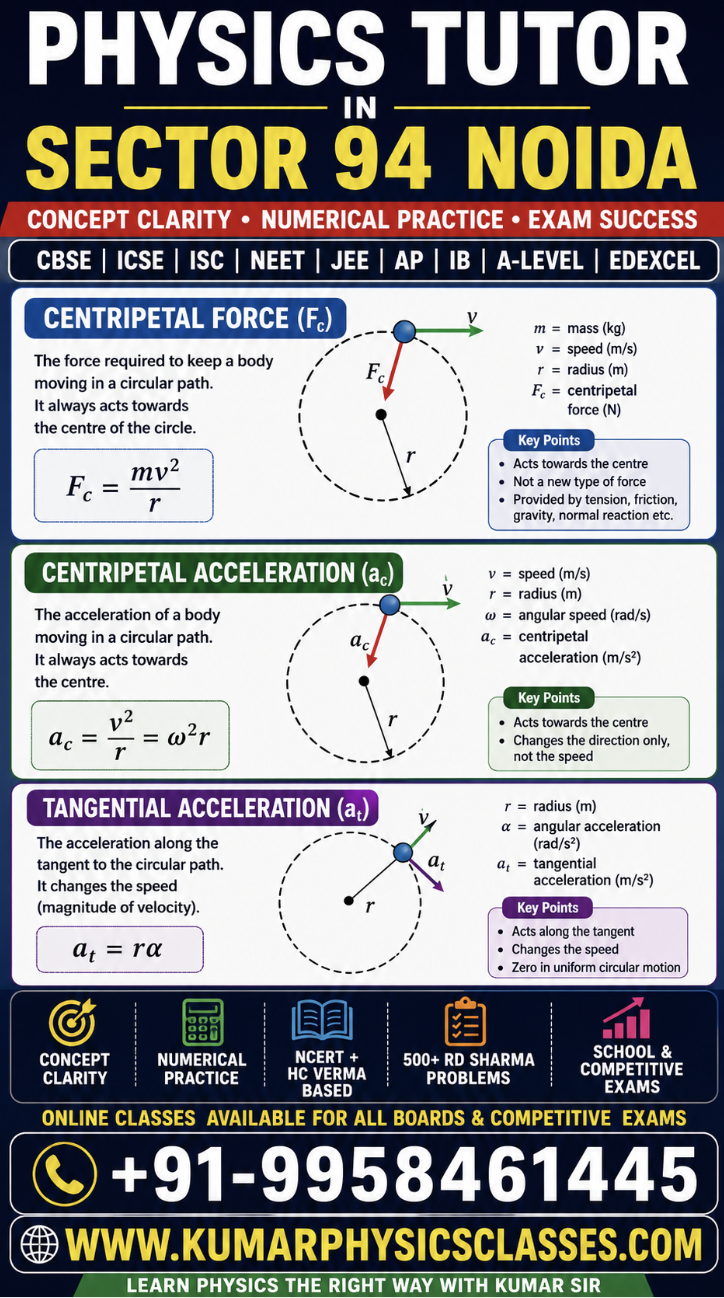
Physics Tutor in Sector 94 Noida – Kumar Physics Classes
+91-9958461445
If you live in Sector 94 Noida and Physics is becoming difficult for you, then the real issue is not only the subject. The real issue is usually weak concept clarity, poor numerical practice, and lack of proper guidance. Many students attend school, watch YouTube videos, join random classes, but still they cannot solve application-based Physics questions.
Physics is not a subject of memorising formulas only. Physics needs understanding, derivation, visualisation and regular numerical practice.
At Kumar Physics Classes, Kumar Sir teaches Physics through proper concepts, H.C. Verma based numerical practice, school exam preparation and competitive exam-oriented approach. Students preparing for CBSE, ICSE, ISC, NEET, JEE, IB, AP Physics, A-Level Physics and Edexcel Physics can contact Kumar Physics Classes.
Website: https://kumarphysicsclasses.com
Contact: +91-9958461445
Email: kumarsirphysics@gmail.com
Why Students in Sector 94 Noida Need a Proper Physics Tutor
Sector 94 Noida is a well-connected area, but many students living here still struggle with Physics. The reason is simple: they study chapters, but they do not understand the logic behind the formulas.
For example, in circular motion, many students know the formula:
Centripetal force = mv²/r
But when the question is slightly twisted, they get confused.
Suppose a street performer is cycling on a circular track of radius 6 m and completes one revolution in 15 seconds. If the total mass of the man, monkey and cycle is 100 kg, then the friction force provides the required centripetal force.
Time period, T = 15 s
Radius, r = 6 m
Mass, m = 100 kg
Speed:
v = 2πr/T
v = 2 × 3.14 × 6 / 15
v ≈ 2.51 m/s
Centripetal force:
F = mv²/r
F = 100 × (2.51)² / 6
F ≈ 105 N
So, the required friction force is nearly 105 N.
This is exactly where students get stuck. They remember formulas but do not know how to apply them in real-life situations. Kumar Sir explains such questions step by step so that students understand the concept permanently.
Kumar Sir’s Teaching Method
Kumar Sir focuses on:
Concept clarity
H.C. Verma based problem solving
NCERT theory understanding
Board exam presentation
NEET and JEE numerical practice
Doubt clearing
Regular revision
Application-based questions
Physics becomes easy when every formula is connected with logic. Whether the chapter is mechanics, circular motion, rotational motion, electrostatics, current electricity, optics, modern physics, waves or thermodynamics, Kumar Sir teaches from the basic level.
Physics Tutor in Noida Schools
Physics Tutor in Delhi Public School Noida, Physics Tutor in Amity International School Noida, Physics Tutor in Lotus Valley International School Noida, Physics Tutor in Step by Step School Noida, Physics Tutor in Shiv Nadar School Noida, Physics Tutor in Pathways School Noida, Physics Tutor in Genesis Global School Noida, Physics Tutor in Mayoor School Noida, Physics Tutor in Somerville School Noida, Physics Tutor in Cambridge School Noida, Physics Tutor in Apeejay School Noida, Physics Tutor in Bal Bharati Public School Noida, Physics Tutor in Ryan International School Noida, Physics Tutor in Billabong High International School Noida, Physics Tutor in The Khaitan School Noida, Physics Tutor in Ramagya School Noida, Physics Tutor in Manav Rachna International School Noida, Physics Tutor in Global Indian International School Noida, Physics Tutor in JBM Global School Noida, Physics Tutor in Sapphire International School Noida
Physics Tutor in Greater Noida Schools
Physics Tutor in Delhi Public School Greater Noida, Physics Tutor in Ryan International School Greater Noida, Physics Tutor in Apeejay International School Greater Noida, Physics Tutor in Cambridge School Greater Noida, Physics Tutor in Somerville School Greater Noida, Physics Tutor in Jaypee Public School Greater Noida, Physics Tutor in GD Goenka Public School Greater Noida, Physics Tutor in Lotus Valley International School Greater Noida, Physics Tutor in Greater Valley School Greater Noida, Physics Tutor in Pacific World School Greater Noida
Important Physics Tutor Tags in Noida
CBSE Physics Tutor in Noida, ICSE Physics Tutor in Noida, ISC Physics Tutor in Noida, NEET Physics Tutor in Noida, IIT Physics Tutor in Noida, JEE Physics Tutor in Noida, IB Physics Tutor in Noida, AP Physics Tutor in Noida, A-Level Physics Tutor in Noida, Edexcel Physics Tutor in Noida, British Curriculum Physics Tutor in Noida
Why Kumar Physics Classes?
Kumar Sir has more than 30 years of teaching experience. His teaching style is simple, direct and exam-oriented. Students are not only taught formulas, but also the reason behind every formula. This helps them solve numerical questions confidently.
If a student is weak in Physics, the first step is not to panic. The first step is to rebuild the foundation. Once concepts become clear, Physics becomes logical and scoring.
Final Words
If you live in Sector 94 Noida and Physics is troubling you, do not waste time in random shortcuts. Physics needs a proper teacher, proper notes, proper derivations and regular numerical practice.
For online Physics classes, contact Kumar Physics Classes.
Website: https://kumarphysicsclasses.com
Contact: +91-9958461445
Email: kumarsirphysics@gmail.com
50 Conceptual Questions and Answers on Centripetal Force, Centrifugal Force, Tangential Acceleration and Centripetal Acceleration
1. What is centripetal force?
Answer: Centripetal force is the force required to keep a body moving in a circular path. It always acts towards the centre of the circle.
2. Why is centripetal force necessary in circular motion?
Answer: Because without centripetal force, the body will move in a straight line due to inertia. Circular motion needs continuous change in direction, and this change is produced by centripetal force.
3. What is the direction of centripetal force?
Answer: Centripetal force always acts towards the centre of the circular path.
4. Is centripetal force a new type of force?
Answer: No. Centripetal force is not a separate force. It may be provided by tension, friction, gravitational force, normal reaction or electrostatic force.
5. What is the formula of centripetal force?
Answer:
Centripetal force = mv²/r
where m is mass, v is speed and r is radius.
6. What happens if centripetal force suddenly disappears?
Answer: The body will move along the tangent to the circular path at that point.
7. Why does a stone tied to a string move in a circle?
Answer: Because tension in the string provides the required centripetal force towards the centre.
8. What happens when the string breaks?
Answer: The stone moves tangentially, not radially outward. This is very important.
9. Why does a car need friction while taking a turn?
Answer: Friction provides the required centripetal force for the car to move along a curved path.
10. Why does a cyclist bend while taking a turn?
Answer: The cyclist bends to balance the torque and to get the required centripetal force safely without falling.
11. What is centripetal acceleration?
Answer: Centripetal acceleration is the acceleration directed towards the centre of the circular path.
12. What is the formula of centripetal acceleration?
Answer:
Centripetal acceleration = v²/r
or
a = ω²r
13. Does centripetal acceleration change speed?
Answer: No. Centripetal acceleration changes only the direction of velocity, not the magnitude of velocity.
14. Can a body have acceleration even if its speed is constant?
Answer: Yes. In uniform circular motion, speed is constant but direction changes continuously, so acceleration exists.
15. Why is uniform circular motion called accelerated motion?
Answer: Because velocity changes continuously due to change in direction.
16. What is tangential acceleration?
Answer: Tangential acceleration is the acceleration along the tangent to the circular path. It changes the speed of the body.
17. What is the formula of tangential acceleration?
Answer:
Tangential acceleration = rα
where r is radius and α is angular acceleration.
18. What does tangential acceleration change?
Answer: Tangential acceleration changes the magnitude of velocity, means speed.
19. What does centripetal acceleration change?
Answer: Centripetal acceleration changes the direction of velocity.
20. Can tangential acceleration be zero?
Answer: Yes. In uniform circular motion, tangential acceleration is zero because speed is constant.
21. Can centripetal acceleration be zero in circular motion?
Answer: No, if the body is moving in a circular path with non-zero speed, centripetal acceleration must exist.
22. What is the difference between centripetal and tangential acceleration?
Answer: Centripetal acceleration acts towards the centre and changes direction. Tangential acceleration acts along tangent and changes speed.
23. Are centripetal acceleration and tangential acceleration perpendicular?
Answer: Yes. Centripetal acceleration is radial, and tangential acceleration is along tangent, so they are perpendicular.
24. What is total acceleration in non-uniform circular motion?
Answer: Total acceleration is the vector sum of centripetal acceleration and tangential acceleration.
25. What is centrifugal force?
Answer: Centrifugal force is an apparent or pseudo force experienced in a rotating frame. It appears to act away from the centre.
26. Is centrifugal force real?
Answer: In an inertial frame, centrifugal force is not real. It is a pseudo force used only in a rotating frame.
27. Why do we feel thrown outward in a turning car?
Answer: Due to inertia, our body tends to move straight. In the rotating frame of the car, this effect is felt as centrifugal force.
28. What is the direction of centrifugal force?
Answer: Centrifugal force acts away from the centre in a rotating frame.
29. What is the magnitude of centrifugal force?
Answer: Its magnitude is equal to mv²/r, but direction is outward in rotating frame.
30. Are centripetal and centrifugal forces action-reaction pair?
Answer: No. They are not action-reaction pair because they act in different frames of reference.
31. Why is centrifugal force called pseudo force?
Answer: Because it appears only when we observe motion from a non-inertial rotating frame.
32. In a rotating merry-go-round, why do we feel pushed outward?
Answer: Because our body tends to continue in a straight line due to inertia, but from the rotating frame it feels like an outward force.
33. Why does mud fly off tangentially from a rotating tyre?
Answer: When mud loses contact with the tyre, centripetal force disappears, so it moves along the tangent.
34. Why are roads banked at turns?
Answer: Roads are banked so that a component of normal reaction provides centripetal force, reducing dependence on friction.
35. Why is it difficult to take a sharp turn at high speed?
Answer: Because required centripetal force increases with v². If speed doubles, required force becomes four times.
36. How does radius affect centripetal force?
Answer: For same mass and speed, smaller radius requires greater centripetal force.
37. Why do satellites move around planets?
Answer: Gravitational force provides the required centripetal force for orbital motion.
38. Does a satellite need fuel continuously to remain in orbit?
Answer: Ideally no. Gravity provides centripetal force, and the satellite keeps moving due to inertia.
39. Why does water not fall immediately from a bucket rotated vertically?
Answer: At the top, if speed is sufficient, gravity and normal reaction provide centripetal force, so water remains in circular motion.
40. What is the minimum speed at the top of vertical circle?
Answer: Minimum speed at the top is √(gr), when tension or normal reaction becomes zero.
41. Why does tension vary in vertical circular motion?
Answer: Because weight also acts vertically downward, so its contribution to centripetal force changes at different positions.
42. Where is tension maximum in vertical circular motion?
Answer: Tension is maximum at the lowest point because it must provide centripetal force and also balance weight.
43. Where is tension minimum in vertical circular motion?
Answer: Tension is minimum at the highest point because weight already acts towards the centre.
44. Can centripetal force do work?
Answer: In uniform circular motion, centripetal force does no work because it is perpendicular to displacement at every instant.
45. Can tangential force do work?
Answer: Yes. Tangential force can do work because it acts along the direction of motion and changes speed.
46. Why is power zero due to centripetal force in uniform circular motion?
Answer: Power = Fv cosθ. Here θ = 90°, so power is zero.
47. If angular speed increases, what happens to centripetal acceleration?
Answer: Centripetal acceleration increases because a = ω²r.
48. If radius increases at same angular speed, what happens to centripetal acceleration?
Answer: It increases because a = ω²r.
49. If radius increases at same linear speed, what happens to centripetal acceleration?
Answer: It decreases because a = v²/r.
50. What is the most important concept in circular motion?
Answer: The most important concept is that velocity is tangential, centripetal acceleration is towards the centre, and centrifugal force is only a pseudo force in rotating frame.