
Physics Tutor in Navi Mumbai – Kumar Physics Classes
+91-9958461445
Navi Mumbai is one of the fastest-growing education hubs near Mumbai. Families living in Vashi, Nerul, Kharghar, Seawoods, Belapur, Airoli, Ghansoli, Kopar Khairane, Sanpada and Panvel want strong education, good schools and serious preparation for NEET, IIT JEE, CBSE, ICSE, IB, IGCSE and A-Level Physics.
But the real problem is very simple: many students study Chemistry, Biology or Maths properly, but Physics creates fear. In NEET, Biology and Chemistry may improve with regular reading, but Physics needs concept clarity, formula application, numerical practice and logical thinking. In IIT JEE also, many students manage Maths and Chemistry, but Physics becomes the deciding subject because JEE Physics demands imagination, diagrams, analysis and step-by-step problem solving.
This is where Kumar Physics Classes helps students. Kumar Sir teaches Physics from the root level. He does not only explain formulas; he explains why the formula is used, where it is used and how the question setter thinks. If a student is weak in mechanics, current electricity, magnetism, optics, modern physics, waves or thermodynamics, Kumar Sir works on the basic concept first and then moves towards exam-level questions.
For students preparing for NEET, IIT JEE Main, JEE Advanced, CBSE Class 11, CBSE Class 12, ICSE, ISC, IB Physics, IGCSE Physics, A-Level Physics and AP Physics, personal guidance can make a big difference. Many students join big coaching institutes, but their doubts remain pending. When doubts remain pending, confidence goes down and marks do not improve. Kumar Sir focuses on doubt clearing, concept building, numerical confidence and exam-oriented preparation.
If you are living in Navi Mumbai and searching for a serious Physics tutor, you can contact Kumar Sir.
Contact Kumar Physics Classes
Phone: +91-9958461445
Website: www.kumarphysicsclasses.com
Email: kumarsirphysics@gmail.com
Physics Tutor in Navi Mumbai for NEET and IIT JEE
NEET Physics needs accuracy, speed and conceptual clarity. A student may know the formula, but if he does not understand the concept behind the formula, he will get stuck in the exam. Similarly, IIT JEE Physics needs deep thinking. In JEE Advanced, questions are not direct. They test whether the student can connect different concepts together.
Kumar Sir helps students understand Physics in a simple and practical way. Every topic is taught with examples, diagrams, numerical practice and exam-based discussion.
Physics Tutor in Vashi, Physics Tutor in Nerul, Physics Tutor in Kharghar, Physics Tutor in Seawoods, Physics Tutor in CBD Belapur, Physics Tutor in Airoli, Physics Tutor in Ghansoli, Physics Tutor in Kopar Khairane, Physics Tutor in Sanpada, Physics Tutor in Juinagar, Physics Tutor in Turbhe, Physics Tutor in Panvel, Physics Tutor in Kamothe, Physics Tutor in Ulwe, Physics Tutor in Taloja, Physics Tutor in Kalamboli, Physics Tutor in Kharghar Sector 35, Physics Tutor in Vashi Sector 17, Physics Tutor in Nerul Sector 21, Physics Tutor in Seawoods Grand Central
Physics Tutor in Ryan International School Navi Mumbai, Physics Tutor in Delhi Public School Nerul, Physics Tutor in Apeejay School Nerul, Physics Tutor in DAV Public School Airoli, Physics Tutor in DAV Public School Nerul, Physics Tutor in Podar International School Nerul, Physics Tutor in Vibgyor High Airoli, Physics Tutor in Orchids International School Vashi, Physics Tutor in Goldcrest High Vashi, Physics Tutor in Fr Agnel Multipurpose School Vashi, Physics Tutor in St Xavier’s High School Airoli, Physics Tutor in Avalon Heights International School Vashi
NEET Physics Tutor in Navi Mumbai, IIT JEE Physics Tutor in Navi Mumbai, JEE Main Physics Tutor in Navi Mumbai, JEE Advanced Physics Tutor in Navi Mumbai, CBSE Physics Tutor in Navi Mumbai, ICSE Physics Tutor in Navi Mumbai, ISC Physics Tutor in Navi Mumbai, IB Physics Tutor in Navi Mumbai, IGCSE Physics Tutor in Navi Mumbai, A-Level Physics Tutor in Navi Mumbai, AP Physics Tutor in Navi Mumbai, Edexcel Physics Tutor in Navi Mumbai
Why Kumar Sir?
Because Physics is not only about memorising formulas. Physics is about understanding nature, logic, diagrams, graphs, forces, fields, circuits, waves and energy. Kumar Sir teaches in a way that students start feeling the subject. Once the concept becomes clear, numerical questions become easier and confidence improves.
If you are in Navi Mumbai and Physics is troubling you, do not wait. Talk to Kumar Sir once.
Kumar Physics Classes
Call: +91-9958461445
Website: www.kumarphysicsclasses.com
Email: kumarsirphysics@gmail.com
Node, Branch and Mesh in Electric Circuits – Explained by Kumar Sir
In electric circuits, many students directly start solving questions without understanding the basic language of circuits. This is the biggest reason why they get confused in Kirchhoff’s Laws, Wheatstone Bridge, meter bridge, complex resistor networks and current electricity numericals.
Kumar Sir first explains the circuit like a road map.
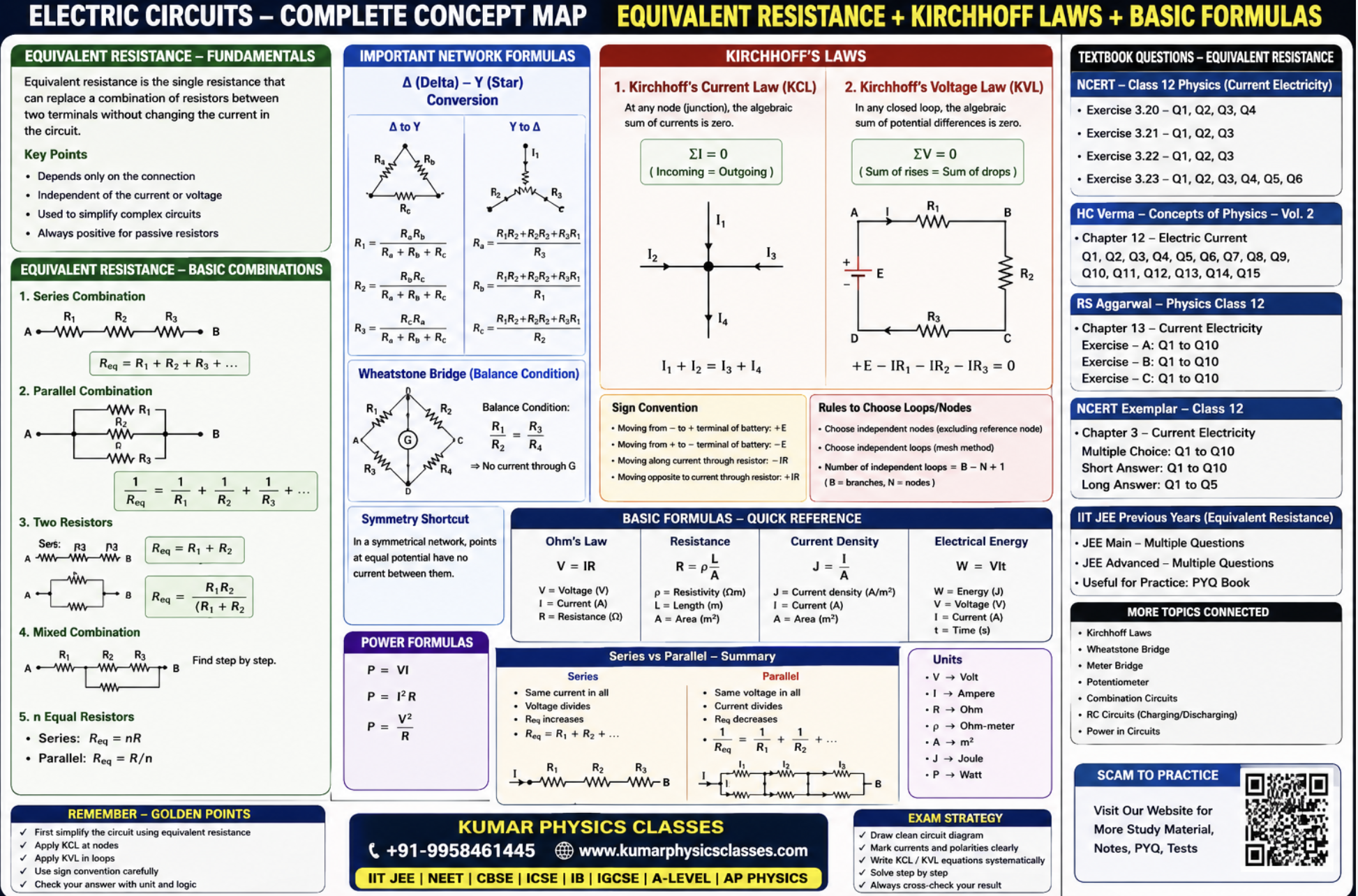
A branch is a part of the circuit through which the same current flows. If a wire has one resistor or one battery and the current does not split in between, that complete path is called a branch.
A node is a junction point where two or more branches meet. At a node, current may enter, leave or divide. This is the place where Kirchhoff’s Current Law becomes useful.
A mesh is a closed path in a circuit. If we start from one point, move through the circuit and come back to the same point without breaking the path, that closed path is called a mesh or loop.
Simple Diagram
        R1
   A ─────── B
   |         |
 R2|         |R3
   |         |
   C ─────── D
        R4
In this circuit:
Nodes:
A, B, C, D are nodes because branches meet at these points.
Branches:
AB branch contains R1
AC branch contains R2
BD branch contains R3
CD branch contains R4
Mesh / Loop:
A → B → D → C → A is one closed mesh.
How Kumar Sir Explains It
Kumar Sir does not make students memorize definitions blindly. He explains that a circuit is like Mumbai traffic:
Branch = one road where traffic flows in one direction
Node = junction where roads meet
Mesh = complete round trip from one point back to the same point
Once a student understands node, branch and mesh, Kirchhoff’s laws become very easy. KCL is applied at nodes, KVL is applied in loops or meshes, and current is assigned branch-wise.
This is why Kumar Sir focuses on concept clarity first. He teaches every topic step by step with diagrams, examples and numerical practice so that students can solve NEET, IIT JEE, CBSE, ICSE, IB, IGCSE, A-Level and AP Physics questions confidently.
Kumar Physics Classes
Phone: +91-9958461445
Website: www.kumarphysicsclasses.com
Email: kumarsirphysics@gmail.com
Kirchhoff’s Current Law and Voltage Law – Kumar Sir Style
1. Kirchhoff’s Current Law — KCL
Statement:
The algebraic sum of all currents meeting at a node is zero.
In simple words:
Total incoming current = Total outgoing current
If current enters a junction, it cannot disappear. Whatever current comes into the node must leave the node.
Example:
If 5 A current enters a node and two currents leave as 2 A and 3 A, then:
5 A = 2 A + 3 A
So KCL is based on conservation of charge.
2. Kirchhoff’s Voltage Law — KVL
Statement:
The algebraic sum of all potential differences in a closed loop or mesh is zero.
In simple words:
When we move around a complete closed circuit and come back to the same point, the total voltage rise is equal to the total voltage drop.
Example:
If a battery gives 12 V and two resistors drop 7 V and 5 V, then:
12 V = 7 V + 5 V
So KVL is based on conservation of energy.
Kumar Sir Style Explanation
Kumar Sir explains it very simply:
Node means junction.
At a junction, current comes and current goes. Current cannot be stored there. So whatever current enters must come out. This is KCL.
Mesh means closed path.
If you start from one point in a circuit and return to the same point, your net potential change becomes zero. Whatever energy is given by the battery is used by resistors and other elements. This is KVL.
So remember:
KCL → Node → Current → Conservation of Charge
KVL → Mesh/Loop → Voltage → Conservation of Energy
Kirchhoff Laws: IIT JEE Advanced Level 40 Conceptual Questions
KCL + KVL | Conceptual + Numerical | Kumar Sir Style
KVL: In any closed loop, algebraic sum of potential changes is zero.
Main idea: Current conservation at node, energy conservation in loop.
Q1. Sign Convention Trap
In a loop, a student writes: +IR + E = 0 while moving from negative to positive terminal of battery and along current through resistor. Identify the mistake.
Solution: Across battery from negative to positive: +E. Across resistor along current: -IR. Correct equation: E - IR = 0.Q2. Zero Current Branch
In a balanced Wheatstone bridge, why does the current through galvanometer branch become zero?
Solution: The two junctions connected by galvanometer are at same potential. Since potential difference is zero, current is zero.Q3. KCL with Capacitor at Steady State
A DC circuit has a capacitor branch connected at a node. After long time, should capacitor current be included in KCL?
Solution: Yes, but capacitor current is zero at steady state. KCL still applies: sum of other branch currents = 0.Q4. Ideal Voltmeter Branch
An ideal voltmeter is connected between two nodes. Does it affect KCL at those nodes?
Solution: No. Ideal voltmeter has infinite resistance, so current through it is zero.Q5. Ideal Ammeter in Loop
An ideal ammeter is inserted in a loop. How does it affect KVL?
Solution: Ideal ammeter has zero resistance, so potential drop across it is zero. KVL remains unchanged.Q6. Dependent Source Concept
A loop contains a dependent voltage source V = 3I and a resistor 5Ω carrying current I. Write KVL.
Solution: If source supports current: 3I - 5I = 0. Direction must be chosen carefully.Q7. Node Equation
At a node, three resistors 2Ω, 3Ω, 6Ω connect to potentials 10V, 0V, and unknown V. Write KCL.
Solution: Current leaving node: (V-10)/2 + V/3 + V/6 = 0.Q8. Supernode Idea
Why is a supernode used when a voltage source lies between two non-reference nodes?
Solution: Current through ideal voltage source is unknown, so both nodes are combined and voltage constraint is used.Q9. Supermesh Idea
Why is supermesh used when a current source lies between two meshes?
Solution: Voltage across current source is unknown, so outer loop KVL is written and current-source constraint is added.Q10. Common Resistor in Two Loops
Two mesh currents I1 and I2 pass through common resistor R in opposite directions. What is voltage drop in loop 1?
Solution: Drop = R(I1 - I2).Q11. Battery Charging Case
If current enters positive terminal of a battery, is battery charging or discharging?
Solution: Charging. In KVL, battery behaves as potential rise opposite to normal discharge direction.Q12. KVL Validity in Magnetic Field
Is KVL always valid in a loop with changing magnetic flux?
Solution: No. Changing magnetic flux induces non-conservative electric field. Modified KVL includes induced emf.Q13. Floating Node
A node is connected only through capacitors in DC steady state. What can be said about current?
Solution: All capacitor currents become zero. Node potential may depend on initial charge, not simple resistor KCL.Q14. Current Source in Parallel
A current source is parallel with a resistor. Can KVL directly determine current source voltage?
Solution: Voltage across current source equals voltage across parallel resistor, but source current is fixed independently.Q15. Hidden Symmetry
In a symmetric circuit, two identical nodes have same potential. What happens to current between them?
Solution: Potential difference is zero, so current through connecting branch is zero.Q16. KCL with Electron Flow
If electron flow enters a node, what is direction of conventional current?
Solution: Opposite to electron flow. KCL is applied using conventional current direction.Q17. Open Circuit Branch
Can an open branch have voltage across it?
Solution: Yes. Current is zero, but potential difference can exist.Q18. Short Circuit Branch
Can a short branch have current?
Solution: Yes. Voltage across ideal short is zero, but current can be finite.Q19. Negative Current Meaning
In mesh analysis, calculated current comes negative. What does it mean?
Solution: Actual current direction is opposite to assumed direction.Q20. KCL at Ground Node
Should KCL be applied at ground node?
Solution: It can be applied, but it is usually dependent on other node equations and not necessary.Q21. Multi-loop Circuit
Why are all loop equations not independent?
Solution: Some loop equations can be obtained by adding/subtracting other loop equations.Q22. Ideal Battery Parallel Conflict
Can two ideal batteries of different emf be connected directly in parallel?
Solution: No. It violates circuit constraints and causes infinite current in ideal model.Q23. Ideal Current Source Series Conflict
Can two ideal current sources of different current be connected in series?
Solution: No. Same branch current cannot have two different fixed values.Q24. Junction Rule Basis
KCL is based on which conservation law?
Solution: Conservation of charge.Q25. Loop Rule Basis
KVL is based on which conservation law?
Solution: Conservation of energy.Q26. Non-ohmic Element
Can Kirchhoff laws be applied to a diode circuit?
Solution: Yes. Kirchhoff laws apply, but diode V-I relation is nonlinear.Q27. Kirchhoff with Inductor
In an RL circuit, what is voltage across inductor?
Solution: V = L dI/dt. KVL includes this term.Q28. Kirchhoff with Capacitor
In an RC circuit, what is current through capacitor?
Solution: I = C dV/dt. KCL includes capacitor current.Q29. Common Battery in Two Loops
If two loops share a battery, how should emf sign be taken?
Solution: Sign depends on traversal direction through battery terminals in each loop.Q30. Internal Resistance
A cell of emf E and internal resistance r supplies current I. Terminal voltage?
Solution: During discharge: V = E - Ir.Q31. Charging Cell Terminal Voltage
For a charging cell, terminal voltage is?
Solution: V = E + Ir.Q32. Bridge Circuit Shortcut
When can the middle branch of a bridge be removed?
Solution: When the bridge is balanced and current through middle branch is zero.Q33. Direction of Potential Drop
Moving opposite to current through resistor gives what sign?
Solution: Potential rise: +IR.Q34. Direction Along Current
Moving along current through resistor gives what sign?
Solution: Potential drop: -IR.Q35. Node Voltage Method
Why is node voltage method powerful for circuits with many current sources?
Solution: KCL naturally handles current sources and reduces number of equations.Q36. Mesh Method
Why is mesh method powerful for circuits with many voltage sources?
Solution: KVL naturally handles voltage sources and loop currents.Q37. Dependent Current Source
A current source value is 2Vx. What extra equation is required?
Solution: Relation defining Vx in terms of circuit node voltages or branch voltage.Q38. Constraint Equation
Two mesh currents I1 and I2 have a current source Is between them. Write constraint.
Solution: Depending on direction: I1 - I2 = Is or I2 - I1 = Is.Q39. Physical Meaning of KVL Failure
Why does ordinary KVL fail in a loop linked with changing magnetic flux?
Solution: Electric field becomes non-conservative; induced emf appears around the loop.Q40. Advanced Concept
Can KCL fail at very high frequency circuits?
Solution: Lumped KCL may need correction because charge accumulation and displacement current become important.Kumar Physics Classes
NEET Physics | IIT JEE Physics | CBSE | ICSE | IB | IGCSE | A-Level | AP Physics
Call: +91-9958461445
Website: www.kumarphysicsclasses.com
Email: kumarsirphysics@gmail.com