
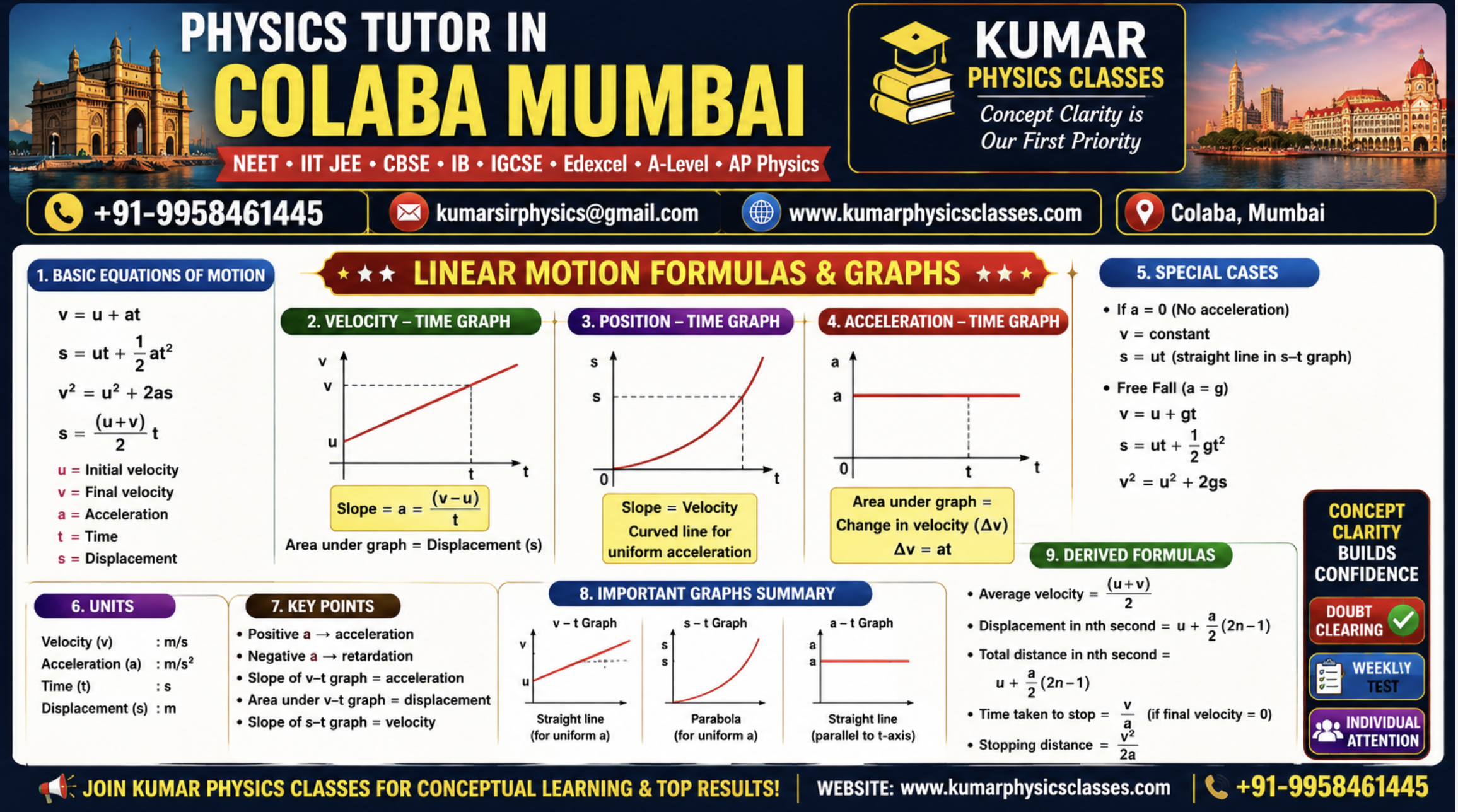
Physics Tutor in Colaba Mumbai
Call / WhatsApp:
+91-9958461445
If you live in Colaba Mumbai and you wake up in the morning with full motivation to solve Physics questions, but after a few minutes the questions do not open, then the real problem is not your hard work. The real problem is usually concept clarity.
Many students studying in private schools sit in a classroom of 20, 40 or even more students. The school teacher has limited time. The syllabus has to be completed. The teacher has to cover chapters, tests, assignments and board requirements. In that situation, many students feel shy to ask doubts again and again. They think, “What will others say?” Slowly, doubts increase. Then Physics becomes stressful.
Physics is not a subject of only memorising formulas. Physics is a subject of concept, imagination, mathematical thinking and step-by-step reasoning. If your basic concepts are weak, even a simple question can look impossible.
That is why students in Colaba Mumbai who are preparing for NEET, IIT JEE, CBSE, IB, IGCSE, Edexcel, A-Level or AP Physics need proper personal guidance. Kumar Sir explains Physics from the root level. He focuses on concept clarity, numerical practice, previous year questions, school exam preparation and competitive exam thinking.
Contact Kumar Sir: +91-9958461445
Email: kumarsirphysics@gmail.com
Website: Kumar Physics Classes
Why is displacement zero after one complete circular motion, but distance is not zero?
This is a very important basic Physics question.
Suppose a particle starts from a point on a circular path and completes one full round. After one complete circular motion, it comes back to the same starting point.
Displacement means the shortest straight-line distance between initial position and final position.
Since initial point and final point are the same, the shortest distance between them is zero.
So,
Displacement = 0
But distance means the actual path covered by the particle.
In one complete circular motion, the particle covers the full circumference of the circle.
So,
Distance = 2πr
Therefore, after one complete circular motion:
Displacement = 0, but Distance = 2πr
This is why Kumar Sir always tells students that Physics is not just formula. You must understand the meaning of every word. Distance and displacement look simple, but if the concept is not clear, students make mistakes in NEET, IIT JEE and school exams.
Physics Tutor in Colaba Mumbai Localities
Physics Tutor in Colaba Mumbai, Physics Tutor in Navy Nagar Mumbai, Physics Tutor in Cuffe Parade Mumbai, Physics Tutor in Apollo Bunder Mumbai, Physics Tutor in Gateway of India Mumbai, Physics Tutor in Colaba Causeway Mumbai, Physics Tutor in Regal Cinema Area Mumbai, Physics Tutor in Cooperage Mumbai, Physics Tutor in Nariman Point Mumbai, Physics Tutor in Fort Mumbai, Physics Tutor in Churchgate Mumbai, Physics Tutor in Marine Lines Mumbai, Physics Tutor in Kala Ghoda Mumbai, Physics Tutor in Ballard Estate Mumbai, Physics Tutor in Mantralaya Mumbai
Physics Tutor in Schools and Colleges Near Colaba Mumbai
Physics Tutor in Army Public School Colaba Mumbai, Physics Tutor in Navy Children School Colaba Mumbai, Physics Tutor in Campion School Mumbai, Physics Tutor in Cathedral and John Connon School Mumbai, Physics Tutor in St Anne’s High School Mumbai, Physics Tutor in GD Somani Memorial School Mumbai, Physics Tutor in Scholar High School Mumbai, Physics Tutor in Bombay International School Mumbai, Physics Tutor in JB Petit High School Mumbai, Physics Tutor in St Xavier’s College Mumbai, Physics Tutor in HR College Mumbai, Physics Tutor in Jai Hind College Mumbai, Physics Tutor in KC College Mumbai
Physics Tutor in Buildings and Landmarks Near Colaba Mumbai
Physics Tutor in Maker Tower Cuffe Parade Mumbai, Physics Tutor in World Trade Centre Mumbai, Physics Tutor in Taj Mahal Palace Area Mumbai, Physics Tutor in Colaba Post Office Area Mumbai, Physics Tutor in Cusrow Baug Mumbai, Physics Tutor in Bakhtawar Cuffe Parade Mumbai, Physics Tutor in Maker Arcade Mumbai, Physics Tutor in Mittal Court Nariman Point Mumbai, Physics Tutor in Express Towers Nariman Point Mumbai
Course Keywords for Colaba Mumbai
NEET Physics Tutor in Colaba Mumbai, IIT JEE Physics Tutor in Colaba Mumbai, CBSE Physics Tutor in Colaba Mumbai, IB Physics Tutor in Colaba Mumbai, IGCSE Physics Tutor in Colaba Mumbai, Edexcel Physics Tutor in Colaba Mumbai, A-Level Physics Tutor in Colaba Mumbai, AP Physics Tutor in Colaba Mumbai, Class 11 Physics Tutor in Colaba Mumbai, Class 12 Physics Tutor in Colaba Mumbai
Final Message
If you live in Colaba Mumbai and Physics questions are not getting solved, do not wait until marks fall. Take guidance early. A short interaction with Kumar Sir can show you where your concept is weak and how it can be improved.
Physics becomes easy when every concept is explained with examples, diagrams, formulas and numerical practice.
Call / WhatsApp: +91-9958461445
Email: kumarsirphysics@gmail.com
Website: kumarphysicsclasses.com
40 Conceptual Physics Questions with Answers
These questions are based on basic Physics concepts like distance, displacement, speed, velocity, acceleration, circular motion and simple motion. They are very useful for CBSE, NEET, IIT JEE, IGCSE, IB, A-Level and AP Physics students.
1. Why is displacement zero after one complete circular motion, but distance is not zero?
Answer: After one complete circle, the final point is the same as the initial point, so displacement is zero. But the actual path covered is the circumference, so distance is 2πr.
2. Can distance be zero while displacement is not zero?
Answer: No. If distance is zero, the body has not moved, so displacement must also be zero.
3. Can displacement be zero while distance is not zero?
Answer: Yes. If a body returns to its starting point, displacement is zero but distance is not zero.
4. Which is greater: distance or displacement?
Answer: Distance is always greater than or equal to the magnitude of displacement.
5. Why is distance a scalar quantity?
Answer: Distance has only magnitude and no direction, so it is scalar.
6. Why is displacement a vector quantity?
Answer: Displacement has both magnitude and direction from initial position to final position.
7. Can speed be negative?
Answer: No. Speed is distance travelled per unit time, and distance cannot be negative.
8. Can velocity be negative?
Answer: Yes. Velocity depends on direction, so it can be positive, negative or zero.
9. Can average velocity be zero but average speed not zero?
Answer: Yes. In a round trip, displacement is zero, so average velocity is zero, but distance is not zero, so average speed is not zero.
10. Can a body have constant speed but changing velocity?
Answer: Yes. In uniform circular motion, speed is constant but direction changes continuously, so velocity changes.
11. Can a body have acceleration even when speed is constant?
Answer: Yes. In circular motion, acceleration exists because direction of velocity changes.
12. Why is acceleration directed towards the centre in uniform circular motion?
Answer: Because velocity direction keeps changing towards the centre. This acceleration is called centripetal acceleration.
13. Is uniform circular motion accelerated motion?
Answer: Yes. Even though speed is constant, velocity changes due to changing direction.
14. Can acceleration be zero when velocity is not zero?
Answer: Yes. A body moving with constant velocity has zero acceleration.
15. Can velocity be zero but acceleration not zero?
Answer: Yes. At the highest point of vertical motion, velocity is zero but acceleration due to gravity is still downward.
16. Why does a stone thrown upward come back down?
Answer: Because gravity continuously acts downward and reduces upward velocity to zero, then pulls it down.
17. At the highest point of vertical motion, what is velocity and acceleration?
Answer: Velocity is zero, but acceleration is g downward.
18. Can a body move opposite to acceleration?
Answer: Yes. A ball moving upward has upward velocity but downward acceleration.
19. Why does displacement depend only on initial and final positions?
Answer: Because displacement is the shortest straight-line change in position, not the actual path.
20. Why does distance depend on path?
Answer: Distance is the actual length of path travelled, so it depends on the route taken.
21. Can two bodies have same displacement but different distances?
Answer: Yes. They may start and end at the same points but follow different paths.
22. Can two bodies have same distance but different displacement?
Answer: Yes. They may travel equal path lengths but end at different positions.
23. Why is slope of displacement-time graph velocity?
Answer: Slope gives change in displacement per unit time, which is velocity.
24. Why is slope of velocity-time graph acceleration?
Answer: Slope gives change in velocity per unit time, which is acceleration.
25. What does area under velocity-time graph represent?
Answer: It represents displacement.
26. What does area under speed-time graph represent?
Answer: It represents distance travelled.
27. Why is displacement in one full oscillation zero?
Answer: Because after one full oscillation, the particle returns to its initial position.
28. Is distance in one full oscillation zero?
Answer: No. In one full oscillation of amplitude A, distance covered is 4A.
29. Why is acceleration in SHM maximum at extreme position?
Answer: In SHM, acceleration is proportional to displacement. At extreme position, displacement is maximum.
30. Why is velocity maximum at mean position in SHM?
Answer: At mean position, potential energy is minimum and kinetic energy is maximum, so velocity is maximum.
31. Why is velocity zero at extreme position in SHM?
Answer: At extreme position, the particle changes direction, so velocity becomes zero.
32. Why is acceleration zero at mean position in SHM?
Answer: At mean position, displacement is zero. Since a = -ω²x, acceleration is zero.
33. Can force be zero but velocity maximum?
Answer: Yes. In SHM at mean position, restoring force is zero but velocity is maximum.
34. Can force be maximum but velocity zero?
Answer: Yes. In SHM at extreme position, restoring force is maximum but velocity is zero.
35. Why is SHM called periodic motion?
Answer: Because the motion repeats itself after equal intervals of time.
36. Is every periodic motion SHM?
Answer: No. For SHM, acceleration must be directly proportional to displacement and opposite in direction.
37. Is every SHM periodic?
Answer: Yes. SHM always repeats after a fixed time period.
38. Why does a pendulum clock become slow in summer?
Answer: In summer, length of pendulum increases due to expansion. Since T ∝ √l, time period increases and clock becomes slow.
39. Why does time period of simple pendulum not depend on mass?
Answer: The mass cancels out in the equation of motion, so time period depends only on length and gravity.
40. Why does time period increase on the Moon?
Answer: Gravity on the Moon is less than Earth. Since T ∝ 1/√g, time period increases.