
Physics Tutor in Pokhran Road Thane Mumbai – Concept Clarity for NEET, IIT JEE and Board Physics
+91-9958461445
If you live near Pokhran Road Thane Mumbai and Physics is not becoming clear, the problem is usually not intelligence. The real problem is weak concept clarity, poor visualization and lack of proper guidance. Many students attend school, coaching classes and online lectures, but still they struggle when the question becomes application-based.
This is where Kumar Sir helps students at Kumar Physics Classes. Kumar Sir teaches Physics from the basic level to the advanced level. Whether the student is preparing for NEET Physics, IIT JEE Physics, CBSE Physics, ICSE Physics, IB Physics, IGCSE Physics, A-Level Physics or AP Physics, the main focus is always on concept clarity, diagram understanding, numerical confidence and exam-oriented thinking.
For students living in Pokhran Road, Vasant Vihar, Manpada, Majiwada, Hiranandani Meadows, Ghodbunder Road, Thane West and nearby areas, Kumar Physics Classes can be a strong option for serious Physics preparation.
Contact Kumar Sir: +91-9958461445
Website: KumarPhysicsClasses.com
Why Students Near Pokhran Road Thane Need a Good Physics Tutor
Pokhran Road is one of the important residential and educational areas of Thane. Students living here often study in good schools and coaching centres, but Physics becomes difficult when they move from simple theory to real application.
In Class 9 and 10, many students feel Physics is easy because questions are mostly direct. But in Class 11, Class 12, NEET and IIT JEE, Physics becomes completely different. Now the student must understand force, field, charge, potential, energy, current, capacitor, magnetism, optics and modern physics deeply.
Kumar Sir explains every topic step by step so that the student does not just memorise formulas but understands why the formula works.
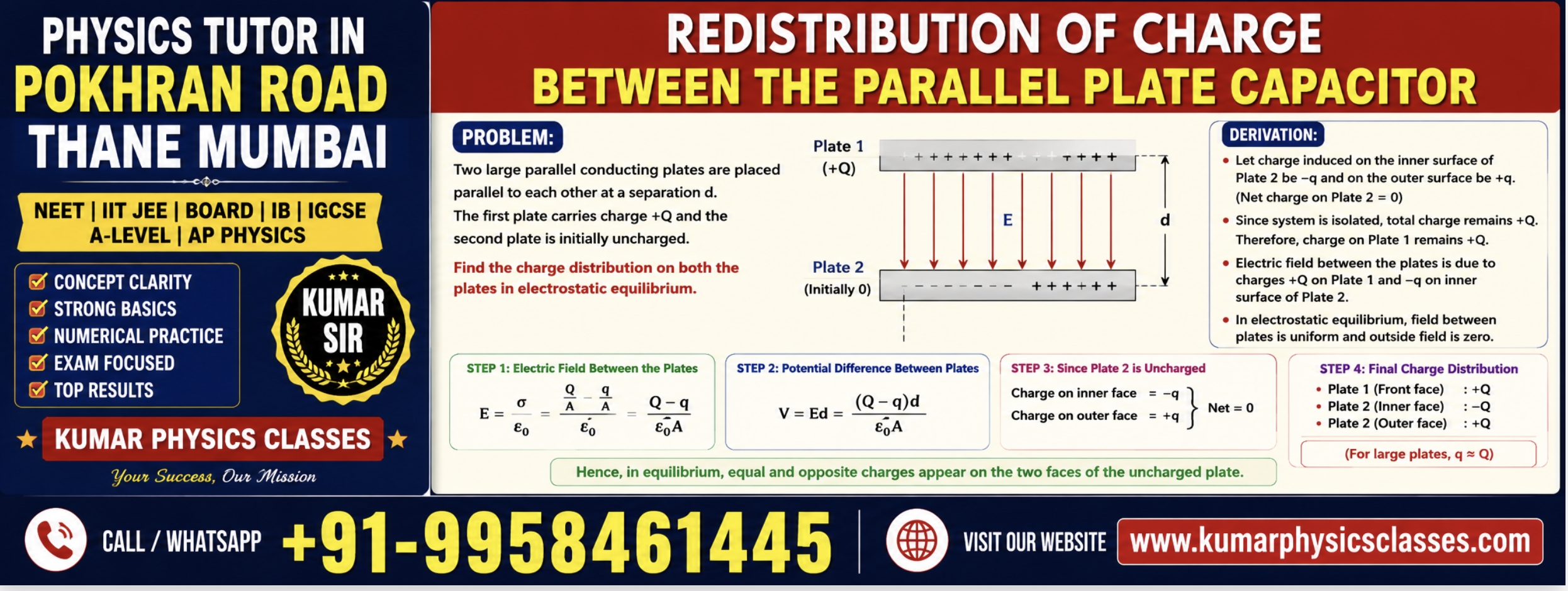
Parallel Plate Capacitor: Charge Distribution When One Plate Has +Q and Other Plate Has Zero Charge
Now let us understand a very important electrostatics concept.
Suppose we have a parallel plate capacitor. One conducting plate is given charge +Q and the other plate is initially neutral, meaning its net charge is 0.
Many students think that the neutral plate has no role, but that is not correct. Due to electrostatic induction, charges redistribute on the neutral plate.
When the first plate has charge +Q, it creates an electric field. This field affects the second neutral conducting plate. Since the second plate is a conductor, free electrons inside it move due to the electric field.
The side of the neutral plate facing the positive plate gets induced negative charge. The far side of the neutral plate gets induced positive charge. So even though the total charge of the second plate is zero, charges appear on its two surfaces.
That means:
Plate 1 has total charge +Q
Plate 2 has net charge 0
Inner surface of Plate 2 gets negative induced charge
Outer surface of Plate 2 gets positive induced charge
Total charge on Plate 2 remains zero
This is the beauty of electrostatics. Charge does not disappear; it redistributes.
Kumar Sir explains this with diagrams, electric field lines and surface charge distribution so that students can clearly understand what happens on each surface of the conductor.
Important Linked Keywords for Pokhran Road Thane Mumbai
Physics Tutor in Pokhran Road Thane Mumbai, Physics Tutor in Pokhran Road 1 Thane, Physics Tutor in Pokhran Road 2 Thane, Physics Tutor in Vasant Vihar Thane, Physics Tutor in Manpada Thane, Physics Tutor in Majiwada Thane, Physics Tutor in Hiranandani Meadows Thane, Physics Tutor in Ghodbunder Road Thane, Physics Tutor in Thane West, Physics Tutor in Kapurbawdi Thane, Physics Tutor in Upvan Thane, Physics Tutor in Samata Nagar Thane, Physics Tutor in Vartak Nagar Thane, Physics Tutor in Lok Puram Thane, Physics Tutor in Smt. Sulochanadevi Singhania School Thane, Physics Tutor in DAV Public School Thane, Physics Tutor in Vasant Vihar High School Thane, Physics Tutor in Billabong High International School Thane, Physics Tutor in CP Goenka International School Thane, Physics Tutor in Hiranandani Foundation School Thane, Physics Tutor in Orchids The International School Thane, Physics Tutor in Podar International School Thane, Physics Tutor in Lodha World School Thane, Physics Tutor in Rustomjee Cambridge International School Thane, Physics Tutor in Jupiter Hospital Thane Area, Physics Tutor in Viviana Mall Thane Area, Physics Tutor in Korum Mall Thane Area
Final Words
Physics is not a subject of fear. Physics becomes difficult only when the student studies formulas without understanding the concept behind them. In topics like capacitor, charge distribution, electric field and potential, one small confusion can spoil many questions.
Kumar Sir focuses on removing that confusion. He teaches from the lower level to the upper level, from basic theory to advanced application, so that students can handle NEET, IIT JEE and board-level Physics with confidence.
For Physics tuition near Pokhran Road Thane Mumbai, students and parents can contact Kumar Sir at +91-9958461445 or visit KumarPhysicsClasses.com.
Redistribution of Charge in 2, 3 and 4 Plate Systems – 50 IIT Advanced Level Questions
Kumar Physics Classes | Kumar Sir | +91-9958461445 | www.kumarphysicsclasses.com
-
Question: Two identical isolated conducting plates carry charges +Q and 0. When they are brought close parallel to each other, what happens to charge distribution?
Answer: The neutral plate gets induced charge: negative charge appears on the face near +Q plate and positive charge appears on the far face. Net charge remains zero. -
Question: In a two-plate system, why does charge appear on the inner surface of a neutral conducting plate?
Answer: Because the electric field of the charged plate causes free electrons to move inside the conductor, producing induced surface charges. -
Question: If plate A has +Q and plate B has -Q, what is the ideal charge distribution in a parallel plate capacitor?
Answer: Charge mainly resides on the facing surfaces: +Q on inner face of A and -Q on inner face of B. Outer surface charge becomes nearly zero for large plates. -
Question: Why is charge on the outer surface nearly zero in an ideal capacitor?
Answer: Because electric field outside an ideal parallel plate capacitor cancels due to equal and opposite charges on facing plates. -
Question: Two plates have charges +Q and +Q. Can they form a normal capacitor field between them?
Answer: No. Since both plates are positively charged, the field between them depends on redistribution, but it will not behave like a standard +Q, -Q capacitor. -
Question: If two isolated plates have charges +3Q and +Q, what decides the redistribution?
Answer: Redistribution is decided by electrostatic equilibrium: field inside each conductor must be zero and potential of each connected conductor must be same if connected. -
Question: What is the basic condition inside a conductor in electrostatic equilibrium?
Answer: Electric field inside the conducting material must be zero. -
Question: Why does charge reside only on the surface of a conductor?
Answer: Because any internal charge would create electric field inside the conductor, which is impossible in electrostatic equilibrium. -
Question: In a three-plate system A, B, C, if B is neutral and placed between A(+Q) and C(-Q), what happens?
Answer: B gets induced negative charge on the side facing A and positive charge on the side facing C, while its net charge remains zero. -
Question: Can a neutral middle plate change capacitance of a system?
Answer: Yes. A neutral conducting plate inserted between capacitor plates changes effective separation and hence changes capacitance. -
Question: If a conducting slab of thickness t is inserted between capacitor plates separated by d, what is effective separation?
Answer: Effective separation becomes d - t, assuming slab does not touch plates. -
Question: Why is electric field inside the inserted conducting slab zero?
Answer: Free charges redistribute on its surfaces to cancel the external electric field inside the conductor. -
Question: In three plates, if A and C are connected together and B is charged, what happens?
Answer: A and C become one conductor, so their combined potential is same. Charge redistributes on their surfaces according to capacitances with B. -
Question: If two outer plates are connected and middle plate has +Q, where does induced negative charge appear?
Answer: Negative charge appears on the inner faces of the two outer plates facing the middle plate. -
Question: If middle plate is exactly midway between two connected outer plates, how is induced charge divided?
Answer: Symmetrically. Equal negative charge appears on both inner faces of outer plates. -
Question: If middle plate is closer to one outer plate, where is more induced charge?
Answer: More charge appears on the side with smaller separation because capacitance is larger there. -
Question: In a three-plate system, capacitance between closer plates is higher or lower?
Answer: Higher, because capacitance C = εA/d and smaller d gives larger C. -
Question: Why does charge distribution depend on distance between plates?
Answer: Because capacitance depends on separation, and charge on connected conductors distributes according to capacitance. -
Question: If three parallel plates are connected alternately to battery terminals, how many capacitors are formed?
Answer: Two capacitors are formed between adjacent plates. -
Question: In a four-plate system connected alternately to + and - terminals, how many effective capacitors are formed?
Answer: Three capacitors are formed between adjacent plates, generally connected in parallel if alternate plates are connected together. -
Question: For n parallel plates connected alternately, how many capacitors are formed?
Answer: n - 1 capacitors are formed. -
Question: If n plates are connected alternately, each adjacent pair has capacitance C, what is equivalent capacitance?
Answer: C_eq = (n - 1)C. -
Question: Why do alternate connected plates form parallel combination?
Answer: Because each adjacent capacitor has the same potential difference across it. -
Question: In a four-plate system A-B-C-D, if A and C are connected, B and D are connected, what is equivalent capacitance?
Answer: Three capacitors AB, BC and CD are effectively in parallel, so C_eq = 3C if all separations and areas are same. -
Question: If one plate in a multi-plate capacitor is floating, does it affect charge distribution?
Answer: Yes. A floating conductor develops induced charges while maintaining its net charge constant. -
Question: What does “floating conductor” mean?
Answer: A conductor not connected to battery or ground; its total charge remains fixed. -
Question: If a neutral floating plate is inserted inside a capacitor, does it acquire net charge?
Answer: No. It acquires induced charges on surfaces but net charge remains zero. -
Question: If a floating plate initially has charge +q, what remains constant?
Answer: Its total charge remains +q, but distribution on its two faces changes. -
Question: Why can charges appear unequally on two faces of a floating conductor?
Answer: Because external fields and distances to nearby plates may be different. -
Question: In charge redistribution problems, which equations are most important?
Answer: Charge conservation, equal potential condition, zero field inside conductor and capacitor relation Q = CV. -
Question: If two conductors are connected by a wire, what becomes equal?
Answer: Their potentials become equal. -
Question: Does equal potential mean equal charge?
Answer: No. Charge depends on capacitance. Larger capacitance can hold more charge at same potential. -
Question: Why is grounding important in redistribution?
Answer: Grounding fixes potential at zero and allows charge to flow to or from Earth. -
Question: If a plate is grounded near a +Q plate, what charge appears on it?
Answer: Negative charge flows from Earth and appears mainly on the face near the +Q plate. -
Question: Can a grounded plate have non-zero charge?
Answer: Yes. Grounded means zero potential, not zero charge. -
Question: If the battery is disconnected before inserting a slab, what remains constant?
Answer: Charge remains constant. -
Question: If the battery remains connected while inserting a slab, what remains constant?
Answer: Potential difference remains constant. -
Question: In redistribution, why must we know whether battery is connected or disconnected?
Answer: Because connected battery fixes voltage, while disconnected capacitor fixes charge. -
Question: In a two-plate capacitor, if distance is reduced while isolated, what happens to potential difference?
Answer: Potential difference decreases because V = Q/C and capacitance increases. -
Question: If distance is reduced while battery remains connected, what happens to charge?
Answer: Charge increases because Q = CV and V is constant. -
Question: In a multi-plate capacitor, why do inner plates carry charge on both faces?
Answer: Because each face interacts with a neighbouring plate and forms a separate capacitor region. -
Question: Why do extreme outer surfaces sometimes carry no charge?
Answer: In ideal symmetric capacitor systems, external electric field cancels, so no charge is required on extreme outer surfaces. -
Question: If external field is not zero, can outer surfaces have charge?
Answer: Yes. Outer surfaces may carry charge to satisfy electrostatic equilibrium. -
Question: What is the role of symmetry in charge redistribution?
Answer: Symmetry helps divide charge equally between identical regions. -
Question: If symmetry is broken by unequal distances, how does charge divide?
Answer: Charge divides in proportion to capacitance, which is inversely proportional to separation. -
Question: In three plates with middle plate charged +Q and outer plates grounded symmetrically, what charge appears on each outer inner face?
Answer: Each outer inner face gets -Q/2. -
Question: What happens to the outer faces of grounded outer plates in the symmetric case?
Answer: Ideally, outer faces carry zero charge. -
Question: If a conductor is placed in an external electric field, what is potential inside it?
Answer: Potential is constant throughout the conductor. -
Question: Why is redistribution instantaneous in ideal conductors?
Answer: Because free charges move until electrostatic equilibrium is reached. -
Question: What is the biggest mistake students make in charge redistribution questions?
Answer: They assume net charge and surface charge are the same. In reality, each surface may carry different charge while total charge follows conservation. -
Question: What is Kumar Sir’s method for solving these questions?
Answer: First draw every plate surface separately, assign unknown charges, apply charge conservation, zero field inside conductors, equal potential condition and Q = CV step by step.
For NEET Physics, IIT JEE Physics, CBSE, ICSE, IB, IGCSE, A-Level and AP Physics
Call: +91-9958461445
Website: www.kumarphysicsclasses.com