
Physics Tutor in Sector 72 Noida | Kumar Physics Classes
+91-9958461445
If you live in Sector 72 Noida and Physics is not making sense to you, then you must understand one thing clearly: Physics does not become difficult in one day. It becomes difficult slowly when the student does not get proper concept clarity from the beginning.
Many students score 2, 3 or 4 marks in Physics tests, and then parents become worried during parent-teacher meetings. The problem is not always that the student is weak. Many times, the real problem is that the student is studying from random sources, weak teachers, incomplete notes, shortcut videos and unstructured online content.
Physics is not a subject of drama, shortcuts or entertainment. Physics needs a proper teacher, proper textbook approach, proper derivation, proper numerical practice and proper revision. If a student keeps watching random YouTube videos without understanding the concept, then time is wasted and confidence goes down.
At Kumar Physics Classes, Kumar Sir teaches Physics in a systematic and exam-oriented way. Students are guided for CBSE Physics, ICSE Physics, NEET Physics, JEE Physics, AP Physics, IB Physics and A-Level Physics with strong conceptual clarity.
Website: KumarPhysicsClasses.com
Contact: +91-9958461445
Email: kumarsirphysics@gmail.com
Why Students in Sector 72 Noida Need a Good Physics Tutor
Physics is a subject where one weak chapter affects the next chapter. If vectors are weak, mechanics becomes difficult. If electrostatics is weak, current electricity and capacitance become difficult. If basic mathematics is weak, derivations and numericals become confusing.
Many students in Sector 72 Noida face these common problems:
They understand theory but cannot solve numericals.
They remember formulas but do not know where to apply them.
They make mistakes in signs, units and directions.
They do not understand derivations.
They are unable to connect concepts with questions.
They waste time on random online videos.
They do not follow NCERT, H.C. Verma or proper textbooks seriously.
Kumar Sir focuses on concept clarity first. Once the concept is clear, formulas become meaningful and numericals become easier.
Why Kumar Physics Classes?
Kumar Sir teaches Physics like a real subject, not like a collection of formulas. Every topic is explained from basic level to advanced level.
At Kumar Physics Classes, students get:
Concept clarity
Numerical practice
Board exam preparation
NEET Physics preparation
JEE Main and Advanced Physics preparation
AP Physics guidance
IB Physics guidance
A-Level Physics guidance
Doubt clearing
Previous year question practice
Proper derivation-based learning
Exam-oriented revision
Physics becomes easy only when it is taught logically.
Noida Sector Wise Physics Tutor Links
Physics Tutor in Sector 1 Noida, Physics Tutor in Sector 2 Noida, Physics Tutor in Sector 3 Noida, Physics Tutor in Sector 4 Noida, Physics Tutor in Sector 5 Noida, Physics Tutor in Sector 6 Noida, Physics Tutor in Sector 7 Noida, Physics Tutor in Sector 8 Noida, Physics Tutor in Sector 9 Noida, Physics Tutor in Sector 10 Noida, Physics Tutor in Sector 11 Noida, Physics Tutor in Sector 12 Noida, Physics Tutor in Sector 15 Noida, Physics Tutor in Sector 16 Noida, Physics Tutor in Sector 18 Noida, Physics Tutor in Sector 19 Noida, Physics Tutor in Sector 20 Noida, Physics Tutor in Sector 21 Noida, Physics Tutor in Sector 22 Noida, Physics Tutor in Sector 25 Noida, Physics Tutor in Sector 26 Noida, Physics Tutor in Sector 27 Noida, Physics Tutor in Sector 28 Noida, Physics Tutor in Sector 29 Noida, Physics Tutor in Sector 30 Noida, Physics Tutor in Sector 31 Noida, Physics Tutor in Sector 34 Noida, Physics Tutor in Sector 36 Noida, Physics Tutor in Sector 37 Noida, Physics Tutor in Sector 39 Noida, Physics Tutor in Sector 40 Noida, Physics Tutor in Sector 41 Noida, Physics Tutor in Sector 44 Noida, Physics Tutor in Sector 45 Noida, Physics Tutor in Sector 46 Noida, Physics Tutor in Sector 47 Noida, Physics Tutor in Sector 49 Noida, Physics Tutor in Sector 50 Noida, Physics Tutor in Sector 51 Noida, Physics Tutor in Sector 52 Noida, Physics Tutor in Sector 55 Noida, Physics Tutor in Sector 56 Noida, Physics Tutor in Sector 61 Noida, Physics Tutor in Sector 62 Noida, Physics Tutor in Sector 63 Noida, Physics Tutor in Sector 70 Noida, Physics Tutor in Sector 71 Noida, Physics Tutor in Sector 72 Noida, Physics Tutor in Sector 73 Noida, Physics Tutor in Sector 74 Noida, Physics Tutor in Sector 75 Noida, Physics Tutor in Sector 76 Noida, Physics Tutor in Sector 77 Noida, Physics Tutor in Sector 78 Noida, Physics Tutor in Sector 79 Noida, Physics Tutor in Sector 93 Noida, Physics Tutor in Sector 100 Noida, Physics Tutor in Sector 104 Noida, Physics Tutor in Sector 105 Noida, Physics Tutor in Sector 108 Noida, Physics Tutor in Sector 110 Noida, Physics Tutor in Sector 119 Noida, Physics Tutor in Sector 120 Noida, Physics Tutor in Sector 121 Noida, Physics Tutor in Sector 122 Noida, Physics Tutor in Sector 128 Noida, Physics Tutor in Sector 132 Noida, Physics Tutor in Sector 137 Noida, Physics Tutor in Sector 150 Noida
School Wise Physics Tutor Links in Noida
Physics Tutor in DPS Noida, Physics Tutor in Delhi Public School Noida, Physics Tutor in Mayoor School Noida, Physics Tutor in Somerville School Noida, Physics Tutor in Amity International School Noida, Physics Tutor in Apeejay School Noida, Physics Tutor in Cambridge School Noida, Physics Tutor in Lotus Valley International School Noida, Physics Tutor in Bal Bharati Public School Noida, Physics Tutor in Ryan International School Noida, Physics Tutor in The Khaitan School Noida, Physics Tutor in Shiv Nadar School Noida, Physics Tutor in Step by Step School Noida, Physics Tutor in Pathways School Noida, Physics Tutor in Genesis Global School Noida, Physics Tutor in Gyanshree School Noida, Physics Tutor in Billabong High International School Noida, Physics Tutor in JBM Global School Noida, Physics Tutor in Global Indian International School Noida, Physics Tutor in Kothari International School Noida, Physics Tutor in Ramagya School Noida, Physics Tutor in Manav Rachna International School Noida, Physics Tutor in Indus Valley Public School Noida, Physics Tutor in Vishwa Bharati Public School Noida, Physics Tutor in Rockwood School Noida, Physics Tutor in Sapphire International School Noida, Physics Tutor in Jaypee Public School Noida, Physics Tutor in Fortune World School Noida, Physics Tutor in Army Public School Noida, Physics Tutor in Kendriya Vidyalaya Noida, Physics Tutor in Maharishi Vidya Mandir Noida, Physics Tutor in Presidium School Noida, Physics Tutor in Millennium School Noida, Physics Tutor in Modern School Noida, Physics Tutor in City Public School Noida, Physics Tutor in Raghav Global School Noida, Physics Tutor in Noida Educational Academy, Physics Tutor in Marigold Public School Noida, Physics Tutor in Yadu Public School Noida, Physics Tutor in Father Agnel School Noida, Physics Tutor in Pragyan School Noida, Physics Tutor in Shriram Millennium School Noida, Physics Tutor in GD Goenka Global School Noida, Physics Tutor in Delhi World Public School Noida, Physics Tutor in Pacific World School Noida, Physics Tutor in Learners International School Noida, Physics Tutor in Sanfort World School Noida
Important Physics Tags for Noida Students
AP Physics Tutor in Noida, IB Physics Tutor in Noida, A-Level Physics Tutor in Noida, NEET Physics Tutor in Noida, IIT JEE Physics Tutor in Noida, JEE Main Physics Tutor in Noida, JEE Advanced Physics Tutor in Noida, CBSE Physics Tutor in Noida, ICSE Physics Tutor in Noida
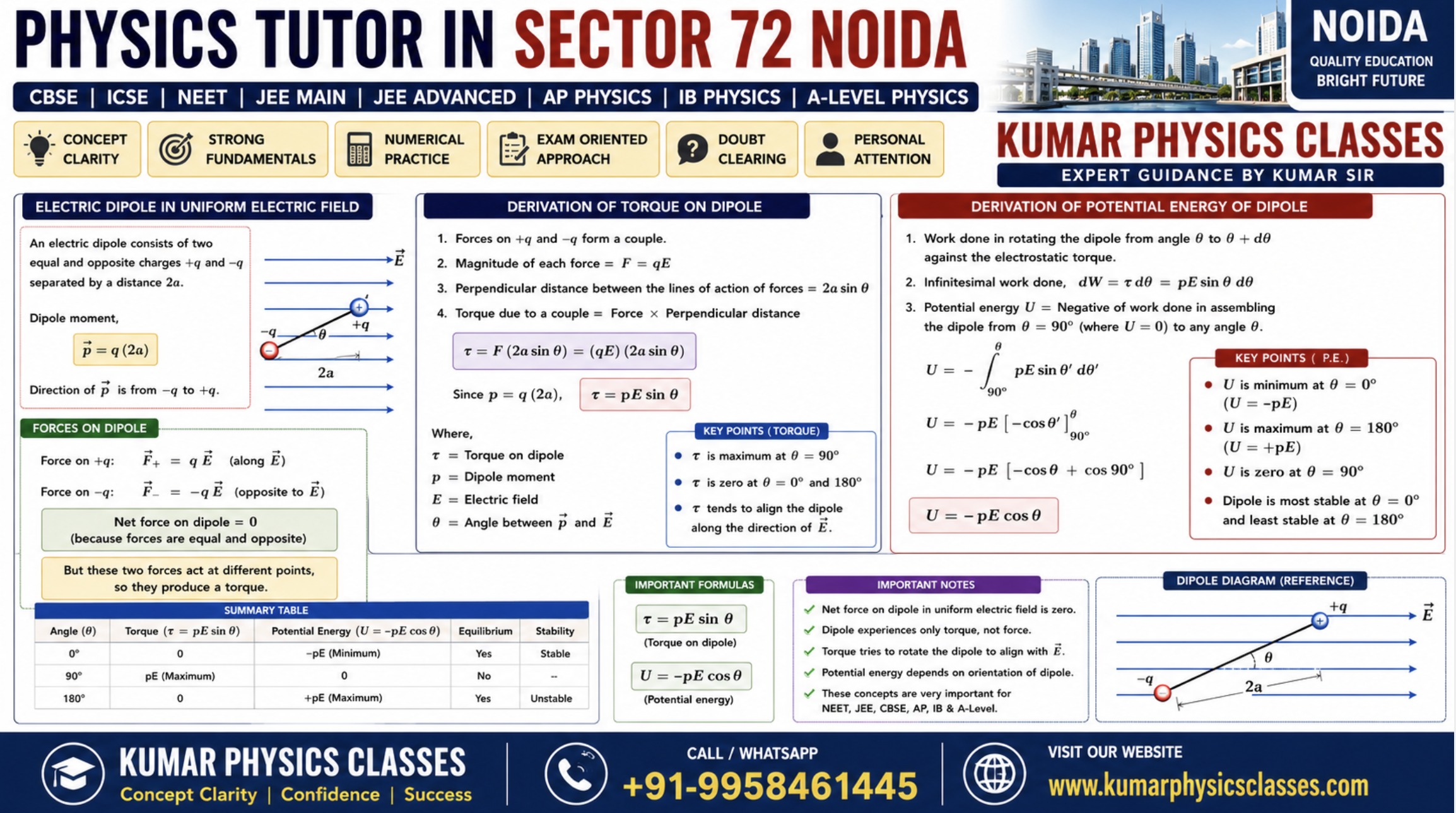
Electric Dipole in Uniform Electric Field
An electric dipole consists of two equal and opposite charges separated by a small distance.
Suppose the charges are:
+q and -q
Distance between charges = 2a
Dipole moment is:
p = q x 2a
Direction of dipole moment is from negative charge to positive charge.
Copy-paste friendly formula:
p = q x 2a
What Happens When a Dipole Is Placed in a Uniform Electric Field?
When an electric dipole is placed in a uniform electric field, the positive charge experiences force in the direction of electric field, and the negative charge experiences force opposite to the electric field.
Force on +q:
F = qE
Force on -q:
F = qE
These two forces are equal in magnitude and opposite in direction. Therefore, net force on the dipole is zero in a uniform electric field.
But these two forces act at different points, so they produce a turning effect. This turning effect is called torque.
Torque on an Electric Dipole
Torque on an electric dipole in a uniform electric field is:
tau = pE sin theta
Where:
tau = torque
p = electric dipole moment
E = electric field
theta = angle between dipole moment and electric field
This torque tries to rotate the dipole and align it with the electric field.
Important Cases of Torque
Case 1: theta = 0 degree
When dipole moment is parallel to electric field:
tau = pE sin 0 degree
sin 0 degree = 0
Therefore:
tau = 0
The dipole is in stable equilibrium.
Case 2: theta = 90 degree
When dipole moment is perpendicular to electric field:
tau = pE sin 90 degree
sin 90 degree = 1
Therefore:
tau = pE
Torque is maximum.
Case 3: theta = 180 degree
When dipole moment is opposite to electric field:
tau = pE sin 180 degree
sin 180 degree = 0
Therefore:
tau = 0
The dipole is in unstable equilibrium.
Potential Energy of Electric Dipole
Potential energy of an electric dipole in a uniform electric field is:
U = -pE cos theta
Where:
U = potential energy
p = electric dipole moment
E = electric field
theta = angle between dipole moment and electric field
This formula tells us how much energy is stored due to the orientation of the dipole in the electric field.
Important Cases of Potential Energy
Case 1: theta = 0 degree
U = -pE cos 0 degree
cos 0 degree = 1
Therefore:
U = -pE
This is minimum potential energy. The dipole is most stable.
Case 2: theta = 90 degree
U = -pE cos 90 degree
cos 90 degree = 0
Therefore:
U = 0
Case 3: theta = 180 degree
U = -pE cos 180 degree
cos 180 degree = -1
Therefore:
U = +pE
This is maximum potential energy. The dipole is unstable.
Simple Explanation for Students
Think of an electric dipole like a small arrow placed in an electric field. The electric field tries to rotate this arrow so that it points in the direction of the field.
If the dipole is already aligned with the field, it does not rotate.
If it is perpendicular to the field, it experiences maximum rotation.
If it is opposite to the field, it is balanced but unstable. A small disturbance will rotate it toward the field direction.
This is why the formula for torque is:
tau = pE sin theta
And the formula for potential energy is:
U = -pE cos theta
Final Note
If you are searching for Physics Tutor in Sector 72 Noida, Kumar Physics Classes can help you build strong Physics concepts from basic to advanced level. Physics becomes easy when the teacher explains the logic behind every formula.
For CBSE, ICSE, NEET, JEE, AP Physics, IB Physics and A-Level Physics, proper guidance is very important.
Website: KumarPhysicsClasses.com
Contact: +91-9958461445
Email: kumarsirphysics@gmail.com
40 MCQs on Torque and Potential Energy of Electric Dipole
With Answers | Copy-Paste Ready
Basic Formulas
Torque on electric dipole:
tau = pE sin theta
Potential energy of electric dipole:
U = -pE cos theta
Where:
p = electric dipole moment
E = uniform electric field
theta = angle between dipole moment and electric field
1. An electric dipole is placed in a uniform electric field. The net force on the dipole is:
A. Maximum
B. Minimum
C. Zero
D. Infinite
Answer: C. Zero
2. The torque on an electric dipole in a uniform electric field is given by:
A. tau = pE cos theta
B. tau = pE sin theta
C. tau = p / E
D. tau = E / p
Answer: B. tau = pE sin theta
3. Potential energy of an electric dipole in a uniform electric field is:
A. U = pE sin theta
B. U = pE cos theta
C. U = -pE cos theta
D. U = -pE sin theta
Answer: C. U = -pE cos theta
4. Torque on a dipole is maximum when theta is:
A. 0 degree
B. 45 degree
C. 90 degree
D. 180 degree
Answer: C. 90 degree
5. Torque on a dipole is zero when theta is:
A. 0 degree only
B. 90 degree only
C. 0 degree and 180 degree
D. 45 degree only
Answer: C. 0 degree and 180 degree
6. Potential energy of a dipole is minimum when theta is:
A. 0 degree
B. 90 degree
C. 180 degree
D. 270 degree
Answer: A. 0 degree
7. Potential energy of a dipole is maximum when theta is:
A. 0 degree
B. 90 degree
C. 180 degree
D. 45 degree
Answer: C. 180 degree
8. When dipole moment is parallel to electric field, potential energy is:
A. 0
B. +pE
C. -pE
D. pE / 2
Answer: C. -pE
9. When dipole moment is opposite to electric field, potential energy is:
A. -pE
B. 0
C. +pE
D. -2pE
Answer: C. +pE
10. When dipole moment is perpendicular to electric field, potential energy is:
A. -pE
B. +pE
C. 0
D. Infinite
Answer: C. 0
11. At theta = 90 degree, torque on dipole is:
A. Zero
B. pE
C. -pE
D. pE / 2
Answer: B. pE
12. At theta = 0 degree, torque on dipole is:
A. pE
B. pE / 2
C. Zero
D. Infinite
Answer: C. Zero
13. At theta = 180 degree, torque on dipole is:
A. pE
B. Zero
C. -pE
D. Infinite
Answer: B. Zero
14. Stable equilibrium of a dipole occurs when theta is:
A. 0 degree
B. 90 degree
C. 180 degree
D. 45 degree
Answer: A. 0 degree
15. Unstable equilibrium of a dipole occurs when theta is:
A. 0 degree
B. 90 degree
C. 180 degree
D. 60 degree
Answer: C. 180 degree
16. In stable equilibrium, potential energy is:
A. Maximum
B. Minimum
C. Zero always
D. Infinite
Answer: B. Minimum
17. In unstable equilibrium, potential energy is:
A. Minimum
B. Maximum
C. Zero always
D. Negative always
Answer: B. Maximum
18. Torque tends to rotate the dipole:
A. Opposite to electric field always
B. Along the electric field direction
C. Randomly
D. Perpendicular to electric field always
Answer: B. Along the electric field direction
19. If electric field is doubled, torque becomes:
A. Half
B. Double
C. Four times
D. Zero
Answer: B. Double
20. If dipole moment is doubled, torque becomes:
A. Half
B. Double
C. Four times
D. Zero
Answer: B. Double
21. If theta changes from 0 degree to 90 degree, torque:
A. Decreases
B. Increases from zero to maximum
C. Remains zero
D. Becomes negative
Answer: B. Increases from zero to maximum
22. If theta changes from 90 degree to 180 degree, torque:
A. Increases
B. Decreases from maximum to zero
C. Remains maximum
D. Becomes infinite
Answer: B. Decreases from maximum to zero
23. If theta = 60 degree, torque is:
A. pE
B. pE / 2
C. pE sin 60 degree
D. Zero
Answer: C. pE sin 60 degree
24. If theta = 60 degree, potential energy is:
A. -pE cos 60 degree
B. pE sin 60 degree
C. pE
D. Zero
Answer: A. -pE cos 60 degree
25. If theta = 60 degree, U is equal to:
A. -pE / 2
B. +pE / 2
C. -pE
D. 0
Answer: A. -pE / 2
26. If theta = 120 degree, potential energy is:
A. -pE / 2
B. +pE / 2
C. 0
D. -pE
Answer: B. +pE / 2
27. If theta = 30 degree, torque is:
A. pE / 2
B. pE
C. 0
D. -pE
Answer: A. pE / 2
28. If theta = 90 degree, potential energy is:
A. -pE
B. +pE
C. 0
D. pE / 2
Answer: C. 0
29. Work done in rotating a dipole from theta1 to theta2 is related to:
A. Change in force
B. Change in potential energy
C. Change in charge only
D. Change in mass
Answer: B. Change in potential energy
30. Work done by external agent in rotating dipole slowly is:
A. Delta U
B. Zero always
C. tau / p
D. E / p
Answer: A. Delta U
31. Work done in rotating dipole from 0 degree to 180 degree is:
A. pE
B. 2pE
C. -2pE
D. 0
Answer: B. 2pE
Explanation:
U at 0 degree = -pE
U at 180 degree = +pE
Work done = change in potential energy = +pE – (-pE) = 2pE
32. Work done in rotating dipole from 0 degree to 90 degree is:
A. pE
B. -pE
C. 0
D. 2pE
Answer: A. pE
Explanation:
U at 0 degree = -pE
U at 90 degree = 0
Work done = 0 – (-pE) = pE
33. Work done in rotating dipole from 90 degree to 180 degree is:
A. pE
B. -pE
C. 0
D. 2pE
Answer: A. pE
Explanation:
U at 90 degree = 0
U at 180 degree = +pE
Work done = +pE – 0 = pE
34. If p = 2 C m, E = 5 N/C and theta = 90 degree, torque is:
A. 0
B. 5 N m
C. 10 N m
D. 20 N m
Answer: C. 10 N m
Explanation:
tau = pE sin theta
tau = 2 x 5 x sin 90 degree
tau = 10 N m
35. If p = 3 C m, E = 4 N/C and theta = 0 degree, torque is:
A. 12 N m
B. 0
C. 7 N m
D. 3 N m
Answer: B. 0
36. If p = 2 C m, E = 10 N/C and theta = 60 degree, potential energy is:
A. -10 J
B. +10 J
C. -20 J
D. 0
Answer: A. -10 J
Explanation:
U = -pE cos theta
U = -2 x 10 x cos 60 degree
U = -20 x 1/2
U = -10 J
37. If p = 1 C m, E = 8 N/C and theta = 180 degree, potential energy is:
A. -8 J
B. 0
C. +8 J
D. +16 J
Answer: C. +8 J
38. If torque on a dipole is zero, the dipole may be at:
A. theta = 0 degree only
B. theta = 180 degree only
C. theta = 0 degree or 180 degree
D. theta = 90 degree only
Answer: C. theta = 0 degree or 180 degree
39. Which position of dipole is most stable?
A. theta = 0 degree
B. theta = 90 degree
C. theta = 180 degree
D. theta = 270 degree
Answer: A. theta = 0 degree
40. Which statement is correct?
A. Torque is maximum at theta = 0 degree
B. Potential energy is minimum at theta = 180 degree
C. Torque is maximum at theta = 90 degree
D. Potential energy is zero at theta = 0 degree
Answer: C. Torque is maximum at theta = 90 degree
Final Note
These MCQs are very important for CBSE, ICSE, NEET, JEE, AP Physics, IB Physics and A-Level Physics students. Torque and potential energy of an electric dipole are highly conceptual topics. If students understand the meaning of theta, torque and potential energy, they can solve most questions easily.
Kumar Physics Classes teaches Physics with strong concept clarity and exam-oriented numerical practice.
Website: https://kumarphysicsclasses.com/
Contact: +91-9958461445
Email: kumarsirphysics@gmail.com