
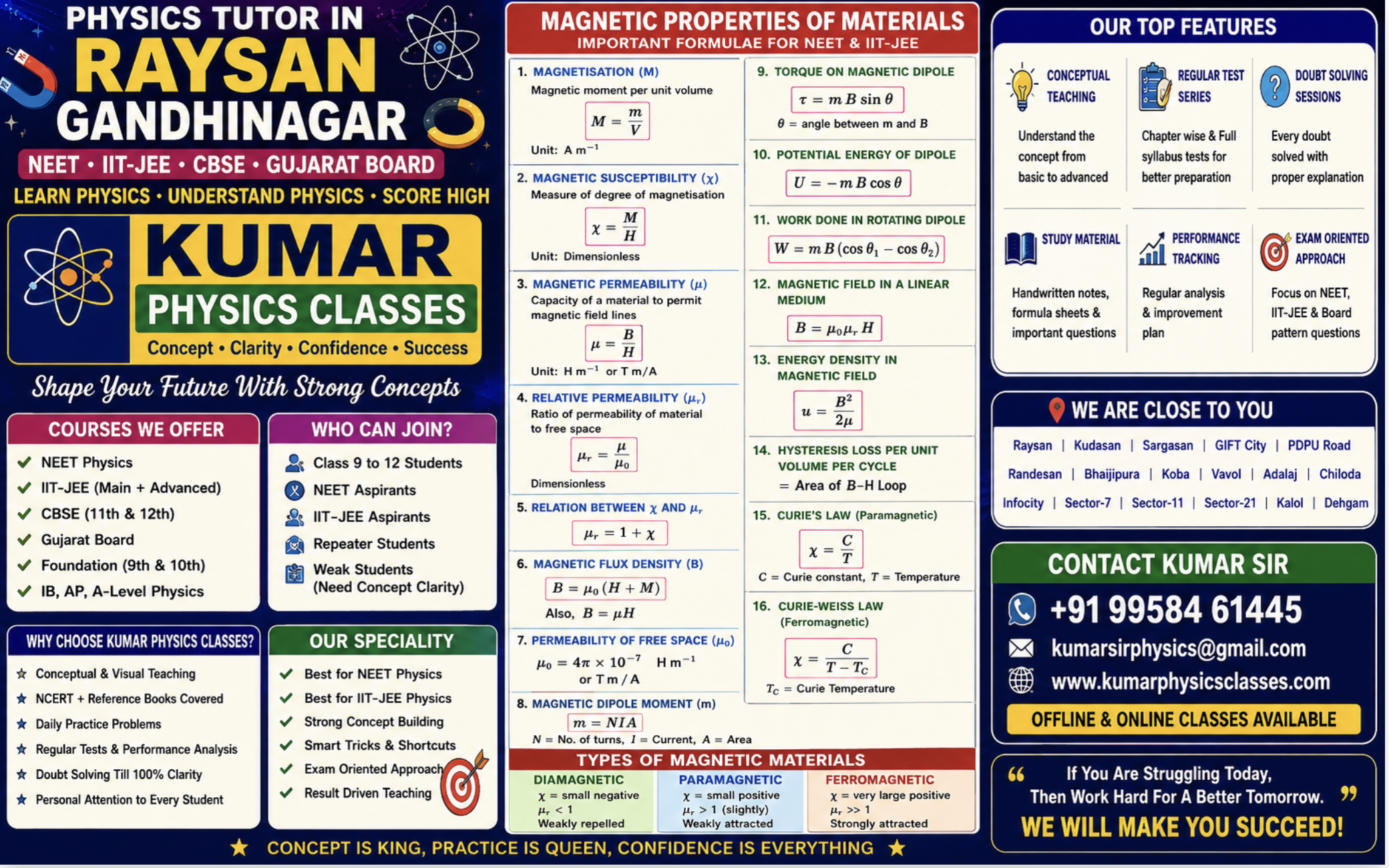
Physics Tutor in Raysan Gandhinagar
+91-9958461445
If you are living in Raysan Gandhinagar and today your Physics test result has shocked you, do not panic. Maybe you scored 2 marks, 4 marks, 8 marks, or maybe you attempted the paper but could not understand what the question was asking. This happens with many students of Class 11, Class 12, NEET and IIT-JEE because Physics is not a subject of only formulas. Physics needs concept clarity, imagination, diagram reading, mathematical confidence and regular numerical practice.
Raysan is close to many education-focused areas like GIFT City, Kudasan, PDPU Road, Sargasan and Randesan. Students here dream big. Some want NEET. Some want IIT-JEE. Some want CBSE board excellence. Some want Gujarat Board marks. Some are preparing for IB, AP Physics or A-Level Physics. But the common problem is the same: concepts are not clear.
A student may know the formula of magnetic field, but when the question changes language, the answer disappears. A student may remember Biot-Savart Law, but when a circular loop, solenoid, moving charge or magnetic dipole appears, confusion starts. This is why a good Physics Tutor in Raysan Gandhinagar becomes important.
Kumar Sir focuses on concept clarity first. If a student is weak in basics, he does not directly jump to advanced questions. He first explains the meaning of current, charge, magnetic field, direction, right-hand thumb rule, field lines, torque and magnetic moment. Once the foundation becomes strong, NEET and IIT-JEE questions become easier.
Why Magnetic Properties Matter in NEET and IIT-JEE
Magnetic Properties of Matter is a small-looking chapter, but it connects deeply with Magnetism and Current Electricity. In NEET, direct conceptual questions often come from diamagnetic, paramagnetic and ferromagnetic materials. Students must know magnetic susceptibility, permeability, relative permeability, hysteresis, retentivity, coercivity and Curie temperature.
In IIT-JEE, the chapter becomes more analytical. Questions may connect magnetic field, magnetic moment, torque, potential energy and material behavior. If the student only memorizes definitions, he will struggle. But if the student understands why iron behaves differently from copper, why soft iron is used in electromagnets, why steel is used in permanent magnets, then the chapter becomes logical.
Physics is not fear. Physics is a language. Once Kumar Sir teaches the language, the same student who scored 2 or 4 marks can slowly start solving questions confidently.
Important Nearby Linked Keywords
Physics Tutor in Raysan Gandhinagar, Physics Tutor in GIFT City Gandhinagar, Physics Tutor in Kudasan Gandhinagar, Physics Tutor in Sargasan Gandhinagar, Physics Tutor in PDPU Road Gandhinagar, Physics Tutor in Randesan Gandhinagar, Physics Tutor in Bhaijipura Gandhinagar, Physics Tutor in Koba Gandhinagar, Physics Tutor in Infocity Gandhinagar, Physics Tutor in Sector 7 Gandhinagar, Physics Tutor in Sector 11 Gandhinagar, Physics Tutor in Sector 21 Gandhinagar, Physics Tutor in Adalaj Gandhinagar, Physics Tutor in Palaj Gandhinagar, Physics Tutor in IIT Gandhinagar, Physics Tutor in DAIICT Gandhinagar, Physics Tutor in PDEU Gandhinagar, Physics Tutor in NIFT Gandhinagar, Physics Tutor in Gujarat National Law University Gandhinagar, Physics Tutor in TCS Garima Park Gandhinagar, Physics Tutor in Gift One Tower Gandhinagar, Physics Tutor in Gift Two Tower Gandhinagar, NEET Physics Tutor in Raysan Gandhinagar, IIT Physics Tutor in Raysan Gandhinagar, JEE Physics Tutor in Raysan Gandhinagar, CBSE Physics Tutor in Raysan Gandhinagar, Gujarat Board Physics Tutor in Raysan Gandhinagar, IB Physics Tutor in Raysan Gandhinagar, AP Physics Tutor in Raysan Gandhinagar, A-Level Physics Tutor in Raysan Gandhinagar
Contact Kumar Sir
If you live in Raysan Gandhinagar and Physics is not improving, contact Kumar Sir.
Kumar Physics Classes
Phone: +91-9958461445
Email: kumarsirphysics@gmail.com
Website: https://kumarphysicsclasses.com
1. Magnetic Susceptibility
Magnetic susceptibility is the property of a material which tells how strongly it gets magnetised when placed in an external magnetic field.
Here, χ = magnetic susceptibility, M = magnetisation, H = magnetising field.
2. Magnetic Permeability
Magnetic permeability tells how easily magnetic field lines can pass through a material.
Here, μ = permeability of material, μ₀ = permeability of free space, μᵣ = relative permeability.
3. Relation Between Susceptibility and Relative Permeability
40 IIT & NEET Level Questions with Answers
NEET | IIT-JEE | CBSE | IB | AP | A-Level Physics
Contact: +91-9958461445
Email: kumarsirphysics@gmail.com
Website: https://kumarphysicsclasses.com