
CBSE | NEET | JEE Main | JEE Advanced
Electric Flux & Gauss's Law MCQ Practice
A full-screen study website for electrostatics practice: corrected formulas, symmetry-based diagrams, and original exam-pattern MCQs for NEET, JEE Main, and JEE Advanced preparation.
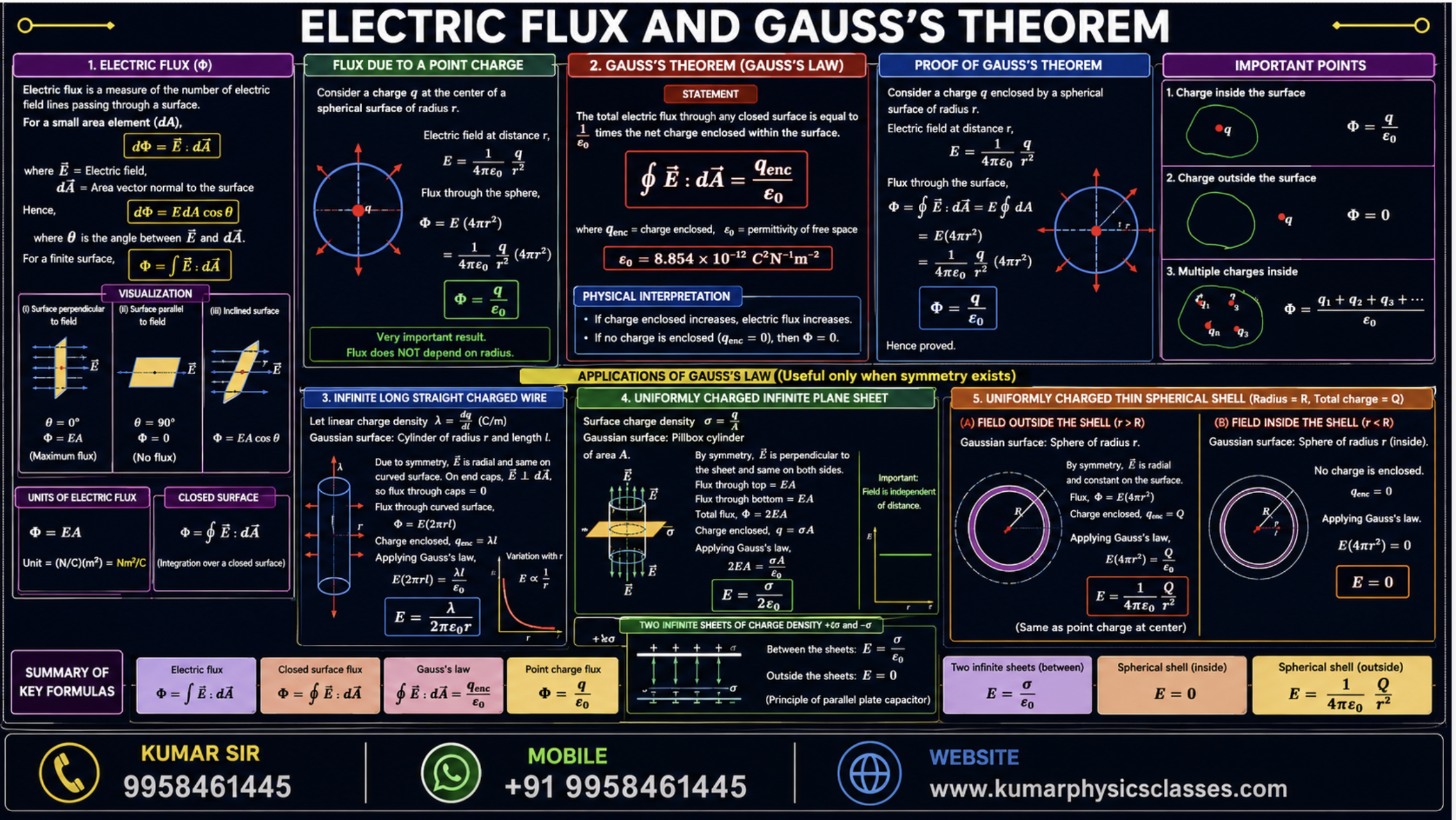
Core results you need before attempting MCQs
Most questions in this chapter become short once you decide whether the surface is closed or open, and whether symmetry divides the flux equally.
SI unit of electric flux: N m2 C-1, also equal to V m.
Visual shortcuts for flux questions
These are the four diagrams behind the most common board, NEET, and JEE questions on Electric Flux and Gauss's Law.
Charge at cube centre
By symmetry, all six faces receive equal flux. So one face gets q / 6ε0.
Hemisphere in uniform field
For a closed hemisphere, net flux is zero. Therefore the curved surface flux has magnitude EπR2.
Open cylindrical vessel
A charge at the centre of the opening sends half of its total flux into the vessel: Q / 2ε0.
Pillbox for charged sheet
For an infinite sheet, the Gaussian pillbox gives 2EA = σA/ε0.
NEET, IIT/JEE Advanced, IB and CBSE case-study practice
150 distinct source-tagged practice MCQs are rendered below: 50 NEET style, 50 IIT/JEE Advanced style, 50 IB DP Physics style, plus CBSE case-study practice. Questions are paraphrased/original exam-pattern items, not verbatim copied papers.
- Aq/ε0
- Bq/3ε0
- Cq/6ε0
- D0
Answer and explanation
- AQ/2ε0
- BQ/ε0
- C2Q/ε0
- D0
Answer and explanation
- A2πR2E
- BπR2E
- C4πR2E
- D0
Answer and explanation
- A4πε0
- B1/4πε0
- C1/ε0
- Dε0
Answer and explanation
- A0
- BGreater than F
- CLess than F
- DEqual to F
Answer and explanation
- APositive
- BZero
- CNegative
- DDepends only on surface area
Answer and explanation
- AEA
- B6EA
- CEA/6
- D0
Answer and explanation
- AFour times
- BTwo times
- CSame
- DHalf
Answer and explanation
- A2 N m2/C
- B10 N m2/C
- C14 N m2/C
- D-2 N m2/C
Answer and explanation
- AEA
- BEA/2
- CEA√3/2
- D0
Answer and explanation
- Aq/ε0
- Bq/2ε0
- Cq/8ε0
- Dq/24ε0
Answer and explanation
- Aq/8ε0
- Bq/12ε0
- Cq/24ε0
- D0
Answer and explanation
- AQ/ε0
- BQr/ε0R
- CQr2/ε0R2
- DQr3/ε0R3
Answer and explanation
- AλL/ε0
- B2πλL/ε0
- Cλ/2πε0L
- D0
Answer and explanation
- A0
- Bq/ε0
- C-q/ε0
- DDepends on shell thickness
Answer and explanation
- AIt is valid for any closed surface; total flux depends on enclosed charge.
- BIt is useful for field calculation mainly when symmetry is high.
- CExternal charges can change field at the surface but not the net flux.
- DAll of A, B and C are correct.
Answer and explanation
- Aq/ε0
- BQ/ε0
- C(q + Q)/ε0
- D0
Answer and explanation
- A10
- B100
- C1000
- D10000
Answer and explanation
What to revise for each exam level
Use this table to decide which question pattern to practise next.
| Exam | Common pattern | Fast method |
|---|---|---|
| CBSE / Boards | Definition of flux, unit, Gauss's law statement, charge at centre of cube. | Write formula first, then apply symmetry clearly. |
| NEET | Direct MCQs on total flux, unit charge, conductor shell, hemisphere in uniform field. | Check whether charge is enclosed; avoid unnecessary field calculation. |
| JEE Main | Vector dot product, angle with area vector, charge at corner, line charge, sheet charge. | Use Φ = E · A for open surfaces and qenc/ε0 for closed surfaces. |
| JEE Advanced / IIT | Multi-correct, sign convention, non-uniform charge distribution, linked symmetry cases. | Separate total flux from field distribution; external charges do not affect net flux. |
Need help in Physics?
If you are facing difficulty in Electric Flux, Gauss's Law, NCERT, H.C. Verma, Errorless Physics, Arihant problems, numerical questions, JEE Main, JEE Advanced, NEET Physics or board exam preparation, contact Kumar Sir for one-to-one online Physics tuition.
Classes are available for CBSE, ISC, IGCSE, IB, AP Physics, NEET, JEE Main and JEE Advanced students.