+91-9958461445
If you are searching for a Physics Tutor in Elgin Road Kolkata, then this detailed article is specially written for you. Many students preparing for NEET, IIT JEE, CBSE, ICSE, IB and A-Level Physics often feel confused in Electrostatics and Capacitors because the concepts look easy but the questions become tricky in examinations. Kumar Sir teaches these concepts in a very practical and concept-based style so that students understand the logic instead of memorizing formulas.
One of the most important topics in Electrostatics is Combination of Capacitors. Students generally learn formulas but do not understand when capacitors are actually in series, when they are in parallel, and when some capacitors should simply be ignored because of open circuit conditions.
Let us understand this in Kumar Sir style.
Whenever capacitors are connected in series, the equivalent capacitance decreases. In series combination, the reciprocal values are added. But whenever capacitors are connected in parallel, the equivalent capacitance increases because all capacitances are directly added together.
Now the real problem starts in advanced questions.
Many IIT JEE and NEET questions contain complicated capacitor networks. Students become confused because they try to directly apply formulas without understanding the actual path of current flow.
Kumar Sir always explains one golden rule:
“Whenever you want to find equivalent capacitance between two points, imagine that a battery is connected between those two points.”
This single idea changes the entire question.
Now think carefully. If current cannot pass through a certain branch because the circuit is open, then that branch behaves like infinite resistance. In that condition, those capacitors become useless for that particular circuit and can be ignored.
This is called the Open Circuit Concept.
Suppose two capacitors are connected in a branch but that branch is disconnected from the main conducting path. Then no charge transfer takes place through that branch. Since no charge transfer happens, those capacitors do not affect the equivalent capacitance between the required points.
On the other hand, if a direct conducting wire is present between two points, then that condition becomes a Short Circuit.
In short circuit condition, the potential difference becomes zero between those points. Because the wire offers negligible resistance, current prefers to pass through the wire.
This is one of the most important conceptual differences in capacitor networks:
Students who understand this idea properly can solve difficult IIT JEE capacitor problems very easily.
Kumar Sir always tells students not to panic when they see large capacitor networks. Instead, first identify:
Once this understanding develops, the entire chapter becomes simple.
Why Students in Kolkata Prefer Kumar Sir for Physics
Students from Kolkata often struggle in Physics because many coaching institutes focus only on formulas and shortcut tricks. But competitive exams like IIT JEE and NEET now focus heavily on concepts and logical understanding.
Kumar Sir teaches:
in a deeply conceptual and easy language.
Students preparing for:
-
NEET Physics
-
IIT JEE Physics
-
CBSE Physics
-
ICSE Physics
-
IB Physics
-
IGCSE Physics
-
A-Level Physics
can understand even difficult chapters comfortably.
Why Capacitor Concepts Are Important for IIT JEE and NEET
In NEET and IIT JEE, capacitor questions are rarely direct. Examiners test:
That is why students must build proper conceptual clarity.
Kumar Sir explains every topic from basics to advanced level.
For example, students are first taught:
-
What is capacitance
-
Why charge stores
-
What is dielectric
-
Why electric field changes
-
How energy gets stored
-
What happens during charge redistribution
-
Why energy loss occurs during capacitor connection
Only after building this foundation are advanced network problems introduced.
Common Mistakes Students Make
1. Applying Series Formula Everywhere
Many students assume all capacitors in one line are in series. This is wrong.
2. Ignoring Open Circuit
Students forget that disconnected branches carry no charge flow.
3. Ignoring Short Circuit
Students fail to understand that direct wires make potential difference zero.
4. Memorizing Without Understanding
This creates panic during exams.
Kumar Sir focuses on removing these mistakes permanently.
Physics Tutor in Elgin Road
Physics Tutor in Park Street
Physics Tutor in Camac Street
Physics Tutor in Ballygunge
Physics Tutor in Bhawanipur
Physics Tutor in Alipore
Physics Tutor in New Alipore
Physics Tutor in Hazra
Physics Tutor in Kalighat
Physics Tutor in Southern Avenue
Physics Tutor in Lake Gardens
Physics Tutor in Prince Anwar Shah Road
Physics Tutor in Tollygunge
Physics Tutor in Jodhpur Park
Physics Tutor in Rashbehari Avenue
Physics Tutor in Gariahat
Physics Tutor in Golf Green
Physics Tutor in New Town Kolkata
Physics Tutor in Salt Lake
Physics Tutor in EM Bypass
Physics Tutor in Ruby
Physics Tutor in Kasba
Physics Tutor in Behala
Physics Tutor in Chetla
Physics Tutor in Kidderpore
Physics Tutor in Bhowanipore
Physics Tutor in Sealdah
Physics Tutor in Dum Dum
Physics Tutor in Howrah
Physics Tutor in Barasat
Physics Tutor in Rajarhat
Physics Tutor in Baguiati
Physics Tutor in Patuli
Physics Tutor in Santoshpur
Physics Tutor in Lake Town
Physics Tutor in Ultadanga
Physics Tutor in Shyambazar
Physics Tutor in Maniktala
Physics Tutor in College Street
Physics Tutor in Esplanade
Physics Tutor in Dhakuria
Physics Tutor in Garia
Physics Tutor in Narendrapur
Physics Tutor in Sonarpur
Physics Tutor in Belgharia
Physics Tutor in Madhyamgram
Physics Tutor in Kankurgachi
Physics Tutor in Chinar Park
All these keywords can be linked with:
kumarphysicsclasses.com
Schools and Institutes Near Elgin Road
Physics Tutor in La Martiniere for Boys
Physics Tutor in La Martiniere for Girls
Physics Tutor in South Point School
Physics Tutor in St Xavier’s Collegiate School
Physics Tutor in Modern High School
Physics Tutor in Don Bosco School
Physics Tutor in Calcutta International School
Physics Tutor in Future Foundation School
Physics Tutor in Patha Bhavan
Physics Tutor in Ashok Hall School
Physics Tutor in DPS Ruby Park
Physics Tutor in Heritage School
Physics Tutor in Birla High School
Physics Tutor in National High School
Physics Tutor in Pratt Memorial School
Physics Tutor in Scottish Church Collegiate School
Physics Tutor in Adamas International School
Physics Tutor in Julien Day School
Physics Tutor in MP Birla Foundation School
NEET Physics Preparation with Kumar Sir
NEET students need very high accuracy because even one mistake changes rank significantly.
Kumar Sir teaches:
Students are trained to solve questions quickly and accurately.
IIT JEE Physics Preparation
IIT JEE Physics requires deep conceptual understanding.
Topics like:
-
Capacitors
-
Electric Dipole
-
Gauss Law
-
Potential
-
Equipotential Surfaces
-
Electric Field
-
Current Electricity
are taught from advanced perspective.
Kumar Sir regularly discusses:
This improves analytical ability.
IB and A-Level Physics Coaching
International board students often require:
Kumar Sir explains topics in easy English suitable for:
-
IB Physics
-
IGCSE Physics
-
Cambridge Physics
-
A-Level Physics
Online and Offline Physics Classes
Students can attend:
-
Home tuition
-
Online live classes
-
Recorded sessions
-
One-to-one mentoring
-
Doubt sessions
Flexible timings are available.
Final Advice for Students
Never study Physics by memorizing formulas only.
Physics is about:
When students understand concepts like:
-
Open circuit
-
Short circuit
-
Equivalent capacitance
-
Charge conservation
-
Potential equality
then even difficult questions become easy.
That is why students across Kolkata trust Kumar Sir for Physics preparation.
If you are serious about scoring high in:
-
NEET
-
IIT JEE
-
CBSE Boards
-
ICSE Boards
-
IB Physics
-
A-Level Physics
then concept-based learning is extremely important.
Kumar Sir’s teaching method focuses on:
-
Clarity
-
Logic
-
Simplicity
-
Visualization
-
Deep understanding
This is why students from different schools and localities across Kolkata continue learning Physics with Kumar Sir year after year.
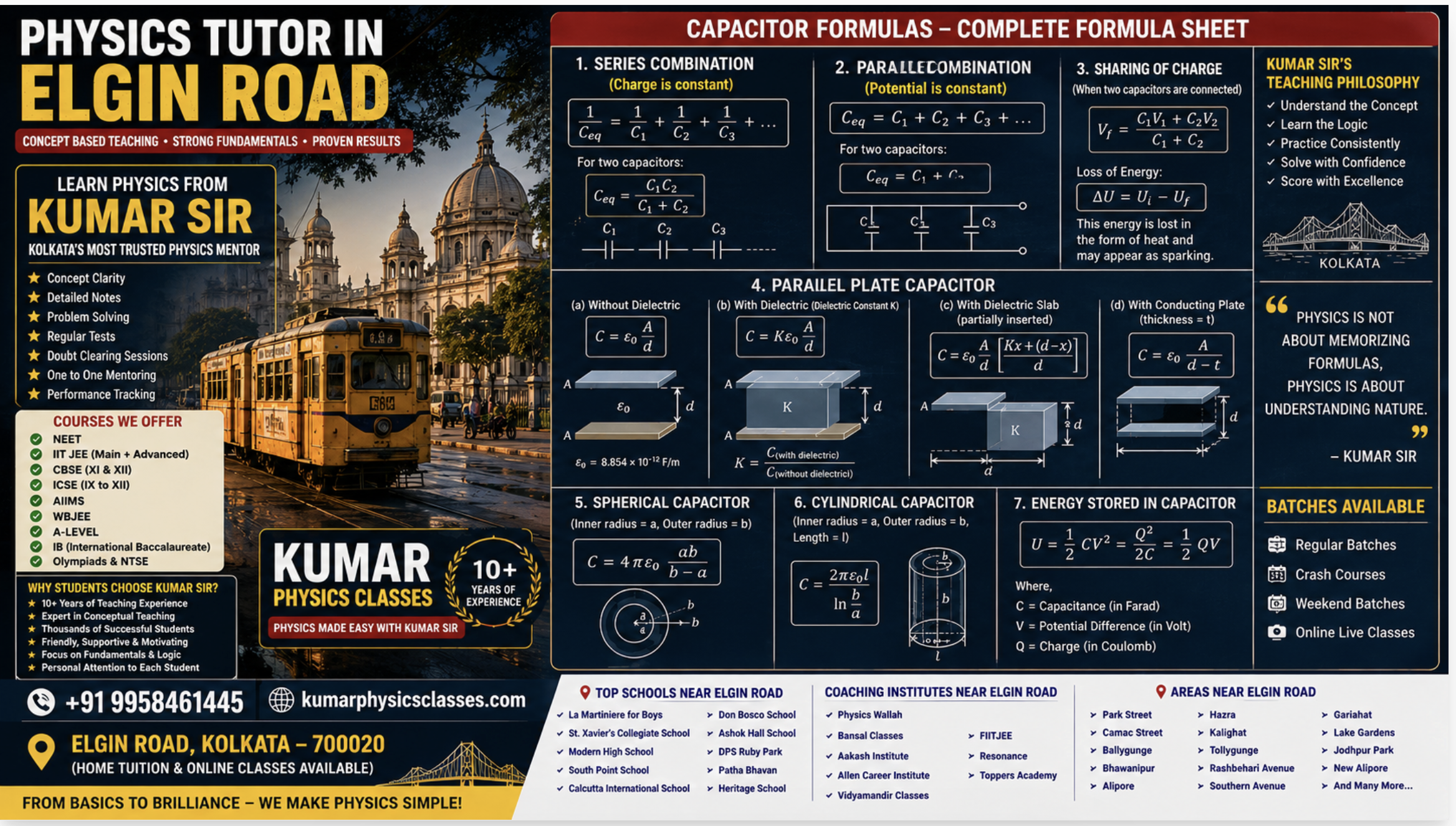
Whenever capacitors are connected in series, the charge on every capacitor remains constant. This is one of the most important concepts in Electrostatics and Capacitors. Kumar Sir always explains that in series connection, the same amount of charge flows through every capacitor because there is only one path for the charge to move. The potential difference may change across different capacitors, but the charge remains the same on all capacitors.
On the other hand, whenever capacitors are connected in parallel, the potential difference across every capacitor remains constant. This happens because all the capacitors are connected directly across the same battery terminals. Therefore, voltage remains the same, while the charge stored on different capacitors may become different depending upon their capacitance values.
So while solving equivalent capacitance problems, students must always remember these two golden rules:
-
In series combination → Charge remains constant.
-
In parallel combination → Potential difference remains constant.
Kumar Sir teaches students to first identify whether the capacitors are in series or parallel before solving the question. Once this idea becomes clear, most capacitor questions become very easy.
Another important topic is sharing of charge. Whenever two charged capacitors are connected together, charges redistribute between them until both reach a common potential. During this process, some energy is lost. Students often ask where this energy goes. Kumar Sir explains that this loss of energy generally appears in the form of heat and small sparking. Initially, the energy stored in the capacitors is more, and after redistribution, the final energy becomes less. The difference between initial and final energy is the energy loss.
Kumar Sir also explains the Parallel Plate Capacitor very clearly. The normal formula of capacitance for a parallel plate capacitor is:
C = ε₀A/d
where ε₀ is permittivity of free space, A is the area of plates, and d is the separation between the plates.
If a dielectric material is inserted between the plates, the capacitance increases. In that case, the formula becomes:
C = Kε₀A/d
where K is the dielectric constant of the material.
This means dielectric materials help the capacitor store more charge. This concept is extremely important for NEET, IIT JEE, CBSE, ICSE, IB, and A-Level Physics examinations. Kumar Sir always teaches these concepts with logic and practical understanding so that students can solve even difficult numerical problems confidently.
Students searching for Physics Tutor in Alipore, Physics Tutor in Ballygunge, Physics Tutor in New Alipore, Physics Tutor in Salt Lake City, Physics Tutor in Rajarhat, Physics Tutor in New Town, Physics Tutor in Camac Street, Physics Tutor in Park Street, Physics Tutor in Southern Avenue, Physics Tutor in Lake Gardens, Physics Tutor in Jodhpur Park, Physics Tutor in EM Bypass Luxury Belt, Physics Tutor in Prince Anwar Shah Road, Physics Tutor in Tollygunge, and Physics Tutor in Elgin Road