
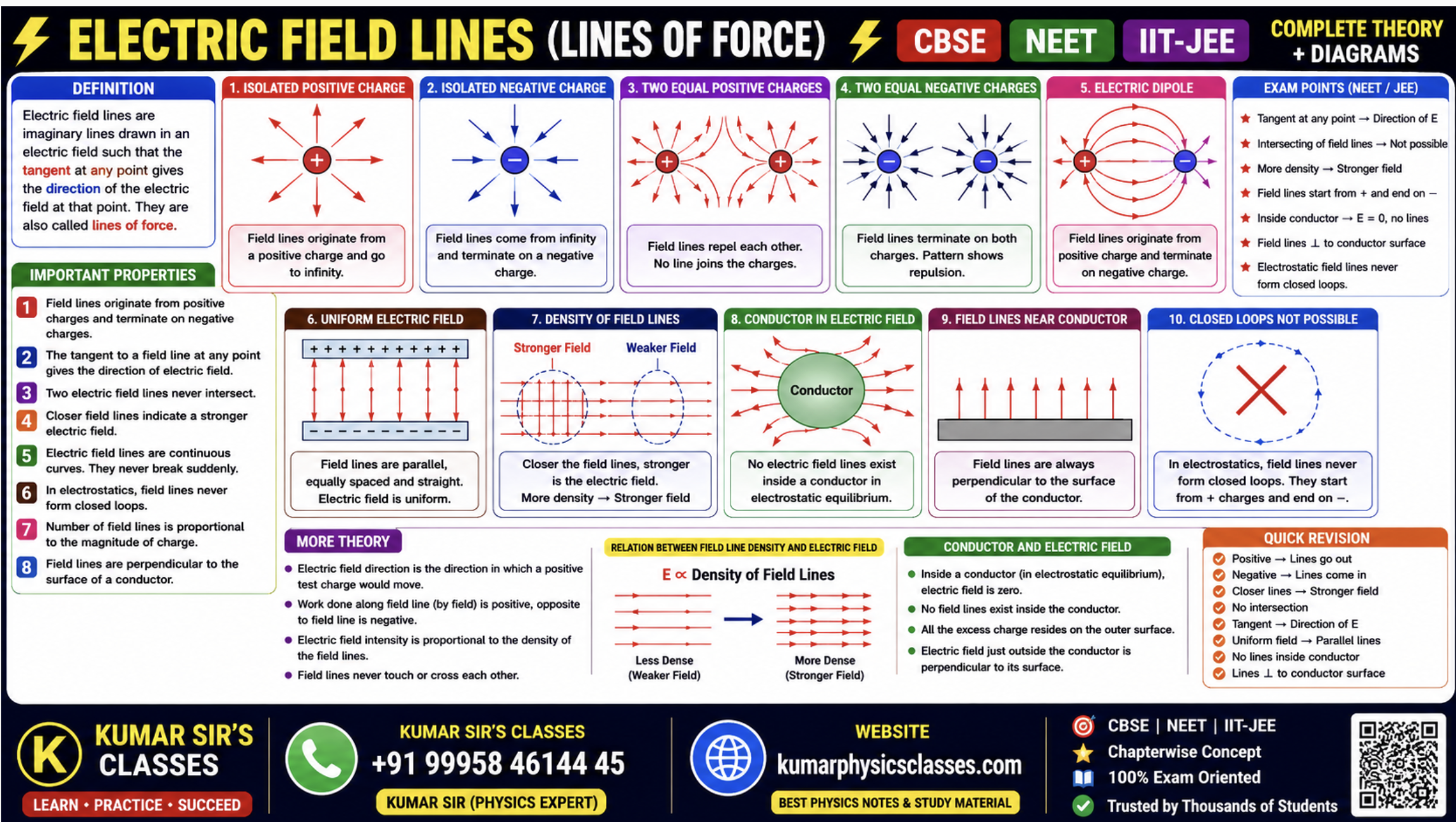
1. Lines originate from positive charge and terminate on negative charge
For electrostatic fields, the chosen direction is the direction in which a positive test charge would move. Therefore, lines leave positive charge and enter negative charge.
If you are searching for Electrostatics Class 12, NEET Physics, JEE Physics or an expert Physics Tutor, contact Kumar Sir for one-to-one online Physics mentoring.
Kumar Physics Classes
A complete conceptual guide for CBSE, NEET, JEE Main, JEE Advanced, IB Physics and IGCSE
Section 1
Electric field lines are imaginary lines drawn in an electric field such that the tangent at any point on a line gives the direction of the electric field at that point.
They are also called lines of force because a positive test charge placed in the field would experience electric force in the direction of the tangent to the line. The line does not physically exist in space. It is a visual model used to represent a vector field that is otherwise invisible.
An electric field is the actual physical quantity: force per unit positive test charge. Electric field lines are a drawing convention used to show the direction, relative strength and pattern of that field. A single point in space has one electric field vector, while a diagram may contain many lines to help us understand the whole region.
E = F/q and the tangent to a field line gives the direction of E.
Section 2
These properties are the backbone of CBSE board diagrams, NEET concept questions, JEE reasoning and IB/IGCSE explanation questions.
For electrostatic fields, the chosen direction is the direction in which a positive test charge would move. Therefore, lines leave positive charge and enter negative charge.
The field vector at a point is along the tangent to the curve at that point. If the line is curved, the direction changes from point to point.
If two lines intersected, there would be two tangents at the same point. That would mean two directions of electric field at one point, which is impossible.
The number of lines crossing a unit area normal to the field indicates relative field strength. Crowded lines mean a larger electric field.
A line does not suddenly break in empty space. It starts on a positive charge or infinity and ends on a negative charge or infinity.
Electrostatic force is conservative. If field lines formed closed loops, a charge could gain or lose net energy around a closed path, which contradicts electrostatics.
A charge with larger magnitude is represented by a larger number of field lines, so that line density reflects field strength.
Charge Field Diagrams
Section 3
For an isolated positive charge, electric field lines are radially outward. The pattern is symmetric because the charge has no preferred direction in space. The field strength decreases with distance according to E = kq/r2, so the field line density becomes smaller as we move away from the charge.
This is the simplest diagram for understanding why electric field is a vector. At every point, the direction points directly away from the positive charge.
Section 4
For an isolated negative charge, electric field lines are radially inward. The pattern remains symmetric, but every arrow is directed towards the charge because a positive test charge would be attracted by the negative source charge.
Field lines terminate on the negative charge. As the distance from the charge increases, field strength decreases and the field lines become less crowded.
Section 5
For two equal positive charges, field lines emerge from both charges and bend away from each other. No field line joins the two positive charges because lines do not terminate on positive charge. The pattern shows repulsion.
At the midpoint between two equal positive charges, the fields due to the two charges are equal in magnitude and opposite in direction. Therefore, the resultant electric field is zero. This point is called a null point.
Section 6
For two equal negative charges, field lines terminate on both charges. The arrows point towards the negative charges, but the overall shape still shows repulsion between like charges because the lines bend away from the central region.
The midpoint between the charges is again a null point for equal charges. The fields due to the two charges cancel there.
Section 7
An electric dipole consists of two equal and opposite charges separated by a small distance. Field lines originate from the positive charge and terminate on the negative charge. Near the charges, lines are crowded, so the field is strong. Away from the charges, lines spread out, so the field becomes weak.
The curved pattern shows that the field is non-uniform. The direction and magnitude of the electric field change from point to point. Dipole field lines are extremely important for CBSE, NEET and JEE because they test direction, symmetry, null-point reasoning and potential concepts.
| Feature | Isolated Charge | Electric Dipole |
|---|---|---|
| Source | Single positive or negative charge | Equal and opposite pair |
| Line shape | Radial straight lines | Curved lines from + to - |
| Uniformity | Non-uniform | Strongly non-uniform |
| Symmetry | Spherical symmetry | Axial and equatorial symmetry |
Section 8
A uniform electric field is produced approximately between two large parallel oppositely charged plates, away from the edges. In this region, the field lines are straight, parallel and equally spaced.
The direction of electric field is from the positive plate to the negative plate. Since the field line density is the same everywhere between the plates, electric field strength remains constant in magnitude and direction.
Uniform field: E = constant
Section 9
Electric field strength is proportional to field line density. Crowded lines mean stronger electric field. Widely spaced lines mean weaker electric field.
E ∝ density of field lines
For a point charge, the same set of lines spreads over larger and larger spherical surfaces as distance increases. Since surface area increases as 4πr2, the number of lines per unit area decreases, so the field becomes weaker.
| Observation in diagram | Meaning | Exam conclusion |
|---|---|---|
| Lines are crowded | Large field line density | Electric field is strong |
| Lines are far apart | Small field line density | Electric field is weak |
| Lines equally spaced | Same density everywhere | Uniform electric field |
| Density falls away from point charge | Spreading over larger area | Field follows inverse-square trend |
Section 10
When a positive charge moves along the direction of electric field lines, the electric force and displacement are in the same direction. Therefore, work done by the electric field is positive.
When a positive charge moves opposite to the direction of field lines, the electric force and displacement are opposite. Therefore, work done by the electric field is negative. An external agent must do positive work to move a positive charge opposite to the field.
Electric potential decreases in the direction of electric field. Thus, a positive test charge naturally moves from higher potential to lower potential under the action of electric force.
Wfield = q(Vinitial - Vfinal)
Conductor Field Rules
Section 11
In electrostatic equilibrium, the electric field inside a conductor is zero. If a field existed inside, free electrons would experience force and keep moving. Since electrostatic equilibrium means charges are at rest, the internal electric field must vanish.
Therefore, no electric field lines exist inside a conductor in electrostatic equilibrium. Free charges redistribute themselves on the surface so that their combined field cancels the field inside the conducting material.
Section 12
Electric field lines are always perpendicular to the surface of a charged conductor. If the field had a tangential component, charges would move along the surface. That would contradict electrostatic equilibrium.
Section 13
If two lines intersected, the same point would have two tangents and therefore two electric field directions. A unique electric field vector exists at every point, so intersection is impossible.
A tangential electric field component would move free charges along the surface. In electrostatic equilibrium charges are at rest, so only a normal component can remain just outside the surface.
Electrostatic force is conservative. A closed field line would imply continuous work around a closed path, which is not possible for an electrostatic field.
Look for the region where field lines are most crowded. Higher line density represents larger electric field strength.
Near a charge, the same number of lines crosses a smaller area. Far away, the lines spread over a larger area, so density decreases.
They are a drawing model. They are not physical threads. They help us visualize direction and relative strength of an invisible vector field.
In electrostatic equilibrium, no field lines pass through the conducting material because the electric field inside the conductor is zero.
Parallel equally spaced lines show that direction and magnitude are the same at every point. This is the visual signature of a uniform electric field.
Section 14
Section 15
Section 16
These examples build from board-level recall to competitive-exam reasoning.
Section 17
Questions below are marked exam-style where exact year is not being claimed. Answers and explanations are included for revision.
Answer: They never intersect and the tangent gives direction of electric field. Explanation: These two statements test vector uniqueness and field-line interpretation.
Answer: Both are true and the reason correctly explains the assertion. A tangential field would move charges.
Answer: Field lines cannot intersect. Explanation: Intersection would imply two directions of electric field at the same point.
Answer: EA > EB. Explanation: Line density is proportional to electric field strength.
Answer: Both are true and the reason explains the assertion. Electron charge is negative, so force is opposite to E.
Answer: The diagram with radially inward arrows. Explanation: Field lines terminate on negative charges.
Answer: At the midpoint. Explanation: Fields are equal and opposite there.
Answer: Both are true and the reason is correct. A closed electrostatic line would imply net work around a closed path.
Answer: Yes. Explanation: Only a number proportional to q can terminate on -q; remaining lines from +3q go to infinity.
Answer: Because electric field is perpendicular to equipotential surfaces. Explanation: A tangential component would do work along an equipotential, contradicting constant potential.
Answer: Both are true and the reason explains the assertion. Higher surface charge density gives higher external field.
Answer: Yes. Explanation: At a null point, resultant electric field magnitude is zero, so no unique direction exists.
Answer: Spacing increases with distance. Explanation: Field strength decreases as field lines spread out.
Answer: Parallel lines show same direction; equal spacing shows same magnitude. Together they represent constant vector field.
Answer: Draw straight parallel arrows from positive plate to negative plate. Explanation: The field is approximately uniform between large plates.
Answer: Field lines are imaginary. Explanation: They are a model used to represent an electric field, not physical strings.
Section 18
A teacher shows two diagrams. Diagram A has arrows radially outward from a charge. Diagram B has arrows radially inward toward a charge. Students are asked to identify the charge sign and compare field strength at near and far points.
Two large parallel plates are connected to a battery. The left plate is positive and the right plate is negative. The central region between plates shows straight equally spaced lines.
A charged metal conductor is kept isolated. After a short time, charges come to rest. A student draws field lines inside the conductor and slanting lines at the surface.
Section 19
They are imaginary visual tools. The electric field is real; the lines are a representation.
Intersecting lines would mean two directions of electric field at one point.
Closed loops belong to different field situations, not static charge fields.
Near a negative charge, arrows point inward, not outward.
At a conducting surface, lines must be perpendicular in electrostatic equilibrium.
Field direction is force direction on a positive test charge; electrons move opposite to E.
Equal spacing means uniform field, not a point-charge field.
Section 20
Revise NCERT statements exactly. Practice drawing positive charge, negative charge, dipole, uniform field and conductor-surface diagrams with arrows. Prepare one-line reasons for non-intersection and perpendicular conductor lines.
Focus on rapid concept recognition. Identify direction, density, strong field regions and sign of work. Assertion-reason questions often test definitions and exceptions.
Combine field-line diagrams with vector cancellation. Null points, unequal charges, potential decrease and conductor behavior are high-value conceptual areas.
Connect field lines with equipotential surfaces, flux, conductor boundary conditions and symmetry. Do not rely only on diagram memory; reason from vector addition.
Use precise language: model, direction, relative strength, uniformity and limitation. Explain diagrams in sentences, not just labels.
Practice neat labelled diagrams. Use arrows correctly and describe stronger field as closer spacing of field lines.
Kumar Physics Classes
If electric field lines, electrostatics, Coulomb's law or Gauss's law feels confusing, contact Kumar Sir for one-to-one online Physics classes.