
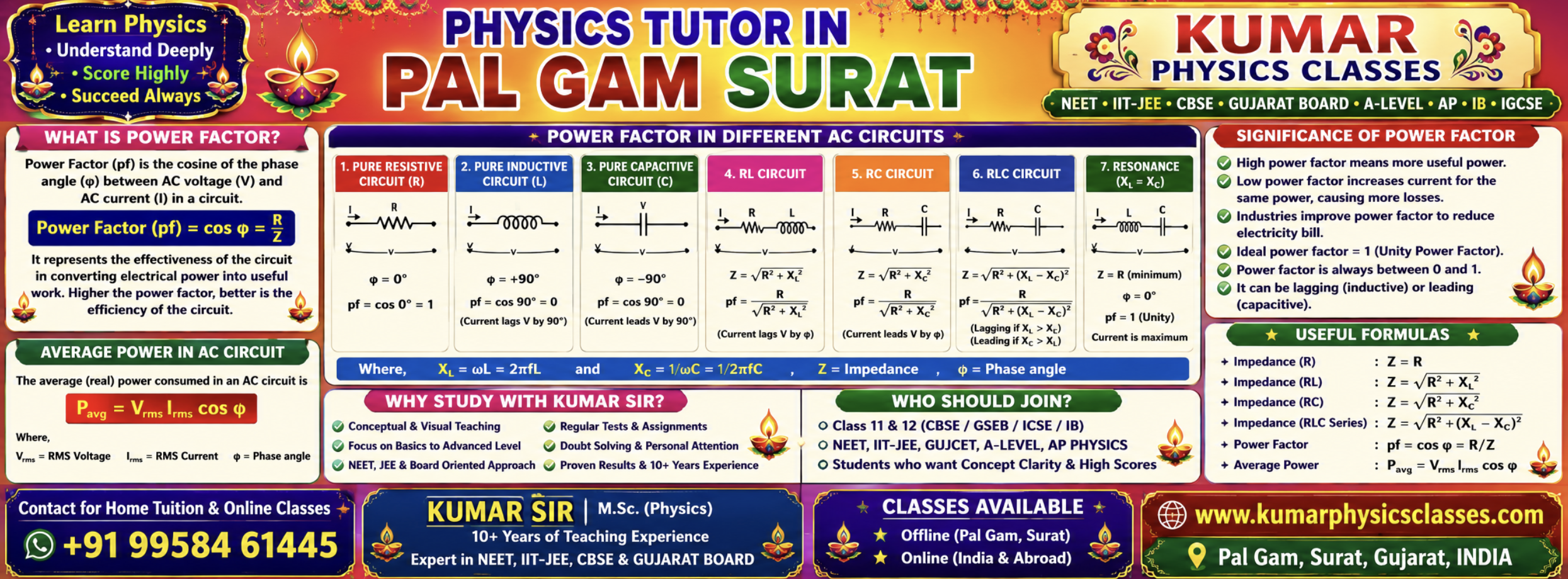
Physics Tutor in Pal Gam Surat – Learn AC Power Factor, NEET Physics, IIT-JEE Physics and Board Physics with Kumar Sir
+91-9958461445
Pal Gam Surat is one of the fast-growing residential areas of Surat. Families living in Pal Gam, Pal Road, Adajan, Palanpur, Bhatha and nearby localities give strong importance to education, career and professional success. Pal Gam is known as a developing locality with good residential options, connectivity, schools, hospitals and shopping facilities.
If you live in Pal Gam Surat and Physics is not becoming clear, then the problem is not always hard work. Sometimes the real problem is the teaching method. Many students read NCERT, attend coaching, solve modules, but still get confused in concepts like AC circuits, power factor, current, voltage, resistance, capacitor, inductor, phase difference and average power.
This is where Kumar Sir can help.
For NEET, IIT-JEE, CBSE, Gujarat Board, IB, IGCSE and A-Level Physics, Kumar Sir teaches Physics from the root level. He explains every formula, every graph, every derivation and every numerical in a simple and logical way.
Contact Kumar Physics Classes: +91-9958461445
Website: Kumar Physics Classes
What is Power Factor in AC Circuit?
In an AC circuit, voltage and current may not always be in the same phase. In a pure resistor, current and voltage are in the same phase. But in an inductor or capacitor, current and voltage have a phase difference.
Power factor is defined as:
Power Factor = cos φ
Here, φ is the phase difference between voltage and current.
If voltage and current are in the same phase, φ = 0°, so cos φ = 1. This is the best condition because maximum power is used.
If voltage and current have a large phase difference, power factor becomes low. That means the circuit is drawing current, but useful power is less.
Significance of Power Factor
Power factor tells us how effectively electrical power is being used in an AC circuit.
Average power in AC circuit is:
Pavg = Vrms Irms cos φ
Here, cos φ is the power factor.
So, power factor directly controls average power. If power factor is high, useful power is high. If power factor is low, useful power is low.
For students preparing for NEET and JEE, power factor is very important because it connects AC circuit theory with real electrical power usage.
Why Students in Pal Gam Surat Need Strong Physics Guidance
A student may live in a good locality, attend a good school, and still struggle in Physics. The reason is simple: Physics needs conceptual clarity. Memorising formulas is not enough.
If you do not understand phase difference, impedance, reactance, resonance and power factor, AC circuit numericals become confusing.
Kumar Sir teaches these topics step by step:
Meaning of AC voltage and AC current
RMS value and peak value
Resistance, inductive reactance and capacitive reactance
Impedance triangle
Phase angle
Power factor
Average power
Resonance condition
NEET and JEE numerical practice
Linked Keywords for Pal Gam Surat
Physics Tutor in Pal Gam Surat, Physics Tutor in Pal Road Surat, Physics Tutor in Adajan Surat, Physics Tutor in Palanpur Surat, Physics Tutor in Bhatha Surat, Physics Tutor in L.P. Savani Road Surat, Physics Tutor in Gaurav Path Road Surat, Physics Tutor in Narayana eTechno School Pal Gam Surat, Physics Tutor in Delhi Public School Surat, Physics Tutor in St. Xavier’s High School Surat, Physics Tutor in S. M. S. High School Surat, Physics Tutor in Gajera Global School Surat, Physics Tutor in Lotus Cricket Academy Pal Surat, Physics Tutor in Shaligram Felicity Pal Surat, Physics Tutor in Pal Gam Garden Surat, Physics Tutor in Surat Municipal Corporation Garden Pal, Physics Tutor in Adajan Gam Surat, Physics Tutor in Vesu Surat, Physics Tutor in Piplod Surat, Physics Tutor in City Light Surat, Physics Tutor in New City Light Surat, Physics Tutor in VIP Road Surat, Physics Tutor in Dumas Road Surat, NEET Physics Tutor in Surat, IIT Physics Tutor in Surat, JEE Physics Tutor in Surat, CBSE Physics Tutor in Surat, Gujarat Board Physics Tutor in Surat, IB Physics Tutor in Surat, IGCSE Physics Tutor in Surat, A-Level Physics Tutor in Surat, British Curriculum Physics Tutor in Surat, AP Physics Tutor in Surat, Online Physics Tutor in Surat, Physics Home Tutor in Pal Gam Surat, Best Physics Tutor in Pal Gam Surat, Physics Teacher in Pal Gam Surat, Physics Classes in Pal Gam Surat, Physics Coaching in Pal Gam Surat, NEET Physics Classes in Pal Gam Surat, JEE Physics Classes in Pal Gam Surat, Class 11 Physics Tutor in Pal Gam Surat, Class 12 Physics Tutor in Pal Gam Surat
Why Kumar Sir?
Kumar Sir focuses on concept building first. He does not simply give formulas. He explains why the formula is used, where it comes from and how to apply it in NEET, JEE and board exams.
For AC power factor, he explains:
Why current lags in an inductor
Why current leads in a capacitor
Why resistor has power factor 1
Why pure inductor and pure capacitor consume zero average power
Why real circuits need good power factor
How power factor affects average power
This type of teaching makes Physics logical and interesting.
Final Message for Students of Pal Gam Surat
If you are living in Pal Gam Surat and Physics is creating pressure in NEET, IIT-JEE, CBSE or Gujarat Board, do not wait. Physics can become your strongest subject if it is taught properly.
Call Kumar Sir and start learning Physics with clarity, confidence and proper exam direction.
Kumar Physics Classes
Contact: +91-9958461445
Website: https://kumarphysicsclasses.com
Power Factor in AC Circuits
RL Circuit | RC Circuit | RLC Circuit | Resonance | Impedance
What is Power Factor?
Power factor is the cosine of the phase angle between AC voltage and AC current. It tells how effectively electrical power is converted into useful average power.
Average Power in AC Circuit
In AC circuits, voltage and current may not be in the same phase. Therefore, average power depends on power factor.
Power Factor in Different Circuits
- Pure Resistor: φ = 0°, Power Factor = 1
- Pure Inductor: φ = 90°, Power Factor = 0
- Pure Capacitor: φ = 90°, Power Factor = 0
- RL Circuit: Current lags voltage, PF = R / √(R² + XL²)
- RC Circuit: Current leads voltage, PF = R / √(R² + XC²)
- RLC Circuit: PF = R / √[R² + (XL − XC)²]
- Resonance: XL = XC, Z = R, PF = 1
40 Conceptual Questions with Answers
NEET | IIT-JEE | CBSE | Gujarat Board | IB | AP Physics
Contact: +91-9958461445
Website: www.kumarphysicsclasses.com