Physics Tutor in Piplod Surat +91-9958461445
Piplod is one of the most premium and fast-developing areas of Surat. It is a place of modern families, business-class homes, good schools, coaching centres, apartments, malls, restaurants and ambitious students. Parents living in Piplod want their children to become doctors, engineers, IITians, researchers and successful professionals.
But sometimes, even in such a strong educational environment, one subject becomes a big problem.
That subject is Physics.
A student may live in Piplod Surat, study in a good school, attend coaching classes and buy expensive modules, but still feel confused in Physics. Resistance does not make sense. Voltage feels abstract. Newton’s laws look simple in theory but become difficult in numericals. Rotation feels like a nightmare. Heat and thermodynamics go above the head. Current electricity becomes confusing. Mechanics becomes heavy. Electrostatics becomes dry.
This is where Kumar Sir can help.
Kumar Sir teaches Physics in a simple, logical and result-oriented way. He explains concepts from the root level so that students can understand, apply and solve questions confidently.
A Simple Physics Concept: Resistance of a Hollow Cylindrical Pipe
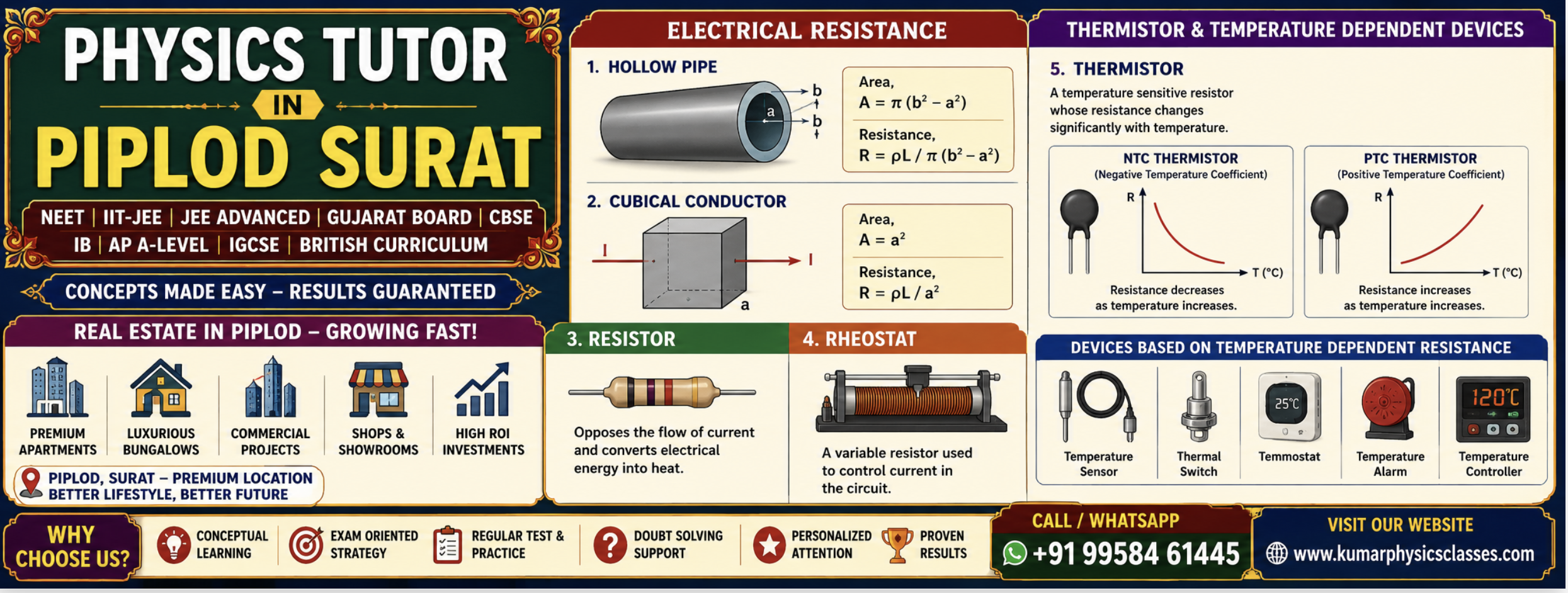
Suppose we have a hollow conducting pipe. Its internal radius is small a and outer radius is small b. Current flows along the length of the pipe.
The conducting cross-sectional area is not the full circle. It is the area of the outer circle minus the area of the inner hollow circle.
So,
Area = πb² − πa²
Therefore,
Area = π(b² − a²)
Resistance is given by:
R = ρL / A
So for the hollow pipe:
R = ρL / π(b² − a²)
This is a beautiful example of Physics. The formula is simple, but the concept matters. If a student blindly writes area as πr², the answer becomes wrong. The student must understand geometry, current flow and resistance together.
This is exactly where many students struggle.
They remember formulas, but they do not understand where to apply them.
Why Students in Piplod Surat Struggle in Physics
Many students in Piplod attend good schools and coaching institutes. They listen to lectures, write notes and revise chapters. But when they sit alone with questions, they feel stuck.
They ask themselves:
Why is resistance inversely proportional to area?
Why does voltage drop across a resistor?
Why does current divide in parallel circuits?
Why is rotation so difficult?
Why do Newton’s laws change from one question to another?
Why does heat feel so confusing?
Why do capacitor and current electricity questions become tricky?
The problem is not that the student is weak. The problem is that Physics needs a different style of teaching.
Physics cannot be mastered only by memorising formulas. Physics needs imagination, diagrams, logic and practice.
Kumar Sir’s Teaching Method
Kumar Sir teaches Physics like a story. First, he builds the situation. Then he explains the concept. Then he derives the formula. Then he solves examples. Then he gives practice questions. Then he checks whether the student can apply the idea independently.
For NEET students, he focuses on speed, accuracy and MCQ practice.
For IIT-JEE students, he focuses on deep concepts and multi-step problem solving.
For CBSE and Gujarat Board students, he focuses on derivations, diagrams and scoring answers.
For IB, AP, IGCSE, A-Level and British Curriculum students, he focuses on reasoning, graphs, explanation and structured answers.
Physics Tutor in Piplod Surat for NEET
NEET Physics is rank-deciding. Many students are good in Biology, but Physics reduces their score. They know NCERT Biology, but they cannot solve Physics numericals quickly.
Kumar Sir helps NEET students understand every concept clearly. Mechanics, heat, thermodynamics, waves, electrostatics, current electricity, magnetism, EMI, optics and modern physics are taught step by step.
The target is simple: improve confidence, improve accuracy and improve marks.
Physics Tutor in Piplod Surat for IIT-JEE
IIT-JEE Physics requires deep understanding. A student cannot depend only on formulas. JEE questions test whether the student can think.
In mechanics, students must understand vectors, Newton’s laws, friction, circular motion, work-energy, centre of mass, rotation and gravitation. In electricity, they must understand resistance, current, voltage, Kirchhoff’s laws, capacitors and circuits.
Kumar Sir trains students to break difficult questions into small steps. He teaches how to draw diagrams, choose equations and avoid silly mistakes.
Physics Tutor for Piplod Surat
Physics Tutor in Piplod Surat, NEET Physics Tutor in Piplod Surat, IIT-JEE Physics Tutor in Piplod Surat, JEE Main Physics Tutor in Piplod Surat, JEE Advanced Physics Tutor in Piplod Surat, CBSE Physics Tutor in Piplod Surat, Gujarat Board Physics Tutor in Piplod Surat, IB Physics Tutor in Piplod Surat, AP Physics Tutor in Piplod Surat, IGCSE Physics Tutor in Piplod Surat, A-Level Physics Tutor in Piplod Surat, British Curriculum Physics Tutor in Piplod Surat
Physics Tutor in Nearby Areas of Piplod Surat
Physics Tutor in Vesu Surat, Physics Tutor in City Light Surat, Physics Tutor in Dumas Road Surat, Physics Tutor in VIP Road Surat, Physics Tutor in Ghod Dod Road Surat, Physics Tutor in Athwa Surat, Physics Tutor in Althan Surat, Physics Tutor in Bhimrad Surat, Physics Tutor in Pal Gam Surat, Physics Tutor in Canal Road Surat
Physics Tutor in Schools Near Piplod Surat
Physics Tutor in Delhi Public School Surat, Physics Tutor in Fountainhead School Surat, Physics Tutor in G.D. Goenka International School Surat, Physics Tutor in Ryan International School Surat, Physics Tutor in Podar International School Surat, Physics Tutor in Tapti Valley International School Surat, Physics Tutor in T. M. Patel International School Surat, Physics Tutor in P. P. Savani School Surat
Physics Tutor in Colleges and Institutions Near Piplod Surat
Physics Tutor in SVNIT Surat, Physics Tutor in Veer Narmad South Gujarat University Surat, Physics Tutor in AURO University Surat, Physics Tutor in Bhagwan Mahavir University Surat, Physics Tutor in Sarvajanik College of Engineering and Technology Surat
Physics Tutor in Apartments and Premium Residential Areas Near Piplod Surat
Physics Tutor in Rajhans Campus Surat, Physics Tutor in Green City Surat, Physics Tutor in Weekend Address Surat, Physics Tutor in Avadh Utopia Surat, Physics Tutor in Imperial Heights Surat, Physics Tutor in Shivalik Western Surat, Physics Tutor in Raghuvir Symphony Surat, Physics Tutor in Milestone Habitat Surat
Why Physics Must Be Corrected Early
Physics problems do not disappear automatically. If a student does not understand basic resistance today, tomorrow current electricity becomes difficult. If Newton’s laws are weak, work-energy, circular motion and rotation become difficult. If vectors are weak, mechanics becomes weak. If graphs are weak, modern Physics and waves become confusing.
That is why students should not wait until the final exam.
If a child is struggling in Physics, the right time to take help is now.
Final Message for Piplod Surat Parents
Surat is a city of diamonds, textiles, business and ambition. But for a student, education is the real diamond. A family may build business, wealth and success, but the child’s academic foundation must be strong.
If your child lives in Piplod Surat and is struggling in Physics, speak to Kumar Sir once.
Whether the problem is resistance, voltage, current electricity, mechanics, Newton’s laws, rotation, heat, thermodynamics, capacitors, optics or modern Physics, Kumar Sir can explain it from the root level.
Physics becomes easy when it is taught in the right way.
Contact Kumar Physics Classes
Call / WhatsApp: +91-9958461445
Email: kumarsirphysics@gmail.com
Website: https://kumarphysicsclasses.com
Resistance, Rheostat, Thermistor & Shape-Based Resistance
40 Conceptual Questions with Solid Explanations
Basic Definitions
1. Hollow Pipe Conductor: A conducting pipe has inner radius a and outer radius b. Its conducting area is the ring-shaped area: A = π(b² − a²). Therefore resistance is R = ρL / π(b² − a²).
2. Cubical Conductor: A cube-shaped conductor has equal length, breadth and height. If current flows through one face to the opposite face, resistance depends on the side length and cross-sectional area.
3. Resistor: A resistor is an electrical component that opposes the flow of current and converts electrical energy into heat.
4. Rheostat: A rheostat is a variable resistor used to change current in a circuit by changing effective resistance.
5. Thermistor: A thermistor is a temperature-sensitive resistor whose resistance changes significantly with temperature.
Important Formula
R = ρL / A
Resistance increases with length and decreases with area.
1. Why does a hollow pipe have area π(b² − a²)?
Because current flows only through the conducting material. The inner hollow part does not conduct, so we subtract inner circular area from outer circular area.
2. What is the resistance of a hollow pipe?
R = ρL / π(b² − a²). Here ρ is resistivity, L is length, b is outer radius and a is inner radius.
3. If inner radius increases, what happens to resistance?
Resistance increases because conducting area decreases.
4. If outer radius increases, what happens to resistance?
Resistance decreases because conducting area increases.
5. Why is resistance inversely proportional to area?
Larger area gives more paths for charge flow, so opposition decreases.
6. Why is resistance directly proportional to length?
Longer length gives more collisions to electrons, so resistance increases.
7. What is resistivity?
Resistivity is the material property that tells how strongly a material opposes current.
8. Does resistance depend on material?
Yes. Different materials have different resistivity, so resistance changes.
9. Does resistance depend on shape?
Yes. Shape changes length and area, so resistance changes.
10. What is a resistor?
A resistor limits current and produces voltage drop in a circuit.
11. What is a rheostat?
A rheostat is a variable resistor used to control current.
12. How does a rheostat control current?
It changes effective length of resistive wire. More length means more resistance and less current.
13. What happens if rheostat resistance increases?
Current decreases according to Ohm’s law: I = V/R.
14. What happens if rheostat resistance decreases?
Current increases because total opposition becomes smaller.
15. Why is rheostat connected in series?
Because it must control the total current flowing through the circuit.
16. What is a thermistor?
A thermistor is a resistor whose resistance changes with temperature.
17. What is NTC thermistor?
NTC means negative temperature coefficient. Its resistance decreases when temperature increases.
18. What is PTC thermistor?
PTC means positive temperature coefficient. Its resistance increases when temperature increases.
19. Why is thermistor useful?
Because it can detect temperature changes very sensitively.
20. Where are thermistors used?
They are used in temperature sensors, alarms, electronic devices and protection circuits.
21. If a wire is stretched, what happens to resistance?
Resistance increases because length increases and area decreases.
22. If a wire is folded, what happens to resistance?
Effective length decreases and parallel paths increase, so resistance decreases.
23. If length becomes double and area remains same, resistance becomes?
Resistance becomes double.
24. If area becomes double and length remains same, resistance becomes?
Resistance becomes half.
25. Why does thick wire have less resistance?
Because thick wire has larger cross-sectional area.
26. Why does thin wire have more resistance?
Because thin wire has smaller area, so electrons face more opposition.
27. In a cube, does resistance depend on direction?
For a uniform cube, resistance between opposite faces is same in all three directions.
28. What happens to resistance if temperature increases in a metal?
Resistance increases because lattice vibrations increase.
29. What happens to resistance if temperature increases in a semiconductor?
Resistance usually decreases because more charge carriers become available.
30. Is thermistor a metal?
No. Thermistors are usually made from semiconductor materials.
31. Why is copper used in wires?
Copper has low resistivity, so it allows current to flow easily.
32. Why is nichrome used in heaters?
Nichrome has high resistance and can withstand high temperature.
33. What is the role of resistor in LED circuit?
It limits current and protects LED from damage.
34. Can resistance be zero?
In ordinary conductors, no. But superconductors can have nearly zero resistance at very low temperature.
35. Why does a resistor heat up?
Electrical energy is converted into heat due to collisions of electrons with atoms.
36. What is power loss in resistor?
Power loss is P = I²R. It appears as heat.
37. If current doubles, heat produced becomes?
Heat effect becomes four times because power is proportional to I².
38. Why is resistance important in NEET/JEE?
Because it connects current electricity, circuits, heating effect and material properties.
39. What is the golden rule for resistance questions?
Always identify length, area and material first.
40. What is the final concept?
Resistance is not just a formula. It is the opposition offered by geometry, material and temperature together.
Kumar Physics Classes
Call / WhatsApp: +91-9958461445
Email: kumarsirphysics@gmail.com
Website: kumarphysicsclasses.com