
Physics Tutor in Ghodbunder Road Thane Mumbai – Concept Clarity for NEET, IIT JEE and Board Physics
+91-9958461445
If you live near Ghodbunder Road, Thane Mumbai, and Physics is not becoming clear, then the problem is usually not intelligence. The real problem is weak concept clarity, lack of proper numerical practice, and no personal doubt-solving support. Many students attend school, coaching classes, online lectures and test series, but still they feel stuck when actual Physics questions come in NEET, IIT JEE, CBSE, ICSE, IB, IGCSE, A-Level or AP Physics.
This is where Kumar Physics Classes helps students. Kumar Sir teaches Physics from the basic level to the advanced level. He does not simply tell students to memorise formulas. He explains why the formula is used, where it comes from, how to apply it, and how to think in a Physics question.
For students living in Ghodbunder Road, Thane West, Hiranandani Estate, Manpada, Kasarvadavali, Waghbil, Anand Nagar, Patlipada, Owale, Majiwada, Kapurbawdi and nearby areas, online Physics classes by Kumar Sir can be a strong support system.
Why Physics Becomes Difficult for Students
Physics is not like a subject where only reading theory is enough. In Class 9 and Class 10, many students score good marks because questions are direct. But when they enter Class 11, Class 12, NEET or IIT JEE, Physics suddenly becomes application-based.
A student may know the definition of electric field, potential, capacitance or current, but when a numerical comes, he does not know where to start. This happens because Physics needs three things:
Concept clarity
Mathematical application
Regular problem solving
If any one of these is weak, marks do not improve.
Kumar Sir focuses on all three.
Physics Tutor in Ghodbunder Road Thane Mumbai – Why Kumar Sir?
Kumar Sir explains every chapter from the root level. Whether the student is preparing for NEET Physics, IIT JEE Physics, CBSE Board Physics, ICSE Physics, IB Physics, IGCSE Physics, A-Level Physics or AP Physics, the teaching method is always concept-based.
He first checks what the student already knows. Then he finds the weak areas. After that, he explains the topic step by step with diagrams, derivations, numerical examples and exam-based questions.
Many students say, “Sir, theory samajh aa gayi, but questions nahi ho rahe.” Kumar Sir explains that if questions are not happening, then theory is not fully converted into application. Physics is not complete until you can solve questions.
Capacitor and Distribution of Charge on Plates
One important topic in electrostatics is capacitor. Many students memorise the formula:
C = Q/V
But they do not understand what actually happens inside a capacitor.
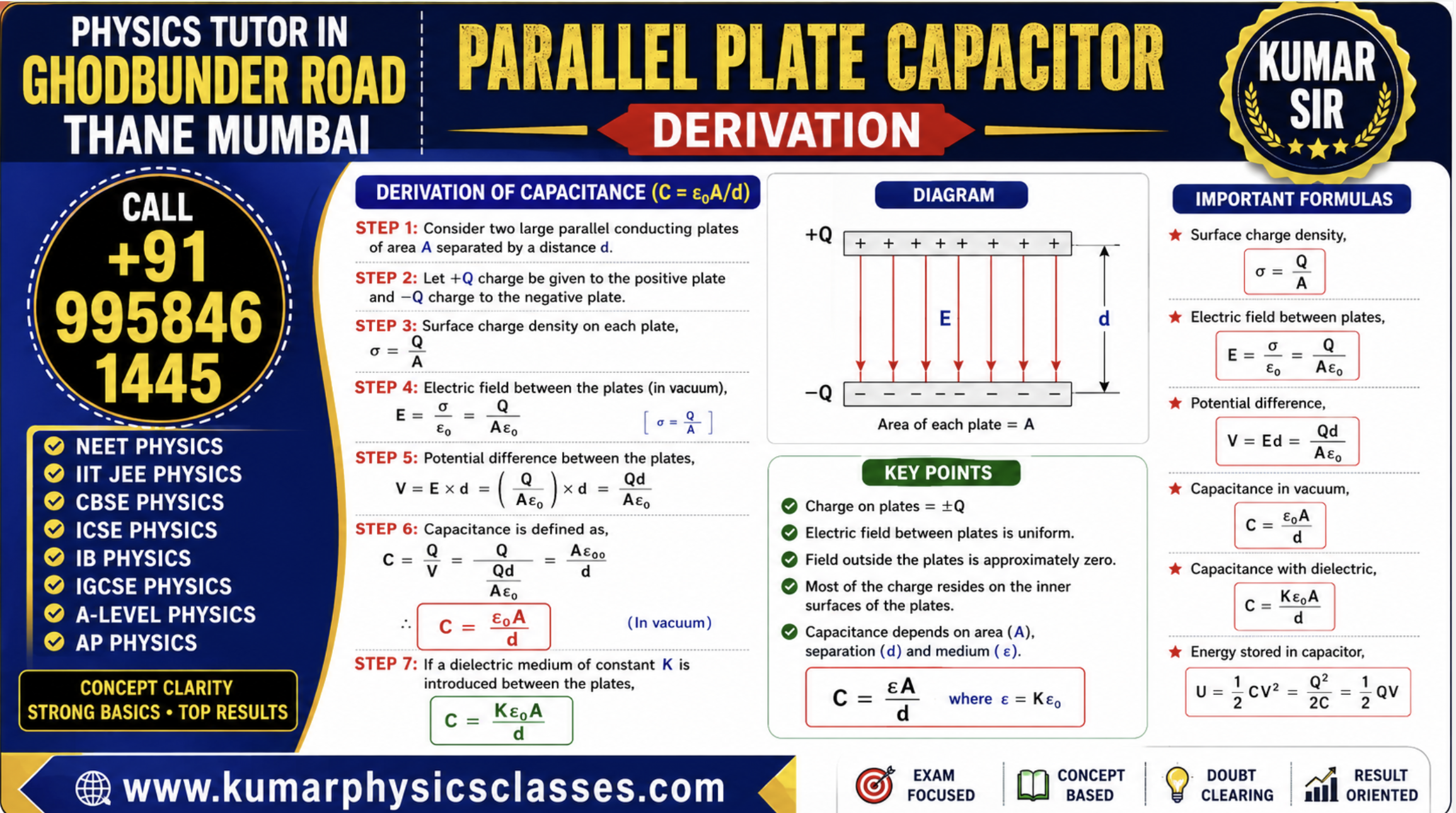
A capacitor is a device used to store electric charge and electrical energy. The simplest capacitor is a parallel plate capacitor. It consists of two conducting plates separated by a small distance. When the plates are connected to a battery, one plate gets positive charge and the other plate gets negative charge.
Suppose one plate has charge +Q and the other plate has charge −Q. The charge does not remain inside the metal body randomly. In electrostatic equilibrium, charge resides on the surface of a conductor. In a parallel plate capacitor, most of the charge appears on the inner surfaces of the plates because the electric field is mainly present between the plates.
If the plates are large and the separation between them is small, the electric field outside the plates is almost zero, and the field between the plates is nearly uniform.
For a parallel plate capacitor:
Electric field between plates:
E = σ / ε₀
where σ is surface charge density.
Potential difference between plates:
V = Ed
So,
V = σd / ε₀
Since σ = Q/A,
V = Qd / Aε₀
Therefore,
C = Q/V = Aε₀ / d
This means capacitance depends on area of plates, distance between plates and medium between them. It does not depend directly on charge or potential.
Physical Meaning of Capacitance
Capacitance tells us how much charge a conductor system can store for a given potential difference. If capacitance is high, it can store more charge for the same voltage.
If area A increases, capacitance increases.
If distance d increases, capacitance decreases.
If dielectric medium is inserted, capacitance increases.
This is why capacitor questions in NEET and IIT JEE often involve area, separation, dielectric constant, charge distribution and energy stored.
Kumar Sir’s Way of Teaching Capacitors
Kumar Sir does not start directly with formulas. He first explains:
What is charge?
Why charge appears on the surface?
Why inner plates carry charge in a capacitor?
Why electric field outside is nearly zero?
Why capacitance increases with area?
Why capacitance decreases with distance?
What happens when dielectric is inserted?
What changes when battery is connected or disconnected?
Once these concepts are clear, students can solve even difficult numerical questions.
Important Capacitor Formulae
Capacitance:
C = Q/V
Parallel plate capacitor:
C = ε₀A/d
With dielectric:
C = Kε₀A/d
Energy stored:
U = 1/2 CV² = Q²/2C = 1/2 QV
Electric field:
E = V/d
Surface charge density:
σ = Q/A
These formulas are important, but Kumar Sir always says that formulas are useful only when you understand their meaning.
For NEET Students
In NEET Physics, capacitor questions are usually concept-based and formula-based. But sometimes they involve battery connected or disconnected cases. Students must know what remains constant.
If battery is connected, voltage remains constant.
If battery is disconnected, charge remains constant.
This single idea helps in many questions.
For IIT JEE Students
In IIT JEE, capacitor questions can become very advanced. They may involve combination of capacitors, dielectric slabs, variable separation, energy loss, charge redistribution and circuits. For IIT JEE Advanced, students must understand the derivation and physical meaning deeply.
Kumar Sir trains students from basic level to advanced problem-solving level.
Contact Kumar Sir
For Physics classes, contact:
Kumar Physics Classes
Kumar Sir
Phone: +91-9958461445
Website: www.kumarphysicsclasses.com
Email: kumarsirphysics@gmail.com
Linked Keywords
Physics Tutor in Ghodbunder Road Thane Mumbai, Physics Tutor in Hiranandani Estate Thane, Physics Tutor in Manpada Thane, Physics Tutor in Kasarvadavali Thane, Physics Tutor in Waghbil Thane, Physics Tutor in Anand Nagar Thane, Physics Tutor in Patlipada Thane, Physics Tutor in Owale Thane, Physics Tutor in Majiwada Thane, Physics Tutor in Kapurbawdi Thane, Physics Tutor in Thane West, Physics Tutor in Thane Mumbai, NEET Physics Tutor in Ghodbunder Road, IIT JEE Physics Tutor in Ghodbunder Road, CBSE Physics Tutor in Ghodbunder Road, ICSE Physics Tutor in Ghodbunder Road, IB Physics Tutor in Ghodbunder Road, IGCSE Physics Tutor in Ghodbunder Road, A-Level Physics Tutor in Ghodbunder Road, AP Physics Tutor in Ghodbunder Road
50 IIT JEE Level Conceptual Questions on Parallel Plate Capacitor
Kumar Physics Classes +91-9958461445 www.kumarphysicsclasses.com
1. Why does capacitance of a parallel plate capacitor increase when plate area increases?
Answer: Larger area stores more charge for the same potential difference, so C = ε₀A/d increases.
2. Why does capacitance decrease when separation between plates increases?
Answer: Larger separation increases potential difference for same charge, hence C = Q/V decreases.
3. Does capacitance depend on charge stored?
Answer: No. Capacitance depends on geometry and medium, not on Q directly.
4. Does capacitance depend on potential difference?
Answer: No. C = Q/V, but C itself depends on A, d and dielectric.
5. Why is electric field between large parallel plates nearly uniform?
Answer: Because edge effects are negligible when plate separation is very small compared to plate dimensions.
6. What happens to capacitance if a dielectric of constant K completely fills the gap?
Answer: Capacitance becomes K times: C = Kε₀A/d.
7. Battery connected: dielectric inserted. What remains constant?
Answer: Potential difference V remains constant because battery controls voltage.
8. Battery disconnected: dielectric inserted. What remains constant?
Answer: Charge Q remains constant because capacitor is isolated.
9. Battery connected: dielectric inserted. What happens to charge?
Answer: Charge increases because C increases and Q = CV.
10. Battery disconnected: dielectric inserted. What happens to voltage?
Answer: Voltage decreases because V = Q/C and C increases.
11. Why is energy reduced when dielectric is inserted in isolated capacitor?
Answer: For isolated capacitor Q is constant, U = Q²/2C. Since C increases, U decreases.
12. Battery connected: dielectric inserted. What happens to energy stored?
Answer: Energy increases because U = ½CV² and V is constant while C increases.
13. Where does extra energy come from when battery remains connected?
Answer: From the battery, which supplies extra charge and energy.
14. Why does dielectric get pulled inside capacitor?
Answer: System tends to increase capacitance and reduce energy configuration, producing attractive force on dielectric.
15. What is fringing effect?
Answer: Bending of electric field lines near plate edges is called fringing effect.
16. When can fringing be ignored?
Answer: When plate separation is much smaller than plate dimensions.
17. Why is charge mainly on inner surfaces of plates?
Answer: Opposite charges attract and field is concentrated between plates, so charge resides mainly on facing surfaces.
18. What is surface charge density?
Answer: Charge per unit area, σ = Q/A.
19. Electric field between plates in vacuum is?
Answer: E = σ/ε₀ = Q/(ε₀A).
20. Potential difference between plates is?
Answer: V = Ed = Qd/(ε₀A).
21. Derive capacitance from field relation.
Answer: E = Q/ε₀A, V = Ed = Qd/ε₀A, so C = Q/V = ε₀A/d.
22. If plate separation is doubled, capacitance becomes?
Answer: Half, because C ∝ 1/d.
23. If plate area is doubled, capacitance becomes?
Answer: Double, because C ∝ A.
24. If dielectric constant is doubled, capacitance becomes?
Answer: Double, because C ∝ K.
25. Why does dielectric reduce electric field?
Answer: Induced bound charges create an opposing electric field.
26. What is dielectric polarization?
Answer: Separation/alignment of charges or dipoles inside dielectric under external electric field.
27. What happens to electric field when dielectric fills isolated capacitor?
Answer: Field reduces by factor K.
28. What happens to electric field when dielectric fills battery-connected capacitor?
Answer: Net field remains V/d because voltage and distance are fixed.
29. In battery-connected capacitor, why does charge increase after dielectric insertion?
Answer: Dielectric reduces effective field tendency, so battery supplies more free charge to maintain same V.
30. What is energy density in capacitor?
Answer: u = ½εE². In vacuum, u = ½ε₀E².
31. Why is capacitor energy stored in electric field?
Answer: Work done in separating charges appears as energy of electric field between plates.
32. If distance decreases while battery connected, what happens to force between plates?
Answer: Force generally increases because field remains V/d and becomes stronger as d decreases.
33. If distance decreases while isolated, what happens to capacitance?
Answer: Capacitance increases because C = ε₀A/d.
34. If distance decreases while isolated, what happens to voltage?
Answer: Voltage decreases because V = Q/C.
35. If distance decreases while battery connected, what happens to charge?
Answer: Charge increases because C increases and Q = CV.
36. What is equivalent capacitance if two capacitors are in parallel?
Answer: C_eq = C₁ + C₂ because voltage is same and charges add.
37. What is equivalent capacitance if two capacitors are in series?
Answer: 1/C_eq = 1/C₁ + 1/C₂ because charge is same and voltages add.
38. A dielectric slab of thickness t is inserted partially in thickness direction. Effective separation?
Answer: d_eff = d - t + t/K.
39. Capacitance with dielectric slab thickness t is?
Answer: C = ε₀A / (d - t + t/K).
40. If dielectric slab thickness equals d, formula becomes?
Answer: C = Kε₀A/d.
41. If half area is filled with dielectric, how to treat it?
Answer: Treat as two capacitors in parallel: one with dielectric, one without dielectric.
42. If half thickness is filled with dielectric, how to treat it?
Answer: Treat as two capacitors in series along field direction.
43. Why is capacitor combination in parallel when area is divided?
Answer: Both parts have same potential difference, so they behave like parallel capacitors.
44. Why is capacitor combination in series when thickness is divided?
Answer: Same charge passes through layers and potential differences add.
45. What happens if conducting slab is inserted between plates without touching?
Answer: Effective separation reduces, so capacitance increases.
46. Conducting slab of thickness t inserted. Capacitance?
Answer: C = ε₀A/(d - t), assuming slab does not touch plates.
47. Why electric field inside conductor slab is zero?
Answer: Free charges rearrange until internal electric field becomes zero.
48. Why does potential drop not occur inside conductor slab?
Answer: Since E = 0 inside conductor, ΔV = Ed = 0.
49. What is the main IIT JEE trick in capacitor problems?
Answer: First decide whether Q is constant or V is constant. Then choose correct energy formula.
50. Kumar Sir’s key rule for capacitors?
Answer: Do not memorise blindly. Understand field, potential, charge distribution, dielectric effect and energy change.
NEET Physics | IIT JEE Physics | CBSE | ICSE | IB | IGCSE | A-Level | AP Physics
Call: +91-9958461445
Website: www.kumarphysicsclasses.com
Email: kumarsirphysics@gmail.com