
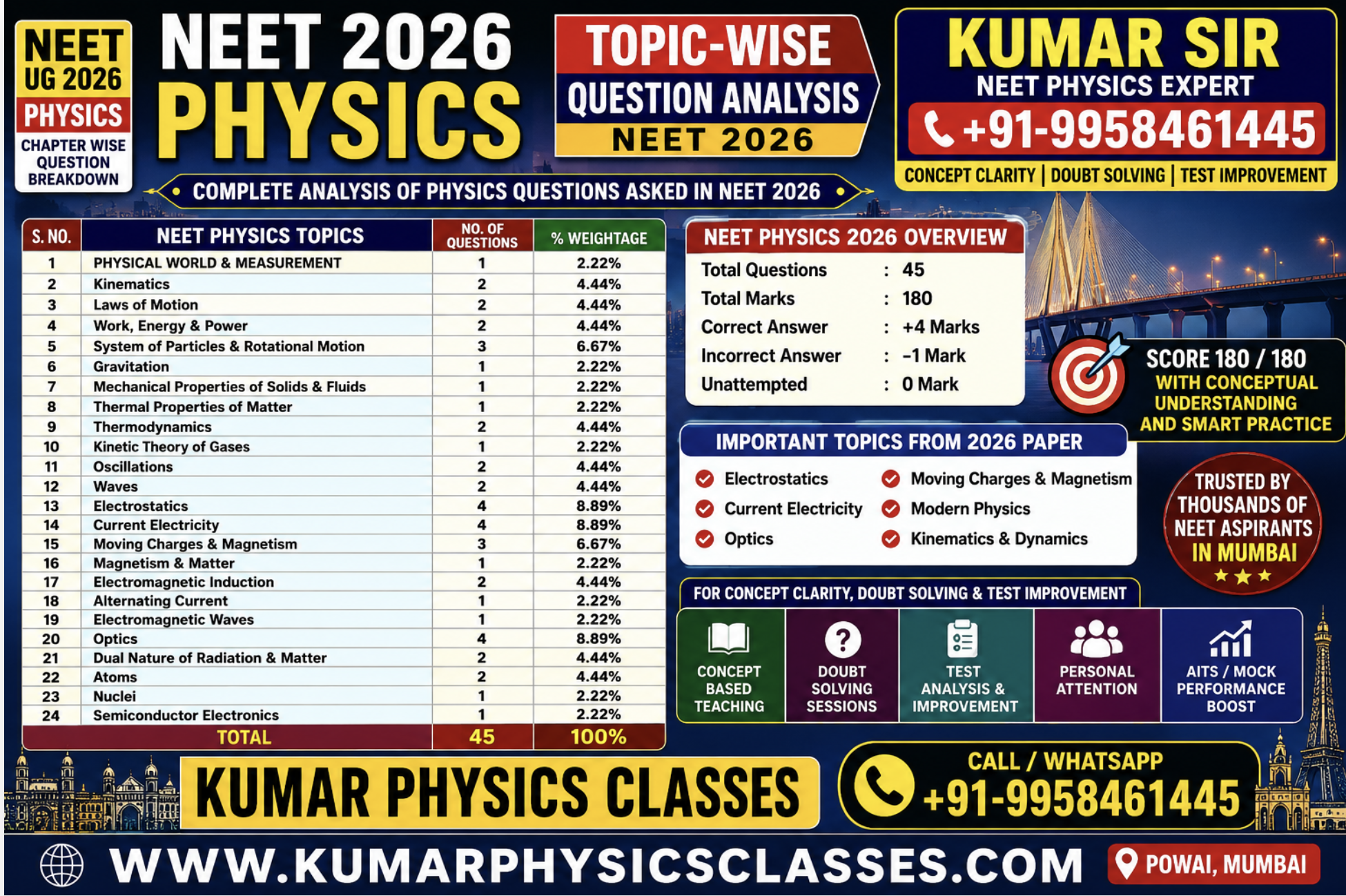
NEET Physics Tutor in Powai Mumbai – Why Students Need Personal Concept Clarity
+91-9958461445
If you are living in Powai Mumbai and preparing for NEET, then you already know one thing very clearly: competition is not easy. Many students join big coaching institutes, attend regular classes, solve modules, watch online lectures and give weekly tests. Still, when the result of the test comes, marks do not improve as expected. This creates frustration, pressure and self-doubt.
The problem is not always hard work. Many students are working very hard. The real problem is concept clarity. In NEET Physics, if your basic concepts are weak, then even after reading theory many times, questions will not click in the exam. You may remember the formula, but you may not understand where to apply it. You may know the chapter name, but you may not understand the logic behind the question.
This is exactly where Kumar Physics Classes can help.
Many NEET students in Powai attend coaching at Aakash, Allen, Physics Wallah, Unacademy, Vedantu or other institutes. That is perfectly fine. Continue your coaching. But if your doubts are not getting cleared properly, if you are not able to score in tests, if AITS or internal test marks are low, then you need personal attention. You need someone who can sit with you, identify your weak areas and explain Physics according to your level.
Kumar Sir focuses on concept-based Physics teaching. He does not only teach formulas. He explains why the formula works, how the question is framed, how to identify the correct approach and how to avoid silly mistakes. In NEET Physics, chapters like Current Electricity, Ray Optics, Modern Physics, Electrostatics, Magnetism, Mechanics, SHM, Waves and Thermodynamics require strong fundamentals. If one basic point is weak, the whole chapter becomes confusing.
Many students say, “Sir, I studied the chapter but questions are not happening.” The reason is simple: reading and solving are different. In Physics, you must understand the concept, visualize the situation and then apply the formula. Kumar Sir helps students develop this thinking.
If you are preparing for NEET in Powai Mumbai and your marks are not improving, do not wait for more frustration. Contact Kumar Sir and clear your doubts properly.
Why NEET Students in Powai Need Kumar Sir
Powai is one of the most educated and competitive areas of Mumbai. Students here are ambitious. Parents are serious about education. Many students study in reputed schools and join big coaching institutes. Still, Physics becomes a problem for many NEET aspirants.
The reason is that NEET Physics is not just about attending lectures. It needs personal correction. Every student has different weak points. Some students are weak in vectors. Some are weak in graphs. Some cannot understand circuits. Some get confused in rotational motion. Some students know the concept but make calculation mistakes. Some students panic in tests.
Kumar Sir gives tailor-made classes according to the student’s requirement. If you are weak in Mechanics, he will strengthen Mechanics. If you are weak in Electricity, he will clear Electricity. If your numerical approach is weak, he will train you step by step. If your test performance is low, he will guide you on how to improve marks.
So if you are searching for NEET Physics Tutor in Powai Mumbai, Kumar Physics Classes can be the right support system for you.
Kumar Physics Classes Contact Details
Kumar Physics Classes
Phone: +91-9958461445
Website: kumarphysicsclasses.com
Email: kumarsirphysics@gmail.com
Important Mumbai School Keywords
Physics Tutor in Dhirubhai Ambani International School Mumbai, Physics Tutor in Bombay Scottish School Mumbai, Physics Tutor in Jamnabai Narsee School Mumbai, Physics Tutor in Ecole Mondiale World School Mumbai, Physics Tutor in Podar International School Mumbai, Physics Tutor in Hiranandani Foundation School Powai, Physics Tutor in Bombay Cambridge International School Mumbai, Physics Tutor in Ryan International School Mumbai, Physics Tutor in Billabong High International School Mumbai, Physics Tutor in Oberoi International School Mumbai, Physics Tutor in Cathedral and John Connon School Mumbai, Physics Tutor in Campion School Mumbai, Physics Tutor in St. Mary’s School Mumbai, Physics Tutor in Smt. Sulochanadevi Singhania School Mumbai, Physics Tutor in DAV Public School Mumbai, Physics Tutor in Kendriya Vidyalaya Mumbai, Physics Tutor in Navy Children School Mumbai, Physics Tutor in Delhi Public School Mumbai, Physics Tutor in Vibgyor High Mumbai, Physics Tutor in Rustomjee Cambridge International School Mumbai
Important NEET Coaching Keywords in Mumbai
Physics Tutor in Aakash Institute Mumbai, Physics Tutor in Allen Mumbai, Physics Tutor in Physics Wallah Mumbai, Physics Tutor in Unacademy Centre Mumbai, Physics Tutor in Vedantu Mumbai, Physics Tutor in Rao IIT Academy Mumbai, Physics Tutor in Pace IIT and Medical Mumbai, Physics Tutor in Narayana Coaching Mumbai, Physics Tutor in FIITJEE Mumbai, Physics Tutor in Resonance Mumbai
NEET Physics Keywords
NEET Physics Tutor in Mumbai, NEET Physics Tutor in Powai Mumbai, Physics Tutor for NEET in Mumbai, Best NEET Physics Tutor in Mumbai, Online NEET Physics Tutor in Mumbai, Personal NEET Physics Tutor in Mumbai, NEET Physics Doubt Solving Classes Mumbai, NEET Physics Concept Classes Mumbai, NEET Physics Numerical Practice Mumbai, NEET Physics Crash Course Mumbai
NEET Physics Practice Paper With Solutions
Kumar Physics Classes
Q1. For a simple pendulum having time period T, how does kinetic energy vary with time?
Answer: Kinetic energy varies periodically and becomes maximum at mean position.
Q2. A heater is rated 400 W, 220 V. If supply voltage becomes 200 V, find approximate power consumed.
Answer: About 331 W
Q3. Angular speed of a flywheel increases from 600 rpm to 1200 rpm in 10 s. Find number of revolutions completed.
Answer: 150 revolutions
Q4. If total energy of a simple pendulum is 0.02 J and bob mass is 20 g, find speed at equilibrium.
Answer: √2 m/s
Q5. A circular coil has radius 5 cm, 100 turns and magnetic field 3.14 × 10⁻³ T at centre. Find current.
Answer: 2.5 A
Q6. A submarine is designed to withstand pressure at 100 m depth. Find acceleration due to gravity if water density is 1000 kg/m³.
Answer: 9.9 m/s² approximately
Q7. Match electromagnetic concepts: photon energy, diffraction, photoelectric effect and Compton effect.
Answer: Photon energy relates to frequency, diffraction relates to wave nature.
Q8. Match elastic constants: Young’s modulus, compressibility, bulk modulus and Poisson’s ratio.
Answer: Young’s modulus = stress/strain, bulk modulus relates to volume strain.
Q9. Capacitors 10 μF and 2.5 μF are connected with 50 V battery. Find equivalent capacitance and charge.
Answer: Equivalent capacitance depends on connection; charge Q = CV.
Q10. Work done to raise a mass m from Earth surface to height equal to Earth radius R?
Answer: mgR/2
Q11. Five persons walk with different reaction times. Who travels maximum distance before reacting?
Answer: Person with maximum reaction time.
Q12. A crane lifts 20 kg mass to height 1000 m in 10 s. Find power.
Answer: 19.6 kW
Q13. Two uncharged capacitors are connected and one is charged by 100 V. Find energy loss.
Answer: Energy is lost due to redistribution of charge.
Q14. A circuit contains R = 1 kΩ, C = 0.1 μF and L = 1 mH. Find resonance frequency.
Answer: Around 15.9 kHz
Q15. Current flows through a long straight conductor. How does magnetic field vary with distance from axis?
Answer: Inside conductor B ∝ r, outside conductor B ∝ 1/r.
Physics Tutor for NEET, IIT JEE, CBSE, ICSE, IB, IGCSE, A-Level & AP Physics
Phone: +91-9958461445
Website: kumarphysicsclasses.com
Email: kumarsirphysics@gmail.com
Q16. Why does a passenger fall forward when a moving bus suddenly stops?
Answer: Due to inertia of motion.
Q17. Why is it difficult to walk on a frictionless surface?
Answer: Because friction provides the forward reaction force needed for walking.
Q18. Why does a gun recoil after firing a bullet?
Answer: Due to conservation of linear momentum.
Q19. Why is Newton’s first law called the law of inertia?
Answer: Because it describes the natural tendency of a body to resist change in its state.
Q20. Can an object have zero velocity but non-zero acceleration?
Answer: Yes.
Q21. Can acceleration be opposite to velocity?
Answer: Yes, it means the object is slowing down.
Q22. Can average velocity be zero while average speed is non-zero?
Answer: Yes.
Q23. Why is displacement zero after one complete circular motion?
Answer: Because initial and final positions are the same.
Q24. Why is distance not zero after one complete circular motion?
Answer: Because distance is the actual path travelled.
Q25. Why is horizontal velocity constant in projectile motion?
Answer: Because there is no horizontal acceleration.
Q26. Why does a projectile follow a parabolic path?
Answer: Because horizontal motion is uniform and vertical motion is uniformly accelerated.
Q27. Why is time of flight independent of horizontal velocity?
Answer: Because time of flight depends on vertical motion only.
Q28. Why does relative velocity depend on the observer?
Answer: Because motion is measured with respect to a reference frame.
Q29. Why does a person feel pushed backward when a car suddenly starts?
Answer: Due to inertia of rest.
Q30. Why are seat belts used in cars?
Answer: To reduce the effect of sudden change in motion.
Q31. Why does a heavy body have more inertia than a light body?
Answer: Because inertia depends on mass.
Q32. Why does a cyclist bend while taking a turn?
Answer: To balance centripetal force and avoid falling outward.
Q33. Why are roads banked at curves?
Answer: To provide necessary centripetal force safely.
Q34. Why does a stone tied to a string move in a circle?
Answer: Because string tension provides centripetal force.
Q35. What happens if the string breaks during circular motion?
Answer: The stone moves tangentially.
Q36. Why is centripetal force not a new type of force?
Answer: Because it is only the name of the inward resultant force.
Q37. Why does a satellite not fall on Earth?
Answer: It is continuously falling around Earth.
Q38. Why does weight become zero in a freely falling lift?
Answer: Because normal reaction becomes zero.
Q39. Why does a person feel heavier in an upward accelerating lift?
Answer: Because normal reaction increases.
Q40. Why does a person feel lighter in a downward accelerating lift?
Answer: Because normal reaction decreases.
Q41. Why is impulse equal to change in momentum?
Answer: Because impulse is force multiplied by time.
Q42. Why does a cricket player move his hands backward while catching a ball?
Answer: To increase stopping time and reduce force.
Q43. Why does a glass break when it falls on a hard floor but not easily on a carpet?
Answer: Because stopping time is smaller on hard floor.
Q44. Why is momentum conserved in absence of external force?
Answer: Because internal forces are equal and opposite.
Q45. Why does rocket move upward?
Answer: Due to conservation of momentum and Newton’s third law.
Physics Tutor for NEET, IIT JEE, CBSE, ICSE, IB, IGCSE, A-Level & AP Physics
Phone: +91-9958461445
Website: kumarphysicsclasses.com
Email: kumarsirphysics@gmail.com