
Physics Tutor in Breach Candy Mumbai Call WhatsApp: +91-9958461445
If you live in Breach Candy Mumbai and you are preparing for NEET, IIT JEE, CBSE, IB, IGCSE, Edexcel, A-Level or AP Physics, then Physics can sometimes become very confusing, especially in chapters like Simple Harmonic Motion.
Breach Candy is one of South Mumbai’s upscale residential localities near the Arabian Sea, also connected with areas like Cumballa Hill, Warden Road / Bhulabhai Desai Road, Peddar Road, Altamount Road and Malabar Hill. (Mygate)
Now take this SHM question:
A particle executing SHM of amplitude A has displacement A/2 at time T/4 and negative velocity. Find the epoch of the particle.
Here, epoch means initial phase angle, usually written as ϕ.
We start with:
y = A sin(ωt + ϕ)
Differentiate it:
v = Aω cos(ωt + ϕ)
Given:
y = A/2
So,
A/2 = A sin(ωt + ϕ)
Therefore,
sin(ωt + ϕ) = 1/2
At t = T/4,
ωt = (2π/T) × (T/4) = π/2
So,
sin(π/2 + ϕ) = 1/2
But velocity is negative, so:
v = Aω cos(π/2 + ϕ) < 0
That means the angle must be in the second quadrant where sine is positive and cosine is negative.
So,
π/2 + ϕ = 5π/6
Therefore,
ϕ = 5π/6 − π/2 = π/3
So the epoch of the particle is:
π/3 radian
This is exactly the type of question where many students get stuck. They know the formula, but they do not know how to use the sign of velocity. Kumar Sir explains these questions step by step: first displacement equation, then velocity equation, then quadrant selection, then final phase angle.
If you are stuck in SHM, waves, mechanics, electrostatics, current electricity, optics or modern physics, you can contact Kumar Sir for online Physics classes.
Call / WhatsApp: +91-9958461445
Email: kumarsirphysics@gmail.com
Website: Kumar Physics Classes
Physics Tutor in Breach Candy Mumbai Localities
Physics Tutor in Breach Candy Mumbai, Physics Tutor in Warden Road Mumbai, Physics Tutor in Bhulabhai Desai Road Mumbai, Physics Tutor in Cumballa Hill Mumbai, Physics Tutor in Peddar Road Mumbai, Physics Tutor in Altamount Road Mumbai, Physics Tutor in Malabar Hill Mumbai, Physics Tutor in Kemps Corner Mumbai, Physics Tutor in Haji Ali Mumbai, Physics Tutor in Nepean Sea Road Mumbai, Physics Tutor in Tardeo Mumbai
Physics Tutor in Schools Near Breach Candy Mumbai
Physics Tutor in DSB International School Breach Candy, Physics Tutor in Greenlawns High School Breach Candy, Physics Tutor in Activity High School Mumbai, Physics Tutor in Villa Theresa High School Mumbai, Physics Tutor in Aditya Birla World Academy Mumbai, Physics Tutor in Cathedral and John Connon School Mumbai, Physics Tutor in Campion School Mumbai, Physics Tutor in Bombay International School Mumbai, Physics Tutor in Dhirubhai Ambani International School Mumbai, Physics Tutor in Jamnabai Narsee School Mumbai. (Edustoke)
Physics Tutor in Buildings Near Breach Candy Mumbai
Physics Tutor in Asha Mahal Breach Candy, Physics Tutor in Suraj Millennium Breach Candy, Physics Tutor in Goolestan Building Breach Candy, Physics Tutor in Mona Apartments Breach Candy, Physics Tutor in Breach Candy Apartments Mumbai, Physics Tutor in Cumballa Hill Buildings Mumbai, Physics Tutor in Altamount Road Residences Mumbai, Physics Tutor in Lodha Altamount Mumbai, Physics Tutor in Imperial Towers Mumbai. (MagicBricks)
Course Keywords
NEET Physics Tutor in Breach Candy Mumbai, IIT JEE Physics Tutor in Breach Candy Mumbai, CBSE Physics Tutor in Breach Candy Mumbai, IB Physics Tutor in Breach Candy Mumbai, IGCSE Physics Tutor in Breach Candy Mumbai, Edexcel Physics Tutor in Breach Candy Mumbai, A-Level Physics Tutor in Breach Candy Mumbai, AP Physics Tutor in Breach Candy Mumbai.
Effect on Time Period of Simple Pendulum
In Simple Harmonic Motion, the time period of a simple pendulum depends mainly on the effective length of the pendulum and the effective acceleration due to gravity. For small oscillations, the standard formula is:
Here, l is the effective length of the pendulum and g is the effective acceleration due to gravity. Whenever length increases, time period increases. Whenever effective gravity decreases, time period increases.
Important Conditions Affecting Time Period
- 1. Length increases: Time period increases because T ∝ √l.
- 2. Length decreases: Time period decreases.
- 3. Gravity increases: Time period decreases because T ∝ 1/√g.
- 4. Gravity decreases: Time period increases.
- 5. Mass of bob changes: No effect on time period.
- 6. Amplitude changes slightly: For small oscillations, no effect.
- 7. Large amplitude: Time period slightly increases.
- 8. Temperature increases: Length of pendulum increases due to expansion, so time period increases.
- 9. Temperature decreases: Length decreases, so time period decreases.
Second Pendulum
A second pendulum is a pendulum whose time period is exactly 2 seconds. It takes 1 second to go from one extreme to the other and 2 seconds to complete one full oscillation.
For a second pendulum on Earth, its length is nearly 1 metre. More accurately, it is about 99.3 cm.
Effect of Temperature on Second Pendulum
If temperature increases, the metallic rod or string expands. Its length increases. Since T = 2π√(l/g), the time period increases. Therefore, the clock becomes slow because each oscillation takes more time.
Here, α is the coefficient of linear expansion and Δθ is the rise in temperature.
Pendulum Taken to Height Above Earth
When a pendulum is taken above the surface of Earth, the value of g decreases. Since time period is inversely proportional to √g, the time period increases.
So, at height, the pendulum clock becomes slow.
Pendulum Taken Deep Inside Earth
When a pendulum is taken inside the Earth, the value of g decreases with depth. Therefore, time period increases.
At the centre of Earth, g becomes zero. Therefore, the time period becomes infinite and the pendulum will not oscillate.
Pendulum Taken to Infinity
At infinity, gravitational field becomes almost zero. Therefore, restoring force becomes zero and the pendulum cannot perform normal SHM.
Pendulum in a Lift
- Lift moving upward with acceleration a: effective gravity = g + a, so time period decreases.
- Lift moving downward with acceleration a: effective gravity = g - a, so time period increases.
- Lift falling freely: effective gravity = 0, so time period becomes infinite.
Pendulum in an Accelerating Vehicle
If the support of pendulum accelerates horizontally with acceleration a, effective gravity becomes the resultant of g and a.
So the time period decreases because effective gravity increases.
Pendulum in Electric Field
If the bob is charged and placed in an electric field, electric force changes the effective acceleration. Depending on the direction of electric force, time period may increase or decrease.
Pendulum on Moon
On the Moon, gravity is nearly g/6. Therefore, time period increases.
Ball Dropped Through a Tunnel Inside Earth
If a straight tunnel is made through the Earth and a ball is dropped inside it, the ball performs SHM because the restoring force is proportional to displacement from the centre of Earth.
This time period is approximately 84.6 minutes. This is a very important result for NEET and IIT JEE.
Complete Summary
- Time period increases if length increases.
- Time period decreases if length decreases.
- Time period increases if gravity decreases.
- Time period decreases if gravity increases.
- Temperature rise increases time period.
- At height, time period increases.
- At depth, time period increases.
- At Earth’s centre, pendulum stops oscillating.
- At infinity, time period becomes infinite.
- In upward accelerating lift, time period decreases.
- In downward accelerating lift, time period increases.
- In freely falling lift, time period becomes infinite.
- On Moon, time period increases.
- For large amplitude, time period slightly increases.
- Mass of bob has no effect.
- For a ball oscillating through Earth tunnel, T = 2π√(R/g).
For NEET, IIT JEE, CBSE, IB, IGCSE, Edexcel, A-Level and AP Physics, these pendulum time period cases are very important. If a student understands effective gravity and effective length, almost every pendulum question becomes easy.
SHM of Floating Body and Pendulum in Liquid
In Physics, many oscillation problems become easy when we understand the idea of restoring force. If a body is floating in a liquid and it is slightly pushed downward or upward, then the upthrust changes. This change in upthrust provides the restoring force and the body performs Simple Harmonic Motion.
1. Floating Body Performing SHM in Liquid
Suppose a body of density σ is floating in a liquid of density ρ. Let the area of cross-section of the body be A. If the body is slightly pushed down by a distance x, then extra volume of liquid displaced will be:
Extra upthrust acting on the body will be:
This restoring force acts upward, opposite to displacement. Therefore:
For SHM:
Comparing both:
Now mass of the body:
If the body has height h and cross-sectional area A, then:
So:
Therefore, the time period is:
This is the time period of vertical oscillation of a floating body in a liquid. Here, σ is density of body, ρ is density of liquid, and h is the height of the body.
Important Special Result
If the body is floating, then at equilibrium:
Here, y is the submerged depth of the body at equilibrium.
So time period can also be written as:
This is a very beautiful result. The time period depends on the submerged depth at equilibrium.
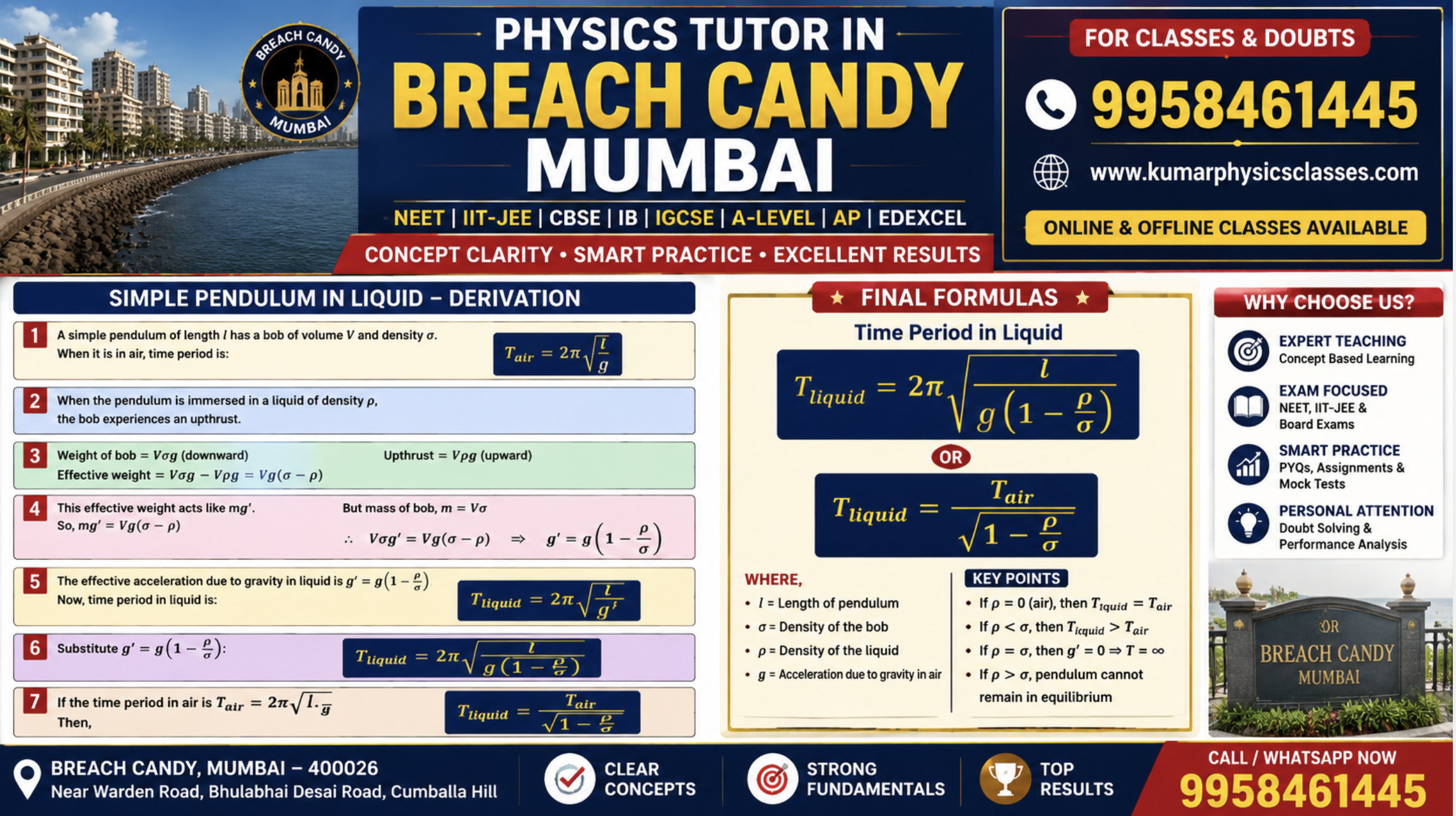
2. Simple Pendulum in Air and Then in Liquid
For a simple pendulum in air, the time period is:
Now suppose the pendulum bob is placed inside a liquid of density ρ. Let the density of bob be σ. Due to buoyancy, the effective weight of the bob decreases.
Actual weight of bob:
Buoyant force:
Effective weight:
But effective weight can also be written as:
Since mass of bob is:
Therefore:
So, in liquid, the effective acceleration due to gravity becomes:
Therefore, the time period of pendulum in liquid becomes:
If time period in air is:
Then:
Final Comparison
Since 1 - ρ/σ is less than 1, the time period in liquid becomes greater than the time period in air.
So, when a pendulum is taken from air into water or any liquid, its time period increases because buoyancy reduces effective gravity.
Important Notes for NEET and IIT JEE
If ρ = 0, then liquid effect is zero and the formula becomes the normal air formula.
If ρ = σ, then effective gravity becomes zero. In that case, the pendulum will not oscillate normally and time period becomes infinite.
If ρ > σ, the bob cannot remain properly submerged as a normal pendulum bob because buoyant force becomes greater than weight.
These two derivations are very important for NEET Physics, IIT JEE Physics, CBSE Class 11 Physics, A-Level Physics and AP Physics. Once the student understands restoring force and effective gravity, these questions become very easy.