
Physics Tutor in Sector 148 Noida – Kumar Physics Classes
+91-9958461445
If you live in Sector 148 Noida and Physics is not making sense to you, then the real problem is not Physics. The real problem is usually weak concept clarity, incomplete derivations, poor numerical practice and lack of proper guidance.
Many students attend school, coaching or online classes, but still they struggle in chapters like Atoms, Bohr’s Model, Modern Physics, Current Electricity, Electrostatics, Mechanics, Optics and Magnetism. Physics cannot be mastered by memorising formulas only. Physics needs clear explanation, step-by-step derivation and regular practice.
At Kumar Physics Classes, Kumar Sir teaches Physics from basic to advanced level for CBSE, ICSE, ISC, NEET, JEE, AP Physics, IB Physics, A-Level Physics and Edexcel Physics.
Website: Kumar Physics Classes
Contact: +91-9958461445
Email: kumarsirphysics@gmail.com
Why Students in Sector 148 Noida Need a Good Physics Tutor
Sector 148 Noida is a developing and well-connected area, but students still face the same problem: Physics concepts are not clear. They may know the formula, but they do not know where the formula comes from, how to apply it and how to solve numerical questions.
For example, in Bohr’s Atomic Model, many students remember formulas like radius, velocity and energy of electron, but they do not understand the logic behind them. That is why they get confused in NEET, JEE and board exam questions.
Kumar Sir explains every concept in a simple way so that students can understand the physical meaning behind the formula.
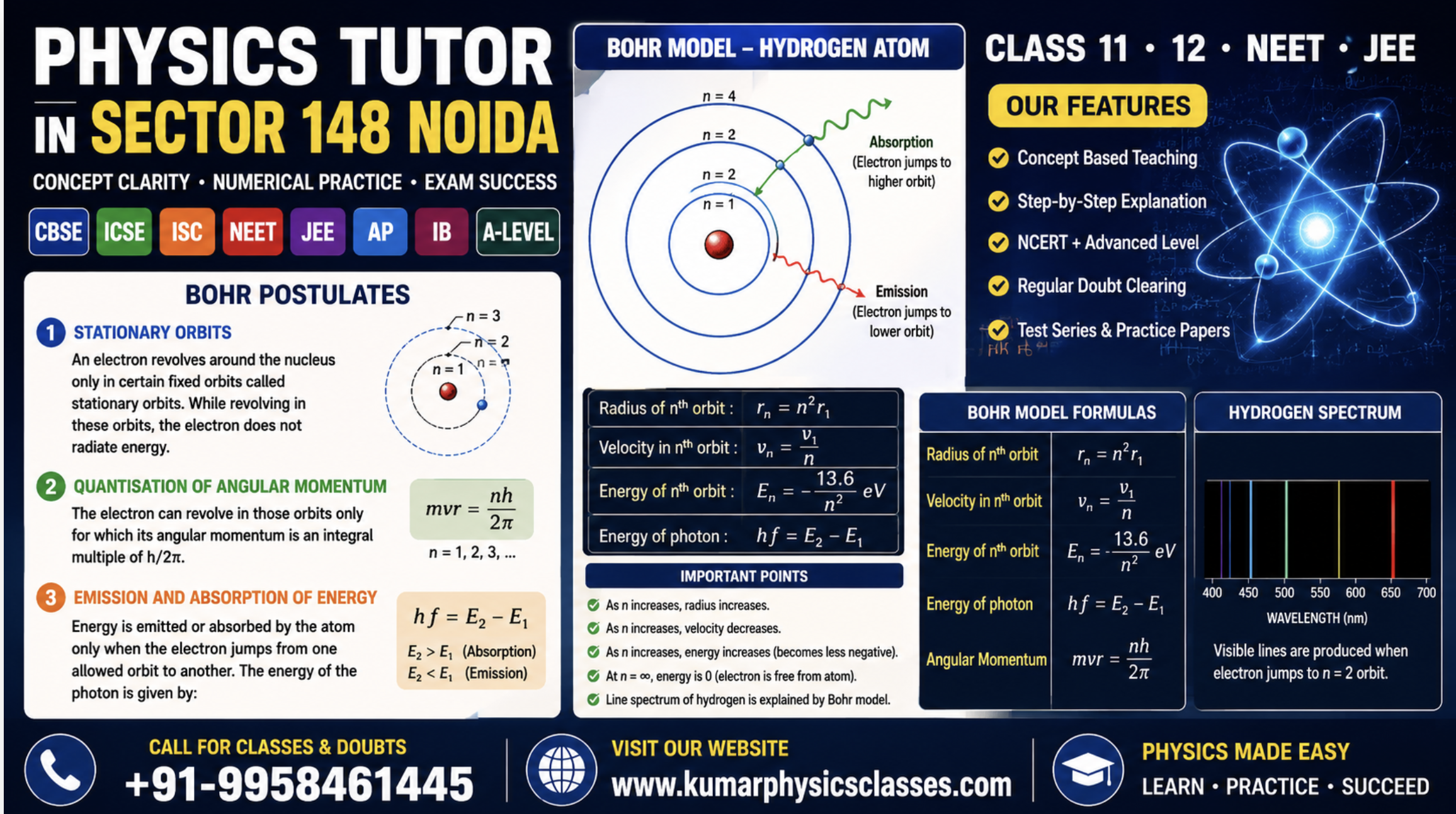
Bohr’s Postulates Explained
Bohr proposed a model of hydrogen atom to explain why atoms are stable and why hydrogen gives line spectrum.
First Postulate: Stationary Orbits
According to Bohr, an electron revolves around the nucleus only in certain fixed circular orbits. These orbits are called stationary orbits.
The important point is that while moving in these orbits, the electron does not radiate energy.
This was a very big idea because according to classical physics, an accelerating charge should radiate energy. Since an electron moving in a circle has centripetal acceleration, it should lose energy and fall into the nucleus. But atoms are stable, so Bohr said that electrons do not radiate energy in allowed orbits.
Second Postulate: Quantisation of Angular Momentum
Bohr said that electron can revolve only in those orbits where angular momentum is quantised.
mvr = nh / 2π
Where:
m = mass of electron
v = velocity of electron
r = radius of orbit
n = orbit number
h = Planck’s constant
This means electron cannot have any random orbit. Only selected orbits are allowed.
Third Postulate: Emission and Absorption of Energy
When electron jumps from higher orbit to lower orbit, energy is emitted in the form of radiation.
When electron jumps from lower orbit to higher orbit, energy is absorbed.
Energy of photon is:
hf = E₂ − E₁
This explains the line spectrum of hydrogen atom.
Important Results of Bohr Model
For hydrogen atom:
Radius of nth orbit:
rₙ = n²r₁
So radius increases as square of orbit number.
Velocity of electron:
vₙ ∝ 1/n
So velocity decreases as orbit number increases.
Energy of electron:
Eₙ = −13.6 / n² eV
Negative energy means electron is bound to the nucleus.
For ground state, n = 1:
E₁ = −13.6 eV
For second orbit:
E₂ = −3.4 eV
For third orbit:
E₃ = −1.51 eV
When electron goes far away from nucleus, energy becomes zero. This is called ionisation.
How Kumar Sir Explains Bohr Model
Kumar Sir does not simply ask students to memorise formulas. He explains:
Why electron does not fall into nucleus
Why only fixed orbits are allowed
Why angular momentum is quantised
Why energy is negative
Why hydrogen spectrum has lines
Why energy difference gives photon energy
How to solve numerical questions quickly
This type of teaching helps students in school exams, NEET and JEE.
Physics Tutor Keywords with Links
Physics Tutor in Sector 148 Noida, Physics Tutor in Noida, Physics Tutor in Sector 37 Noida, Physics Tutor in Sector 44 Noida, Physics Tutor in Sector 62 Noida, Physics Tutor in Sector 71 Noida, Physics Tutor in Sector 75 Noida, Physics Tutor in Sector 76 Noida, Physics Tutor in Sector 78 Noida, Physics Tutor in Sector 94 Noida, Physics Tutor in Sector 96 Noida, Physics Tutor in Sector 97 Noida, Physics Tutor in Sector 98 Noida, Physics Tutor in Sector 119 Noida, Physics Tutor in Sector 120 Noida, Physics Tutor in Sector 121 Noida, Physics Tutor in Sector 122 Noida, Physics Tutor in Sector 133 Noida, Physics Tutor in Sector 144 Noida, Physics Tutor in Sector 150 Noida
School and Exam Keywords with Links
CBSE Physics Tutor in Noida, ICSE Physics Tutor in Noida, ISC Physics Tutor in Noida, NEET Physics Tutor in Noida, JEE Physics Tutor in Noida, IIT Physics Tutor in Noida, AP Physics Tutor in Noida, IB Physics Tutor in Noida, A-Level Physics Tutor in Noida, Edexcel Physics Tutor in Noida, British Curriculum Physics Tutor in Noida, Dropper NEET Physics Tutor in Noida, JEE Advanced Physics Tutor in Noida
Conclusion
If you are living in Sector 148 Noida and Physics is becoming difficult, then you need proper concept clarity. Physics becomes easy when the teacher explains the reason behind every formula.
At Kumar Physics Classes, Kumar Sir teaches Physics with derivations, diagrams, numerical practice and exam-oriented preparation. Students preparing for CBSE, ICSE, ISC, NEET, JEE, AP, IB, A-Level and Edexcel Physics can contact Kumar Physics Classes.
Contact: +91-9958461445
Website: https://kumarphysicsclasses.com
Bohr Postulates Conceptual Questions
Question: Why did Bohr introduce stationary orbits?
Answer: Because according to classical physics, a revolving electron should radiate energy and fall into the nucleus. Bohr said electrons do not radiate energy in allowed stationary orbits.Question: What is the meaning of stationary orbit?
Answer: A stationary orbit is an allowed orbit in which an electron can revolve without losing energy.Question: Why does an electron not fall into the nucleus in Bohr model?
Answer: Because in allowed stationary orbits, the electron does not radiate energy.Question: What is Bohr’s angular momentum condition?
Answer: The angular momentum of electron is quantised: mvr = nh/2π.Question: What does quantisation of angular momentum mean?
Answer: It means electron cannot have any random angular momentum. Only fixed values are allowed.Question: Why are only certain orbits allowed in Bohr model?
Answer: Because only those orbits satisfy mvr = nh/2π.Question: What happens when electron jumps from higher orbit to lower orbit?
Answer: It emits energy in the form of photon.Question: What happens when electron jumps from lower orbit to higher orbit?
Answer: It absorbs energy.Question: What is the energy of emitted photon?
Answer: hf = E₂ − E₁, where energy difference gives photon energy.Question: Why does hydrogen atom give line spectrum?
Answer: Because electron can jump only between fixed energy levels, so only fixed wavelengths are emitted.Question: Why is energy of electron negative in Bohr model?
Answer: Negative energy means electron is bound to the nucleus.Question: What is the energy of hydrogen atom in ground state?
Answer: −13.6 eV.Question: What is ionisation energy of hydrogen atom?
Answer: 13.6 eV, because this much energy is needed to remove electron from ground state to infinity.Question: What happens to radius as orbit number increases?
Answer: Radius increases as n².Question: What happens to velocity as orbit number increases?
Answer: Velocity decreases as 1/n.Question: What happens to energy as orbit number increases?
Answer: Energy becomes less negative and approaches zero.Question: Which force provides centripetal force in hydrogen atom?
Answer: Electrostatic attraction between nucleus and electron.Question: Why is Bohr model successful for hydrogen atom?
Answer: Because hydrogen has only one electron.Question: Why does Bohr model fail for multi-electron atoms?
Answer: Because electron-electron repulsion is not properly explained.Question: What is ground state?
Answer: The lowest energy state of an atom.Question: What is excited state?
Answer: Any state above the ground state.Question: Can electron remain between two allowed orbits?
Answer: No, electron can exist only in allowed orbits.Question: Does electron radiate energy while revolving in stationary orbit?
Answer: No.Question: When is photon emitted?
Answer: When electron jumps from higher energy level to lower energy level.Question: When is photon absorbed?
Answer: When electron jumps from lower energy level to higher energy level.Question: What is the relation between energy gap and frequency?
Answer: Greater energy gap means higher frequency photon.Question: What is the relation between energy gap and wavelength?
Answer: Greater energy gap means shorter wavelength.Question: Why is first orbit most stable?
Answer: Because it has minimum energy.Question: What happens at n = infinity?
Answer: Electron is free from atom and energy becomes zero.Question: What is the radius of first Bohr orbit?
Answer: Approximately 0.529 Å.Question: If n increases, does electron move closer or farther from nucleus?
Answer: Farther from nucleus.Question: If electron is farther from nucleus, is it more tightly bound?
Answer: No, it is less tightly bound.Question: What is the main idea of Bohr’s third postulate?
Answer: Radiation is emitted or absorbed only during transition between energy levels.Question: Why does Bohr model contradict classical electromagnetic theory?
Answer: Classical theory says accelerating charge must radiate energy, but Bohr says electron does not radiate in stationary orbit.Question: What is the formula for energy of nth orbit of hydrogen?
Answer: Eₙ = −13.6/n² eV.Question: What is the formula for radius of nth orbit?
Answer: rₙ = n²r₁.Question: What is the formula for velocity in nth orbit?
Answer: vₙ = v₁/n.Question: Why are spectral lines discrete?
Answer: Because energy levels are discrete.Question: What is the biggest limitation of Bohr model?
Answer: It cannot explain spectra of multi-electron atoms accurately.Question: What should students remember about Bohr postulates?
Answer: Remember three things: fixed orbits, quantised angular momentum, and energy emission/absorption during jumps.