
Physics Tutor in Sector 98 Noida
+91-9958461445
If you live in Sector 98 Noida and Physics is not making sense to you, then the problem is usually not that Physics is impossible. The real problem is weak concept clarity, poor numerical practice and incomplete understanding of formulas.
Many students attend school, coaching or online classes, but still they are not able to solve questions from topics like Photoelectric Effect, Electric Current, Modern Physics, Mechanics, Optics and Electrostatics. The reason is simple: Physics cannot be learned by memorising formulas only. Physics needs explanation, derivation, application and regular practice.
At Kumar Physics Classes, Kumar Sir teaches Physics in a simple, logical and exam-oriented way. Students are guided step by step for CBSE Physics, ICSE Physics, ISC Physics, NEET Physics, JEE Physics, AP Physics, IB Physics, A-Level Physics and Edexcel Physics.
Website: Kumar Physics Classes
Contact: +91-9958461445
Email: kumarsirphysics@gmail.com
Why Students in Sector 98 Noida Need a Good Physics Tutor
Sector 98 Noida is close to many developed areas of Noida, but even in good localities, students often struggle in Physics. The main issue is not lack of intelligence. The issue is lack of proper explanation.
A student may know the formula, but when the question changes slightly, confusion starts. For example, in Photoelectric Effect, students may remember Einstein’s equation, but they do not understand why current increases with intensity, why stopping potential depends on frequency, and why below threshold frequency no electron is emitted.
This is where a proper Physics tutor becomes important.
Kumar Sir focuses on:
Concept clarity
Derivation of formulas
Numerical practice
Board exam preparation
NEET and JEE level problem solving
Regular doubt clearing
NCERT and H.C. Verma based understanding
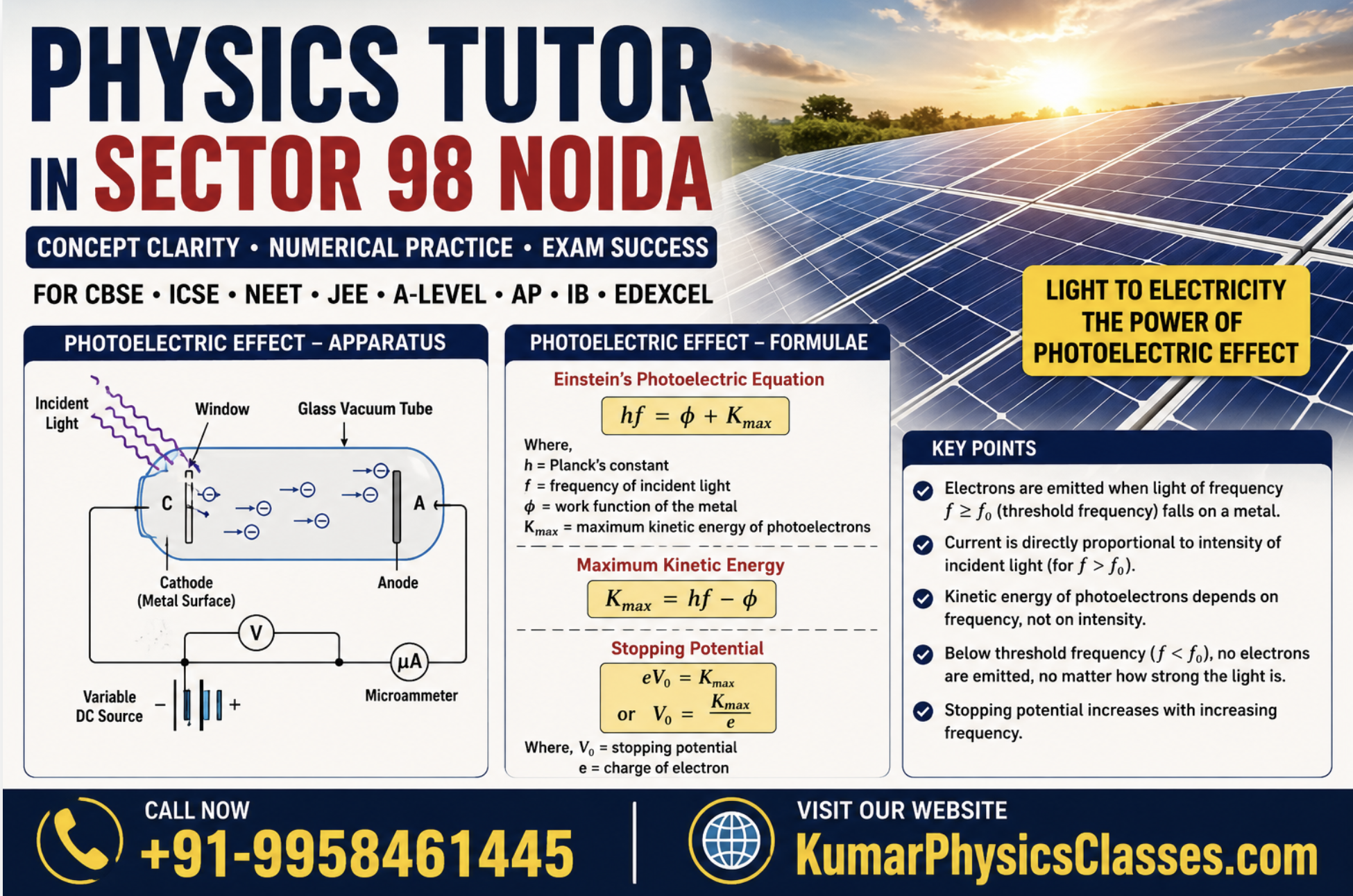
Photoelectric Effect and Current Explained
Photoelectric Effect is the phenomenon in which electrons are emitted from a metal surface when light of suitable frequency falls on it.
These emitted electrons are called photoelectrons.
The basic idea is:
When light falls on a metal surface, the energy of light is absorbed by electrons. If the energy of incident light is greater than the minimum energy required to remove electrons from the metal surface, electrons come out.
This minimum energy is called work function.
Einstein’s photoelectric equation is:
hf = φ + Kmax
Where:
h = Planck’s constant
f = frequency of incident light
φ = work function
Kmax = maximum kinetic energy of emitted photoelectrons
Now the important point is current.
In Photoelectric Effect, current is produced because photoelectrons move from cathode to anode. This current is called photoelectric current.
Dependence of Photoelectric Current on Intensity
If frequency is greater than threshold frequency, then increasing intensity increases the number of photons falling per second.
More photons means more emitted electrons.
More emitted electrons means more photoelectric current.
So:
Photoelectric current is directly proportional to intensity of incident light, provided frequency is above threshold frequency.
Dependence on Frequency
Frequency decides the energy of each photon.
If frequency increases, kinetic energy of emitted electrons increases.
But frequency alone does not mainly increase current. Current depends mainly on number of emitted electrons, and number of emitted electrons depends on intensity.
So students must remember:
Intensity controls number of photoelectrons.
Frequency controls kinetic energy of photoelectrons.
Stopping potential depends on frequency.
Saturation current depends on intensity.
Threshold Frequency
If incident frequency is less than threshold frequency, no electron is emitted, no matter how high the intensity is.
This is a very important concept.
Even if you increase brightness, if frequency is below threshold frequency, photoelectric emission will not take place.
That means:
No threshold frequency, no photoelectric current.
Why Kumar Sir’s Teaching Helps
At Kumar Physics Classes, topics like Photoelectric Effect are not taught only by writing formulas. Kumar Sir explains the physical meaning behind every term.
For example, students are made to understand:
Why light behaves like particles in photoelectric effect
Why one photon gives energy to one electron
Why current increases with intensity
Why stopping potential is negative
Why saturation current becomes constant
Why photoelectric effect proves particle nature of light
This type of teaching helps students solve both theory and numerical questions.
Important Physics Tutor Keywords
Physics Tutor in Sector 98 Noida, Physics Tutor in Noida, CBSE Physics Tutor in Noida, ICSE Physics Tutor in Noida, ISC Physics Tutor in Noida, NEET Physics Tutor in Noida, JEE Physics Tutor in Noida, AP Physics Tutor in Noida, IB Physics Tutor in Noida, A-Level Physics Tutor in Noida, Edexcel Physics Tutor in Noida
Conclusion
If you are living in Sector 98 Noida and Physics is becoming difficult, then do not wait until marks go down. Physics needs regular practice, strong fundamentals and proper guidance.
Kumar Physics Classes helps students understand Physics from basic to advanced level. Whether the student is preparing for CBSE, ICSE, ISC, NEET, JEE, AP, IB, A-Level or Edexcel Physics, Kumar Sir explains every topic with clarity, derivation and numerical practice.
Contact Kumar Physics Classes: +91-9958461445
Website: https://kumarphysicsclasses.com
Conceptual Questions on Blue Light in Photoelectric Effect with Answers
1. What happens when blue light falls on a metal surface?
Answer: If the frequency of blue light is greater than the threshold frequency of the metal, photoelectrons will be emitted.
2. Why is blue light more effective than red light in photoelectric effect?
Answer: Blue light has higher frequency than red light, so each photon of blue light has more energy.
3. If blue light causes photoelectric emission, will violet light also cause emission?
Answer: Yes, because violet light has even higher frequency than blue light.
4. If blue light falls on a metal and electrons are emitted, what happens when intensity is increased?
Answer: More photoelectrons are emitted per second, so photoelectric current increases.
5. Does increasing intensity of blue light increase kinetic energy of photoelectrons?
Answer: No. Kinetic energy depends on frequency, not intensity.
6. If blue light is dim but frequency is above threshold, will emission occur?
Answer: Yes, emission will occur, but current will be small.
7. If very bright red light falls on the same metal but red light is below threshold frequency, will electrons come out?
Answer: No. Even high intensity cannot cause emission if frequency is below threshold.
8. What decides whether blue light can eject electrons or not?
Answer: The frequency of blue light compared with the threshold frequency of the metal.
9. If blue light just equals threshold frequency, what is the kinetic energy of emitted electrons?
Answer: The kinetic energy will be zero or nearly zero.
10. What happens to stopping potential when blue light is replaced by ultraviolet light?
Answer: Stopping potential increases because ultraviolet light has higher frequency.
11. What happens to photoelectric current when blue light intensity is doubled?
Answer: Photoelectric current approximately doubles, if all emitted electrons are collected.
12. What happens to maximum kinetic energy when blue light intensity is doubled?
Answer: Maximum kinetic energy remains unchanged.
13. Why does blue light produce electrons immediately?
Answer: Because one photon transfers its energy to one electron almost instantly.
14. If blue light falls at an angle, will photoelectric effect stop?
Answer: No, if frequency is above threshold. Angle may affect effective intensity, but frequency remains the deciding factor.
15. If blue light is replaced by green light, what may happen?
Answer: If green light frequency is still above threshold, emission occurs with lower kinetic energy. If below threshold, emission stops.
16. Why is threshold frequency important?
Answer: It is the minimum frequency needed to eject electrons from the metal surface.
17. What is the role of work function?
Answer: Work function is the minimum energy required to remove an electron from the metal.
18. If blue light has energy less than work function, what happens?
Answer: No photoelectron is emitted.
19. If blue light has energy greater than work function, where does extra energy go?
Answer: Extra energy appears as kinetic energy of emitted photoelectrons.
20. What is Einstein’s photoelectric equation?
Answer:
hf = φ + Kmax
Energy of photon = work function + maximum kinetic energy.
21. If frequency of blue light increases, what happens to kinetic energy?
Answer: Maximum kinetic energy increases.
22. If frequency of blue light increases, what happens to photoelectric current?
Answer: Current may not increase unless intensity also increases.
23. If intensity increases but frequency remains blue, what changes?
Answer: Number of emitted electrons increases, so current increases.
24. If frequency increases but intensity remains same, what changes?
Answer: Kinetic energy and stopping potential increase.
25. Why can blue light eject electrons but red light may fail?
Answer: Because blue photons have more energy than red photons.
26. What happens when blue light falls on zinc?
Answer: Emission depends on whether blue light frequency is greater than zinc’s threshold frequency.
27. What happens when blue light falls on sodium?
Answer: Sodium has relatively low work function, so blue light can usually eject electrons.
28. What is stopping potential?
Answer: It is the minimum negative potential required to stop the fastest photoelectrons.
29. Does stopping potential depend on intensity of blue light?
Answer: No, it depends on frequency.
30. Does saturation current depend on intensity of blue light?
Answer: Yes, saturation current increases with intensity.
31. If blue light is made brighter, why does current increase?
Answer: More photons fall per second, so more electrons are emitted per second.
32. If blue light is made brighter, why does electron speed not increase?
Answer: Because energy of each photon depends on frequency, not brightness.
33. If blue light is monochromatic, what does it mean?
Answer: It has a single frequency or wavelength.
34. If blue light has shorter wavelength, what does it mean?
Answer: Shorter wavelength means higher frequency and higher photon energy.
35. What is the relation between photon energy and frequency?
Answer:
E = hf
36. What is the relation between frequency and wavelength?
Answer:
c = fλ
37. If wavelength decreases, what happens to photon energy?
Answer: Photon energy increases.
38. If blue light wavelength is decreased, what happens to photoelectron energy?
Answer: Maximum kinetic energy increases.
39. If blue light wavelength is increased toward red region, what may happen?
Answer: Kinetic energy decreases, and emission may stop if frequency falls below threshold.
40. What is the main concept students must remember?
Answer: Intensity controls current, frequency controls kinetic energy, and threshold frequency decides whether emission happens or not.
Noida Sectors
Physics Tutor in Sector 1 Noida, Physics Tutor in Sector 2 Noida, Physics Tutor in Sector 3 Noida, Physics Tutor in Sector 4 Noida, Physics Tutor in Sector 5 Noida, Physics Tutor in Sector 6 Noida, Physics Tutor in Sector 7 Noida, Physics Tutor in Sector 8 Noida, Physics Tutor in Sector 9 Noida, Physics Tutor in Sector 10 Noida, Physics Tutor in Sector 11 Noida, Physics Tutor in Sector 12 Noida, Physics Tutor in Sector 15 Noida, Physics Tutor in Sector 16 Noida, Physics Tutor in Sector 16A Noida, Physics Tutor in Sector 18 Noida, Physics Tutor in Sector 19 Noida, Physics Tutor in Sector 20 Noida, Physics Tutor in Sector 21 Noida, Physics Tutor in Sector 22 Noida, Physics Tutor in Sector 23 Noida, Physics Tutor in Sector 24 Noida, Physics Tutor in Sector 25 Noida, Physics Tutor in Sector 26 Noida, Physics Tutor in Sector 27 Noida, Physics Tutor in Sector 28 Noida, Physics Tutor in Sector 29 Noida, Physics Tutor in Sector 30 Noida, Physics Tutor in Sector 31 Noida, Physics Tutor in Sector 33 Noida, Physics Tutor in Sector 34 Noida, Physics Tutor in Sector 35 Noida, Physics Tutor in Sector 36 Noida, Physics Tutor in Sector 37 Noida, Physics Tutor in Sector 39 Noida, Physics Tutor in Sector 40 Noida, Physics Tutor in Sector 41 Noida, Physics Tutor in Sector 44 Noida, Physics Tutor in Sector 45 Noida, Physics Tutor in Sector 46 Noida, Physics Tutor in Sector 47 Noida, Physics Tutor in Sector 48 Noida, Physics Tutor in Sector 49 Noida, Physics Tutor in Sector 50 Noida, Physics Tutor in Sector 51 Noida, Physics Tutor in Sector 52 Noida, Physics Tutor in Sector 53 Noida, Physics Tutor in Sector 55 Noida, Physics Tutor in Sector 56 Noida, Physics Tutor in Sector 58 Noida, Physics Tutor in Sector 59 Noida, Physics Tutor in Sector 61 Noida, Physics Tutor in Sector 62 Noida, Physics Tutor in Sector 63 Noida, Physics Tutor in Sector 70 Noida, Physics Tutor in Sector 71 Noida, Physics Tutor in Sector 72 Noida, Physics Tutor in Sector 73 Noida, Physics Tutor in Sector 74 Noida, Physics Tutor in Sector 75 Noida, Physics Tutor in Sector 76 Noida, Physics Tutor in Sector 77 Noida, Physics Tutor in Sector 78 Noida, Physics Tutor in Sector 79 Noida, Physics Tutor in Sector 82 Noida, Physics Tutor in Sector 93 Noida, Physics Tutor in Sector 93A Noida, Physics Tutor in Sector 100 Noida, Physics Tutor in Sector 104 Noida, Physics Tutor in Sector 105 Noida, Physics Tutor in Sector 108 Noida, Physics Tutor in Sector 110 Noida, Physics Tutor in Sector 117 Noida, Physics Tutor in Sector 118 Noida, Physics Tutor in Sector 119 Noida, Physics Tutor in Sector 120 Noida, Physics Tutor in Sector 121 Noida, Physics Tutor in Sector 122 Noida, Physics Tutor in Sector 125 Noida, Physics Tutor in Sector 126 Noida, Physics Tutor in Sector 127 Noida, Physics Tutor in Sector 128 Noida, Physics Tutor in Sector 129 Noida, Physics Tutor in Sector 130 Noida, Physics Tutor in Sector 131 Noida, Physics Tutor in Sector 132 Noida, Physics Tutor in Sector 133 Noida, Physics Tutor in Sector 134 Noida, Physics Tutor in Sector 135 Noida, Physics Tutor in Sector 137 Noida, Physics Tutor in Sector 143 Noida, Physics Tutor in Sector 144 Noida, Physics Tutor in Sector 150 Noida, Physics Tutor in Sector 151 Noida, Physics Tutor in Sector 168 Noida
Noida Schools
Physics Tutor in Delhi Public School Noida, Physics Tutor in DPS GBN Sector 132 Noida, Physics Tutor in Amity International School Noida, Physics Tutor in Apeejay School Noida, Physics Tutor in Cambridge School Noida, Physics Tutor in Bal Bharati Public School Noida, Physics Tutor in Kothari International School Noida, Physics Tutor in Pathways School Noida, Physics Tutor in Ramagya School Noida, Physics Tutor in Manav Rachna International School Noida, Physics Tutor in Billabong High International School Noida, Physics Tutor in The Shriram Millennium School Noida, Physics Tutor in Fortune World School Noida, Physics Tutor in City Public School Noida, Physics Tutor in Presidium School Noida, Physics Tutor in Indraprastha Global School Noida, Physics Tutor in GD Goenka International School Noida, Physics Tutor in Somerville School Noida, Physics Tutor in Vishwa Bharati Public School Noida, Physics Tutor in The Khaitan School Noida, Physics Tutor in Fr Agnel School Noida, Physics Tutor in Modern School Noida, Physics Tutor in Ryan International School Noida Extension, Physics Tutor in Delhi World Public School Noida Extension, Physics Tutor in BLS World School Noida Extension, Physics Tutor in Gaurs International School Noida Extension