
Physics Tutor in Sector 96 Noida
+91-9958461445
If you live in Sector 96 Noida and Physics is becoming difficult for you, then the real problem is usually not the subject. The real problem is weak concept clarity. Many students attend school regularly, join coaching classes, watch online videos, but still they cannot solve questions based on tension, dynamometer, pulleys, blocks, friction, circular motion and Newton’s laws.
Physics is not a subject of memorising formulas. Physics is a subject of understanding force, motion, logic and application. If a student does not understand what a dynamometer measures, how tension works, and how equations are written for different blocks, then even a simple question becomes confusing.
At Kumar Physics Classes, Kumar Sir teaches Physics with more than 30 years of teaching experience. Students are guided step by step for CBSE Physics, ICSE Physics, ISC Physics, NEET Physics, JEE Physics, AP Physics, IB Physics, A-Level Physics and Edexcel Physics.
Website: https://kumarphysicsclasses.com
Contact: +91-9958461445
Email: kumarsirphysics@gmail.com
Why Students in Sector 96 Noida Need a Proper Physics Tutor
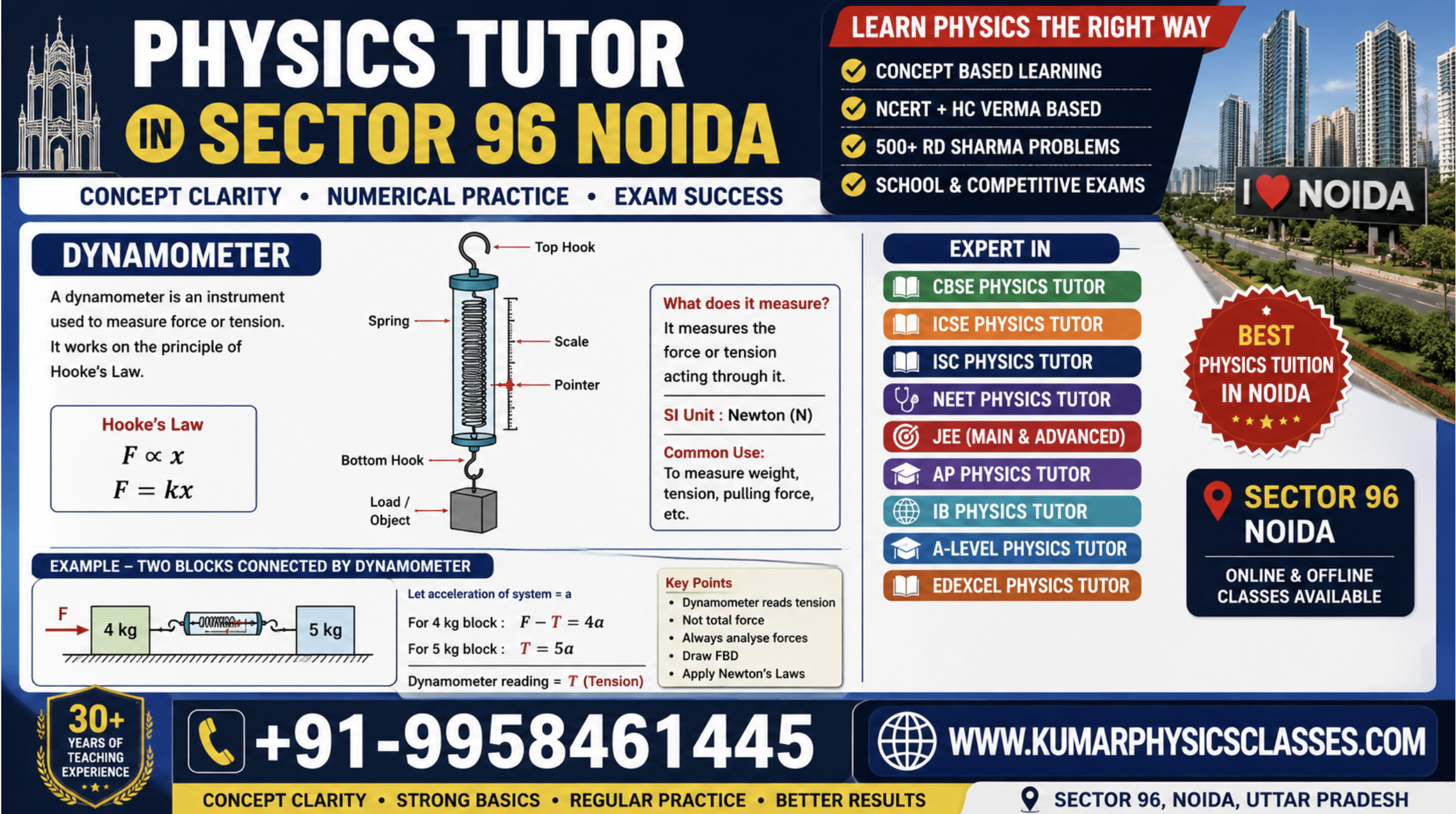
Many students feel that they know the chapter, but when a numerical comes, they get stuck. For example, in Newton’s Laws of Motion, a dynamometer attached between two blocks does not measure force applied directly by hand. It measures tension.
This is where students make mistakes. They do not understand that tension is an internal force between connected bodies. If two blocks of mass 4 kg and 5 kg are connected and pulled, then the dynamometer reading is the tension in the string or connector.
Suppose a 4 kg block and a 5 kg block are connected. If the system is accelerating, then we write equations separately for each block.
For the 4 kg block:
Force equation:
F – T = 4a
For the 5 kg block:
T = 5a
Here, T is the tension and the dynamometer reading will be equal to T.
This is the correct way to solve such questions. Kumar Sir teaches students how to identify forces, how to draw free body diagrams, how to write equations and how to avoid common mistakes.
What Does a Dynamometer Measure?
A dynamometer measures force. In many school-level Physics questions, when a dynamometer is connected between two blocks, it measures the tension between them.
Students often think that the dynamometer will show total force, but that is wrong. It shows the force transmitted through it. If it is connected between two masses, it reads the tension.
This concept is very important in:
Newton’s Laws of Motion
Pulley systems
Connected blocks
Friction problems
Elevator problems
Tension-based numerical questions
JEE and NEET level mechanics
Why Kumar Sir’s Teaching Helps
At Kumar Physics Classes, the focus is not only on formula application. Kumar Sir explains:
Free body diagram
Direction of tension
Net force
Acceleration of system
Equation writing
Sign convention
Common mistakes
Numerical shortcuts after concept clarity
HC Verma and NCERT-based practice
School exam and competitive exam approach
A student who understands these basics can solve difficult problems confidently.
Physics Tutor in Noida Sectors
Physics Tutor in Sector 1 Noida, Physics Tutor in Sector 2 Noida, Physics Tutor in Sector 11 Noida, Physics Tutor in Sector 12 Noida, Physics Tutor in Sector 15 Noida, Physics Tutor in Sector 18 Noida, Physics Tutor in Sector 22 Noida, Physics Tutor in Sector 27 Noida, Physics Tutor in Sector 37 Noida, Physics Tutor in Sector 44 Noida, Physics Tutor in Sector 50 Noida, Physics Tutor in Sector 51 Noida, Physics Tutor in Sector 52 Noida, Physics Tutor in Sector 61 Noida, Physics Tutor in Sector 62 Noida, Physics Tutor in Sector 71 Noida, Physics Tutor in Sector 72 Noida, Physics Tutor in Sector 75 Noida, Physics Tutor in Sector 76 Noida, Physics Tutor in Sector 78 Noida, Physics Tutor in Sector 93 Noida, Physics Tutor in Sector 94 Noida, Physics Tutor in Sector 96 Noida, Physics Tutor in Sector 100 Noida, Physics Tutor in Sector 104 Noida, Physics Tutor in Sector 107 Noida, Physics Tutor in Sector 110 Noida, Physics Tutor in Sector 117 Noida, Physics Tutor in Sector 119 Noida, Physics Tutor in Sector 120 Noida, Physics Tutor in Sector 121 Noida, Physics Tutor in Sector 122 Noida, Physics Tutor in Sector 128 Noida, Physics Tutor in Sector 133 Noida, Physics Tutor in Sector 137 Noida, Physics Tutor in Sector 144 Noida, Physics Tutor in Sector 150 Noida, Physics Tutor in Sector 151 Noida, Physics Tutor in Sector 168 Noida
Physics Tutor Near Noida Schools
Physics Tutor in DPS Noida, Physics Tutor in Lotus Valley International School Noida, Physics Tutor in Amity International School Noida, Physics Tutor in Step by Step School Noida, Physics Tutor in Shiv Nadar School Noida, Physics Tutor in Pathways School Noida, Physics Tutor in Genesis Global School Noida, Physics Tutor in Somerville School Noida, Physics Tutor in Cambridge School Noida, Physics Tutor in Apeejay School Noida, Physics Tutor in Ryan International School Noida, Physics Tutor in Khaitan School Noida, Physics Tutor in Billabong High International School Noida, Physics Tutor in Mayoor School Noida, Physics Tutor in JBM Global School Noida
Physics Courses in Noida
NEET Physics Tutor in Noida, CBSE Physics Tutor in Noida, ICSE Physics Tutor in Noida, ISC Physics Tutor in Noida, JEE Physics Tutor in Noida, JEE Advanced Physics Tutor in Noida, AP Physics Tutor in Noida, IB Physics Tutor in Noida, Edexcel Physics Tutor in Noida, A-Level Physics Tutor in Noida, British Curriculum Physics Tutor in Noida
Final Words
If you live in Sector 96 Noida and your child is struggling with Physics, then proper guidance is very important. Concepts like tension, dynamometer reading, acceleration, force, friction and connected blocks cannot be understood by memorising formulas.
Kumar Sir explains Physics from the basic level and then takes students to numerical practice and exam-level questions. With proper concept clarity, regular practice and correct guidance, students can improve their Physics performance in school exams as well as competitive exams.
Contact Kumar Physics Classes: +91-9958461445
Website: https://kumarphysicsclasses.com
Email: kumarsirphysics@gmail.com
50 Conceptual Questions and Answers on Dynamometer
1. What is a dynamometer?
Answer: A dynamometer is an instrument used to measure force.
2. What does a dynamometer measure in a connected block system?
Answer: It measures tension in the string or connector.
3. Does a dynamometer measure mass?
Answer: No. It measures force, not mass.
4. What is the SI unit of dynamometer reading?
Answer: Newton.
5. If a dynamometer is attached between two blocks, what does it show?
Answer: It shows the tension between the two blocks.
6. Is dynamometer reading always equal to applied force?
Answer: No. It depends on where the dynamometer is connected.
7. Why do students get confused in dynamometer questions?
Answer: Because they think it always shows total pulling force, but actually it shows tension at its position.
8. If two blocks are connected and pulled, will the dynamometer show total force?
Answer: No. It will show the force transmitted through it.
9. In a massless string, is tension same everywhere?
Answer: Yes, if the string is ideal and massless.
10. In a massive string, is tension same everywhere?
Answer: No. Tension may vary along the string.
11. If a dynamometer is placed in a massless string, what does it read?
Answer: It reads the tension in the string.
12. Can dynamometer reading be zero?
Answer: Yes, if there is no tension or force through it.
13. If a block is at rest and pulled by a force, can dynamometer show non-zero reading?
Answer: Yes, if tension is present.
14. Does acceleration affect dynamometer reading?
Answer: Yes. In accelerating systems, tension changes, so reading changes.
15. If a 5 kg block is pulled and dynamometer is between hand and block, what does it read?
Answer: It reads the pulling force transmitted to the block.
16. If two blocks of 4 kg and 5 kg are connected, why write equations separately?
Answer: Because tension acts differently on each block, and each block has its own force equation.
17. For a 5 kg block pulled by tension T, what equation can be written?
Answer: T = 5a, if no friction and tension is the only horizontal force.
18. For a 4 kg block pulled by external force F and tension T backward, what equation is written?
Answer: F – T = 4a.
19. What is the dynamometer reading in this case?
Answer: The reading is T.
20. Why is free body diagram important in dynamometer questions?
Answer: Because without FBD, students cannot identify tension correctly.
21. Does a dynamometer measure net force?
Answer: Not always. It measures the force passing through it.
22. If two equal forces pull a dynamometer from opposite sides, what does it read?
Answer: It reads one force value, not double.
23. If 10 N pulls from left and 10 N from right, what is the reading?
Answer: 10 N, not 20 N.
24. Why not 20 N?
Answer: Because tension inside the dynamometer is 10 N.
25. If only one side of dynamometer is pulled with 10 N and other side is fixed, reading?
Answer: 10 N.
26. Can a dynamometer be used vertically?
Answer: Yes, it can measure weight or tension vertically.
27. What will it read if a 2 kg mass hangs from it?
Answer: Approximately 20 N, if g = 10 m/s².
28. What happens to reading if the hanging mass accelerates upward?
Answer: Reading increases.
29. What happens if the hanging mass accelerates downward?
Answer: Reading decreases.
30. What is the reading in free fall?
Answer: Zero, because apparent weight becomes zero.
31. Is dynamometer reading same as apparent weight?
Answer: In vertical motion, yes, it can show apparent weight.
32. In an elevator moving upward with acceleration, what happens to reading?
Answer: It becomes greater than mg.
33. In an elevator moving downward with acceleration, what happens?
Answer: It becomes less than mg.
34. In an elevator moving with constant velocity, what is reading?
Answer: mg.
35. Why constant velocity gives mg?
Answer: Because acceleration is zero.
36. If a dynamometer is between two blocks on a frictionless table, what does it measure?
Answer: Internal tension between blocks.
37. Does friction change dynamometer reading?
Answer: Yes, friction changes acceleration and tension.
38. Can dynamometer reading be greater than weight?
Answer: Yes, in upward accelerated motion.
39. Can it be less than weight?
Answer: Yes, in downward accelerated motion.
40. Can it become negative?
Answer: No. A normal dynamometer cannot show negative force; it shows magnitude of tension.
41. What is the main mistake in dynamometer problems?
Answer: Students do not decide which force the dynamometer is actually measuring.
42. What should be the first step?
Answer: Draw the free body diagram.
43. What should be the second step?
Answer: Write Newton’s second law for each body.
44. What should be the third step?
Answer: Solve for tension.
45. Why is tension equal to dynamometer reading?
Answer: Because the dynamometer is in the line of tension.
46. If the dynamometer has mass, will reading be same on both sides?
Answer: Not necessarily, because its own mass may affect force balance.
47. In school-level problems, what assumption is usually taken?
Answer: The dynamometer is massless and ideal.
48. What does an ideal dynamometer mean?
Answer: It measures force accurately and does not affect the motion.
49. Why is dynamometer important in mechanics?
Answer: It helps students understand tension, apparent weight, connected bodies and Newton’s laws.
50. What is the final concept to remember?
Answer: Dynamometer does not blindly show total force. It shows the tension or force transmitted through the point where it is attached.
40 Conceptual Questions on Dynamometer with Answers
What is a dynamometer?
A dynamometer is an instrument used to measure force, tension, or sometimes power.What does a dynamometer measure in a string-pulley system?
It measures the tension in the string.Does a dynamometer measure mass directly?
No, it measures force. Mass can be calculated if acceleration due to gravity is known.What is the SI unit of dynamometer reading?
Newton.If a dynamometer reads 20 N, what does it mean?
It means the force or tension acting through it is 20 N.Can a dynamometer measure weight?
Yes, because weight is a force.If a 5 kg mass hangs from a dynamometer at rest, what is the reading?
(50 N), taking (g = 10 m/s^2).If the same 5 kg mass moves upward with acceleration, will the reading increase?
Yes, because tension becomes greater than weight.If the mass moves downward with acceleration, will the reading decrease?
Yes, because tension becomes less than weight.If the mass is in free fall, what will the dynamometer read?
Zero, because there is no tension.Why does a dynamometer show zero in free fall?
Because the mass and dynamometer both fall together, so no stretching force acts.Does a dynamometer reading depend on its own mass?
In ideal problems, its mass is neglected.In a horizontal pulling case, what does the dynamometer measure?
It measures the pulling force or tension.If two people pull a dynamometer from opposite sides with 50 N each, what is the reading?
50 N, not 100 N.Why is the reading not 100 N when both sides pull with 50 N?
Because the dynamometer measures tension, and the tension throughout it is 50 N.If one side is fixed to a wall and the other side is pulled with 60 N, what is the reading?
60 N.Does a wall also pull back when a dynamometer is pulled?
Yes, by Newton’s third law.Can a dynamometer measure compression?
A normal spring dynamometer measures tension, not compression.What principle is commonly used in a spring dynamometer?
Hooke’s law.According to Hooke’s law, force is proportional to what?
Extension of the spring.What is the formula for spring force?
(F = kx)What does (k) represent in (F = kx)?
Spring constant.What does (x) represent in (F = kx)?
Extension of the spring.If extension doubles, what happens to the force reading?
The force doubles, if the spring remains within elastic limit.What happens if the elastic limit is crossed?
The dynamometer may give wrong readings or get permanently damaged.Why is calibration important in a dynamometer?
To ensure that the scale gives correct force readings.If a dynamometer is used on the Moon, will the weight reading change?
Yes, because weight depends on gravitational acceleration.Will the mass of the object change on the Moon?
No, mass remains the same.If a 10 kg object is weighed on Earth, reading is about?
(100 N), taking (g = 10 m/s^2).If the same object is weighed on the Moon, reading will be smaller. Why?
Because Moon’s gravity is smaller than Earth’s gravity.In an Atwood machine, what does the dynamometer in the string measure?
It measures tension in the string.Is tension always equal to weight?
No, tension equals weight only in equilibrium or uniform motion.If acceleration is present, can tension differ from weight?
Yes, tension changes according to acceleration.For a block of mass (m) moving upward with acceleration (a), what is tension?
(T = m(g+a))For a block moving downward with acceleration (a), what is tension?
(T = m(g-a))If a dynamometer is attached between two blocks, what does it read?
It reads the tension force between the two blocks.Can dynamometer reading be negative?
No, it shows magnitude of force.If friction increases in a pulling experiment, what happens to dynamometer reading?
It generally increases because more force is needed.Why do students confuse dynamometer reading with net force?
Because they forget that the dynamometer reads tension, not necessarily net force.What is the most important concept about dynamometer?
A dynamometer reads the force or tension acting through it, not the total force of both sides.