
Physics Tutor in Sector 121 Noida | Kumar Physics Classes
+91-9958461445
If you live in Sector 121 Noida and Physics is not making sense to you, then you are not alone. Noida is one of the most developed education hubs, but still many students struggle badly in Physics. The reason is simple: Physics cannot be understood by shortcuts, random videos, incomplete notes or casual teaching.
Many students attend school, take tuition, watch YouTube videos, and still they are unable to understand topics like Bernoulli’s Theorem, Terminal Velocity, Viscosity, Fluid Mechanics, Electrostatics, Current Electricity, Magnetism, Ray Optics, Modern Physics and Mechanics.
If the foundation is weak, then Physics becomes more and more difficult in Class 11 and Class 12. This is why students in Sector 121 Noida need a proper Physics tutor who can explain every concept from the basic level.
At Kumar Physics Classes, Kumar Sir teaches Physics with proper concept clarity, derivation, numerical practice and exam-oriented preparation. Students preparing for CBSE, ICSE, ISC, NEET, JEE, AP Physics, IB Physics, A-Level Physics, British Curriculum and Edexcel Physics can contact Kumar Physics Classes for systematic Physics guidance.
Website: Kumar Physics Classes
Contact: +91-9958461445
Email: kumarsirphysics@gmail.com
Why Physics Becomes Difficult for Students in Sector 121 Noida
Physics becomes difficult when students try to memorise formulas without understanding the concept. For example, many students know the formula of terminal velocity, but they do not understand why velocity becomes constant after some time.
A good Physics teacher does not only write formulas. A good teacher explains:
Why the formula is required
How the formula is derived
Where the formula is applied
What mistakes students usually make
How to solve numerical problems using the formula
This is the teaching style followed at Kumar Physics Classes.
Terminal Velocity Explained
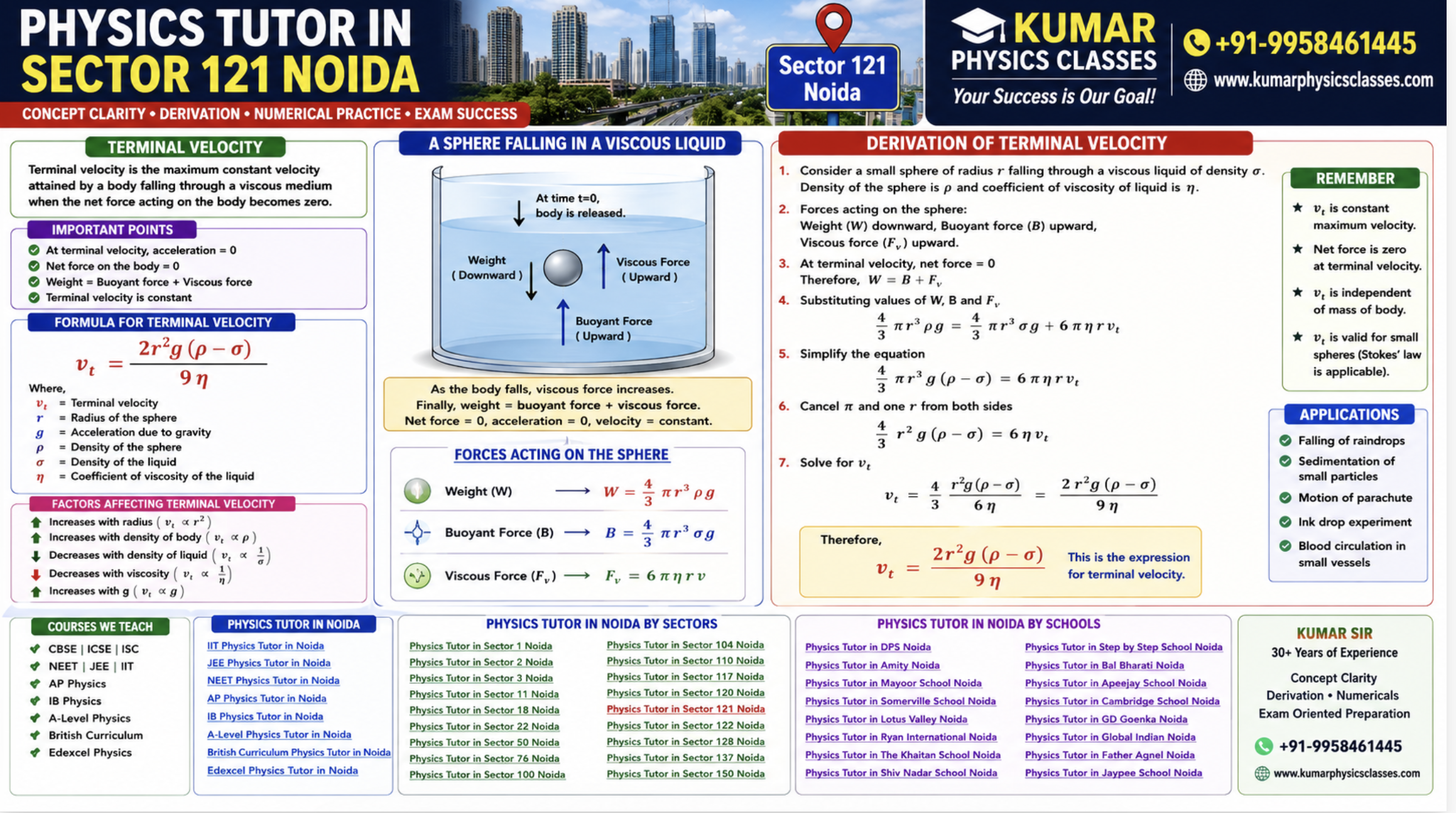
When a small spherical body falls through a viscous liquid, its velocity does not keep increasing forever. Initially, the body accelerates because its weight acts downward. But as its speed increases, the viscous force also increases in the upward direction.
After some time, the downward force becomes equal to the total upward force. At that moment, net force becomes zero and acceleration becomes zero. The body then moves with constant velocity.
This constant maximum velocity is called terminal velocity.
Definition of Terminal Velocity
Terminal velocity is the maximum constant velocity attained by a body while falling through a viscous medium when the net force acting on the body becomes zero.
Forces Acting on a Sphere Falling in a Viscous Liquid
Three forces act on the sphere:
Weight of the sphere acting downward
Buoyant force acting upward
Viscous force acting upward
At terminal velocity:
Weight = Buoyant force + Viscous force
Formula of Terminal Velocity
Copy-paste friendly formula:
v = 2 r^2 g (rho – sigma) / 9 eta
Where:
v = terminal velocity
r = radius of the sphere
g = acceleration due to gravity
rho = density of the sphere
sigma = density of the liquid
eta = coefficient of viscosity of the liquid
Important Points About Terminal Velocity
Terminal velocity is directly proportional to square of radius.
v proportional to r^2
Terminal velocity is inversely proportional to viscosity.
v proportional to 1 / eta
If the density of the sphere increases, terminal velocity increases.
If the density of the liquid increases, terminal velocity decreases.
If viscosity increases, terminal velocity decreases.
A small raindrop falls slowly because its terminal velocity is small.
A large raindrop falls faster because its terminal velocity is greater.
Why Kumar Sir for Physics in Sector 121 Noida?
Kumar Sir has more than 30 years of teaching experience. He teaches Physics in a structured way so that students understand the subject from the root level.
At Kumar Physics Classes, students get:
Concept-based teaching
Step-by-step derivations
Numerical practice
Doubt clearing
Exam-oriented preparation
NEET and JEE level questions
AP, IB and A-Level Physics support
Strong foundation for Class 11 and Class 12
Physics is not about memorising formulas. Physics is about understanding logic. Kumar Sir focuses on logic, clarity and application.
Courses Offered
Physics Tutor in Noida, IIT Physics Tutor in Noida, JEE Physics Tutor in Noida, JEE Advanced Physics Tutor in Noida, NEET Physics Tutor in Noida, AP Physics Tutor in Noida, IB Physics Tutor in Noida, CBSE Physics Tutor in Noida, ICSE Physics Tutor in Noida, ISC Physics Tutor in Noida, A-Level Physics Tutor in Noida, British Curriculum Physics Tutor in Noida, Edexcel Physics Tutor in Noida, IGCSE Physics Tutor in Noida
Noida Sector Wise Physics Tutor
Physics Tutor in Sector 1 Noida, Physics Tutor in Sector 2 Noida, Physics Tutor in Sector 3 Noida, Physics Tutor in Sector 11 Noida, Physics Tutor in Sector 12 Noida, Physics Tutor in Sector 15 Noida, Physics Tutor in Sector 18 Noida, Physics Tutor in Sector 19 Noida, Physics Tutor in Sector 20 Noida, Physics Tutor in Sector 21 Noida, Physics Tutor in Sector 22 Noida, Physics Tutor in Sector 25 Noida, Physics Tutor in Sector 26 Noida, Physics Tutor in Sector 27 Noida, Physics Tutor in Sector 30 Noida, Physics Tutor in Sector 34 Noida, Physics Tutor in Sector 37 Noida, Physics Tutor in Sector 44 Noida, Physics Tutor in Sector 45 Noida, Physics Tutor in Sector 46 Noida, Physics Tutor in Sector 47 Noida, Physics Tutor in Sector 49 Noida, Physics Tutor in Sector 50 Noida, Physics Tutor in Sector 51 Noida, Physics Tutor in Sector 52 Noida, Physics Tutor in Sector 55 Noida, Physics Tutor in Sector 56 Noida, Physics Tutor in Sector 61 Noida, Physics Tutor in Sector 62 Noida, Physics Tutor in Sector 71 Noida, Physics Tutor in Sector 72 Noida, Physics Tutor in Sector 75 Noida, Physics Tutor in Sector 76 Noida, Physics Tutor in Sector 77 Noida, Physics Tutor in Sector 78 Noida, Physics Tutor in Sector 79 Noida, Physics Tutor in Sector 100 Noida, Physics Tutor in Sector 104 Noida, Physics Tutor in Sector 108 Noida, Physics Tutor in Sector 110 Noida, Physics Tutor in Sector 117 Noida, Physics Tutor in Sector 119 Noida, Physics Tutor in Sector 120 Noida, Physics Tutor in Sector 121 Noida, Physics Tutor in Sector 122 Noida, Physics Tutor in Sector 128 Noida, Physics Tutor in Sector 132 Noida, Physics Tutor in Sector 137 Noida, Physics Tutor in Sector 150 Noida
School Wise Physics Tutor Links in Noida
Physics Tutor in DPS Noida, Physics Tutor in Amity International School Noida, Physics Tutor in Mayoor School Noida, Physics Tutor in Somerville School Noida, Physics Tutor in Apeejay School Noida, Physics Tutor in Cambridge School Noida, Physics Tutor in Lotus Valley International School Noida, Physics Tutor in Bal Bharati Public School Noida, Physics Tutor in Ryan International School Noida, Physics Tutor in The Khaitan School Noida, Physics Tutor in Shiv Nadar School Noida, Physics Tutor in Step by Step School Noida, Physics Tutor in Genesis Global School Noida, Physics Tutor in Kothari International School Noida, Physics Tutor in Ramagya School Noida, Physics Tutor in Sapphire International School Noida, Physics Tutor in Jaypee Public School Noida, Physics Tutor in Father Agnel School Noida, Physics Tutor in Shriram Millennium School Noida, Physics Tutor in GD Goenka Global School Noida, Physics Tutor in Global Indian International School Noida
Final Note
If you are searching for Physics Tutor in Sector 121 Noida, Kumar Physics Classes can help you understand Physics in a proper and systematic way. Topics like Terminal Velocity, Bernoulli’s Theorem, Viscosity, Fluid Mechanics and Mechanics become easy when they are explained with logic and derivation.
Physics is not difficult when the teacher explains it properly.
Website: Kumar Physics Classes
Contact: +91-9958461445
Email: kumarsirphysics@gmail.com
40 Conceptual Questions on Terminal Velocity with Answers
Kumar Sir Style – English
1. What is terminal velocity?
Answer: Terminal velocity is the maximum constant velocity attained by a body while falling through a viscous medium when net force becomes zero.
2. Why does terminal velocity become constant?
Answer: Because at terminal velocity, weight is balanced by buoyant force and viscous force, so acceleration becomes zero.
3. Which forces act on a sphere falling in a liquid?
Answer: Weight acts downward, while buoyant force and viscous force act upward.
4. What is the condition for terminal velocity?
Answer:
Weight = Buoyant force + Viscous force.
5. Does terminal velocity depend on radius?
Answer: Yes. Terminal velocity is directly proportional to the square of radius.
6. If radius is doubled, what happens to terminal velocity?
Answer: Terminal velocity becomes four times.
7. Does terminal velocity depend on viscosity?
Answer: Yes. Terminal velocity is inversely proportional to viscosity.
8. If viscosity increases, what happens to terminal velocity?
Answer: Terminal velocity decreases.
9. Why does a small raindrop fall slowly?
Answer: Because its radius is small, so terminal velocity is small.
10. Why does a large raindrop fall faster?
Answer: Because terminal velocity increases with square of radius.
11. What is the formula of terminal velocity?
Answer:
v = 2r²g(ρ – σ) / 9η
12. What does ρ represent in terminal velocity formula?
Answer: ρ represents the density of the falling body.
13. What does σ represent?
Answer: σ represents the density of the liquid or medium.
14. What does η represent?
Answer: η represents the coefficient of viscosity of the medium.
15. When will terminal velocity be zero?
Answer: When density of body equals density of liquid, that is ρ = σ.
16. Can terminal velocity be negative?
Answer: Physically, direction may change if body is lighter than liquid, but speed is taken positive.
17. Why does a body initially accelerate in liquid?
Answer: Initially viscous force is small, so weight is greater than upward forces.
18. Why does viscous force increase with speed?
Answer: According to Stokes’ law, viscous force is proportional to velocity.
19. What is Stokes’ law?
Answer: For a small sphere moving in a viscous fluid:
F = 6πηrv
20. Is terminal velocity possible in vacuum?
Answer: No. In vacuum, there is no viscous or air resistance force.
21. Why does a parachute reduce terminal velocity?
Answer: It increases effective area and air resistance, so terminal velocity becomes smaller.
22. Why is terminal velocity important in rain?
Answer: It prevents raindrops from falling with dangerously high speed.
23. Does terminal velocity depend on gravitational acceleration?
Answer: Yes. Terminal velocity is directly proportional to g.
24. On the Moon, will terminal velocity in air exist?
Answer: No, because the Moon has almost no atmosphere.
25. If density of body increases, what happens to terminal velocity?
Answer: Terminal velocity increases.
26. If density of liquid increases, what happens?
Answer: Terminal velocity decreases.
27. Why does a steel ball fall faster than a wooden ball in oil?
Answer: Steel has higher density, so terminal velocity is greater.
28. Why does honey slow down falling objects more than water?
Answer: Honey has higher viscosity, so terminal velocity becomes smaller.
29. Is terminal velocity reached instantly?
Answer: No. It is reached gradually after some time.
30. At terminal velocity, what is acceleration?
Answer: Acceleration is zero.
31. At terminal velocity, is net force zero?
Answer: Yes, net force is zero.
32. At terminal velocity, is the body at rest?
Answer: No. It moves with constant velocity.
33. Can terminal velocity occur in gases?
Answer: Yes, objects falling through air can attain terminal velocity.
34. Why does dust settle slowly?
Answer: Dust particles are very small, so their terminal velocity is very small.
35. Why does a person with parachute land safely?
Answer: Parachute reduces terminal velocity, so landing speed becomes safe.
36. What is the role of buoyant force?
Answer: Buoyant force reduces the effective downward force on the body.
37. Why is terminal velocity less in glycerine than in water?
Answer: Glycerine is more viscous than water.
38. What happens before terminal velocity is reached?
Answer: Speed increases, viscous force increases, and acceleration decreases.
39. What happens after terminal velocity is reached?
Answer: The body continues to move with constant speed.
40. What is the main concept students must remember?
Answer: Terminal velocity comes when downward weight is exactly balanced by upward buoyant force and viscous force. Net force becomes zero, so acceleration becomes zero.