
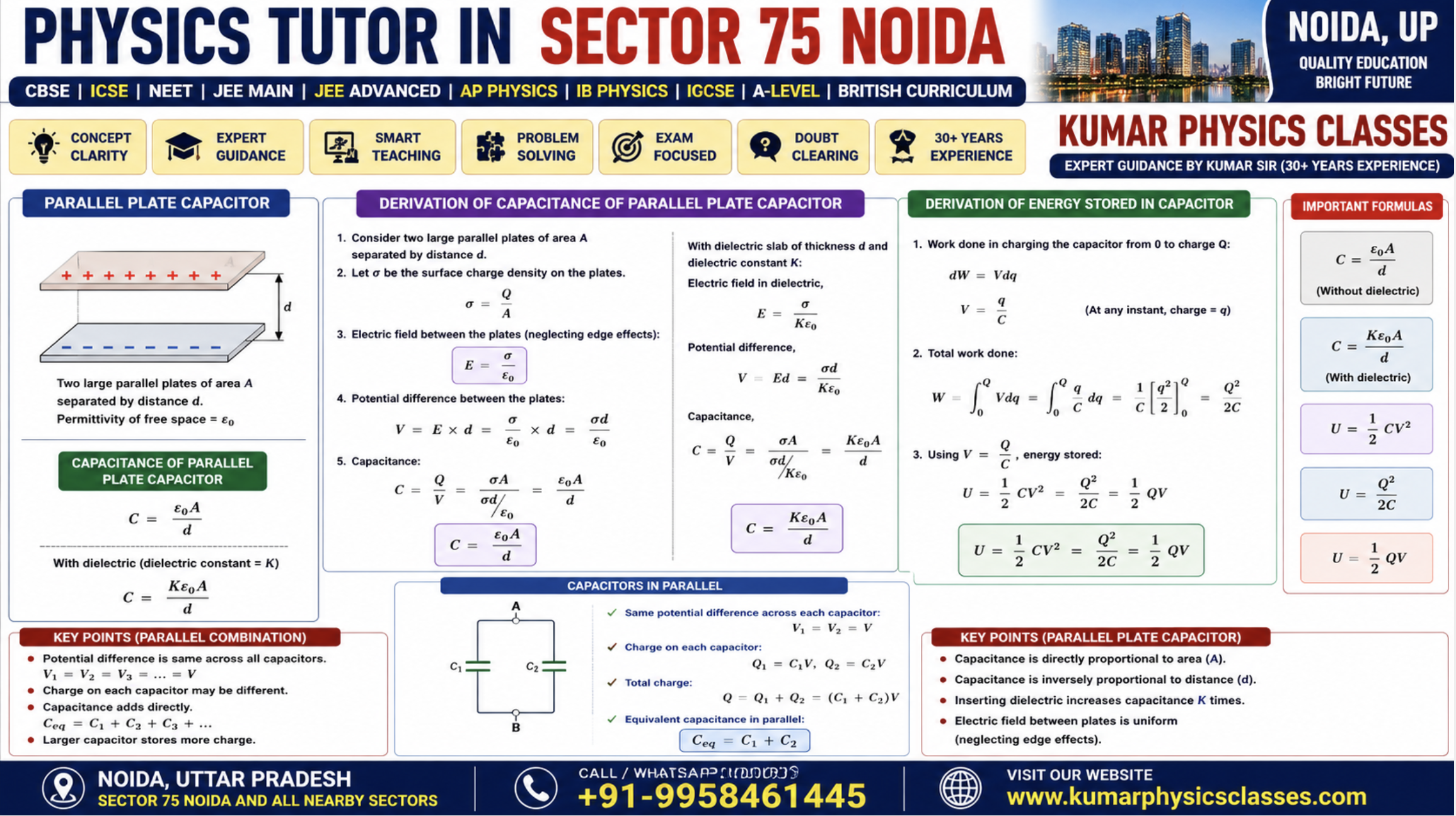
Physics Tutor in Sector 75 Noida | Kumar Physics Classes
+91-9958461445
If you live in Sector 75 Noida and Physics is becoming difficult for you, then you need proper guidance, not random shortcuts. Many students think Physics is tough, but the real problem is usually weak concept clarity, poor numerical practice, incomplete explanation and lack of experienced teaching.
At Kumar Physics Classes, Kumar Sir teaches Physics with deep conceptual clarity, technical accuracy and exam-oriented methods. With more than 30 years of teaching experience, Kumar Sir explains small but important points that many students miss in school classrooms or random online videos.
Physics is not a subject of memorising formulas only. It requires understanding, logic, derivation, numerical application and proper revision. Whether you are preparing for CBSE Physics, ICSE Physics, NEET Physics, IIT JEE Physics, AP Physics, IB Physics, IGCSE Physics, British Curriculum Physics or A-Level Physics, the right teacher can make a big difference.
Website: https://kumarphysicsclasses.com/
Contact: +91-9958461445
Email: kumarsirphysics@gmail.com
Why Students in Sector 75 Noida Need a Good Physics Tutor
Many students in Sector 75 Noida face problems in Physics because they do not understand the subject from the root level. They may attend school classes, watch YouTube videos, take help from random tutors, but still their marks do not improve.
The reason is simple: Physics needs structured teaching.
A good Physics teacher must explain:
Why a formula is used
How a formula is derived
What the physical meaning is
How to apply it in numericals
What mistakes students usually make
How to solve board, NEET and JEE questions
Kumar Sir teaches Physics in a very technical and smart way. He focuses on small details that help students understand the chapter properly.
Capacitors in Series and Parallel
Capacitance is one of the most important topics in Electrostatics. Students often get confused between capacitors in series and capacitors in parallel. But if the basic concept is clear, the topic becomes very simple.
What is Capacitance?
Capacitance is the ability of a conductor or capacitor to store electric charge.
Formula:
C = Q / V
Where:
C = capacitance
Q = charge stored
V = potential difference
Unit of capacitance:
farad
Parallel Plate Capacitor
A parallel plate capacitor consists of two large conducting plates separated by a small distance.
Formula:
C = epsilon_0 A / d
Where:
C = capacitance
epsilon_0 = permittivity of free space
A = area of each plate
d = separation between plates
If dielectric is inserted:
C = K epsilon_0 A / d
Where:
K = dielectric constant
Capacitors in Series
When capacitors are connected end to end, they are said to be connected in series.
In series combination:
Charge remains same on every capacitor.
Q1 = Q2 = Q3 = Q
Potential difference is different across different capacitors.
Total potential difference:
V = V1 + V2 + V3
For series combination:
1 / C equivalent = 1 / C1 + 1 / C2 + 1 / C3
Important point:
In series, charge is same, but potential depends on capacitance.
Since:
V = Q / C
If capacitance is smaller, potential difference is larger.
If capacitance is larger, potential difference is smaller.
So in series:
Smaller capacitor gets more potential difference.
Larger capacitor gets less potential difference.
Example of Capacitors in Series
Suppose two capacitors C1 and C2 are connected in series.
Charge on both capacitors will be same:
Q1 = Q2 = Q
Potential across C1:
V1 = Q / C1
Potential across C2:
V2 = Q / C2
Total voltage:
V = V1 + V2
Therefore:
V = Q / C1 + Q / C2
V = Q (1 / C1 + 1 / C2)
Since:
V = Q / C equivalent
So:
1 / C equivalent = 1 / C1 + 1 / C2
Capacitors in Parallel
When capacitors are connected across the same two points, they are said to be connected in parallel.
In parallel combination:
Potential difference remains same across every capacitor.
V1 = V2 = V3 = V
Charge is different on different capacitors.
Total charge:
Q = Q1 + Q2 + Q3
For parallel combination:
C equivalent = C1 + C2 + C3
Important point:
In parallel, potential is same, but charge depends on capacitance.
Since:
Q = CV
If capacitance is larger, charge stored is larger.
If capacitance is smaller, charge stored is smaller.
So in parallel:
Larger capacitor stores more charge.
Smaller capacitor stores less charge.
Example of Capacitors in Parallel
Suppose two capacitors C1 and C2 are connected in parallel.
Potential across both capacitors will be same:
V1 = V2 = V
Charge on C1:
Q1 = C1 V
Charge on C2:
Q2 = C2 V
Total charge:
Q = Q1 + Q2
Q = C1 V + C2 V
Q = V (C1 + C2)
Since:
Q = C equivalent V
Therefore:
C equivalent = C1 + C2
Series vs Parallel Capacitors
Capacitors in Series
Charge is same on all capacitors.
Q1 = Q2 = Q3
Potential is different.
V = V1 + V2 + V3
Equivalent capacitance:
1 / C equivalent = 1 / C1 + 1 / C2 + 1 / C3
Smaller capacitor gets larger voltage.
Capacitors in Parallel
Potential is same on all capacitors.
V1 = V2 = V3
Charge is different.
Q = Q1 + Q2 + Q3
Equivalent capacitance:
C equivalent = C1 + C2 + C3
Larger capacitor stores more charge.
Why Kumar Sir’s Explanation Helps Students
Many students memorise formulas but do not understand the concept. Kumar Sir explains the logic behind the formula.
For example:
In series, why is charge same?
Because there is only one path for charge movement.
In parallel, why is potential same?
Because all capacitors are connected across the same two terminals.
In series, why does smaller capacitance get more voltage?
Because V = Q / C and Q is same.
In parallel, why does larger capacitance store more charge?
Because Q = CV and V is same.
This type of explanation makes Physics easy and logical.
Noida Sector Wise Physics Tutor Links
Physics Tutor in Sector 1 Noida, Physics Tutor in Sector 2 Noida, Physics Tutor in Sector 3 Noida, Physics Tutor in Sector 4 Noida, Physics Tutor in Sector 5 Noida, Physics Tutor in Sector 6 Noida, Physics Tutor in Sector 7 Noida, Physics Tutor in Sector 8 Noida, Physics Tutor in Sector 9 Noida, Physics Tutor in Sector 10 Noida, Physics Tutor in Sector 11 Noida, Physics Tutor in Sector 12 Noida, Physics Tutor in Sector 15 Noida, Physics Tutor in Sector 16 Noida, Physics Tutor in Sector 18 Noida, Physics Tutor in Sector 19 Noida, Physics Tutor in Sector 20 Noida, Physics Tutor in Sector 21 Noida, Physics Tutor in Sector 22 Noida, Physics Tutor in Sector 25 Noida, Physics Tutor in Sector 26 Noida, Physics Tutor in Sector 27 Noida, Physics Tutor in Sector 28 Noida, Physics Tutor in Sector 29 Noida, Physics Tutor in Sector 30 Noida, Physics Tutor in Sector 31 Noida, Physics Tutor in Sector 34 Noida, Physics Tutor in Sector 36 Noida, Physics Tutor in Sector 37 Noida, Physics Tutor in Sector 39 Noida, Physics Tutor in Sector 40 Noida, Physics Tutor in Sector 41 Noida, Physics Tutor in Sector 44 Noida, Physics Tutor in Sector 45 Noida, Physics Tutor in Sector 46 Noida, Physics Tutor in Sector 47 Noida, Physics Tutor in Sector 49 Noida, Physics Tutor in Sector 50 Noida, Physics Tutor in Sector 51 Noida, Physics Tutor in Sector 52 Noida, Physics Tutor in Sector 55 Noida, Physics Tutor in Sector 56 Noida, Physics Tutor in Sector 61 Noida, Physics Tutor in Sector 62 Noida, Physics Tutor in Sector 63 Noida, Physics Tutor in Sector 70 Noida, Physics Tutor in Sector 71 Noida, Physics Tutor in Sector 72 Noida, Physics Tutor in Sector 73 Noida, Physics Tutor in Sector 74 Noida, Physics Tutor in Sector 75 Noida, Physics Tutor in Sector 76 Noida, Physics Tutor in Sector 77 Noida, Physics Tutor in Sector 78 Noida, Physics Tutor in Sector 79 Noida, Physics Tutor in Sector 93 Noida, Physics Tutor in Sector 100 Noida, Physics Tutor in Sector 104 Noida, Physics Tutor in Sector 105 Noida, Physics Tutor in Sector 108 Noida, Physics Tutor in Sector 110 Noida, Physics Tutor in Sector 119 Noida, Physics Tutor in Sector 120 Noida, Physics Tutor in Sector 121 Noida, Physics Tutor in Sector 122 Noida, Physics Tutor in Sector 128 Noida, Physics Tutor in Sector 132 Noida, Physics Tutor in Sector 137 Noida, Physics Tutor in Sector 150 Noida
School Wise Physics Tutor Links in Noida
Physics Tutor in DPS Noida, Physics Tutor in Delhi Public School Noida, Physics Tutor in Mayoor School Noida, Physics Tutor in Somerville School Noida, Physics Tutor in Amity International School Noida, Physics Tutor in Apeejay School Noida, Physics Tutor in Cambridge School Noida, Physics Tutor in Lotus Valley International School Noida, Physics Tutor in Bal Bharati Public School Noida, Physics Tutor in Ryan International School Noida, Physics Tutor in The Khaitan School Noida, Physics Tutor in Shiv Nadar School Noida, Physics Tutor in Step by Step School Noida, Physics Tutor in Pathways School Noida, Physics Tutor in Genesis Global School Noida, Physics Tutor in Gyanshree School Noida, Physics Tutor in Billabong High International School Noida, Physics Tutor in JBM Global School Noida, Physics Tutor in Global Indian International School Noida, Physics Tutor in Kothari International School Noida, Physics Tutor in Ramagya School Noida, Physics Tutor in Manav Rachna International School Noida, Physics Tutor in Indus Valley Public School Noida, Physics Tutor in Vishwa Bharati Public School Noida, Physics Tutor in Rockwood School Noida, Physics Tutor in Sapphire International School Noida, Physics Tutor in Jaypee Public School Noida, Physics Tutor in Fortune World School Noida, Physics Tutor in Army Public School Noida, Physics Tutor in Kendriya Vidyalaya Noida, Physics Tutor in Maharishi Vidya Mandir Noida, Physics Tutor in Presidium School Noida, Physics Tutor in Millennium School Noida, Physics Tutor in Modern School Noida, Physics Tutor in City Public School Noida, Physics Tutor in Raghav Global School Noida, Physics Tutor in Noida Educational Academy, Physics Tutor in Marigold Public School Noida, Physics Tutor in Yadu Public School Noida, Physics Tutor in Father Agnel School Noida, Physics Tutor in Pragyan School Noida, Physics Tutor in Shriram Millennium School Noida, Physics Tutor in GD Goenka Global School Noida, Physics Tutor in Delhi World Public School Noida, Physics Tutor in Pacific World School Noida, Physics Tutor in Learners International School Noida, Physics Tutor in Sanfort World School Noida
Important Physics Tutor Tags in Noida
NEET Physics Tutor in Noida, IIT Physics Tutor in Noida, IIT JEE Physics Tutor in Noida, JEE Main Physics Tutor in Noida, JEE Advanced Physics Tutor in Noida, AP Physics Tutor in Noida, IB Physics Tutor in Noida, IGCSE Physics Tutor in Noida, British Curriculum Physics Tutor in Noida, A-Level Physics Tutor in Noida, CBSE Physics Tutor in Noida, ICSE Physics Tutor in Noida
Final Note
If you are searching for Physics Tutor in Sector 75 Noida, Kumar Physics Classes can help you understand Physics from basic to advanced level. Topics like capacitors in series, capacitors in parallel, electrostatics, current electricity, magnetism, optics and modern physics become easy when the teacher explains the logic properly.
Physics is not difficult when concepts are clear.
Website: https://kumarphysicsclasses.com/
Contact: +91-9958461445
Email: kumarsirphysics@gmail.com
40 Questions and Answers on Capacitors in Parallel
Copy-Paste Ready for Website
Basic Concept
When capacitors are connected in parallel, their plates are connected across the same two points of a circuit.
In parallel combination:
Potential difference remains the same across all capacitors.
V1 = V2 = V3 = V
Charge on each capacitor may be different.
Q1 = C1 V
Q2 = C2 V
Q3 = C3 V
Total charge:
Q = Q1 + Q2 + Q3
Equivalent capacitance:
C equivalent = C1 + C2 + C3
1. What is meant by capacitors connected in parallel?
Answer:
Capacitors are said to be connected in parallel when all their positive plates are connected to one common point and all their negative plates are connected to another common point.
2. What remains same in parallel combination of capacitors?
Answer:
Potential difference remains same across all capacitors.
V1 = V2 = V3 = V
3. What is different in parallel combination of capacitors?
Answer:
Charge on each capacitor may be different because charge depends on capacitance.
Q = CV
4. What is the equivalent capacitance of capacitors in parallel?
Answer:
Equivalent capacitance is the sum of all capacitances.
C equivalent = C1 + C2 + C3
5. Why is potential difference same in parallel combination?
Answer:
Because all capacitors are connected across the same two terminals of the battery or circuit.
6. Why is charge different on different capacitors in parallel?
Answer:
Because charge stored by a capacitor is given by:
Q = CV
Since voltage is same, charge depends on capacitance.
7. Which capacitor stores more charge in parallel combination?
Answer:
The capacitor with larger capacitance stores more charge.
8. If two capacitors 2 uF and 3 uF are connected in parallel, what is equivalent capacitance?
Answer:
C equivalent = C1 + C2
C equivalent = 2 uF + 3 uF
C equivalent = 5 uF
9. If three capacitors 1 uF, 4 uF and 5 uF are connected in parallel, find equivalent capacitance.
Answer:
C equivalent = 1 uF + 4 uF + 5 uF
C equivalent = 10 uF
10. If capacitors are connected in parallel, is equivalent capacitance greater than individual capacitances?
Answer:
Yes. Equivalent capacitance is always greater than the largest individual capacitance.
11. Why does equivalent capacitance increase in parallel combination?
Answer:
Because connecting capacitors in parallel effectively increases the plate area available for storing charge.
12. What is total charge in parallel combination?
Answer:
Total charge is the sum of charges on all capacitors.
Q total = Q1 + Q2 + Q3
13. If C1 = 2 uF, C2 = 4 uF and V = 10 V, find charge on each capacitor.
Answer:
Q1 = C1 V = 2 uF x 10 V = 20 uC
Q2 = C2 V = 4 uF x 10 V = 40 uC
14. For the above case, what is total charge?
Answer:
Q total = Q1 + Q2
Q total = 20 uC + 40 uC
Q total = 60 uC
15. If C equivalent = 6 uF and V = 10 V, find total charge.
Answer:
Q total = C equivalent x V
Q total = 6 uF x 10 V
Q total = 60 uC
16. In parallel combination, does each capacitor get the same charge?
Answer:
No. Each capacitor gets charge according to its capacitance.
17. In parallel combination, does each capacitor get the same voltage?
Answer:
Yes. Each capacitor gets the same voltage.
18. If two identical capacitors C and C are connected in parallel, what is equivalent capacitance?
Answer:
C equivalent = C + C
C equivalent = 2C
19. If n identical capacitors each of capacitance C are connected in parallel, what is equivalent capacitance?
Answer:
C equivalent = nC
20. If three identical capacitors of 5 uF each are connected in parallel, find equivalent capacitance.
Answer:
C equivalent = 5 uF + 5 uF + 5 uF
C equivalent = 15 uF
21. What happens to equivalent capacitance when one more capacitor is added in parallel?
Answer:
Equivalent capacitance increases.
22. Can equivalent capacitance in parallel be smaller than any individual capacitor?
Answer:
No. In parallel, equivalent capacitance is always greater than each individual capacitance.
23. If a capacitor of very large capacitance is connected in parallel with a small capacitor, which stores more charge?
Answer:
The capacitor with larger capacitance stores more charge because:
Q = CV
24. If voltage is doubled in a parallel combination, what happens to charge on each capacitor?
Answer:
Charge on each capacitor becomes double because:
Q = CV
25. If voltage is doubled, what happens to equivalent capacitance?
Answer:
Equivalent capacitance does not change because capacitance depends on geometry and medium, not on voltage.
26. If capacitance of one capacitor is doubled, what happens to total capacitance?
Answer:
Total capacitance increases by the same added amount because capacitances add directly in parallel.
27. What is energy stored in a capacitor?
Answer:
Energy stored in a capacitor is:
U = 1/2 C V^2
28. What is total energy stored in capacitors connected in parallel?
Answer:
Total energy is the sum of energies stored in individual capacitors.
U total = U1 + U2 + U3
29. If capacitors are connected in parallel to same battery, which capacitor stores more energy?
Answer:
The capacitor with larger capacitance stores more energy because:
U = 1/2 C V^2
Voltage is same for all capacitors.
30. If C1 = 2 uF, C2 = 3 uF and V = 10 V, find total energy stored.
Answer:
C equivalent = 2 uF + 3 uF = 5 uF
U = 1/2 C equivalent V^2
U = 1/2 x 5 uF x 10^2
U = 250 uJ
31. Why do we add capacitances directly in parallel?
Answer:
Because total charge is the sum of individual charges and voltage is same across all capacitors.
Q total = Q1 + Q2 + Q3
Since Q = CV:
C equivalent V = C1 V + C2 V + C3 V
Cancel V:
C equivalent = C1 + C2 + C3
32. What is the main difference between series and parallel capacitors?
Answer:
In series, charge is same and voltage is divided.
In parallel, voltage is same and charge is divided.
33. If capacitors 6 uF and 12 uF are connected in parallel, what is equivalent capacitance?
Answer:
C equivalent = 6 uF + 12 uF
C equivalent = 18 uF
34. If 4 uF, 5 uF and 6 uF capacitors are connected in parallel across 20 V, find total charge.
Answer:
C equivalent = 4 uF + 5 uF + 6 uF
C equivalent = 15 uF
Q total = C equivalent x V
Q total = 15 uF x 20 V
Q total = 300 uC
35. For the above case, find charge on 4 uF capacitor.
Answer:
Q = CV
Q = 4 uF x 20 V
Q = 80 uC
36. For the above case, find charge on 5 uF capacitor.
Answer:
Q = CV
Q = 5 uF x 20 V
Q = 100 uC
37. For the above case, find charge on 6 uF capacitor.
Answer:
Q = CV
Q = 6 uF x 20 V
Q = 120 uC
38. What is the practical use of connecting capacitors in parallel?
Answer:
Capacitors are connected in parallel to increase total capacitance and store more charge at the same voltage.
39. If one capacitor fails open in a parallel combination, do other capacitors still work?
Answer:
Yes. Other capacitors may still remain connected across the same voltage source.
40. What is the most important rule for capacitors in parallel?
Answer:
The most important rule is:
Voltage is same across all capacitors.
V1 = V2 = V3 = V
Equivalent capacitance is:
C equivalent = C1 + C2 + C3
Final Note
Capacitors in parallel become very easy when students remember that voltage remains the same across all capacitors. Charge depends on capacitance, and equivalent capacitance is the direct sum of all capacitances.
Kumar Physics Classes teaches Physics with strong concept clarity and exam-oriented numerical practice.
Website: https://kumarphysicsclasses.com/
Contact: +91-9958461445
Email: kumarsirphysics@gmail.com