
Physics Tutor in JVC
+91-9958461445
If you are searching for a Physics Tutor in JVC, it usually means one thing: Physics has started becoming confusing, numerical-based, formula-heavy, or difficult to connect with real concepts. Many students living in Jumeirah Village Circle study in CBSE, ICSE, IGCSE, IB, A-Level, AP Physics, NEET or IIT JEE curriculum, but the problem is almost the same: they read the chapter, attend school, make notes, but when numerical questions come, they feel stuck.
Physics is not a subject that can be mastered only by memorising formulas. Physics needs concept clarity, diagram understanding, mathematical application, step-by-step derivation, numerical practice and regular doubt solving. This is where Kumar Sir from Kumar Physics Classes helps students build strong fundamentals and better exam confidence.
At Kumar Physics Classes, the aim is not just to finish the syllabus. The aim is to make the student understand why a formula is used, how a concept is developed, how a numerical should be started, and how the same concept appears in school exams, board exams and competitive exams.
Why Students in JVC Need a Good Physics Tutor
JVC is a popular residential area in Dubai where many students study in international schools and follow different academic boards. Some students prepare for CBSE Physics, some for IGCSE Physics, some for IB Physics, some for A-Level Physics, and some students prepare for NEET or IIT JEE along with school.
The difficulty begins when Physics becomes application-based. A student may understand the theory in class, but when the question changes slightly, they are unable to apply the concept. This happens because Physics requires proper sequence:
First understand the concept.
Then understand the formula.
Then understand the derivation.
Then solve basic numericals.
Then move to exam-level questions.
Then practise mixed questions.
If this sequence is missing, Physics becomes difficult.
Kumar Sir’s Teaching Method
Kumar Sir teaches Physics in a very structured and student-friendly way. First, he checks the student’s current level. Then he identifies whether the problem is in basic mathematics, formula understanding, concept clarity, diagram reading, numerical solving or exam presentation.
Every topic is taught from the foundation level. If a student is weak in basics, Kumar Sir does not directly jump to difficult questions. He first clears the root concept, then slowly increases the level.
For example, in Mechanics, students often struggle with Newton’s Laws, friction, circular motion, work-energy theorem and rotational motion. Kumar Sir explains free body diagrams, force balance, acceleration direction and equation formation step by step.
In Electricity and Magnetism, students often struggle with circuits, Kirchhoff’s laws, capacitors, magnetic force, electromagnetic induction and AC circuits. Kumar Sir explains the physical meaning of every formula before solving numerical problems.
In Modern Physics, students often memorise formulas but do not understand photoelectric effect, Bohr model, de Broglie wavelength, nuclear physics and semiconductor concepts. Kumar Sir connects theory with questions so that students can solve exam-level problems confidently.
Courses Covered
Kumar Physics Classes provides Physics tuition for:
CBSE Physics
ICSE Physics
IGCSE Physics
IB Physics
A-Level Physics
AP Physics
NEET Physics
IIT JEE Physics
School Physics
Board Exam Physics
Competitive Exam Physics
Whether the student is in Class 9, Class 10, Class 11, Class 12, preparing for NEET, preparing for IIT JEE, or studying international curriculum, Kumar Sir teaches according to the student’s target exam.
Physics Tutor in JVC for NEET
NEET Physics is one of the most scoring but also one of the most feared sections for medical aspirants. Many students are good in Biology and Chemistry, but Physics reduces their overall score. The reason is simple: NEET Physics requires fast calculation, formula selection, conceptual clarity and regular numerical practice.
Kumar Sir helps NEET students understand Class 11 and Class 12 Physics in a simple and exam-oriented manner. Important chapters like Units and Measurements, Kinematics, Laws of Motion, Work Energy Power, Rotational Motion, Gravitation, Thermodynamics, Waves, Electrostatics, Current Electricity, Magnetism, EMI, AC, Optics, Modern Physics and Semiconductor Electronics are covered with proper numerical practice.
The focus is on NCERT-based concepts, previous year questions, formula revision, short tricks where needed, and strong conceptual clarity.
Physics Tutor in JVC for IIT JEE
IIT JEE Physics needs deeper understanding. It is not enough to know the formula. The student must know how to derive, modify and apply the formula in different situations.
Kumar Sir teaches IIT JEE Physics with detailed explanation, strong fundamentals and problem-solving strategy. Chapters like Mechanics, SHM, Waves, Heat and Thermodynamics, Electrostatics, Current Electricity, Magnetism, EMI, AC, Optics and Modern Physics are taught with JEE-level numerical practice.
The student learns how to approach a problem, how to draw diagrams, how to choose equations and how to avoid common mistakes.
Physics Tutor in JVC for IB, A-Level and AP Physics
International curriculum Physics requires conceptual explanation, mathematical clarity, graph interpretation and application-based answers. Many students studying IB Physics, A-Level Physics or AP Physics need personal guidance because the school pace may be fast and the questions are often analytical.
Kumar Sir helps students understand the topic deeply and also teaches how to write proper exam answers. The focus is on concept explanation, derivations, numerical solving, graph-based questions and past paper practice.
Areas Near JVC
Students from nearby Dubai areas can also join Kumar Physics Classes for online Physics tuition.
Physics Tutor in JVC, Physics Tutor in Jumeirah Village Circle, Physics Tutor in Jumeirah Village Triangle, Physics Tutor in Dubai Sports City, Physics Tutor in Dubai Production City, Physics Tutor in Motor City, Physics Tutor in Arjan, Physics Tutor in Al Barsha, Physics Tutor in Barsha Heights, Physics Tutor in Dubai Marina, Physics Tutor in JLT, Physics Tutor in The Springs, Physics Tutor in The Meadows, Physics Tutor in Emirates Hills, Physics Tutor in Arabian Ranches, Physics Tutor in Business Bay, Physics Tutor in Downtown Dubai
Why Choose Kumar Physics Classes
Kumar Sir has long teaching experience and understands where students usually make mistakes. Many students do not actually hate Physics; they only hate confusion. Once the concept becomes clear, Physics becomes logical and interesting.
At Kumar Physics Classes, every student gets personal attention. Doubts are solved properly. Weak topics are revised again. Numerical practice is done regularly. Formula application is explained clearly. The student is trained to think like a Physics student, not just memorise like a theory student.
Contact Kumar Physics Classes
If you live in JVC and Physics is becoming difficult, confusing or stressful, then you can contact Kumar Sir for proper guidance.
Kumar Physics Classes
Phone / WhatsApp: +91-9958461445
Email: kumarsirphysics@gmail.com
Website: https://kumarphysicsclasses.com
A good Physics tutor can change the way a student thinks about the subject. With proper concept clarity, regular practice and correct guidance, Physics can become one of the strongest scoring subjects.
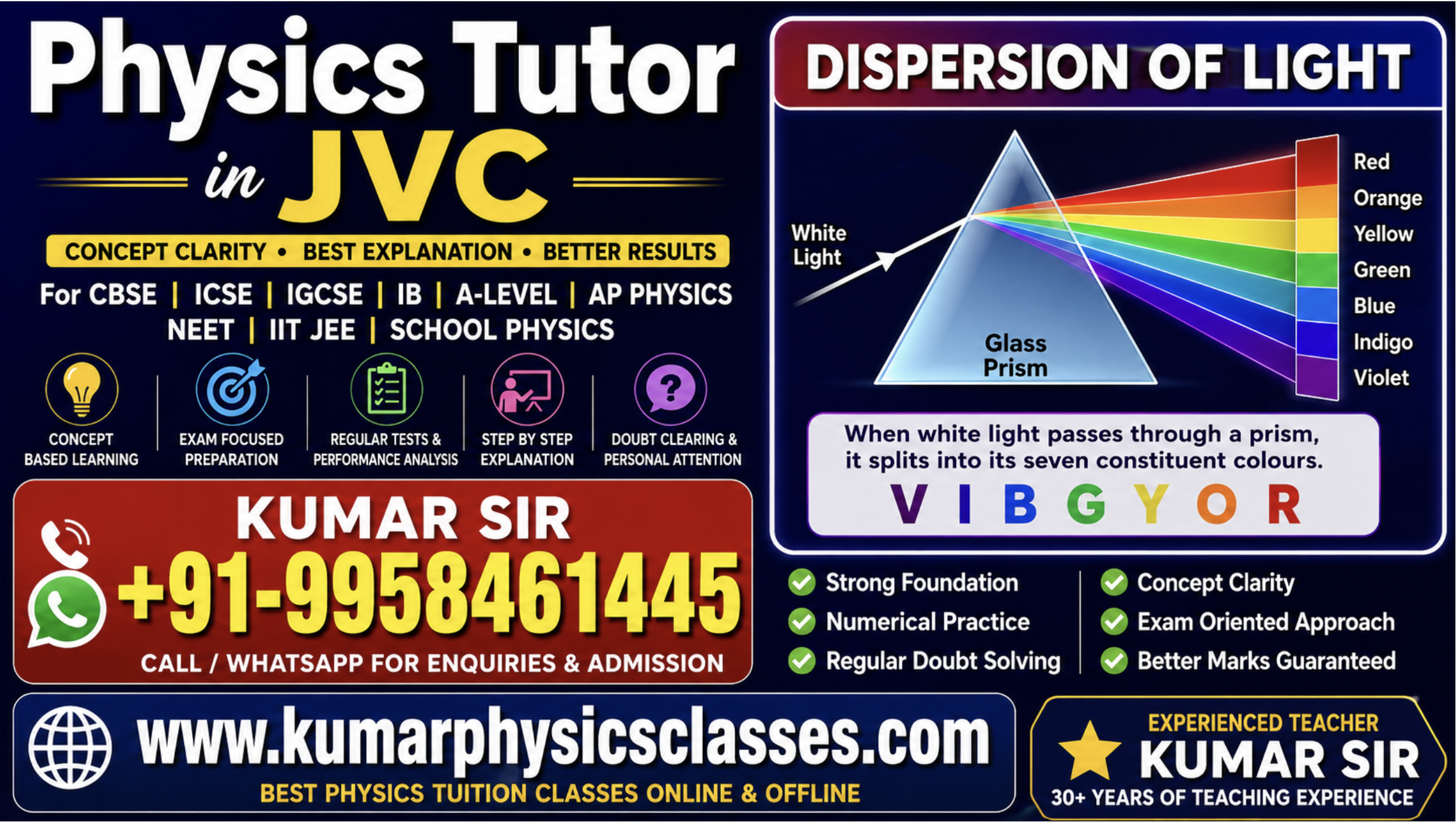
Dispersion of Light
Dispersion of light is the phenomenon in which white light splits into its constituent colours when it passes through a prism.
The seven colours obtained are:
Violet, Indigo, Blue, Green, Yellow, Orange and Red.
This sequence is called VIBGYOR.
When white light enters a prism, different colours bend by different amounts because different colours have different wavelengths and different refractive indices inside glass.
Violet colour deviates maximum because its wavelength is minimum.
Red colour deviates minimum because its wavelength is maximum.
Cause of Dispersion
The refractive index of prism material is different for different wavelengths of light.
For violet light:
mu(violet) is maximum
For red light:
mu(red) is minimum
Since deviation produced by a prism depends upon refractive index, different colours deviate differently and therefore white light splits into many colours.
Angular Dispersion
Angular dispersion is the angle between the emergent red and violet rays after passing through the prism.
Angular dispersion = deviation of violet colour − deviation of red colour
Dispersive Power
Dispersive power measures the ability of a prism material to disperse light.
Dispersive power = (mu(violet) − mu(red)) / (mu(yellow) − 1)
A material with greater dispersive power produces greater separation of colours.
Cauchy’s Principle (Cauchy’s Formula)
According to Cauchy’s formula, refractive index depends on wavelength.
mu = A + B/(lambda)^2 + C/(lambda)^4
where:
mu = refractive index
lambda = wavelength
A, B, C = constants
From this relation:
When wavelength decreases, refractive index increases.
Therefore violet colour has greater refractive index than red colour.
Hence violet deviates more than red.
Prism Formula
For a prism:
delta = i + e − A
where:
delta = angle of deviation
i = angle of incidence
e = angle of emergence
A = angle of prism
Condition for Minimum Deviation
Minimum deviation occurs when light passes symmetrically through the prism.
Condition:
i = e
and
r1 = r2 = A/2
At minimum deviation:
delta(min) = 2i − A
The refractive index of prism material is:
mu = sin[(A + delta(min))/2] / sin(A/2)
At minimum deviation, the path of light inside the prism becomes symmetric.
The deviation becomes minimum and the image becomes brightest and sharpest.
Maximum Deviation in Prism
Maximum deviation occurs when the angle of incidence is very large and the refracted ray travels close to the prism surface.
There is no fixed formula generally used for maximum deviation in standard Class 12 derivation, but deviation increases when incidence angle increases away from minimum deviation condition.
Dispersion Without Deviation
Dispersion without deviation is obtained using two prisms of different materials and opposite orientation.
One prism produces dispersion and deviation.
The second prism cancels the deviation but not the dispersion.
As a result:
Final emergent light remains parallel to incident light but colours remain separated.
Condition:
Net deviation = 0
but
Angular dispersion ≠ 0
This arrangement is used in spectrometers and optical instruments.
Deviation Without Dispersion
Deviation without dispersion is obtained when two prisms are combined so that dispersion produced by one prism is cancelled by the other prism but total deviation remains.
Condition:
Angular dispersion = 0
but
Net deviation ≠ 0
This arrangement is called an achromatic prism combination.
Important Points About Prism
Red colour deviates minimum.
Violet colour deviates maximum.
Refractive index is inversely proportional to wavelength.
Dispersion occurs because refractive index depends on wavelength.
At minimum deviation:
i = e
At minimum deviation:
r1 = r2
Prism angle:
A = r1 + r2
Angle of deviation:
delta = i + e − A
White light splits into seven colours in a prism.
Prism works on refraction of light.