
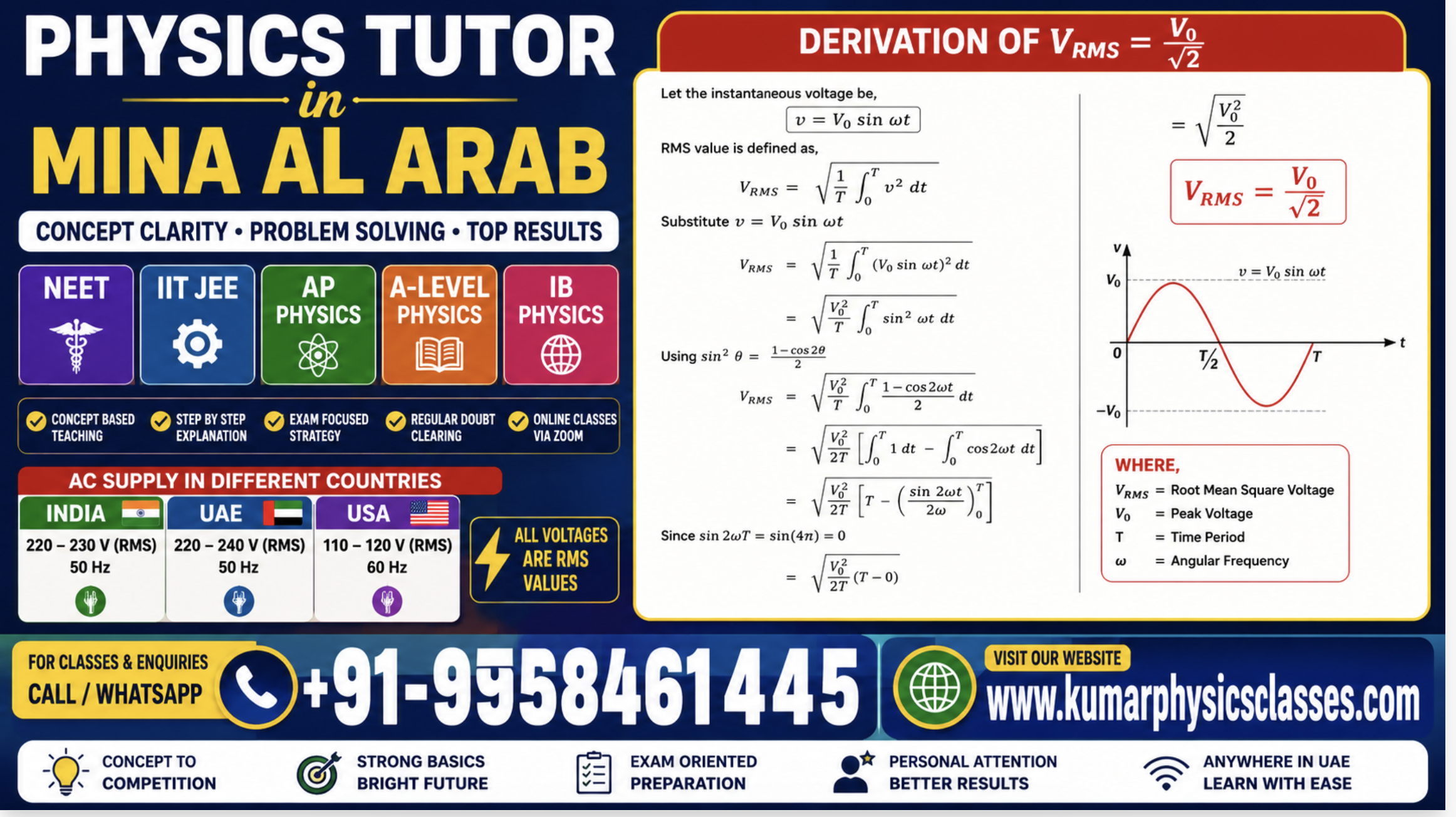
Physics Tutor in Mina Al Arab
+91-9958461445
If you live in Mina Al Arab and your Physics preparation is not going well, you are not alone. Many students study for long hours, complete school homework, attend classes, and still feel that Physics is not entering the mind properly. At home, parents may feel that the child is not studying, but the real problem is often different: the student is studying, but the concepts are not becoming clear.
Physics is not a subject that can be mastered by memorising definitions only. Whether a student is preparing for engineering, medical entrance, AP Physics, A-Level Physics, IB Physics, CBSE Physics, or NEET and IIT JEE, Physics requires concept clarity, mathematical confidence, diagram understanding, and regular numerical practice.
At Kumar Physics Classes, Kumar Sir focuses on the exact problem students face: “I study, but I do not understand how to apply the formula.” His teaching method starts from basic concepts and slowly moves toward advanced problem-solving.
Nearby Areas and Courses
Physics Tutor in Mina Al Arab, Physics Tutor in Ras Al Khaimah, Physics Tutor in Al Hamra Village, Physics Tutor in RAK City, Physics Tutor in Al Nakheel, Physics Tutor in Al Dhait, Physics Tutor in Khuzam, Physics Tutor in Al Qusaidat, Physics Tutor in Al Rams, Physics Tutor in Julphar, Physics Tutor in Al Jazeera Al Hamra
Physics Tutor in Mina Al Arab for IIT JEE, Physics Tutor in Mina Al Arab for NEET, Physics Tutor in Mina Al Arab for AP Physics, Physics Tutor in Mina Al Arab for A-Level Physics, Physics Tutor in Mina Al Arab for IB Physics, Physics Tutor in Mina Al Arab for CBSE Physics
Why Physics Becomes Difficult
Many students know the formula but do not know where to apply it. They may remember Ohm’s law, Newton’s laws, lens formula, capacitor formula, or AC formula, but when the question is slightly twisted, they get confused. This happens because Physics is a logical subject. Every formula has a condition, every diagram has meaning, and every numerical question requires interpretation.
For example, in Alternating Current, many students write voltage as 220 V or 110 V, but they do not understand whether this is peak voltage, instantaneous voltage, or RMS voltage. This confusion creates mistakes in power, current, resistance, impedance, and energy calculations.
What Is RMS Voltage?
In India, the domestic supply is generally written as 220 V, 50 Hz. In the USA, it is commonly written as 110 V, 60 Hz. These values are not peak values. These are RMS values.
RMS means Root Mean Square. It is the effective value of AC voltage or AC current. Since AC changes continuously with time, its instantaneous value keeps changing. Sometimes it is positive, sometimes negative, and sometimes zero. Therefore, we need one fixed value that tells us how much heating effect or power effect this AC can produce. That fixed effective value is called RMS value.
For a sinusoidal AC voltage:
V₍rms₎ = V₀ / √2
Here, V₀ is the peak voltage.
Similarly, for current:
I₍rms₎ = I₀ / √2
So, if household voltage is written as 220 V, it means:
V₍rms₎ = 220 V
Peak voltage will be:
V₀ = 220√2 ≈ 311 V
This means the voltage actually reaches about 311 V at its peak, but its effective value is 220 V.
Why RMS Value Is Important
RMS value is important because it tells us the real heating effect of AC. If an AC current and a DC current produce the same heat in the same resistor in the same time, then the DC value is equal to the RMS value of AC.
That is why electrical appliances are rated in RMS voltage. When a fan, heater, charger, bulb, or refrigerator is connected to 220 V supply, it is designed for 220 V RMS, not 220 V peak.
Instantaneous Voltage, Peak Voltage and RMS Voltage
Instantaneous voltage is the value of voltage at a particular moment.
v = V₀ sin ωt
Peak voltage is the maximum value of voltage.
RMS voltage is the effective value used for power calculation.
So, unless the question clearly says “peak voltage” or “instantaneous voltage”, the normal voltage written in electricity problems is generally taken as RMS voltage.
Frequency: 50 Hz and 60 Hz
In India, the frequency is 50 Hz. This means the AC completes 50 cycles in one second.
In the USA, the frequency is 60 Hz. This means the AC completes 60 cycles in one second.
Frequency affects transformers, motors, inductors, capacitors, and AC circuits. A student preparing for IIT JEE, NEET, AP Physics, or A-Level Physics must understand frequency properly because AC is not just about formula; it is about changing voltage, changing current, phase difference, power factor, and impedance.
How Kumar Sir Teaches AC Concepts
Kumar Sir first explains AC using simple graphs. Students see how voltage changes with time. Then he explains peak value, RMS value, average value, phase difference, reactance, impedance, and power factor step by step.
After that, numerical questions are solved. First basic questions are done, then NEET-level, then IIT JEE-level, then AP and A-Level style conceptual questions. This method helps students understand both school exams and competitive exams.
Why Students in Mina Al Arab Should Contact Kumar Sir
If you are living in Mina Al Arab and Physics is creating stress at home, do not wait until marks become very low. Physics improves when the right teacher explains the concept at the right time.
Kumar Sir teaches online through Zoom and helps students understand Physics from basic to advanced level. His focus is not only on completing the syllabus but also on building confidence.
For NEET, IIT JEE, AP Physics, A-Level Physics, IB Physics, and CBSE Physics, students need a teacher who can explain concepts clearly, solve numerical questions logically, and guide them according to exam pattern.
Contact Details
Kumar Physics Classes
Call / WhatsApp: +91-9958461445
Email: kumarsirphysics@gmail.com
Website: https://kumarphysicsclasses.com/
40 Conceptual Questions on RMS, Average Value, AC Supply in India, USA and UAE
1. What is RMS value of AC?
Answer: RMS value is the effective value of AC which produces the same heating effect as DC in the same resistor.
2. What is the full form of RMS?
Answer: Root Mean Square.
3. Why do we use RMS value in AC?
Answer: Because AC changes continuously, so RMS gives a fixed effective value for power calculation.
4. What is the relation between peak voltage and RMS voltage?
Answer:
V₍rms₎ = V₀ / √2
5. If India supply is 220 V, what does 220 V mean?
Answer: It means 220 V RMS, not peak voltage.
6. What is the peak voltage for 220 V AC?
Answer:
V₀ = 220√2 ≈ 311 V
7. What is the frequency of AC supply in India?
Answer: 50 Hz.
8. What is the usual domestic voltage in India?
Answer: Around 220–230 V RMS, 50 Hz.
9. What is the usual domestic voltage in the USA?
Answer: Around 110–120 V RMS, 60 Hz.
10. What is the usual domestic voltage in UAE?
Answer: Around 220–240 V RMS, 50 Hz.
11. What does 50 Hz mean?
Answer: AC completes 50 cycles in one second.
12. What does 60 Hz mean?
Answer: AC completes 60 cycles in one second.
13. What is instantaneous voltage?
Answer: Voltage at a particular instant of time.
14. Write the equation of instantaneous AC voltage.
Answer:
v = V₀ sin ωt
15. What is peak voltage?
Answer: The maximum value reached by AC voltage.
16. What is average value of AC over one complete cycle?
Answer: Zero.
17. Why is average value of AC over one full cycle zero?
Answer: Because positive half cycle and negative half cycle cancel each other.
18. What is average value of AC over half cycle?
Answer:
Vavg = 2V₀ / π
19. What is the relation between RMS current and peak current?
Answer:
I₍rms₎ = I₀ / √2
20. What is the relation between average current and peak current over half cycle?
Answer:
Iavg = 2I₀ / π
21. Is RMS value greater than average value for sinusoidal AC?
Answer: Yes, RMS value is greater than average value.
22. What is form factor?
Answer:
Form factor = RMS value / Average value
23. What is form factor for sinusoidal AC?
Answer: Approximately 1.11.
24. What is peak factor?
Answer:
Peak factor = Peak value / RMS value
25. What is peak factor for sinusoidal AC?
Answer: √2 ≈ 1.414.
26. If V₍rms₎ = 230 V, what is peak voltage?
Answer:
V₀ = 230√2 ≈ 325 V
27. Why are home appliances rated in RMS voltage?
Answer: Because RMS voltage determines actual heating and power effect.
28. Which value is used in power formula P = VI?
Answer: RMS voltage and RMS current are used.
29. In AC, if voltage is written without specification, which value is assumed?
Answer: RMS value.
30. Why is AC preferred for domestic supply?
Answer: Because AC voltage can be easily stepped up or stepped down using transformers.
31. Why does the USA use 60 Hz while India uses 50 Hz?
Answer: It is due to historical electrical standards and power system design choices.
32. Can a 50 Hz appliance work safely on 60 Hz?
Answer: Sometimes yes, but motors, transformers and timing devices may be affected.
33. Can a 110 V appliance be directly used in India or UAE?
Answer: No, it may get damaged unless a proper step-down transformer is used.
34. Can a 230 V appliance be used in the USA directly?
Answer: Usually no, because USA domestic supply is commonly 110–120 V.
35. What is the angular frequency for 50 Hz AC?
Answer:
ω = 2πf = 100π rad/s
36. What is the angular frequency for 60 Hz AC?
Answer:
ω = 2πf = 120π rad/s
37. What is the time period of 50 Hz AC?
Answer:
T = 1/50 = 0.02 s
38. What is the time period of 60 Hz AC?
Answer:
T = 1/60 ≈ 0.0167 s
39. Why is RMS current important in AC circuits?
Answer: Because heating effect depends on I²R, and RMS current gives the equivalent DC heating effect.
40. Why is average current not used for AC power calculation?
Answer: Because average current over a full cycle is zero, but AC still produces heat and power; therefore RMS value is used.
If you live anywhere in the UAE and Physics is becoming difficult for you, Kumar Sir can be a strong choice for serious Physics preparation. Many students study in good schools, attend regular classes, and complete homework, but still struggle when numerical questions, derivations, diagrams, and application-based problems come. Kumar Sir focuses exactly on this gap.
He teaches Physics from the basic level and slowly takes the student toward advanced problem-solving. Whether the student is preparing for NEET, IIT JEE, AP Physics, IB Physics, A-Level Physics, CBSE, ICSE or IGCSE Physics, his method is concept-based and exam-oriented. He explains formulas, diagrams, derivations and numerical techniques in a simple step-by-step manner.
Students in Dubai, Sharjah, Ajman, Ras Al Khaimah, Abu Dhabi or any other part of the UAE can study online through Zoom without wasting travel time. Kumar Sir gives personal attention, clears doubts, strengthens weak topics and builds confidence in Physics.
For students who want better marks, stronger fundamentals and proper exam preparation, Kumar Sir’s online Physics classes can provide high-quality education from anywhere in the UAE.